You can recite the Quran perfectly and still miss half of what it means. That gap is why so many Muslims start searching for a quranic arabic course the moment they realize translations only take them so far. The problem is that a search brings up dozens of options, from free YouTube playlists to paid academies, and most of them look the same on the surface.
This guide breaks down exactly what separates a course worth your time from one that will leave you stuck on verb forms six months in. You will learn what to check before enrolling, including teacher credentials, curriculum structure, and how one-on-one instruction compares to group classes or self-paced apps when your goal is real comprehension, not just recitation.
We will also cover how to weigh a free online quranic arabic course against a paid one, what a solid learning path looks like for beginners versus advanced students, and the questions to ask any academy before you commit your schedule and money. By the end, you will know how to pick a course that actually gets you reading the Quran with understanding, not just familiarity.
What to know before picking a Quranic Arabic course
Before you compare a single curriculum, understand what you’re actually shopping for. A quranic arabic course teaches you to read classical Quranic text with comprehension: grammar (nahw), morphology (sarf), and enough vocabulary to follow the meaning without leaning on a translation. That’s a different skill set than conversational Arabic, and most learners don’t realize this until they’ve already wasted weeks on the wrong material.

Quranic Arabic is not the same as spoken Arabic
Modern Standard Arabic apps and Quranic Arabic programs are not interchangeable, even though many marketing pages blur the line, so it helps to know the key differences between Quranic and Modern Standard Arabic before you spend money. Quranic Arabic uses a fixed, classical vocabulary and grammatical patterns that repeat constantly across the text, which actually makes it more learnable in a focused course than open-ended conversational Arabic. If you want to learn quranic arabic language online specifically for comprehension of the text, look for a guided path to understanding the Quran built around Quranic vocabulary frequency lists and verse-by-verse grammar, not general Arabic textbooks repurposed for Muslim audiences.
A course that teaches you to chat in Arabic won’t necessarily teach you to understand the Quran.
Know what a realistic timeline looks like
Rushing this expectation is where most learners get discouraged. Genuine comprehension, where you can parse a verse’s grammar and recognize root words without a dictionary, typically takes 12 to 18 months of consistent, structured study, not a six-week crash course. Set that expectation now so you can evaluate course length and pacing honestly instead of chasing promises of fluency in a month.
- Vocabulary: roughly 80% of the Quran’s meaning comes from around 300 to 400 root words, which a beginner vocabulary study plan can cover systematically
- Grammar: nahw and sarf fundamentals usually take 6 to 9 months to build solidly, and a step-by-step path from letters to verse meaning keeps that stage in order
- Application: verse-by-verse practice cements comprehension over the following year
Step 1. Define your goals and current Arabic level
Start by writing down what you actually want to get out of this. Someone who wants to learn quran arabic online to follow Friday khutbahs needs a different course than someone chasing a full grammar-based comprehension of the mus’haf. Be honest about your endpoint before you enroll anywhere, because the wrong goal match is the number one reason people quit three months in.
Honesty about your starting point matters just as much. If you already read Arabic script fluently but don’t know a noun from a verb, you need a grammar-focused quranic arabic online course, not a beginner reading program you’ve outgrown.
Pick the course that matches your goal, not the one with the flashiest ad.
Use this quick checklist before you contact any academy:
- Can you already read Arabic script without sounding out letters?
- Do you know any Quranic vocabulary or root words already?
- Is your goal comprehension, memorization, or both?
- How many hours a week can you realistically commit?
Answer these honestly and you’ll filter out half the wrong-fit courses instantly.
Step 2. Compare course formats: free, group, and one-on-one
Once your goals are clear, weigh the three main ways to study. A free online quranic arabic course on YouTube can teach you the alphabet and basic vocabulary, but there’s no one checking your grammar mistakes or answering your questions about a specific ayah. Group classes fix some of that with a real teacher, though you’re still sharing attention with eight or ten other students at different levels.
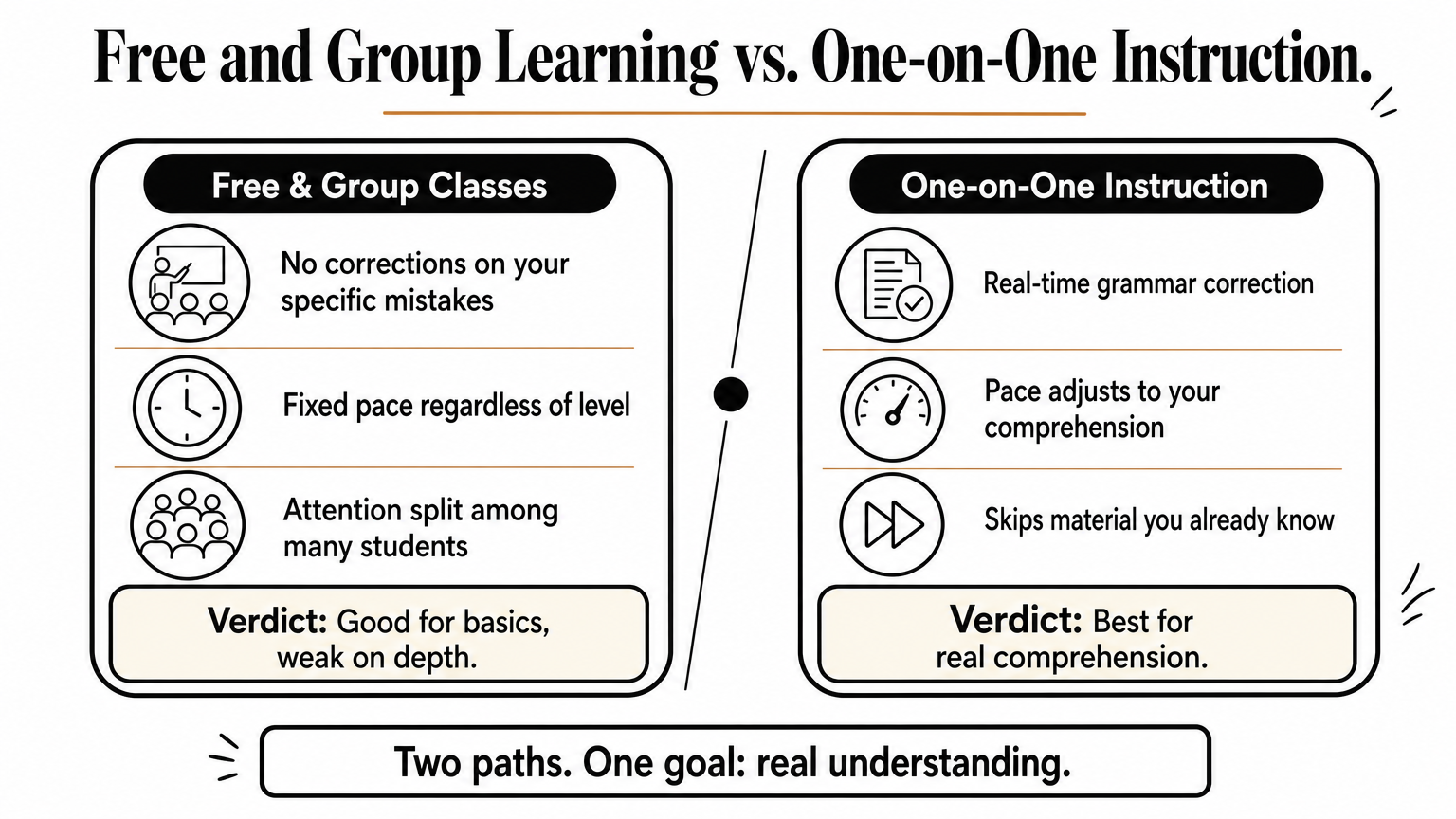
Quranytime’s one-to-one lessons with qualified teachers in Arabic and Quran exist for exactly this gap. Private instruction means the teacher adjusts pace to your comprehension, corrects your grammar in real time, and skips material you’ve already mastered. That level of feedback is nearly impossible in a group setting or a free playlist.
Free resources teach you words. A private teacher teaches you the language.
Here’s how the three formats actually compare:
| Format | Cost | Feedback | Pace |
|---|---|---|---|
| Free videos | $0 | None | Fixed |
| Group classes | Low-moderate | Shared | Fixed |
| One-on-one | Higher | Direct, immediate | Fully custom |
If comprehension is your real goal, the trade-off usually favors personalized instruction.
Step 3. Check teacher credentials and curriculum depth
Credentials matter more in this field than almost any other online course category, because anyone can record a video and call it a quranic arabic course. Before you enroll, ask for the teacher’s specific qualifications, not just a vague "years of experience" claim. At Quranytime, you can meet the Quran and Arabic teachers yourself: they are Al-Azhar University graduates or Ijazah holders, which means their grammar instruction is grounded in classical scholarship rather than a self-taught interpretation.

Curriculum depth is the second filter. A shallow course jumps straight to translation without teaching you to parse the grammar yourself, which leaves you dependent on the teacher forever. A deep curriculum builds nahw and sarf systematically, then applies it to real verses so you can eventually work through the mus’haf independently.
If a teacher can’t explain their own credentials clearly, don’t trust them with your Arabic.
Ask these questions before signing up:
- Where did the teacher train, and do they hold an Ijazah?
- Does the curriculum follow a structured sequence, or is it random topics?
- Will you eventually parse verses without help, or always need translation?
A course that can’t answer these clearly isn’t worth your time.
Step 4. Test flexibility and fit with a trial class
Schedule a free trial class before you commit to a full package, no matter how convincing the sales page reads. Knowing what happens in a free Quran and Arabic assessment helps, because a trial reveals things a website never will: whether the teacher explains grammar clearly, whether the pace matches your level, and whether the platform’s scheduling actually works across your time zone. Quranytime offers a free trial class specifically so you can test this fit before paying for anything.
A single trial class tells you more than a dozen five-star reviews.
Treat the trial like an audition, not a formality. Come with a short list of questions and watch how the teacher responds.
What to evaluate during the trial
Use this checklist while you sit in on the lesson:
- Does the teacher assess your level accurately, or guess?
- Can you reschedule easily if your week gets busy?
- Does the platform support your time zone without awkward hours?
- Do you feel comfortable asking questions mid-lesson?
If the answers are yes across the board, you’ve likely found a course worth sticking with long enough to see real comprehension gains.
Finding your path to understanding the Quran
Choosing a quranic arabic course comes down to four checks: know your goal, compare formats honestly, verify credentials, and test the fit with a real trial before you pay for anything. Skip any of these steps and you risk months of study that never turns into actual comprehension of the mus’haf.
Getting this right matters more than finding the cheapest or flashiest option. A best quranic arabic course for your neighbor might be the wrong fit for you if your goals, schedule, or starting level differ. Trust the checklist over the marketing.
You don’t have to guess anymore. If you want direct feedback from an Al-Azhar-trained teacher who adjusts to your pace from lesson one, book your free Quran and Arabic trial class and see for yourself whether it’s the right path toward real understanding of the Quran.