

You want an advanced Tajweed rules PDF you can study offline, and you want one that covers more than the basics. A good guide should explain madd, noon sakinah and meem sakinah, and hamzatul wasl clearly, with Quranic examples you can check against your own recitation.
Here is the short answer. A solid PDF gives you the rule, the reason, and a verse example for every topic. Many free files list rules without explaining when each one applies, and that is where learners get stuck. If you search for an advanced Tajweed rules PDF in English or in Urdu, pick one that follows a clear order and shows the letters and signs in color.
This article explains what "advanced" Tajweed actually includes and walks through the main rule groups: the types of madd, the four rulings of noon sakinah and tanween, meem sakinah, and hamzatul wasl. You will also see how to use a PDF well. At Quranytime Academy, our Al-Azhar-trained teachers have guided students through these rules one-on-one for over 10 years, and that experience shapes what follows.
Why advanced Tajweed rules matter for your recitation
What makes Tajweed "advanced"
Basic Tajweed teaches you where each letter comes from and how it sounds alone. Advanced Tajweed begins when letters meet each other. Madd lengths, noon sakinah, meem sakinah, and hamzatul wasl are all rules of connection and timing, so you cannot learn them by memorizing letter sounds.
This is why a good advanced Tajweed rules PDF earns its place on your phone or desk. You can read a rule slowly, flip back to it, and compare it with your own recitation line by line.
Clear mistakes and hidden mistakes
Scholars of Tajweed divide common recitation mistakes into two groups. Knowing the difference shows you what advanced study is for.
| Type | What it is | Example |
|---|---|---|
| Lahn jali (clear mistake) | Changes a letter or vowel and is obvious to listeners | Reading an’amta (أَنْعَمْتَ) as an’amtu |
| Lahn khafi (hidden mistake) | Breaks a timing or sound rule that only trained ears catch | Dropping the nasal ghunnah in ikhfa, or cutting a madd short |
Most learners who reach this level have already stopped making the clear mistakes. What remains are the hidden ones, and hidden mistakes are hard to hear in yourself. You hear what you intend to say, not what you actually said. A written rule gives you a fixed standard to check against.
Advanced Tajweed is mostly the study of hidden mistakes, the ones you cannot catch by ear alone.
What you gain from learning them
Precision comes first. Take the word Maaliki (مَالِكِ) in Surah Al-Fatihah. Shorten the natural madd on the meem and you no longer read the word the way Hafs transmits it. A small timing slip changes what you are reciting.
Memorization is the second reason. If you memorize with a wrong madd length or a missing ghunnah, the error settles into your memory and becomes much harder to remove later. Students in Hifz programs who learn these rules before they memorize save weeks of correction.
Third, these rules make recitation smoother. Once you know what happens when a noon sakinah meets a letter, you stop hesitating mid-verse. Your pace steadies and your prayer feels calmer.
Finally, there is encouragement here. The Prophet (peace be upon him) said that the one who recites with difficulty, and finds it hard, receives a double reward (reported in Bukhari and Muslim). Struggling with these rules is not failure. It is part of the effort, and it is rewarded while you improve.
How to study advanced Tajweed rules from a PDF
A PDF is a reference, not a teacher. Used well, an advanced Tajweed rules PDF works like a workbook you open every day. Used badly, it is a file you downloaded and never finished. This is the method we recommend to our students.
Study one rule group at a time
Don’t read the file cover to cover. Pick one rule group per week, such as the madd types or the four rulings of noon sakinah. Each group is big enough to fill several sessions, and mixing them blurs the boundaries between rules.
For each group, follow these steps:
- Read the rule and its definition once, slowly.
- Write the rule in your own words in a notebook.
- Read every example in the PDF aloud.
- Open your mushaf to a page you know and find three more examples yourself.
- Record yourself reciting that page and check each case against the rule.
You have not learned a rule until you can spot it in a verse the PDF never mentioned.
Pair the text with audio
Timing rules are rules of sound, so reading alone gets you halfway. Listen to a slow, teaching-style recitation (often called muallim or murattal) while you follow the text. Pause after each example and repeat it until your length and nasal sound match the reciter.
Pick one PDF as your main source. Two guides sometimes group or name rules differently, and switching sources mid-topic creates confusion. If you prefer Tajweed rules in Urdu, that works just as well, since terms like madd, ghunnah, and ikhfa stay the same in both languages.
Mark your own copy
Color makes patterns visible. Many PDFs already use a color-coded Tajweed Quran, but if yours does not, annotate a printed or digital copy yourself. Keep the code consistent so your eye learns it. This is one workable scheme, not a universal standard:

| Color | Mark it on |
|---|---|
| Red | Every madd, with the count beside it |
| Green | Ghunnah, ikhfa, idgham, and iqlab |
| Blue | Hamzatul wasl and where you stop or start |
Review your marked pages for five minutes before each session. You will notice the same few rules cause most of your slips, and those are the ones to drill first.
Advanced madd rules and how to count them
How a count works
A count (harakah) is roughly the time it takes to fold or open one finger, or to say one short vowel. It measures proportion, not seconds, so it stretches or shrinks with your recitation speed. Natural madd is two counts, and every other madd builds on that base. Any advanced Tajweed rules PDF will use these numbers, so keep your tempo even before you start counting. The madd chart below follows the Hafs recitation, which most learners study.
| Madd | Trigger | Counts | Example |
|---|---|---|---|
| Asli (natural) | Madd letter with no hamza or sukoon after it | 2 | قَالَ |
| Badal | Hamza comes before the madd letter | 2 | آمَنُوا |
| Muttasil (connected) | Madd letter, then hamza in the same word | 4 or 5 | السَّمَاءِ |
| Munfasil (separated) | Madd letter ends a word, hamza starts the next | 4 or 5 | يَا أَيُّهَا |
| Lazim (obligatory) | Madd letter, then a permanent sukoon or shaddah | 6 | الضَّالِّينَ |
| Arid lissukun | Madd letter, then a sukoon created by stopping | 2, 4, or 6 | نَسْتَعِينُ |
| Leen | Sakin waw or ya after a fatha, when you stop | 2, 4, or 6 | خَوْفٍ |
Counting consistently
Muttasil is wajib, meaning every reciter must lengthen it. Reading السَّمَاءِ with two counts is a mistake. Munfasil is jaiz, meaning permissible, and teachers differ slightly on its length. Either way, you choose one length and hold it.
Pick one length for each madd and keep it the same from the first verse to the last.
Stopping changes things. Arid lissukun and leen apply only when you pause, such as on الْعَالَمِينَ at the end of a verse. Keep going and the madd drops back to two counts. Most teachers advise that your stopping length be no longer than your muttasil count, so a student who reads muttasil at four should stop at two or four, not six. Record yourself on Surah Al-Fatihah and check whether الضَّالِّينَ gets a full six counts every time.
Noon sakinah, meem sakinah, and tanween rules in depth
The four rulings of noon sakinah and tanween
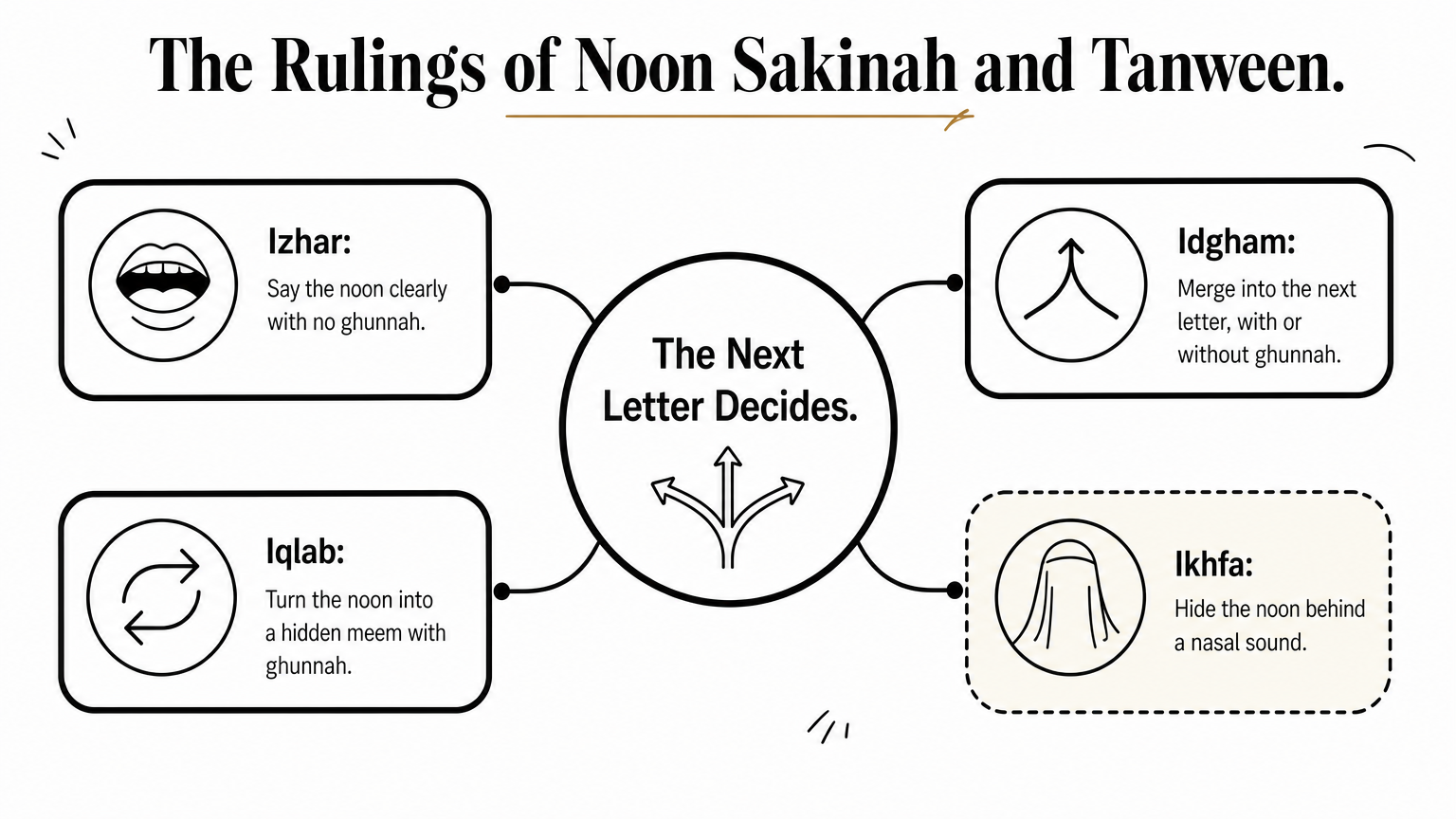
Noon sakinah (نْ) and tanween sound alike, so they follow the same rules. The ruling depends on the letter that comes next. A good advanced Tajweed rules PDF organizes the topic that way, as this table does.
| Ruling | Next letter | What you do | Example |
|---|---|---|---|
| Izhar | ء هـ ع ح غ خ | Say the noon clearly, no ghunnah | مِنْ عِلْمٍ |
| Idgham with ghunnah | ي ن م و | Merge into the next letter, keep the nasal sound | مَنْ يَقُولُ |
| Idgham without ghunnah | ل ر | Merge fully, no nasal sound | مِنْ رَبِّهِمْ |
| Iqlab | ب | Turn the noon into a hidden meem with ghunnah | مِنْ بَعْدِ |
| Ikhfa | The other 15 letters | Hide the noon behind a nasal sound | مِنْ قَبْلُ |
Every noon sakinah is decided by one thing: the letter that follows it.
Two details trip people up. Idgham only happens across two separate words. In a single word like دُنْيَا the noon stays clear. Also, the ghunnah in idgham, iqlab, and ikhfa lasts about two counts, the same base length you used for natural madd.
Meem sakinah: three rulings
Meem sakinah (مْ) is simpler because only the lips are involved. Again, the next letter decides what happens:
- Ikhfa shafawi: before ba (ب), close the lips lightly and hold ghunnah. Example: تَرْمِيهِمْ بِحِجَارَةٍ
- Idgham mithlayn saghir: before another meem, merge the two and hold ghunnah. Example: لَهُمْ مَّا
- Izhar shafawi: before every other letter, pronounce the meem clearly. Example: هُمْ فِيهَا
Slips to catch in your own recitation
Most errors here come from habit, not ignorance. Before waw (و) and fa (ف), students often blur the meem into the next letter, because the lips are already close. Keep the meem crisp and let the next letter begin cleanly. In ikhfa, the opposite problem appears: the tongue touches the roof of the mouth and turns the hidden noon into a full one.
Record Surah Al-Baqarah, verses 1 to 5, and mark each noon sakinah, tanween, and meem sakinah you meet. Name the ruling, then listen for it. Whether your PDF is in English or Urdu, the terms stay the same, so this check works with either.
Hamzatul wasl, two sukoons, and other tricky cases
Most files bury these topics at the end, yet they cause some of the most frequent slips. A thorough advanced Tajweed rules PDF should give them their own pages.
How hamzatul wasl works
Hamzatul wasl is the "connecting hamza" at the start of certain words. You pronounce it only when you begin with that word. When you join it to the word before, it disappears. Read الرَّحْمَنِ الرَّحِيمِ and you say "ar-rahmanir-rahim", with no alif sound in the middle.
When you must start with it, the vowel depends on the word:
| Word type | Starting vowel | Example |
|---|---|---|
| The article ال | Fatha | اَلْحَمْدُ |
| Command verb whose third letter has a damma | Damma | اُنْظُرْ |
| Other verbs and nouns (such as اسم) | Kasra | اِهْدِنَا |
Hamzatul wasl is heard only at the start of your recitation, never in the middle of a flowing verse.
When two sukoons meet
Arabic does not allow two silent letters to sit side by side in flowing speech. Once hamzatul wasl drops, a madd letter can end up beside a sukoon. In that case you skip the madd letter completely. قَالَ الَّذِينَ becomes "qalal-ladhina", and فِي الْأَرْضِ becomes "fil-ard".
A similar problem appears when a silent consonant lands before hamzatul wasl. The usual fix is a kasra. You read قُلِ ادْعُوا as "qulid’u", and أَنِ اعْبُدُوا as "anib’udu". There are exceptions you should confirm in your PDF:
- Min before the article takes a fatha: مِنَ الْكِتَابِ.
- The plural meem takes a damma: عَلَيْهِمُ الْقِتَالُ.
- Tanween takes a kasra: أَحَدٌ اللَّهُ is read "ahadunil-lah".
Mistakes to watch for
Learners often pronounce the connecting alif mid-verse, because the text shows it. The written alif is a sign of where hamzatul wasl sits, not an instruction to say it. The reverse mistake also happens. Some students begin a word with the wrong vowel after stopping, for example saying a kasra on اَلْحَمْدُ.
To practice, open Surah Al-Fatihah and read it with a pause after each verse. Say where you would begin each next verse, then check the starting vowel against the table above. Do the same with Surah Al-Ikhlas and mark every dropped alif in red.
What to look for in an English or Urdu Tajweed PDF
Search for an advanced Tajweed rules PDF and you will find hundreds of files of very uneven quality. Some come from trained teachers. Others are scanned notes with no author and no stated source. Check the file before you commit weeks to it, because a wrong rule studied carefully is still wrong.
A quick quality checklist
Open the file and spend two minutes on the first pages. You should be able to tick off every item below, and a missing item is a warning, not a minor flaw.
- Author: a named teacher or institution, ideally with an ijazah in recitation.
- Riwayah: a clear statement that it follows Hafs from Asim, or whichever transmission it uses.
- Structure: a rule, a reason, and a verse example for every topic.
- Numbers: madd types separated, with counts written out.
- Text: clear Arabic font, color-coded, large enough to read on a phone.
- Practice: review questions or exercise pages after each chapter.
A good Tajweed PDF names its riwayah, explains each rule, and gives verses you can check.
Choosing between English and Urdu
Language matters less than you might expect. An advanced Tajweed rules PDF in English suits learners in the US, UK, and Canada who think in English and want English translation and transliteration beside the Arabic. An advanced Tajweed rules PDF in Urdu often explains the reasoning in more depth for readers who grew up with the language. Pick the one you read fastest, because you need to follow the explanation, not just the examples.
Watch the Quran script, too. Urdu files often use the South Asian print style, which writes some signs differently, such as the sukoon. If your PDF and your mushaf use different scripts, learn the sign shapes once and confirm they match before you mark anything.
Red flags to avoid
Skip any file that mixes several recitations without saying so, or lists rules with no examples. Blurry scans hide the small signs that matter most, and titles promising mastery in a week are selling speed, not accuracy. Above all, remember that no PDF can hear you. Even the best file cannot tell you that your ghunnah is too short, which is why the next section pairs your reading with a teacher.
Practice routine to apply these rules with a teacher
What a teacher catches that a PDF cannot

Your advanced Tajweed rules PDF sets the standard, but it cannot hear you. A live teacher listens for the hidden mistakes covered earlier: a ghunnah that runs a beat short, a muttasil madd that slides from four counts to three, a noon that is not fully hidden in ikhfa. Correction on the spot stops the error before it settles into habit.
One-to-one Tajweed lessons make this work best. In a group, the teacher cannot stop for your single slip. Alone with a teacher, you recite, get corrected, and repeat the verse until it is right. A teacher with an ijazah also links your recitation to a chain of transmission, which no file can give you.
A PDF tells you the rule, but only a teacher can tell you whether you are keeping it.
A weekly routine you can repeat
This plan assumes two lessons a week and about 20 minutes of daily Tajweed practice at home. Adjust it to your teacher’s pace, but keep the order the same each week.
| When | What you do | Time |
|---|---|---|
| Lesson day | Recite the new passage, take corrections, write down every error | 30 min |
| Day after | Re-read your notes and drill each corrected verse five times | 20 min |
| Midweek | Study the next rule in your PDF and restate it in your own words | 20 min |
| Before next lesson | Record yourself and check each marked rule | 15 min |
What to bring to each lesson
Come prepared and your teacher can spend the time on your real weak points. Bring these four things:
- Your marked copy, with the madd counts and noon rulings you identified.
- A recording of your own practice, so the teacher hears what you did alone.
- A short list of rules you could not apply, with the verse numbers.
- Your notebook, to log every correction in writing.
If you do not have a teacher yet, a trial class is a low-risk way to find your level. Quranytime Academy offers a free trial class where a teacher listens to you recite and recommends a path, whether that is Tajweed improvement, Hifz, or Quranic Arabic. You leave knowing which rules to work on first.
Putting your Tajweed study into practice
A good advanced Tajweed rules PDF gives you the map, but your recitation is the journey. Choose one file that names its riwayah, study one rule group per week, and check every rule against verses you already know. Madd counts, noon sakinah rulings, and hamzatul wasl all get easier once you practice them aloud instead of only reading about them.
Remember that hidden mistakes are the ones you cannot hear in yourself. That is why a teacher’s ear matters as much as the file on your phone. Bring your marked copy and your recordings to each lesson, and let correction do what a PDF cannot.
Ready to find out where you stand? Book a free trial assessment class with Quranytime Academy. A qualified teacher will hear you recite, show you which rules to work on first, and recommend a path that fits your schedule.