
If you searched for a tajweed rules makhraj of Arabic letters PDF, here is the short answer. A makhraj (plural makharij) is the exact place in the throat, mouth, lips, or nasal passage where a letter’s sound comes out. Tajweed teaches 17 articulation points in five areas, and each of the 28 Arabic letters belongs to one of them.
Makhraj comes first in tajweed because rules like ghunna, idgham, and qalqalah assume the letter already leaves from the right place. This guide puts the full content on the page. You get the reason makhraj matters, a table of all 17 points, a method to find the exit of any letter, and advice on studying in English or Urdu.
Quranytime Academy teaches tajweed live and one-to-one, so this guide focuses on the letters learners most often mix up. Read it once through, then use the tables as your reference.
Why makhraj matters for your recitation
Makhraj matters because a letter pronounced from the wrong place can turn into a different letter, and a different letter can change the word. Correct exits are the base that every other tajweed rule stands on.
One letter can change the meaning
Take قَلْب (qalb, "heart") and كَلْب (kalb, "dog"). The only difference is whether the first sound comes from the back of the tongue (qaf) or slightly further forward (kaf). Learners who blur the two are not making a small stylistic slip. They are saying another word.

Scholars of tajweed separate clear mistakes (lahn jali) from hidden mistakes (lahn khafi). Wrong makhraj often falls into the first group, because it changes the letter itself. That is why teachers correct it before anything else.
A letter from the wrong exit is a different letter, so makhraj comes before every other tajweed rule.
Makhraj comes before the other rules
Every letter has two identifiers: its makhraj (where it exits) and its sifaat (how it sounds, such as heavy or light). You cannot apply a sifah correctly if the exit is wrong. Rules like ikhfa and idgham also depend on knowing which letter group sits at which point.
So treat makhraj as the first stage of tajweed, not an extra topic. Once the exits are secure, the other rules fall into place much faster.
The 17 articulation points in five areas
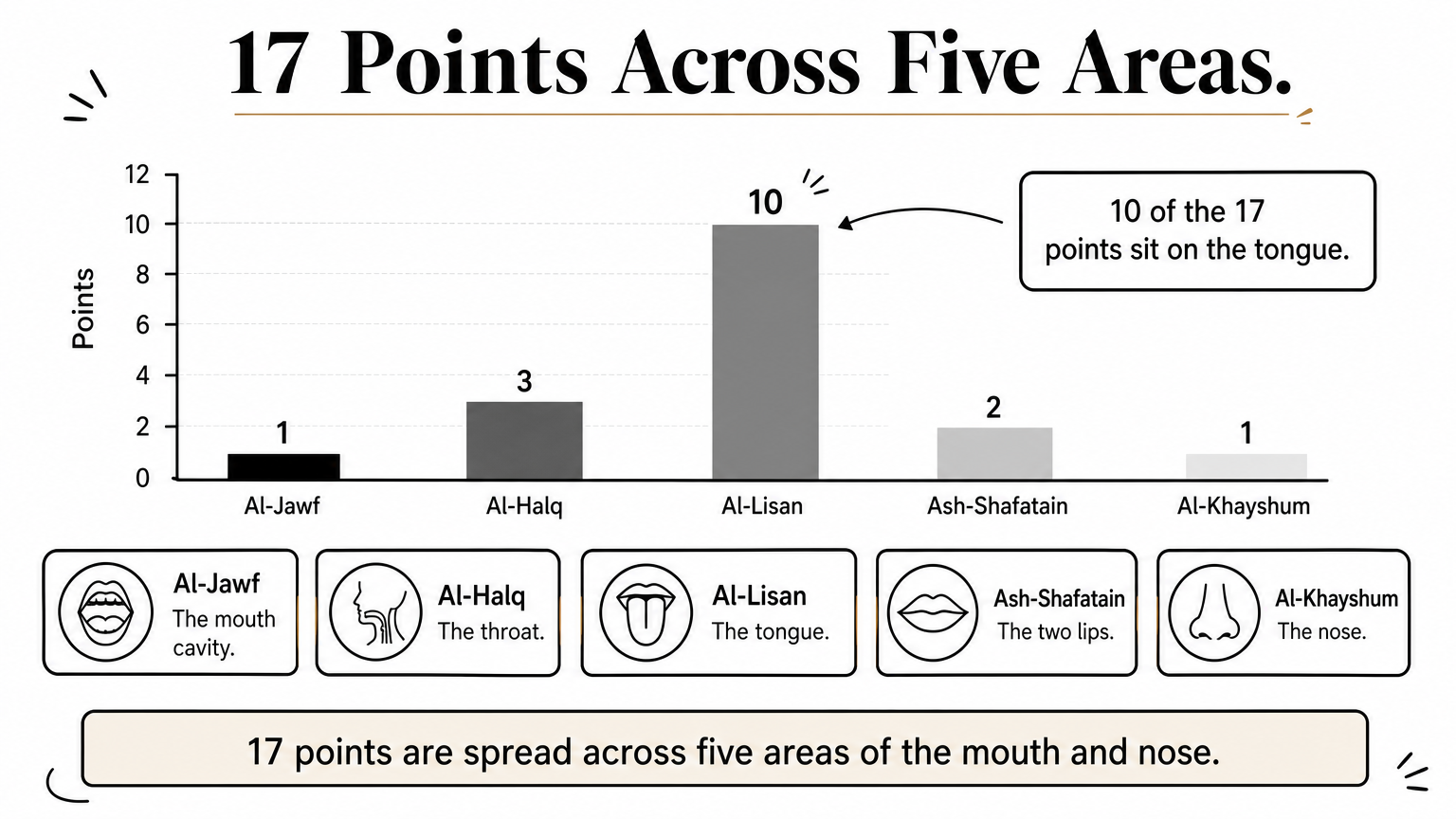
The 17 points sit in five areas: the empty space of the mouth and throat (Al-Jawf, 1 point), the throat (Al-Halq, 3), the tongue (Al-Lisan, 10), the lips (Ash-Shafatain, 2), and the nasal passage (Al-Khayshum, 1). The table below shows every point and its letters.
All 17 points in one table
| # | Area | Exact point | Letters |
|---|---|---|---|
| 1 | Al-Jawf | Empty space of the mouth and throat | Long alif, long waw, long ya (madd letters) |
| 2 | Al-Halq | Deepest part of the throat | ء ه |
| 3 | Al-Halq | Middle of the throat | ع ح |
| 4 | Al-Halq | Top of the throat, nearest the mouth | غ خ |
| 5 | Al-Lisan | Back of the tongue and the soft palate | ق |
| 6 | Al-Lisan | Slightly forward of qaf, at the palate | ك |
| 7 | Al-Lisan | Middle of the tongue and the hard palate | ج ش ي |
| 8 | Al-Lisan | Side edge of the tongue and the upper molars | ض |
| 9 | Al-Lisan | Tongue tip and the gums above the front teeth | ل |
| 10 | Al-Lisan | Tongue tip, slightly lower than lam | ن |
| 11 | Al-Lisan | Tongue tip, slightly further back than nun | ر |
| 12 | Al-Lisan | Tongue tip and the base of the upper front teeth | ت د ط |
| 13 | Al-Lisan | Tongue tip near the edges of the lower front teeth | ص ز س |
| 14 | Al-Lisan | Tongue tip and the edges of the upper front teeth | ث ذ ظ |
| 15 | Ash-Shafatain | Inner lower lip and the edges of the upper front teeth | ف |
| 16 | Ash-Shafatain | Both lips (ب and م close them, و rounds them) | و ب م |
| 17 | Al-Khayshum | Nasal passage | Ghunna of noon and meem |
In row 7, ya counts here when it is a consonant, as in يَوْم. When it is a long vowel after a kasra, it belongs to Al-Jawf.
How to read the table
Jawf letters have no touching point. The sound travels through the open space, which is why madd letters are stretched without a stop. Throat letters are listed deepest to shallowest, and tongue letters run from the back of the mouth to the front.
You will see other counts in some books. A few early grammarians counted 16 or 14 points by folding Al-Jawf or some tongue points together. The 17-point count is the one most tajweed teachers use today, and it is the one to learn.
Memorize the five areas first, then fill in the 17 points one area at a time.
How to find and practice each makhraj
To find the makhraj of any letter, make it silent, put an alif with a fathah before it, say the syllable slowly, and feel where the sound stops. That spot is the exit.
Finding the exit of any letter
Follow these steps for each letter:
- Pick a letter, for example ب.
- Say it with a sukoon after a hamzah with fathah, so it sounds like "ab".
- Stop firmly on the silent letter and hold the position.
- Notice what touches: lips, tongue tip, tongue edge, or nothing.
- Repeat with fathah, dammah, and kasrah to confirm the exit stays the same.
Do this in front of a mirror for lip and tongue-tip letters. For throat letters, place a finger on your throat and notice how deep the sound starts.
The "ab, ak, aq" test shows where a sound stops, and where it stops is its makhraj.
Pairs that get confused
Most errors come from letters with close exits or shared points. Drill these pairs first.
| Pair | Where they differ |
|---|---|
| ح and ه | ح exits the middle throat with a soft, airy friction. ه exits the deepest throat as a plain breath. |
| ع and ء | ع exits the middle throat with a narrowed, voiced sound. ء exits the deepest throat as a brief stop. |
| ق and ك | ق exits the back of the tongue and is heavy. ك exits further forward and is light. |
| س and ص | Same exit. ص is heavy, with the tongue raised, and س is light. |
| ت and ط | Same exit. ط is heavy, with the tongue raised toward the palate. |
| د and ض | د exits the tongue tip. ض exits the side of the tongue and is heavy. |
A simple practice routine
Take one area a day and spend about ten minutes on it. Say each letter slowly with the three short vowels, then record yourself and compare with a qualified reciter. Move to short phrases from the Quran only when the single letters feel stable.
Studying makhraj in English or Urdu
You can study makhraj in English or Urdu, because the terminology is shared and only the explanation changes. Pick the language you think in, but learn the Arabic terms, since teachers and printed charts use them in both.
Urdu and English terms side by side
| Arabic term | Urdu word | English |
|---|---|---|
| Makhraj (plural makharij) | makhraj | exit point |
| Al-Jawf | jauf | empty space |
| Al-Halq | halq | throat |
| Al-Lisan | zubaan | tongue |
| Ash-Shafatain | hont | lips |
| Al-Khayshum | khayshoom | nasal passage |
Urdu charts often title this topic "makharij ul huroof". It is the same 17-point system covered above.
What a chart cannot teach
A chart shows positions, but it cannot hear you. Sound is the real test of makhraj, and a reader cannot tell from a diagram whether their ص still sounds like a س. A teacher who listens to your recitation catches this within minutes.

Quranytime Academy offers live, one-to-one Quran reading and tajweed lessons with teachers who are Al-Azhar graduates with Ijazah. The teacher checks your letters one by one and gives feedback on the spot. No previous knowledge is needed to start, and a free trial class helps you find your level first.
Use a chart to learn where the letters sit, and a teacher to confirm that you say them correctly.
Putting makhraj into practice
Makhraj is the foundation of tajweed. Seventeen points in five areas cover all 28 letters, and each letter must leave from its own place so that no letter turns into another. Learn the areas, test each letter with the "ab" method, and drill the confusable pairs daily.
Reading alone only takes you so far, because your own ear can miss your own mistakes. If you want a teacher to check your letters and set a path that fits your level, book a free trial assessment class with Quranytime Academy.