
The best Quran translation classes online combine a qualified teacher, a clear method that moves from single words to full verses, and a language of instruction you think in. If you want live correction and a plan built around your level, choose one-to-one lessons, such as the ones at Quranytime Academy. If you prefer a fixed syllabus by surah or juz, an institute course fits better. If you only want to build word-for-word vocabulary at no cost, a free class is a fair place to begin.
Choosing is harder than it sounds. Almost every academy promises that you will "understand the Quran," but few say whether they teach word meanings, grammar, or full tafsir. Fewer still say which language the teacher uses, what reading level you need, or what it costs. That gap is why many learners sign up, stall after a month, and search again.
This guide compares five types of class, with a named example where the facts are public. It then gives you a checklist for comparing teachers, language, level, and cost before you pay. We teach translation and tafsir ourselves, so we list our own academy first and say plainly where another option may suit you better.
1. Quranytime Academy
Quranytime Academy suits learners who want a teacher to explain meaning, answer questions on the spot, and set the pace. Lessons are live and one-to-one, taught from home by Al-Azhar University graduates who hold an Ijazah in Quranic and Islamic studies.

One-to-one translation lets the teacher fix your gaps instead of teaching to a class average.
How the classes work
The academy separates three jobs that learners often mix up. Quran Translation and Tafsir lessons give you the meaning of the verses and the interpretation behind them. The Tafseer course studies the meanings of the Quran, its interpretation, and its relevance to modern life. Quranic Arabic online covers vocabulary, selected grammar, and accurate reading. It is language study, not a substitute for Tafseer, so the two work best together.
A sensible path looks like this:
- Start with translation and tafsir if you can already read the Arabic script.
- Add Quranic Arabic if you want to recognize words without a translation beside you.
- Add the Arabic language course if you are still building reading and writing foundations.
Who it suits
Adult beginners, returning learners, and busy professionals fit well, because adult classes are shaped around your ability, goals, and schedule. Parents can book a trial for a child, and teenagers and adults can request one for themselves. The academy requires no previous knowledge to start, and the first session places you at the right level.
Experience matters more in translation than in recitation, because a teacher has to explain why a verse means what it means. The academy has more than 10 years of experience in Quranic education. Its teachers include Maha Gohar, who has more than 20 years in Quran and Islamic studies, and Aliaa Emeira, a Quran educator with 15 years. Tell the team during your first class which language you want explanations in.
Cost and trial
The entry point is a free assessment class: a live, one-to-one session where the team checks your level and recommends a next step. The academy lists one month free for a first registration. Premium learning plans follow the assessment, so the exact fee depends on the plan you choose.
Ask these questions before you commit:
- Which plan includes translation and tafsir, and how many lessons per week?
- How long is each lesson?
- Can you change teacher or schedule later?
2. Al-Azhar Quran Teaching
Al-Azhar Quran Teaching offers a translation course built on one-to-one lessons and word-to-word translation. It is a good example of the tiered course model, where you pick how much interpretation you want.
Tiered tracks make sense only if you know before enrolling whether you want translation alone or translation with tafsir.
How the classes work
Lessons are one-on-one and taught in English, with translation available in English and Urdu. The page describes tracks that range from translation with Arabic grammar and no interpretation, to translation with brief interpretation, to translation with in-depth interpretation. A further track adds both English and Urdu translation. The course ends with an online exam.
- Children’s course: 30-minute lessons for children over seven, in packages of 2, 3, or 4 days a week.
- Prerequisite: the course targets students who can already read the Quran.
- Teaching method: word by word first, then verse meaning and context.
Who it suits
This course fits learners who read Arabic script and want an exam at the end. Urdu speakers get a real advantage, since the Urdu translation track is a separate option. Children who have read the Quran once and want to start meaning are the stated audience for the kids’ course.
It fits poorly if you cannot yet read the script. The page itself recommends learning to read first. Choose a reading course, then come back to translation.
Cost
The translation page shows no prices. The site keeps its fees on a separate Fees page, so check that page against the package you want. A child in a 4-day package takes about 8.7 lessons a month, so compare the monthly fee with lesson count, as the cost section below shows.
3. Al Huda Online
Al Huda Online is the pick for learners who want a structured course with a certificate or diploma. It runs a large student portal of English-language courses, so you follow a published syllabus instead of building your own.
A set syllabus gives you structure and a finish line, but you follow its pace, not yours.
How the classes work
Each course in the portal has a short code, a named course in-charge, and a listed skill level. The portal lists translation-focused courses such as a Juz 30 Qur’an Translation Course in English and a Qur’an Translation Course in English. It also lists surah-focused translation and tafsir courses, for example on Surah al-Baqarah and Surah Aali ‘Imran. Several courses carry a year in their name, which shows that they run on dated schedules.
- Short courses: single juz or single surah.
- Longer programs: diploma-style Taleem al-Qur’an courses.
- Youth tracks: separate courses for young learners.
Who it suits
Pick this route if you like a defined start and end, want a certificate, and are comfortable studying in English. It also works if you want to move surah by surah and stay with one text for weeks. Parents will find separate youth courses, so a teenager does not need to join an adult class.
It suits you less if your level is uneven or you need frequent personal correction. A set course moves at its own speed, so a slow start can leave you behind.
Cost
The portal’s course listing does not show prices. Open the page of the specific course and note the fee, the duration, and the start date. One course in the listing states a four-month duration, so durations differ widely. A short juz course and a diploma are not priced alike, so compare like with like.
4. Word for Word Quran
Word for Word Quran is a free option led by Ustaad Imran Sait, who teaches Quran translation using a word-for-word concept. Its site states that classes are free and available in English, Urdu, and Tamil.
A free word-for-word class builds vocabulary well, but it cannot replace a teacher who corrects you.
How the classes work
The method is simple. You learn the meaning of each Arabic word in the order it appears, then read the sentence as a chain of known words. Many Quranic words repeat often, so the high-frequency ones pay off quickly. After a few weeks, verses you have heard for years start to read as sentences.
- Focus: vocabulary, one word at a time.
- Languages: English, Urdu, and Tamil.
- Teacher: Ustaad Imran Sait.
Who it suits
This route fits self-starters and learners on a tight budget. Tamil and Urdu speakers get a rare chance to study in their own language. It also works as a trial run: if you stay consistent for a month, you can pay for one-to-one lessons knowing you will use them.
Free classes with one teacher usually cannot give individual feedback on your questions. If you need grammar explained, or tafsir with context, you will want a second source.
Cost
According to its site, the classes cost nothing. Your real cost is time and consistency. Check the class schedule against your week before you start. Pair it with a paid trial elsewhere only if you notice gaps, not before.
5. Quran Academy
Quran Academy is the example of a language-first academy. Its site says you can learn the Quran, Arabic language, tajwid, grammar, and tafsir from any level, which means translation grows out of grammar.

Learning grammar first is slower at the start, but it lets you read verses without leaning on a translation.
How the classes work
A grammar-first path teaches you the logic of Arabic roots. Most Arabic words come from a three-letter root, and the root carries the core meaning. Once you spot the root, unfamiliar words stop being unfamiliar.
- Root k-t-b relates to writing.
- kitab means book.
- kataba means he wrote.
- maktab means office or desk.
Tafsir then sits on top of that grammar. You study what a verse says, why its words were chosen, and how scholars interpreted it.
Who it suits
This path fits patient learners who want to read Quranic Arabic on their own in the long run. It works well for adults who have already tried a translation-only course and felt stuck. The "any level" promise means you can begin without reading Arabic.
If you want the meaning of Juz 30 by next Ramadan, this is the slow road. A vocabulary-based class gets you there faster.
Cost
Fees are not listed in the site description we can verify, so confirm the current price and lesson length directly with the academy. Ask whether a trial lesson is offered, who teaches the tafsir track, and what credentials the teachers hold.
How to choose the right Quran translation class
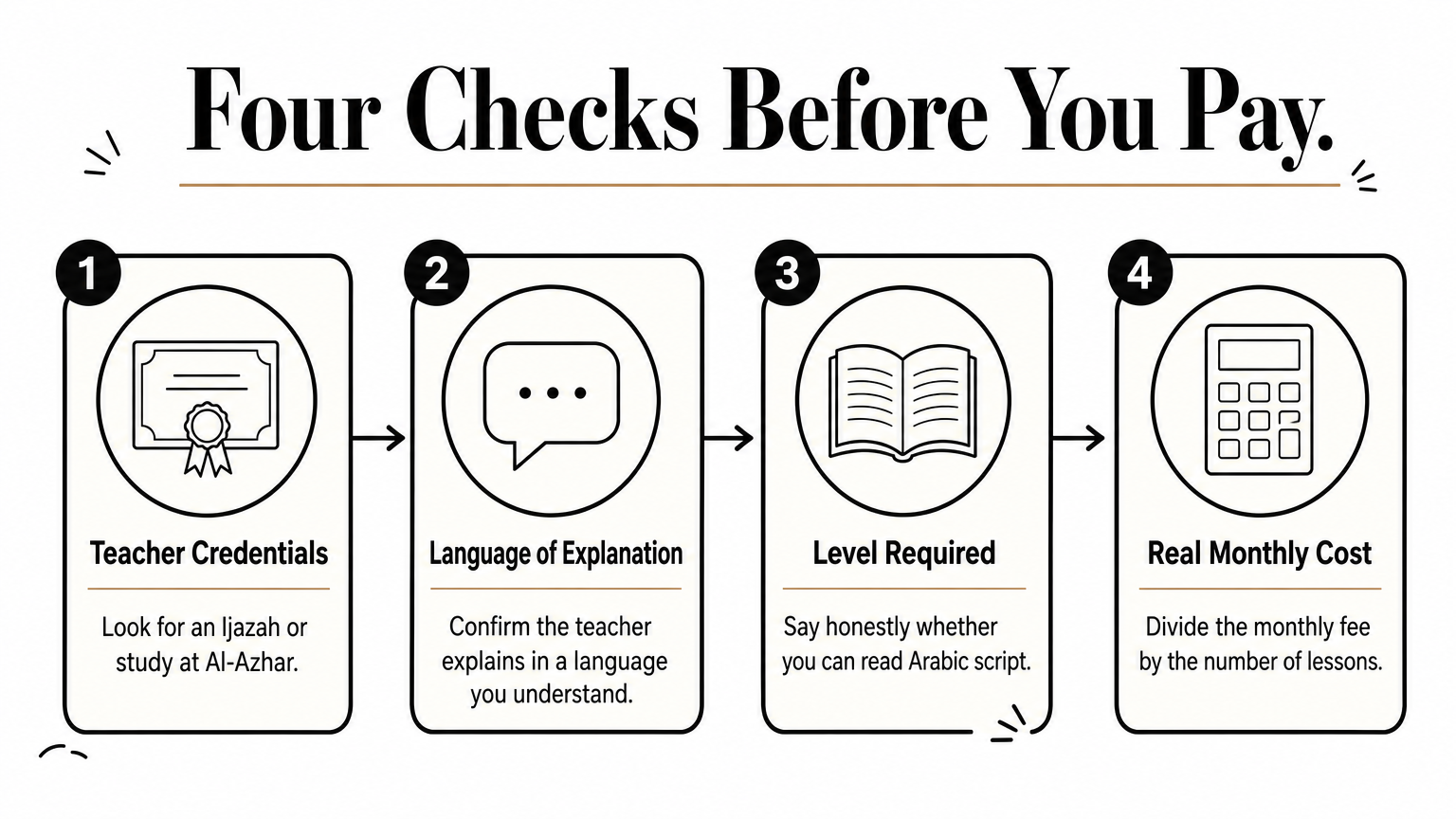
Choose by testing four things in order: the teacher’s credentials, the language of explanation, the level required, and the real monthly cost. Do this before you pay, and use a trial lesson to check each one.
The right class is the one whose teacher you understand, whose level matches yours, and whose price you can sustain for six months.
Compare the five side by side
| Option | Format | Language | Level | Cost |
|---|---|---|---|---|
| Quranytime Academy | Live, one-to-one | Agree in your assessment | Beginner to advanced | Free assessment, then a premium plan |
| Al-Azhar Quran Teaching | One-on-one, tiered tracks | English and Urdu | Learners who can read the script | See its Fees page |
| Al Huda Online | Structured courses | English | Listed as beginner | Set per course |
| Word for Word Quran | Free classes | English, Urdu, Tamil | Vocabulary focus | Free |
| Quran Academy | Grammar-first academy | Confirm with the academy | Any level | Confirm with the academy |
Check teachers, language, and level
Ask who teaches, not just who runs the academy. Look for an Ijazah or study at a recognized institution such as Al-Azhar, and ask how long the teacher has taught translation specifically. Next, confirm that the language of explanation matches yours. A translation lesson in a language you only half understand teaches you little. Finally, say honestly whether you can read Arabic script. Some courses require it, and a trial lesson will show where you stand.
Work out the real cost
Divide the monthly fee by the number of lessons. Three 30-minute lessons a week give about 13 lessons, or 6.5 hours, a month. For illustration only, a plan that costs $60 a month works out to about $4.62 per lesson and $9.23 per hour. Use the same arithmetic on every provider you compare. A cheaper plan with fewer lessons can cost more per hour.
Learn faster between lessons
Translation sticks when you revise it. Follow this routine:
- Review ten new words before each lesson.
- Read the verse in Arabic, then the translation, then the Arabic again.
- Write one sentence on what the verse asks of you.
- Revisit last week’s verses once before starting new ones.
Start with a free trial class
The right online Quran translation class depends on how you learn. One-to-one lessons give you correction and pace, institute courses give you a syllabus and a certificate, free classes build vocabulary, and grammar-first academies teach you to read without help. Whatever you choose, confirm the teacher’s credentials, the language of explanation, the level required, and the cost per lesson.
If you are unsure where to begin, let a teacher place you. You can book a free assessment class at Quranytime Academy, where a live, one-to-one session checks your level and recommends a path with no obligation to continue.