
The tajweed rules in Surah Fatiha come down to five things you can fix in order: where each letter leaves your mouth, which letters are heavy or light, how long each vowel stretches, how those rules combine in each of the seven verses, and how you stop at each verse end. Work through them one at a time, with a recording of a qualified reciter beside you, and the surah becomes accurate in a short daily practice.
You recite Al-Fatiha at least 17 times a day in the obligatory prayers, and almost nobody corrects you. Small habits set hard: a thick lam in Allah, a clipped alif in ad-daalleen, a missing shaddah on iyyaka. Most guides either list rules in the abstract or point you to a video, and neither tells you which rule belongs to which word.
This guide gives you that word-level map, following the Hafs narration from ʿĀṣim, the one most learners study. At Quranytime Academy, our teachers work with learners in live one-to-one lessons, and the steps below build from letters to madd to full verses.
What tajweed covers in Al-Fatiha
Al-Fatiha uses seven families of rules: articulation points (makharij), heavy and light letters, shaddah, madd (elongation), the rules for alif lam, clear pronunciation of noon and meem with sukun, and stopping at verse ends. Knowing this short list tells you where your effort goes.
Rules that appear and rules that do not
The surah has no tanween and no noon or meem carrying a shaddah, so there is no nasal ghunnah to hold. Its one noon with sukun (in anʿamta) is pronounced clearly, and its mim sukuns are all clear too. In normal flow, no qalqalah letter carries a sukun either, so there is nothing to bounce.
That is why mistakes cluster in letters, madd, and shaddah. If a chart tells you to hold a ghunnah in Al-Fatiha, check it with a teacher before you practice it.
What to prepare
Gather these before Step 1:
- The Arabic text of the surah. Transliteration helps, but it never replaces the Arabic.
- A recording of a qualified reciter in Hafs, which you can pause and replay word by word.
- A phone voice recorder, so you can compare yourself with the reciter.
- Ten quiet minutes a day.
Al-Fatiha has few rules, so each one has to be exact.
Step 1. Place each letter and sort heavy from light
Start with letters, because every other rule depends on them. Isolate each problem letter for a minute, say it inside its word, then say it inside its verse.
Letters to isolate
These are the letters learners most often move to the wrong place:

- ʿayn (ع) and ḥā (ح) come from the middle of the throat: ʿaalameen, naʿbudu, al-ḥamdu, raḥmaan.
- Hā (ه) comes from the deepest throat: Allaah, ihdinaa, ʿalayhim.
- Ḍād (ض) comes from the side of the tongue meeting the upper molars: maghḍoobi, ḍ-ḍaalleen. It is not a dal.
- Dhāl (ذ) is the tongue tip against the edge of the upper front teeth: alladheena.
- Qāf (ق) comes from the back of the tongue, deeper than kaf: mustaqeem.
Heavy and light letters
The heavy letters in this surah are ṣād, ḍād, ṭā, qāf, and ghayn. Raise the back of your tongue toward the palate and keep the sound full. Even when they carry a kasra, as the ṣād in ṣiraaṭ and the qāf in mustaqeem do, they stay heavy. Their light neighbors, the sin and ta in mustaqeem and nastaʿeen, must not borrow that weight.
Two more rules fall here:
- Ra is heavy in raḥmaan, raḥeem, rabbi, and ṣiraaṭ, and light only in ghayri, where it carries a kasra.
- The lam of Allah is light both times, in bismillaah and lillaah, because a kasra comes before it.
If a letter leaves the wrong place, no madd or shaddah will rescue the word.
Step 2. Set your madd lengths
Al-Fatiha has three madd lengths: 2 counts for natural madd, 6 counts once, and a flexible 2, 4, or 6 at the end of each verse. Keep these separate and most elongation errors disappear.
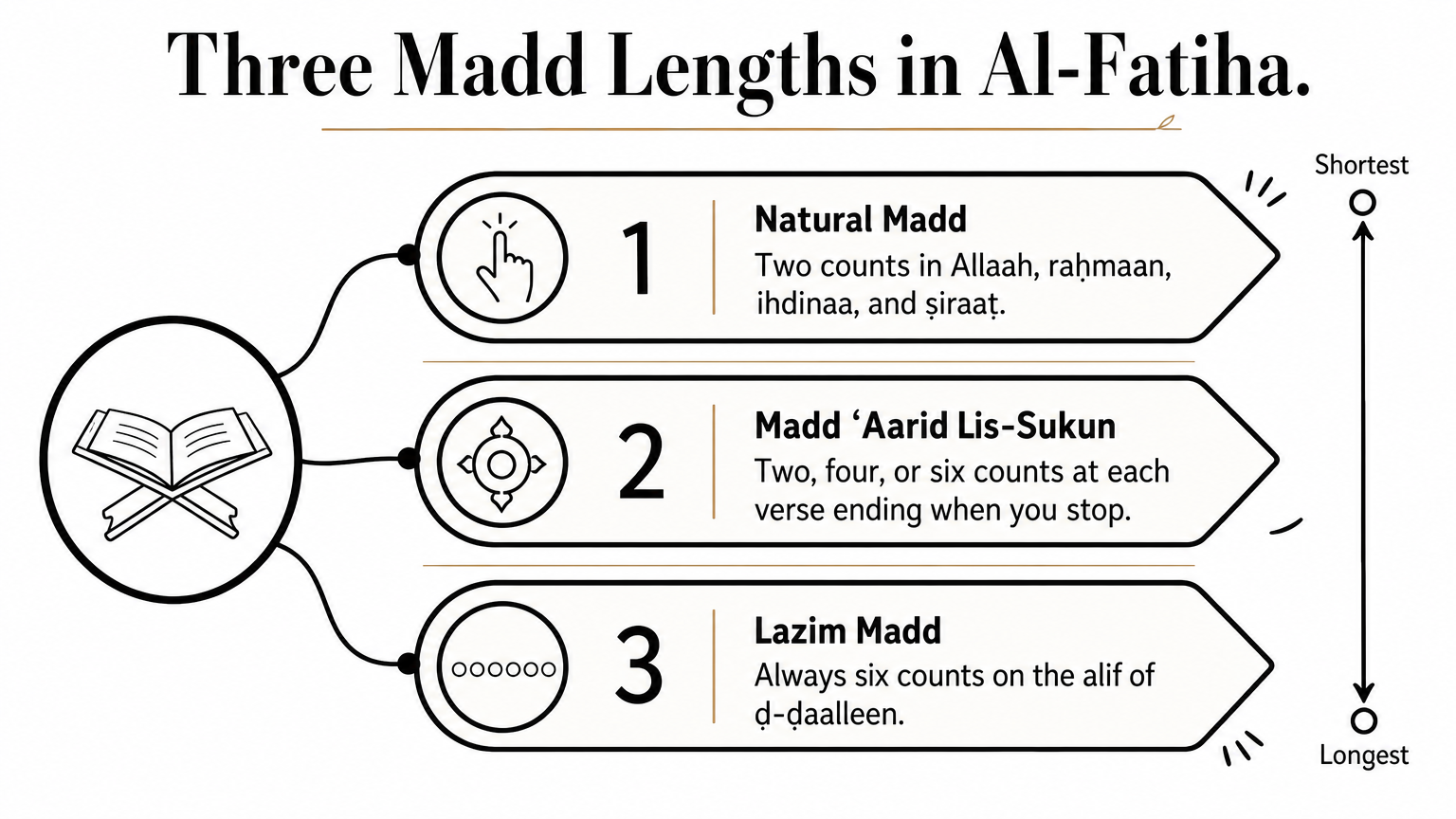
The three lengths in one table
| Madd type | Where it appears | Length |
|---|---|---|
| Natural (asli) | Allaah, raḥmaan, ʿaalameen (first alif), Maaliki, Iyyaaka, ihdinaa, ṣiraaṭ, alladheena, laa | 2 counts |
| Lazim | The alif in ḍ-ḍaalleen, before the doubled lam | 6 counts, always |
| ʿAarid lis-sukun | The long "ee" at each of the 7 verse endings, when you stop | 2, 4, or 6 counts |
The waw of yawm and the ya of ʿalayhim and ghayri are soft letters. When you read on, do not stretch them.
A worked count
A count is roughly one relaxed finger beat. Suppose you choose 4 counts for stops. Then ʿaalameen is ʿaa (2) followed by mee (4). In ḍ-ḍaalleen, the alif takes 6 and the final ee takes 4. Whichever length you choose, keep it identical at all seven verse endings. The 6-count alif in ḍ-ḍaalleen stays 6 whatever you choose.
Two, six, and one chosen stop length: that is every madd in the surah.
Step 3. Apply the rules verse by verse
Now combine Steps 1 and 2 verse by verse. Read the Arabic, check each row below, and recite only after you know what each word asks of you.
The verse-by-verse table
| Verse | Words | What to apply |
|---|---|---|
| 1 | Bismillaahi r-Raḥmaani r-Raḥeem | Light lam in Allaah. Natural madd in Allaah and raḥmaan. Heavy doubled ra. Middle-throat ḥā. Madd ʿaarid on raḥeem. |
| 2 | Al-ḥamdu lillaahi Rabbi l-ʿaalameen | Clear lam of "al" before ḥā. Clear mim before dal. Light lam in Allaah. Heavy ra in rabbi, doubled ba. Madd ʿaarid on mee. |
| 3 | Ar-Raḥmaani r-Raḥeem | Same as verse 1. |
| 4 | Maaliki yawmi d-deen | Two counts on Maa. Do not stretch the waw. The lam of "al" merges into a doubled dal. Madd ʿaarid on deen. |
| 5 | Iyyaaka naʿbudu wa iyyaaka nastaʿeen | Shaddah on both ya. Two counts on the alif. Throat ʿayn. Light sin and ta in nastaʿeen. Madd ʿaarid on ʿeen. |
| 6 | Ihdinaa ṣ-ṣiraaṭa l-mustaqeem | Begin ihdinaa with a kasra. Heavy doubled ṣād, heavy ra and ṭā. Light sin and ta beside the heavy qāf. Madd ʿaarid on qeem. |
| 7 | Ṣiraaṭa lladheena anʿamta ʿalayhim ghayri l-maghḍoobi ʿalayhim wa laa ḍ-ḍaalleen | Clear noon before ʿayn. Clear mim before ta, ghayn, and waw. Light ra in ghayri. Heavy ghayn and ḍād. Six counts on the alif of ḍ-ḍaalleen. |
Using the table as a printed reference
If you searched for a Surah Fatiha with tajweed rules PDF, this table is built for that use. Print this page from your browser, or copy the table into your notes, and keep it beside your mushaf. Read each verse aloud, then tick every rule you applied. Be strict with verse 7. It carries the most rules in the surah, so slow practice there pays off most.

Each verse asks for a handful of specific actions, so check them one by one.
Step 4. Practice, fix mistakes, and get checked
Short daily sessions beat one long weekly session. Spend 5 to 10 minutes a day on a fixed plan, record yourself, and compare with the reciter.
A seven-day plan
- Day 1: Isolate ʿayn, ḥā, hā, ḍād, ṣād, ṭā, and qāf.
- Day 2: Verses 1 to 3, focusing on heavy ra and light lam.
- Day 3: Verses 4 and 5, focusing on shaddah and the soft waw.
- Day 4: Verse 6, focusing on heavy and light letters side by side.
- Day 5: Verse 7 slowly, with the 6-count alif.
- Day 6: The whole surah, with one fixed madd ʿaarid length.
- Day 7: Record the full surah and compare it with your reference recording.
Seven mistakes to listen for
- A heavy lam in Allaah.
- A light ra in raḥmaan, rabbi, or ṣiraaṭ, or a heavy ra in ghayri.
- A dropped shaddah in iyyaaka, ad-deen, or ḍ-ḍaalleen.
- ʿayn and ḥā pronounced as hamza and hā.
- A sin that sounds like ṣād, a ta that sounds like ṭā, or the reverse.
- A 2 or 4 count on the alif of ḍ-ḍaalleen.
- A different stop length at different verse endings, or a vowel added to the final mim of ʿalayhim.
When to bring in a teacher
A recording shows you what to aim for, but only a trained ear hears what you actually produce. If you are unsure whether an error changes meaning, ask a qualified teacher or scholar rather than guess. In live sessions with our Al-Azhar-trained teachers, a correction arrives the moment you make the mistake, which is how a stubborn habit is fixed.
Record yourself every week, because your ear misses what a recording catches.
Ready to check your recitation?
Correct tajweed in Al-Fatiha starts with letters, moves to madd, and then applies both rules verse by verse. The seven-day plan keeps the practice short, and the seven mistakes tell you what to listen for in your own voice.
When you want a trained ear on your recitation, book a free assessment class with Quranytime Academy. A teacher reviews your level, may listen to a short reading sample, and suggests a starting point, with no obligation to continue.