

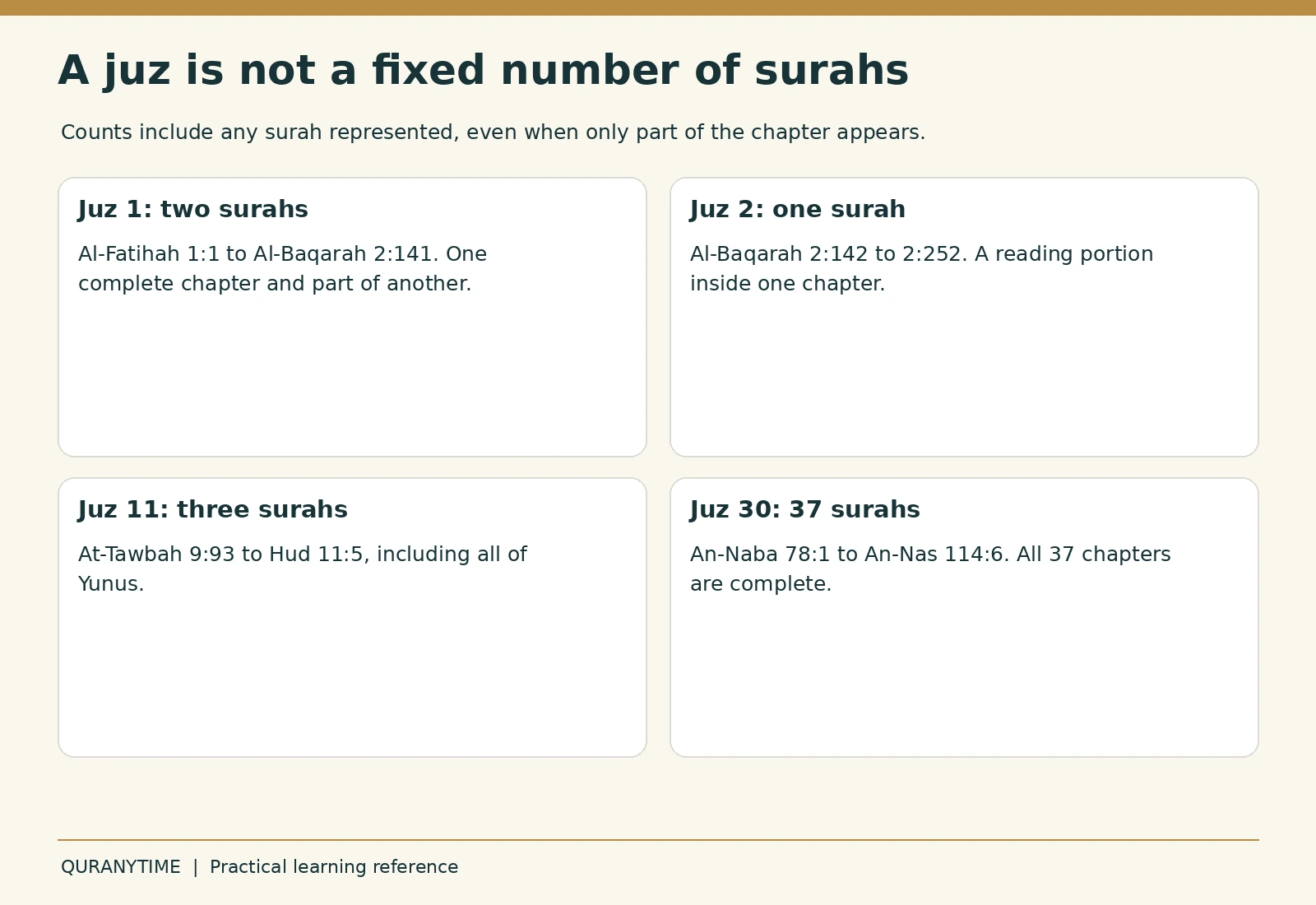
The number of surahs in each juz is not fixed. Some ajza contain part of one surah, while others contain several complete surahs and portions of neighbouring chapters. Juz 30 contains 37 surahs, from An-Naba to An-Nas. Juz 2 and Juz 5 each lie entirely within a single surah. A juz is a reading division, whereas a surah is a chapter.
The table below lists all 30 ajza with their starting verse, ending verse and the number of surahs represented. A surah is counted when any part of it appears in that juz. This definition matters: a count of chapters touched is different from a count of complete chapters contained inside the boundaries. Use the verse references to locate the passage in your own copy rather than relying on page numbers alone.
How to read the table correctly
Each reference uses surah number followed by verse number. For example, 2:142 means Surah Al-Baqarah, verse 142. The start and end references are inclusive. If one juz ends at 2:141, the next begins at 2:142. This makes it possible to check your bookmark without assuming that a juz always begins with a new chapter heading.
The column labelled surahs represented counts partial and complete chapters together. Juz 1 includes Al-Fatihah and part of Al-Baqarah, so its count is two. Juz 2 continues within Al-Baqarah, so its count is one. The overview of the Quran’s 114 surahs explains the chapter structure; this page supplies the separate juz-by-juz reference.
Complete list: surahs represented in all 30 ajza
| Juz | First verse | Last verse | Surahs represented | From surah to surah |
|---|---|---|---|---|
| 1 | 1:1 | 2:141 | 2 | Al-Faatiha to Al-Baqara |
| 2 | 2:142 | 2:252 | 1 | Al-Baqara to Al-Baqara |
| 3 | 2:253 | 3:92 | 2 | Al-Baqara to Aal-i-Imraan |
| 4 | 3:93 | 4:23 | 2 | Aal-i-Imraan to An-Nisaa |
| 5 | 4:24 | 4:147 | 1 | An-Nisaa to An-Nisaa |
| 6 | 4:148 | 5:81 | 2 | An-Nisaa to Al-Maaida |
| 7 | 5:82 | 6:110 | 2 | Al-Maaida to Al-An’aam |
| 8 | 6:111 | 7:87 | 2 | Al-An’aam to Al-A’raaf |
| 9 | 7:88 | 8:40 | 2 | Al-A’raaf to Al-Anfaal |
| 10 | 8:41 | 9:92 | 2 | Al-Anfaal to At-Tawba |
| 11 | 9:93 | 11:5 | 3 | At-Tawba to Hud |
| 12 | 11:6 | 12:52 | 2 | Hud to Yusuf |
| 13 | 12:53 | 14:52 | 3 | Yusuf to Ibrahim |
| 14 | 15:1 | 16:128 | 2 | Al-Hijr to An-Nahl |
| 15 | 17:1 | 18:74 | 2 | Al-Israa to Al-Kahf |
| 16 | 18:75 | 20:135 | 3 | Al-Kahf to Taa-Haa |
| 17 | 21:1 | 22:78 | 2 | Al-Anbiyaa to Al-Hajj |
| 18 | 23:1 | 25:20 | 3 | Al-Muminoon to Al-Furqaan |
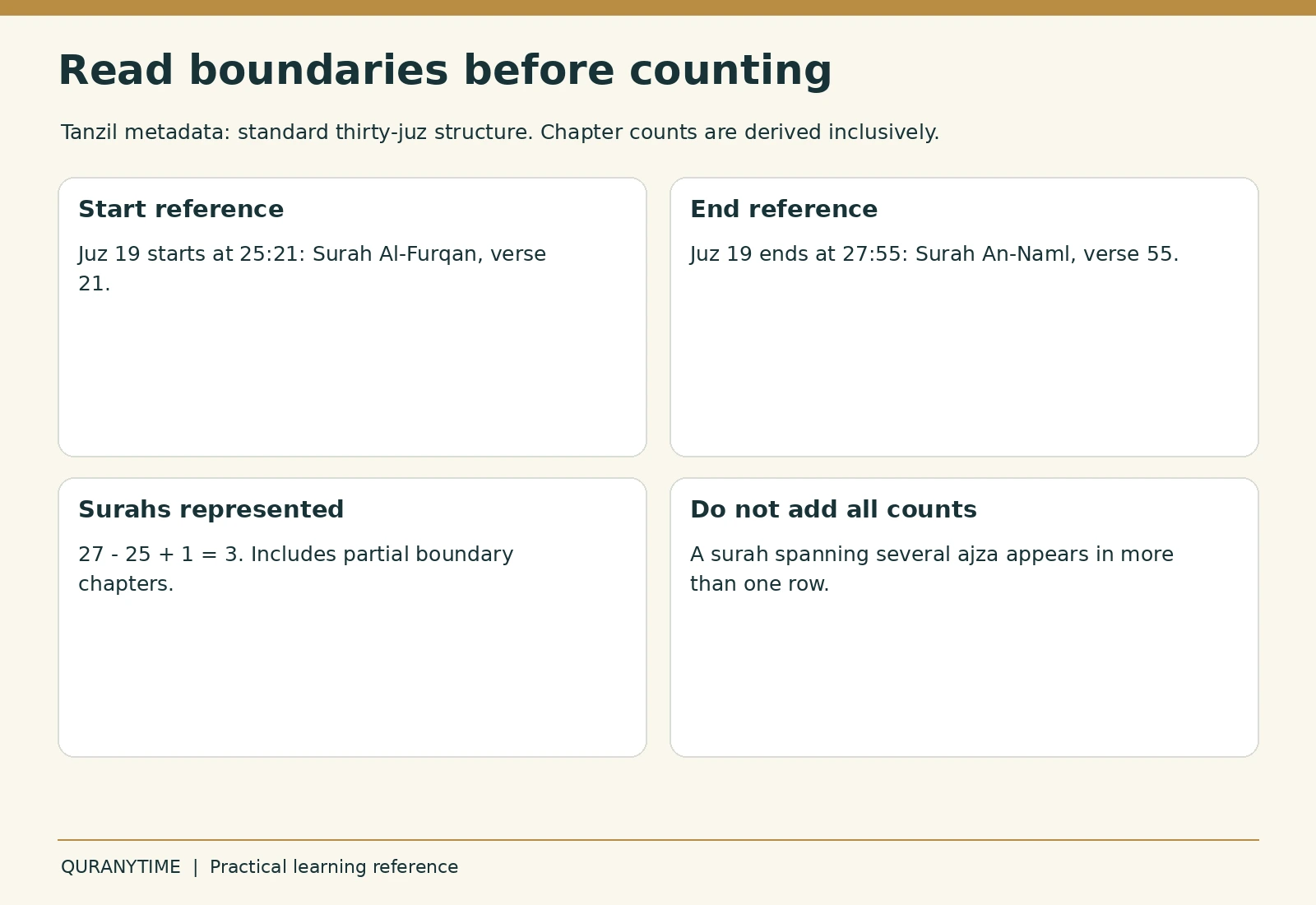
| 19 | 25:21 | 27:55 | 3 | Al-Furqaan to An-Naml |
| 20 | 27:56 | 29:45 | 3 | An-Naml to Al-Ankaboot |
| 21 | 29:46 | 33:30 | 5 | Al-Ankaboot to Al-Ahzaab |
| 22 | 33:31 | 36:27 | 4 | Al-Ahzaab to Yaseen |
| 23 | 36:28 | 39:31 | 4 | Yaseen to Az-Zumar |
| 24 | 39:32 | 41:46 | 3 | Az-Zumar to Fussilat |
| 25 | 41:47 | 45:37 | 5 | Fussilat to Al-Jaathiya |
| 26 | 46:1 | 51:30 | 6 | Al-Ahqaf to Adh-Dhaariyat |
| 27 | 51:31 | 57:29 | 7 | Adh-Dhaariyat to Al-Hadid |
| 28 | 58:1 | 66:12 | 9 | Al-Mujaadila to At-Tahrim |
| 29 | 67:1 | 77:50 | 11 | Al-Mulk to Al-Mursalaat |
| 30 | 78:1 | 114:6 | 37 | An-Naba to An-Naas |
The boundaries follow the standard thirty-part arrangement recorded in Tanzil’s structural metadata. The surah counts are calculated from the inclusive range of surah numbers between each starting and ending reference. They are not counts of complete chapters memorized. Before using the table for a group assignment, agree on this definition with the teacher or organizer.
Why the counts are so different
Surahs vary greatly in length. A long chapter may extend across several ajza, while a juz near the end of the Quran can contain many short chapters. Chapter count therefore tells you little about the effort required for a particular reading or memorization session. One chapter does not necessarily mean a short assignment, and ten chapters do not necessarily mean a longer one.
This is why dividing 114 by 30 does not produce a useful answer to how many surahs are in each juz. That calculation gives an arithmetic average, not a description of the actual boundaries. It also fails because a surah may appear in more than one juz. Adding the table’s chapter counts will therefore count some chapters more than once.
Think of a surah as a chapter and a juz as a separate navigation layer placed across the reading text. The two systems overlap without requiring their boundaries to coincide. This distinction becomes especially clear in Al-Baqarah and An-Nisa, where a single chapter continues through multiple reading portions.
Worked examples from the table
Juz 1 begins at Al-Fatihah 1:1 and ends at Al-Baqarah 2:141. It represents two surahs, but only Al-Fatihah is present in full. A learner who says they have read two complete surahs after finishing Juz 1 would be describing the result inaccurately. They have completed one surah and read part of another.
Juz 11 starts at At-Tawbah 9:93 and ends at Hud 11:5. It therefore includes part of At-Tawbah, all of Yunus and the opening of Hud. Juz 12 continues at Hud 11:6. This boundary is useful to check because simplified online lists sometimes place the start of Juz 12 at the beginning of Hud instead.
Juz 18 ends at Al-Furqan 25:20, and Juz 19 begins at 25:21. Juz 21 begins at Al-Ankabut 29:46 rather than at the start of Ar-Rum. A chapter-only list can hide these details. Keeping the exact verse references prevents a group from accidentally skipping or repeating the verses around a boundary.
Juz 30 and its 37 surahs
Juz 30 runs from Surah 78 through Surah 114, inclusive. Calculating 114 minus 78 plus one gives 37. Unlike many earlier ajza, it starts at the beginning of a surah and finishes at the end of the Quran. All 37 chapters in this particular juz are therefore represented in full.
Its familiar name, Juz Amma, comes from the opening wording of An-Naba. Many learners encounter it early because it contains short surahs frequently studied in introductory Quran lessons. Short does not mean that every pronunciation detail is easy, however. Careful listening, correction and revision remain necessary even when a passage takes only a little time to recite.
For a learning-focused explanation of this final portion, read what Juz Amma is and how to approach it. Keep that purpose separate from the reference table here: this table identifies boundaries, while a teaching plan decides the order, pace and review needed by an individual learner.
Juz, hizb and rub: related but different labels
In the common division system, the Quran contains 30 ajza and 60 ahzab. One juz contains two hizb, and each hizb has four quarters. A rub al-hizb is consequently one eighth of a juz. These smaller divisions offer more frequent checkpoints, but they are still different from chapter boundaries.
You may see these markers in a margin, within the text or in an app’s navigation panel. Their design depends on the edition. A marker identifies a location in the reading framework; it does not by itself tell you that the surrounding sentence is complete or that a reciter must stop there. Follow appropriate recitation guidance when choosing a pause.
Our guide to juz, hizb and rub divisions explains the hierarchy in more detail. When recording progress, combine the division name with a surah-and-verse reference. The second clue remains useful if you change from a physical mushaf to a phone reader with a different page layout.
Why page numbers need an edition label
The familiar Madinah-style layout has 604 Quran-text pages, but not every printed or digital edition shares those page breaks. Font size, line count, commentary and layout all affect pagination. A juz label can be stable while the page number or the place on the page changes.
For that reason, a table that says Juz 10 starts on a certain page should identify the edition. Verse references are more portable. If you are coordinating reading with a relative who uses another script or a large-print copy, give the starting verse rather than asking them to find the same page number.
The Quran page-count guide gives context for the difference between text structure and printed layout. For a class register, a useful entry is the date, juz number, surah name, last completed verse and next starting verse. That removes ambiguity about whether the written number marks completion or a new beginning.
Turn the table into a realistic reading plan
First decide whether your objective is reading, memorization, pronunciation practice or reflection. These activities move at different speeds. A full juz might be a reading target for one person, while another learner needs a short passage repeated carefully. Neither target should be chosen solely because it fills one row of a checklist.
For a thirty-day reading plan, one juz per day is straightforward arithmetic, but real schedules need room for interruptions. Divide a day’s portion into sessions that fit your routine, and record where each session actually ends. If you miss a day, recalculate the remaining work instead of rushing silently through difficult passages just to keep a calendar looking complete.
For memorization, use the table as a navigation aid and build a separate revision schedule. New material, recent revision and older revision all require time. The Hifz calculator can help you explore a planning target, but any calculated timeline should be adjusted to your retention, teacher feedback and available review time.
Downloadable reference and practice worksheets
Download the free three-page practice worksheets and answer guidance (PDF). No registration is required.
The worksheet pack includes a printable thirty-juz reference, boundary-finding exercises and a reading-progress log. In the first exercise, identify the starting and ending surah for a chosen juz. In the second, decide whether a listed chapter is present completely or only partly. Use the answer guidance after you have tried the task.
When teaching children, begin with familiar examples rather than memorizing the whole table. Ask why Juz 2 has one surah represented while Juz 30 has 37. Then ask the learner to point to the actual boundary in a mushaf. This checks understanding more effectively than asking for a number that may have been remembered without context.
Frequently asked questions
Does every juz contain more than one surah?
No. Juz 2 lies within Al-Baqarah, and Juz 5 lies within An-Nisa. Other ajza cross chapter boundaries. The number depends on the lengths of the chapters and where the traditional reading divisions fall.
Is a para different from a juz?
Para is a familiar name for one of the thirty parts in many South Asian learning contexts. When someone assigns a para, check its number and starting reference. Terminology can differ between families and teaching settings, while the intended reading division is usually the same.
Can I count a partial surah as a whole surah completed?
Not when reporting completion accurately. The table counts surahs represented, including partial chapters. If you need complete-surah totals, inspect the boundaries separately and state that different definition clearly.
Which juz has the most surahs?
Juz 30 contains 37 complete surahs, from An-Naba through An-Nas. Its chapter count does not make it thirty-seven times the reading work of an earlier juz containing part of one long chapter.
Can a teacher help me choose a starting point?
Yes. If you want a reading or memorization plan suited to your current level, book a free trial class. Explain what you can already read, what you hope to learn and how much revision time you can realistically maintain each week.
Sources and calculation method
The boundary table uses Tanzil Quran metadata. Spot checks include Juz 12 on Quran.com, Juz 19 and Juz 21. Chapter counts are calculated inclusively from the boundary surah numbers. Suggested exercises and planning examples are teaching aids rather than religiously prescribed schedules.