
So, is the Arabic alphabet hard to learn? It is unfamiliar, but it is not hard. Most English speakers can recognize and sound out all 28 letters within two to four weeks of short daily practice. The real slowdown comes later, when you build vocabulary and grammar, and that has nothing to do with the letters themselves.
The Arabic alphabet is a set of 28 letters written from right to left in joined-up script. Most letters change shape depending on where they sit in a word. The short vowels are marked with small symbols above or below the letters, or left out altogether. There are no capital letters, and printed text is joined the same way handwriting is.
This article explains what makes the script feel difficult, how long it realistically takes, a step-by-step method for learning it, and whether it is a sensible goal for your background. Quranytime Academy teaches Arabic letters to beginners in live one-to-one lessons, so the advice follows how this first stage is usually taught.
Why the Arabic alphabet feels hard to English speakers
The Arabic alphabet feels hard because it breaks three habits that English readers rely on. Letters keep one shape, vowels are written out, and every sound has a familiar equivalent. None of these hurdles is large, but they stack up in the first weeks.
Joined letters that change shape
Arabic runs right to left, and letters join to each other inside a word. Most letters have up to four forms: isolated, initial, medial and final. Six letters (ا د ذ ر ز و) join only to the letter before them, so they break a word into short blocks.
| Letter | Isolated | Initial | Medial | Final |
|---|---|---|---|---|
| Ba | ب | بـ | ـبـ | ـب |
| Ayn | ع | عـ | ـعـ | ـع |
| Alif | ا | ا | ـا | ـا |
Each form keeps a recognizable core, so you are not memorizing 112 separate symbols.
Look-alike letters and unwritten vowels
Many letters share a base shape and differ only by dots. ب has one dot below, ت has two above, and ث has three above. ج, ح and خ follow the same pattern. Training your eye on dot position is the first real skill you build.
Short vowels are the second surprise. Most adult texts leave them out, so the letters د ر س can mean dars (a lesson) or darasa (he studied), depending on the marks and the context. Beginner books and the Quran print the marks, which is why vowelled text is the right place to start.
Sounds with no English match
A few letters need new mouth positions. ع and ح come from the throat, خ and غ from the back of the mouth, and ق is a deeper version of "k". These sounds take weeks of listening, not minutes, and a teacher can correct them far faster than a video can.
The shapes are quick to memorize; joining, dots and throat sounds are what actually take practice.
How long it takes to learn the Arabic alphabet
Plan on two to four weeks of 20 to 30 minutes a day to read simple vowelled words, and several months before unvowelled text feels quick. These are typical ranges, not promises. Your pace depends on how often you practice and whether someone corrects your pronunciation.
A realistic timeline
| Stage | What you can do | Typical time at 20 to 30 minutes a day |
|---|---|---|
| Isolated letters | Name and sound all 28 letters | 1 to 2 weeks |
| Connected words with vowel marks | Sound out words slowly | 3 to 4 weeks |
| Familiar beginner text | Read steadily and aloud | 2 to 3 months |
| Text without vowel marks | Read by recognizing words | Many months, tied to vocabulary |
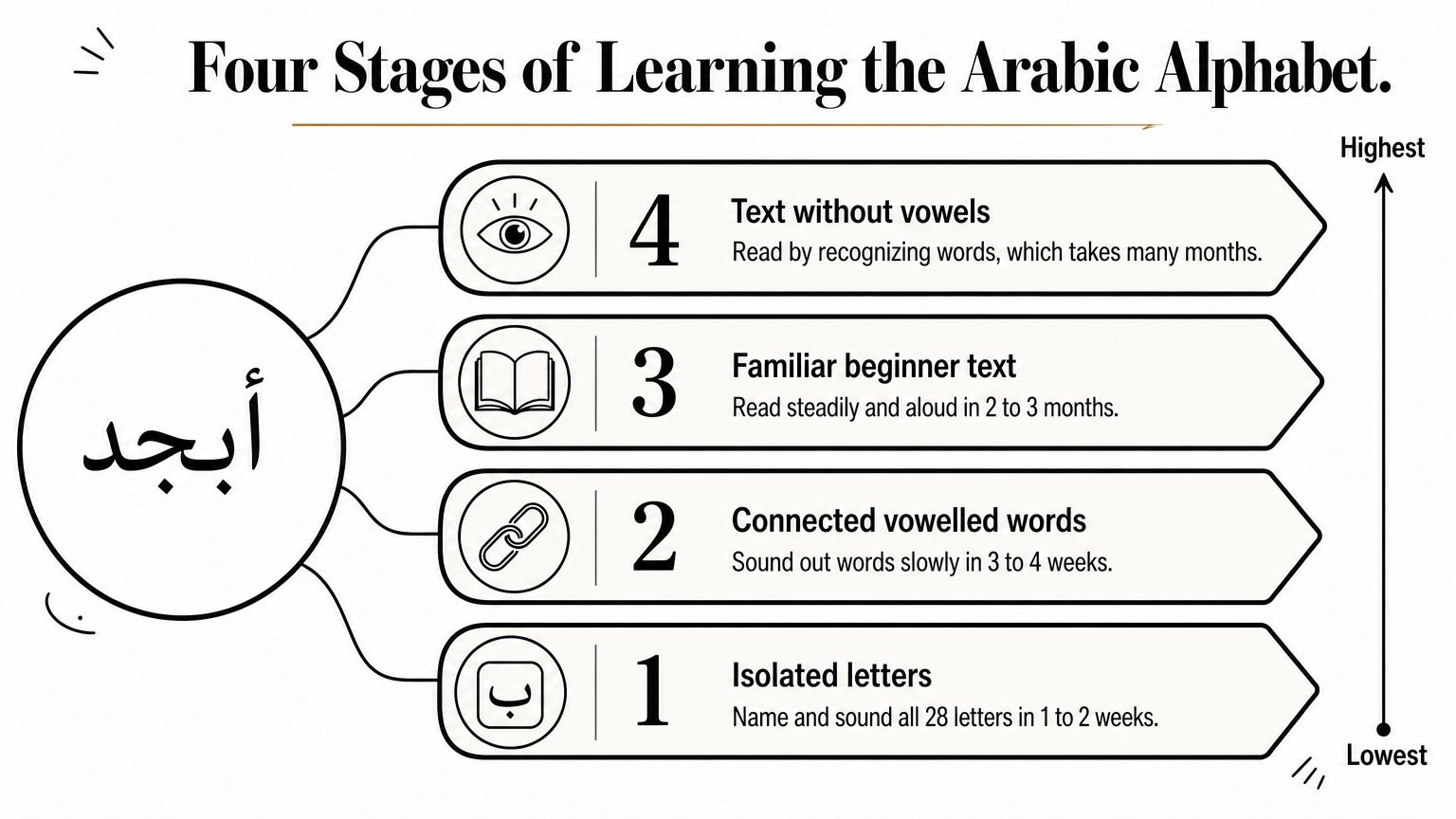
The last stage is slow because reading without vowel marks depends on knowing the words, not on knowing the letters.
A worked example
Say you learn 5 new letters a day. That covers all 28 in 6 days: five days of 5 letters, then 3 on the sixth. Spend the rest of week two on joined forms, and week three on vowel marks and short words. By the end of week four you can sound out simple words, and you have a clear list of the letters that still trip you up. If you miss a few days, add them to the end. The schedule bends easily.
Expect weeks, not months, to read the letters, and months to read fast.
How to learn the Arabic alphabet step by step
Learn the alphabet in shape families, say every letter aloud, and move to joined words early. This routine takes about 20 to 30 minutes a day and avoids the usual stalls.
A six-step routine
- Group letters by shape. Start with ب ت ث ن ي, which share a base, then ج ح خ, then the rest. Alphabetical order teaches you nothing about how letters look.
- Say the name and sound aloud with audio from a native speaker. Do not rely on your own guess from a transliteration.
- Learn all four forms of each letter inside real words, not only in isolation.
- Write by hand for 10 minutes a day. Writing fixes the dots and the connections in memory.
- Add the short vowel marks. Learn fatha, kasra, damma and sukun, then read vowelled words aloud. Structured beginner methods such as Noorani Qaida and Noor Al-Bayan are built around exactly this stage.
- Review with flashcards using spaced repetition, then read short vowelled texts aloud, even before you understand them.

Mistakes that slow beginners down
The most common mistake is leaning on transliteration for too long. Latin spellings hide sounds like ع and خ, and they delay the moment you read the script itself. Drop them as soon as you know the letters.
The second is practicing only isolated letters. You will meet joined forms in every real word, so learn the connected shapes from week one. A third is skipping pronunciation checks. A wrong habit with ح or ق is harder to undo after a month.
Learn letters inside words, aloud and by hand, and the alphabet stops being the obstacle.
Is learning the Arabic alphabet realistic for you?
Yes. The Arabic alphabet is a realistic goal for nearly any motivated learner, because it has only 28 letters and needs no prior Arabic. Your first language changes the speed, not the outcome.
How your background changes the difficulty
| Your background | Head start | Extra hurdle |
|---|---|---|
| English only | Small alphabet, no habits to unlearn | Direction, joining, new sounds |
| Spanish or Portuguese | Some everyday words of Arabic origin | New script and throat sounds |
| Hindi | Some Arabic-origin words through Hindi-Urdu vocabulary | New script, right to left |
| Urdu | Already reads a joined, right-to-left script based on Arabic | Letters like ث, س and ص are distinct in Arabic |
Compared with Greek, Arabic’s script is the bigger first hurdle, since Greek’s 24 letters run left to right and do not join. Against Japanese, the picture reverses: 28 letters are a far smaller job than thousands of kanji.
The alphabet is not the hard part of Arabic
Arabic’s reputation comes from the whole language. The U.S. Foreign Service Institute places it among its hardest languages for English speakers, at roughly 2,200 class hours. Verbs change with gender and number, and spoken dialects differ from Modern Standard Arabic. The alphabet is a small share of that effort, and it is the stage where progress is fastest and most visible.
Can you teach yourself?
You can learn the letters on your own with an app, videos and flashcards. Where self-study falls short is pronunciation and handwriting, because nobody tells you when your ح sounds like an h. A teacher gives immediate feedback on those, which is why a short trial with one is worth it. Quranytime Academy gives new students 3 free trial classes with no obligation to continue.
Learn the alphabet alone if you like, but get your throat sounds checked by a person.
Start with the letters, not the worry
The Arabic alphabet is unfamiliar rather than hard. Expect two to four weeks to read vowelled words, a few months for smooth reading, and a longer road for the language itself. Group the letters by shape, learn them in joined words, write them by hand, and have your pronunciation checked early.
If you want a teacher to guide that first stage, book a free assessment class with Quranytime Academy. The teacher will talk through your goals and current level, then suggest a starting path, whether that is the letters, foundational reading or Quranic Arabic.