
Quranic Arabic grammar · beginner guide
Arabic can say “my book” in one word: كِتَابِي (kitābī). A short pronoun ending attaches directly to the noun instead of appearing as a separate word. These are called possessive pronouns, attached pronouns, or possessive suffixes. This guide shows how to recognize the owner and distinguish a suffix on a noun from one on a verb or preposition. For the wider set of forms, see the Arabic pronoun chart for Quranic reading.
What is an Arabic possessive pronoun?
A possessive suffix is a short pronoun joined to a noun. In كِتَابِي, the noun كِتَاب (kitāb, “book”) is followed by ـي (-ī, “my”). The suffix is part of the same written word; do not insert a space between the noun and its owner ending.
The owner, not the owned noun, determines the suffix. The same feminine-owner ending appears in كِتَابُهَا (kitābuhā, “her book”) and سَيَّارَتُهَا (sayyāratuhā, “her car”). Review Arabic noun gender in Quranic Arabic if masculine and feminine forms are new.
Arabic possessive pronouns chart
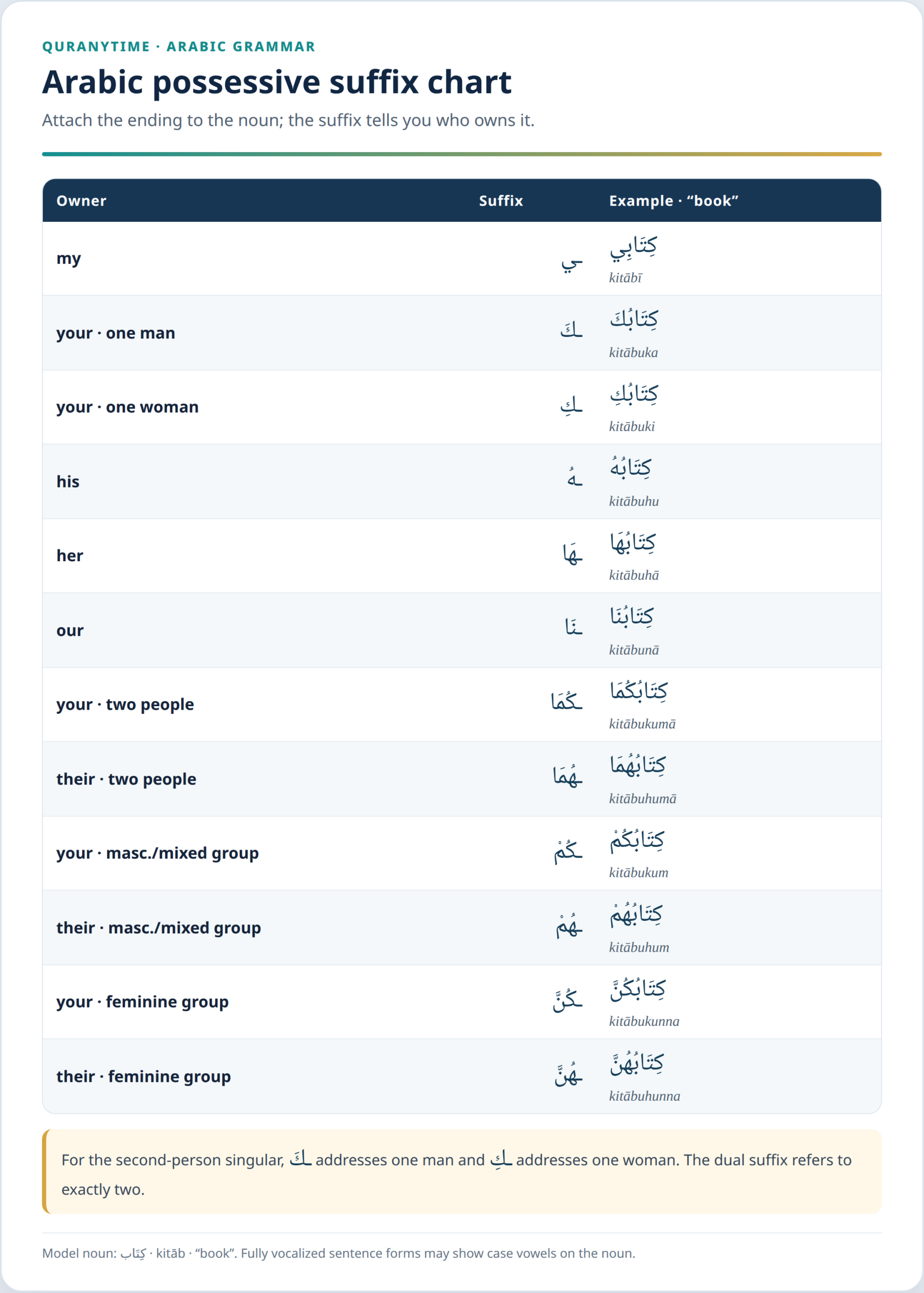
Use كِتَاب (“book”) as a model noun. The second-person endings address the listener: ـكَ is “your” when speaking to one man and ـكِ when speaking to one woman. Dual forms refer to two people; the feminine plural forms address or describe a group of women.
| Owner | Ending | Example |
|---|---|---|
| my | ـي | كِتَابِي kitābī |
| your (one man) | ـكَ | كِتَابُكَ kitābuka |
| your (one woman) | ـكِ | كِتَابُكِ kitābuki |
| his | ـهُ | كِتَابُهُ kitābuhu |
| her | ـهَا | كِتَابُهَا kitābuhā |
| our | ـنَا | كِتَابُنَا kitābunā |
| your (two people) | ـكُمَا | كِتَابُكُمَا kitābukumā |
| their (two people) | ـهُمَا | كِتَابُهُمَا kitābuhumā |
| your (masculine or mixed group) | ـكُمْ | كِتَابُكُمْ kitābukum |
| their (masculine or mixed group) | ـهُمْ | كِتَابُهُمْ kitābuhum |
| your (feminine group) | ـكُنَّ | كِتَابُكُنَّ kitābukunna |
| their (feminine group) | ـهُنَّ | كِتَابُهُنَّ kitābuhunna |
These are chart forms; in a sentence, the noun’s case ending follows its role, while the attached pronoun is genitive in a possessive construction. The neutral Quranic Arabic Corpus guide to possession explains the structure; the site’s case-endings guide shows why the noun’s final vowel can vary.
Read the ending inside a short phrase
Memorize a suffix in a sentence rather than reciting it by itself. هَذَا كِتَابِي (hādhā kitābī, “This is my book”) shows a first-person ending. أَيْنَ كِتَابُهُ؟ (ayna kitābuhu?, “Where is his book?”) has a third-person singular masculine suffix. When the owner is exactly two people, كِتَابُهُمَا means “their book—the two people’s”; for a group, كِتَابُهُمْ means “their book.” The contrast lets you hear the longer dual ending instead of treating every “their” as the same form.
In fully vocalized writing, notice both the noun’s case vowel and the suffix vowel. In unvowelled text, the short difference between كَ and كِ may not be written, so context tells you whether the speaker addresses a man or a woman. Read the whole phrase, not one isolated consonant.
How do suffixes change a noun?
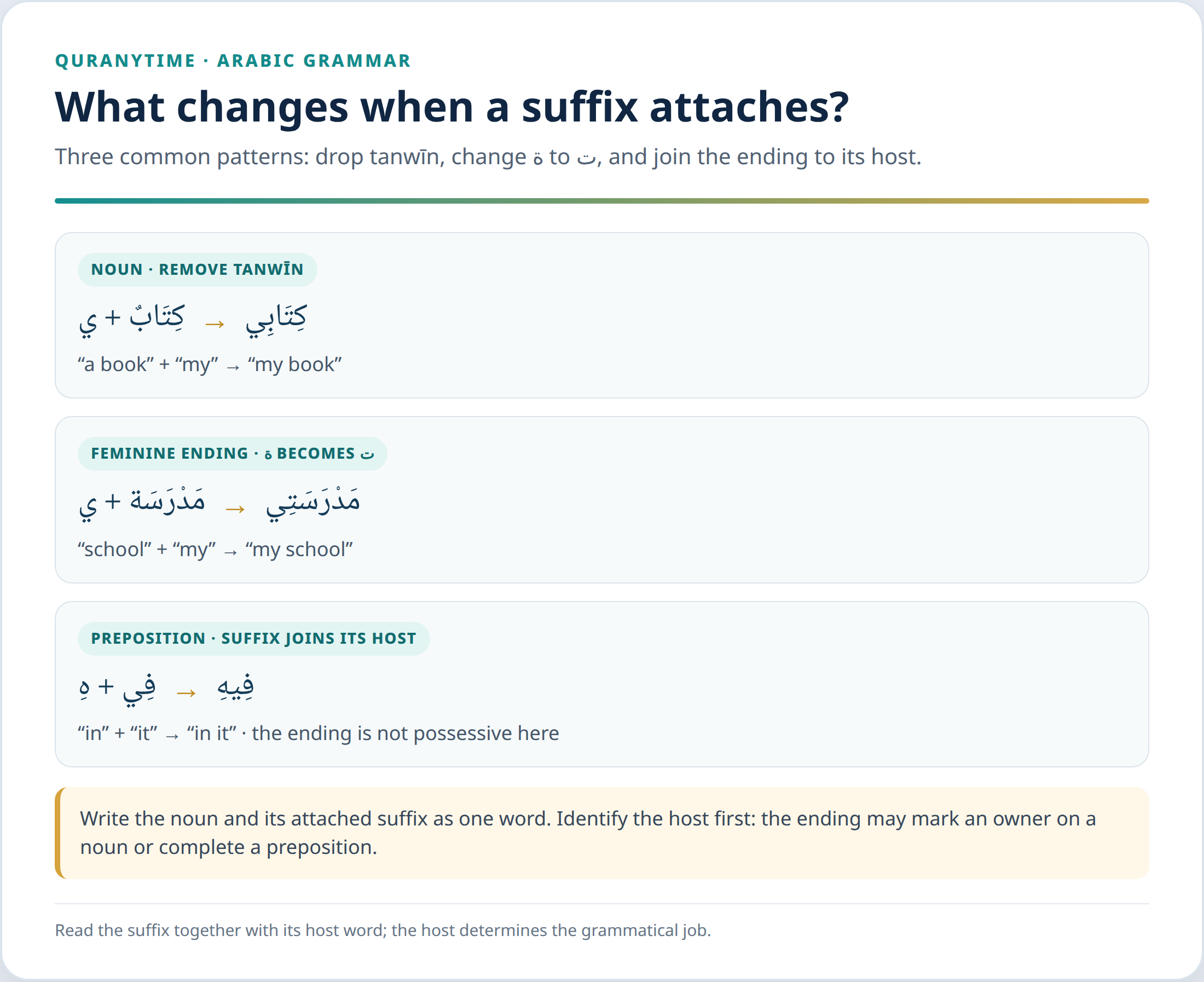
For many consonant-ending nouns, the suffix joins directly to the stem. Do not keep tanwīn beside a possessive suffix: كِتَابٌ (“a book”) becomes كِتَابِي (“my book”). The noun head also does not normally keep الـ (“the”) when it carries an attached owner suffix.
A frequent spelling change affects nouns ending in tāʾ marbūṭa ة. Before a pronoun suffix, it is written as tāʾ ت: مَدْرَسَة (“school”) becomes مَدْرَسَتِي (“my school”) or مَدْرَسَتُهُ (“his school”). Apply the spelling change first, then attach the ending.
Listen to the suffix vowel too. The second-person forms ـكَ and ـكِ differ by a short vowel. The third-person masculine suffix is often shown as ـهُ; after certain sounds it appears with kasra, as in فِيهِ (fīhi, “in it”). That context-sensitive form does not change the owner.
Attached pronouns can have different jobs
“Attached pronoun” names a form; “possessive pronoun” names one job it can do. The host word helps identify the job. After a noun, an ending may mark possession: قُلُوبِهِمْ (qulūbihim, “their hearts”). After a preposition, it completes that preposition: فِيهِ (fīhi, “in it”). After a verb, it can mark the subject or object.
For example, رَزَقْنَاهُمْ (razaqnāhum, “We provided them”) contains نَا (“we”) and هُمْ (“them”); neither means “our” or “their.” Compare the site’s Arabic verb-conjugation guide and lesson on subjects, verbs, objects, and word order.
Recognize suffixes after prepositions
After a preposition, a suffix means “to me,” “with him,” “in it,” or another relationship—not ownership. Examples include لِي (lī, “for me”), لَهُ (lahu, “for him”), مِنْهَا (minhā, “from her/it”), and عَلَيْكِ (ʿalayki, “upon you,” speaking to one woman). A fused-looking form such as فِيهِ can be read as فِي + هِ.
Do not call فِيهِ a noun with “his” attached: فِي means “in,” and هِ refers back to “it” or “him.” For more patterns with مِنْ, لِـ, and عَلَى, see the Arabic prepositions guide.
Three Quranic examples: find the host
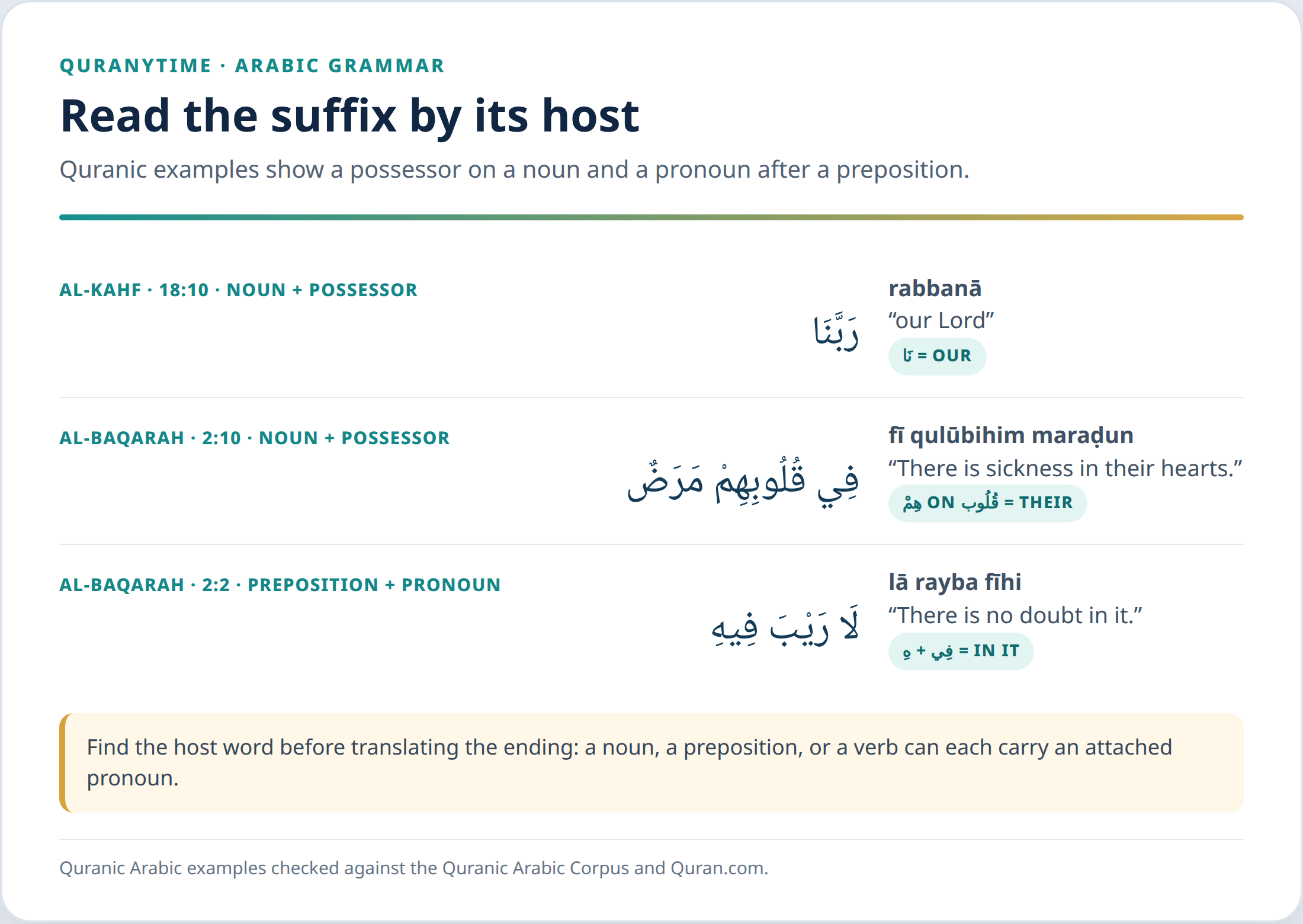
In Al-Kahf 18:10, the youths say رَبَّنَا (“our Lord”). The noun رَبّ (“Lord”) is the host, and نَا identifies the owners as “us.” The same verse has مِنْ أَمْرِنَا (“from our affair / in our matter”): the ending on أَمْر again means “our.”
Al-Baqarah 2:10 says فِي قُلُوبِهِمْ مَرَضٌ (“There is sickness in their hearts”). فِي means “in”; قُلُوب means “hearts”; and هِمْ is attached to that noun to mean “their.” The ending identifies the owners even though the noun is plural.
Al-Baqarah 2:2 offers a contrast: لَا رَيْبَ فِيهِ (“There is no doubt about it / in it”). Here هِ follows the preposition فِي, not a noun. The Quranic Arabic Corpus classifies فِيهِ as a preposition with an attached third-person singular pronoun. Identify the host first, then assign the suffix’s job. The iḍāfa guide to possessive phrases gives more noun-to-noun examples; the dual-noun guide helps with forms referring to exactly two.
Watch a short attached-pronoun lesson
This text-based lesson reviews attached pronouns on nouns, verbs, and prepositions. Pause at each example and name the host word before deciding whether the ending marks an owner, subject, or object.
Common mistakes to avoid
- Adding a space. The noun and suffix form one word: كِتَابِي, not two words for “my book.”
- Using the owned noun’s gender. In كِتَابُهَا, the owner is female; the ending does not describe the gender of كِتَاب.
- Calling every attached pronoun possessive. The same-looking forms after a verb may mark its subject or object; after a preposition, they complete that preposition.
- Mixing up “your” forms. The vowel distinguishes ـكَ (-ka, to a man) from ـكِ (-ki, to a woman).
- Ignoring spelling changes. Check whether final ة becomes ت, as in مَدْرَسَتِي.
Quick practice
- Which ending means “her” in كِتَابُهَا?
- In فِي قُلُوبِهِمْ, is هِمْ attached to a noun, preposition, or verb?
- How does مَدْرَسَة change in “my school”?
- In رَزَقْنَاهُمْ, which part means “we,” and which means “them”?
- Does فِيهِ contain a possessive suffix on a noun?
Answers: ـهَا means “her”; in the second example هِمْ is on قُلُوب; “my school” is مَدْرَسَتِي, with ة changing to ت; نَا means “we” and هُمْ means “them”; and فِيهِ is a preposition plus pronoun, not a noun-plus-owner phrase.
A five-step reading check
- Find the word that hosts the ending.
- Check whether it is a noun, preposition, or verb.
- Separate the suffix mentally without adding a writing space.
- Identify its person, number, and (where relevant) gender.
- Use the whole phrase to decide whether it marks possession, a subject, or an object.
Once you use this host-first method, attached endings become easier to recognize in Quranic reading. For guided practice, book a free Quran and Arabic trial class and bring a verse you want to work through.