
You can learn the Arabic alphabet in 1 hour by splitting the hour into four timed jobs. Spend 20 minutes grouping the 28 letters by shape, 15 minutes on the sounds English lacks, 15 minutes on how letters connect, and 10 minutes reading your first words aloud. One hour gets you to letter recognition and basic sounding out. A short review over the next few days makes it stay.
The usual problem is the order. Most free lessons march through the letters one by one, and that feels slow because the shapes are unfamiliar, the script runs right to left, and each letter changes form inside a word. Many beginners also search for a free downloadable chart, then discover that staring at a chart is not the same as writing the letters yourself.
This guide gives you a timed plan that needs only a pen, a sheet of paper, and audio from a native speaker. Quranytime Academy teaches Arabic online through live one-to-one lessons, and this plan reflects what first-time learners need to get right before anything else makes sense.
What one hour of Arabic alphabet study can do
One hour is enough to recognize the 28 Arabic letters and say each sound. It is not enough to read fluently or to remember everything a week later. Set that expectation now and the hour will feel productive instead of frustrating.
What 60 minutes covers
This plan targets recognition and pronunciation, not vocabulary or grammar. By the end you can point at a letter and name it, and sound out a short word. Expect to forget a few letters by tomorrow. A 10-minute review within 24 hours fixes most of that.
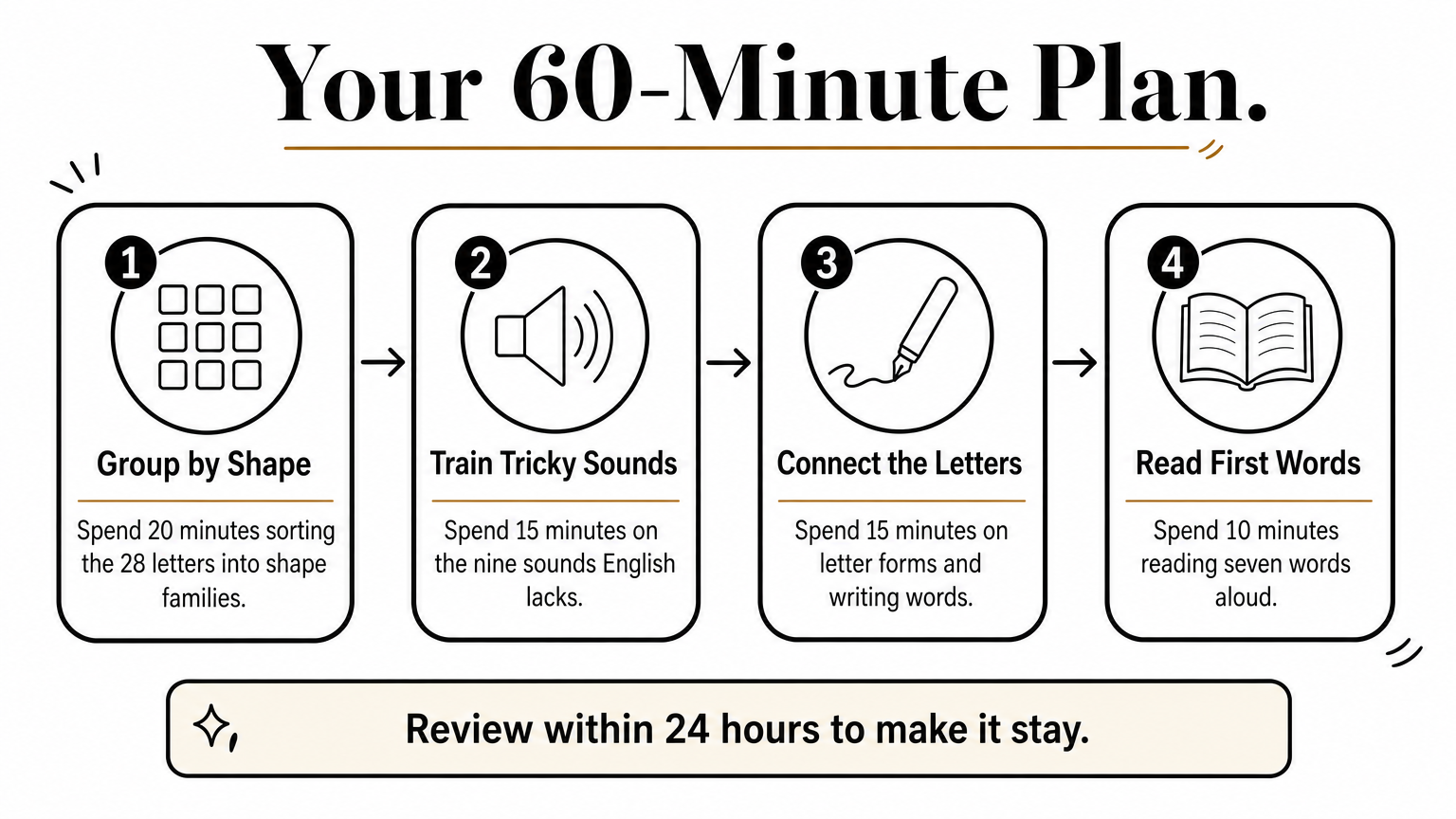
| Minutes | Step | Goal |
|---|---|---|
| 0 to 20 | Step 1 | Recognize all 28 letters through nine shape families and six loners |
| 20 to 35 | Step 2 | Say the nine hardest sounds |
| 35 to 50 | Step 3 | Connect letters and write the four forms |
| 50 to 60 | Step 4 | Read seven words aloud |
One hour builds recognition and sound, and a short review the next day turns it into memory.
Make your own practice sheet instead of downloading one
A printed chart helps, but copying the letters by hand is the real practice, and the sheet takes two minutes to draw. Gather a pen, paper, a timer, and audio from a native speaker, either a teacher or a clear recording. Draw this header across the top of a page and fill one row per letter as you go:
Letter | Name | Sound | Shape family | Written 3 times
A sheet you wrote yourself teaches more than a chart you downloaded and never wrote on.
Step 1. Group the 28 letters by shape
Sort the letters into nine shape families and six loners, then learn one family at a time. Many Arabic letters share one base shape and differ only by dots, so you are really learning far fewer than 28 shapes.
The shape families
Inside a word, the letters ب ت ث ن ي look almost identical apart from their dots. That one family covers five letters. The table below lists every family.
| Family | Letters | What tells them apart |
|---|---|---|
| Boat | ب ت ث ن ي | Dots: one below, two above, three above, one above, two below |
| Hook | ج ح خ | One dot inside, no dot, one dot above |
| Hook-less pair | د ذ | A dot above the second |
| Tail pair | ر ز | A dot above the second |
| Teeth pair | س ش | Three dots above the second |
| Loop pair | ص ض | A dot above the second |
| Tall pair | ط ظ | A dot above the second |
| Eye pair | ع غ | A dot above the second |
| Curl pair | ف ق | One dot above, or two dots above |
| Loners | ا ك ل م ه و | No family, learn each separately |
Drill each family in two minutes
Give each family about two minutes and the six loners two more. That makes nine families at two minutes plus two for the loners, which is the 20 minutes in your plan. Use the same routine every time:
- Look at the base shape and name the dot differences.
- Say each letter’s name aloud after your audio source.
- Write the family three times on your sheet.
- Cover the sheet and write the family from memory.
Writing from memory is the step that locks the shapes in. If you skip it, you are only recognizing, not recalling.
Learn nine shape families, not 28 separate symbols.
Step 2. Train the sounds English lacks
Spend these 15 minutes on nine letters with no clean English match, and listen before you speak. Two others are easy: ث sounds like the "th" in "think" and ذ like the "th" in "this".
The nine tricky letters
Use this table as a starting guide and check every sound against your audio, because a written description only gets you close.
| Letter | Name | How to say it |
|---|---|---|
| ح | Haa | Breathy, harsh "h" from the throat, like whispering onto glass to fog it |
| خ | Khaa | Like "ch" in Scottish "loch" |
| ع | Ayn | Tighten the throat and voice an "ah" from there |
| غ | Ghayn | A gargle, close to the French "r" |
| ق | Qaaf | A "k" made further back, at the rear of the throat |
| ص | Saad | A heavy "s", tongue pulled back and up |
| ض | Daad | A heavy "d" |
| ط | Taa | A heavy "t" |
| ظ | Dhaa | A heavy "dh", as in "this" |
Compare pairs, then record yourself
The fastest way to hear a heavy letter is to say it beside its light twin. Practice these pairs: س and ص, ت and ط, د and ض, ذ and ظ, ك and ق, ه and ح. Say each pair three times. Record yourself on your phone and play it back next to the native audio. The gap you hear is exactly what to fix.

Compare each hard letter with its lighter twin, and your ear will teach your mouth.
Step 3. Learn how letters connect
Arabic is written right to left, and a letter’s shape changes with its position in the word. Six letters never connect to the one after them. Spend 5 minutes on the forms and 10 minutes writing words.
The four forms and the six non-connectors
Every letter has an isolated, initial, medial, and final form, but the core shape stays the same. Take ب as the model:
| Position | Form |
|---|---|
| Isolated | ب |
| Initial | بـ |
| Medial | ـبـ |
| Final | ـب |
Six letters connect to the letter before them but not to the one after: ا د ذ ر ز و. After one of these, the next letter starts fresh in its initial or isolated form. That creates natural breaks in a word, which actually makes reading easier.
Memorize the six non-connectors ا د ذ ر ز و and most connection mistakes disappear.
Write a word step by step
Take كتاب (kitaab, "book") and write it right to left. Start with ك in its initial form, connect ت in its medial form, then connect ا in its final form. Because ا does not connect forward, the last letter ب starts fresh in its isolated form. Add the dots after you finish the body of the word, since dots are usually written last in handwriting. Write كتاب five times, then do the same with باب and بيت.

Step 4. Read your first words and lock it in
Read seven short words aloud using only the letters you just learned, then schedule a review within 24 hours. Reading is what turns a list of shapes into a skill.
Seven words to sound out
Say each word slowly, letter by letter, then smoothly. Arabic usually leaves short vowels unwritten, so beginner books add small marks: fatha for "a", kasra for "i", damma for "u". The letters ا, و, and ي often stretch a vowel.
| Word | Sound | Meaning |
|---|---|---|
| باب | baab | door |
| بيت | bayt | house |
| كتاب | kitaab | book |
| ولد | walad | boy |
| نور | noor | light |
| شمس | shams | sun |
| قلم | qalam | pen |
Lock it in over the next week
Review your sheet for 10 minutes the next day, then do a short daily pass, covering each family and writing it from memory. Short, repeated sessions beat one long cram. Retention varies from person to person, so judge your progress by whether you can read a word without peeking.
If your goal is Quran reading, the next layer is short vowels and Tajweed, where a teacher correcting your throat sounds live saves months of guessing. Beginners at Quranytime Academy can start with Arabic letters and foundational reading, Noorani Qaida, or Noor Al-Bayan, depending on their goals.
Ten minutes of recall tomorrow is worth more than another hour of reading tonight.
Where to go after the first hour
You now have a repeatable method: group the letters by shape, drill the nine hard sounds against audio, learn the four forms and the six non-connectors, and read short words aloud. Repeat your practice sheet daily for a week and the script will stop looking like a wall of symbols.
If you want a teacher to hear your sounds and set your next step, book a free Quran and Arabic assessment class. New students get 3 free trial classes with no obligation to continue, and the teacher can recommend a starting level based on where you are now.