
The best online Quran classes reviews name a teacher, describe a skill the student gained, and come from a source the academy does not control. Use five checks on any academy: independent and specific reviews, teacher credentials you can verify, live one-to-one lessons, a free trial, and parent feedback if the student is a child. Parents should lean on checks 4 and 5. Adult beginners get the most from checks 3 and 4. Learners working on Tajweed or Hifz should start with checks 2 and 3.
Most academy pages show a wall of five-star quotes. A 4.5 average says little about whether your child will be corrected on pronunciation or whether the teacher will show up every week. You end up comparing praise instead of evidence. This article shows you what a useful review contains, which claims to verify, and what to test yourself before you pay.
Quranytime Academy has taught live, one-to-one Quran and Arabic lessons online for more than 10 years. We hold ourselves to the same five checks, and the last section explains how you can test us the same way.
1. Independent reviews that name specifics
Trust reviews that appear on several independent platforms, name a teacher or course, and include some criticism. "Highly recommend" tells you nothing. "My daughter moved from Noorani Qaida to reading with Tajweed in four months" tells you what the academy delivers, and it is a result you can compare against your own goals.
A review that names a teacher, a course and a result is worth ten that only say "highly recommend."
What reviews should show
Compare where a review was published before you compare the stars. An academy controls some pages and has no say over others.
| Source | What it shows | Weakness |
|---|---|---|
| Academy’s own testimonials page | Selected praise, usually all five stars | Chosen by the seller, so criticism never appears |
| Review sites such as Trustpilot | Mixed ratings, dates, and labels such as verified or unprompted | Small counts swing easily, and companies can invite only happy customers |
| Facebook recommendations | A recommend percentage from local parents | A high percentage may rest on a few dozen votes |
| Reddit and parent forums | Unfiltered comparisons and complaints | Anecdotal and hard to verify |
Use the table to weight each source. A forum thread that says "the teachers trained at Al-Azhar and corrected my Tajweed every week" beats ten generic testimonials.
How to check it yourself
Read the 1-star and 3-star reviews first, because they show what happens when something goes wrong. Then look for the same complaint repeated:
- Missed or late classes
- Repeated sales calls after the customer said no
- Teachers swapped without notice
- Billing surprises
Count the reviews as well. On a page with 30 reviews, one complaint is about 3% of the total, so it may be bad luck. Three complaints about the same problem is 10%, and that is a pattern. Check the dates too, and give the last 12 months the most weight.
2. Teacher credentials you can verify
A trustworthy academy tells you who teaches, where they trained, and whether they hold an ijazah. An ijazah is a license from a qualified teacher to pass on Quran recitation, linked through a chain of teachers. Reviews should confirm that the real teacher matches the profile.

A credential means little until a student describes the teacher actually using it in class.
What reviews should show
Look for reviews that describe teaching, not personality alone. Good signs include:
- The teacher corrected specific mistakes, such as letter pronunciation or elongation
- The same teacher stayed with the student for months
- The teacher adjusted to the student’s age and pace
- Mistakes were fixed gently, without embarrassment
Reviews that only say "very polite and friendly" describe manners. Manners matter, but they are not proof of Tajweed skill.
How to check it yourself
Ask for names, training, and years of experience before you book. At Quranytime Academy, teachers are graduates of Al-Azhar University with an ijazah in Quranic and Islamic studies. Maha Gohar has more than 20 years of teaching experience, Aliaa Emeira has 15, and Wafaa Ahmed has more than 10. Nouralhoda Abdel Basset has six years of online teaching.
Whatever academy you consider, ask whether you will meet the teacher you would be assigned. A named teacher with a verifiable background is a better sign than a promise of "certified tutors."
3. Live one-to-one lessons with real feedback
Good reviews confirm that lessons are live and one-to-one. Tajweed correction needs a teacher who hears you recite in real time. Recorded videos and large group classes cannot do that, whatever the brochure says.

If nobody hears you recite, nobody can correct you.
What reviews should show
Search reviews for signs of real attention. Strong reviews mention that the teacher remembered the student’s weak letters, tracked progress between lessons, or adjusted the pace after a hard week. Reviews also reveal reliability. Look for words like "punctual," "consistent," and "fits our schedule," because a great teacher who cancels often will not get a student far.
Be careful with reviews that praise "interactive" classes without detail. That word can describe a one-to-one lesson or a video call with fifteen students.
How to check it yourself
Put these questions to the academy in writing:
- How many students are in each class?
- Which platform do lessons run on, and does it need special software?
- What happens if a class is missed, and can it be made up?
- Will you receive progress updates, and how often?
- Can lessons be scheduled in your time zone?
Quranytime Academy teaches live and one-to-one, with flexible scheduling across time zones. The format covers reading, Tajweed, memorization, and Quranic Arabic. Any academy should answer these five questions clearly and without pressure.
4. A free trial class before you pay
A free trial is the one review you write yourself. Other people’s reviews show their experience. A trial shows whether this teacher suits you or your child at your level. Treat any academy that avoids a trial as a warning sign.
Reviews tell you what others experienced. A trial class tells you what you will.
What reviews should show
Look for reviews that describe the first class. Useful ones say the academy assessed the student’s level and suggested a path instead of selling a package. Some reviews describe the opposite, with calls and messages that continue after the student declined. Reviewers on public review pages do raise this complaint, and it tells you how an academy treats people who say no.
How to check it yourself
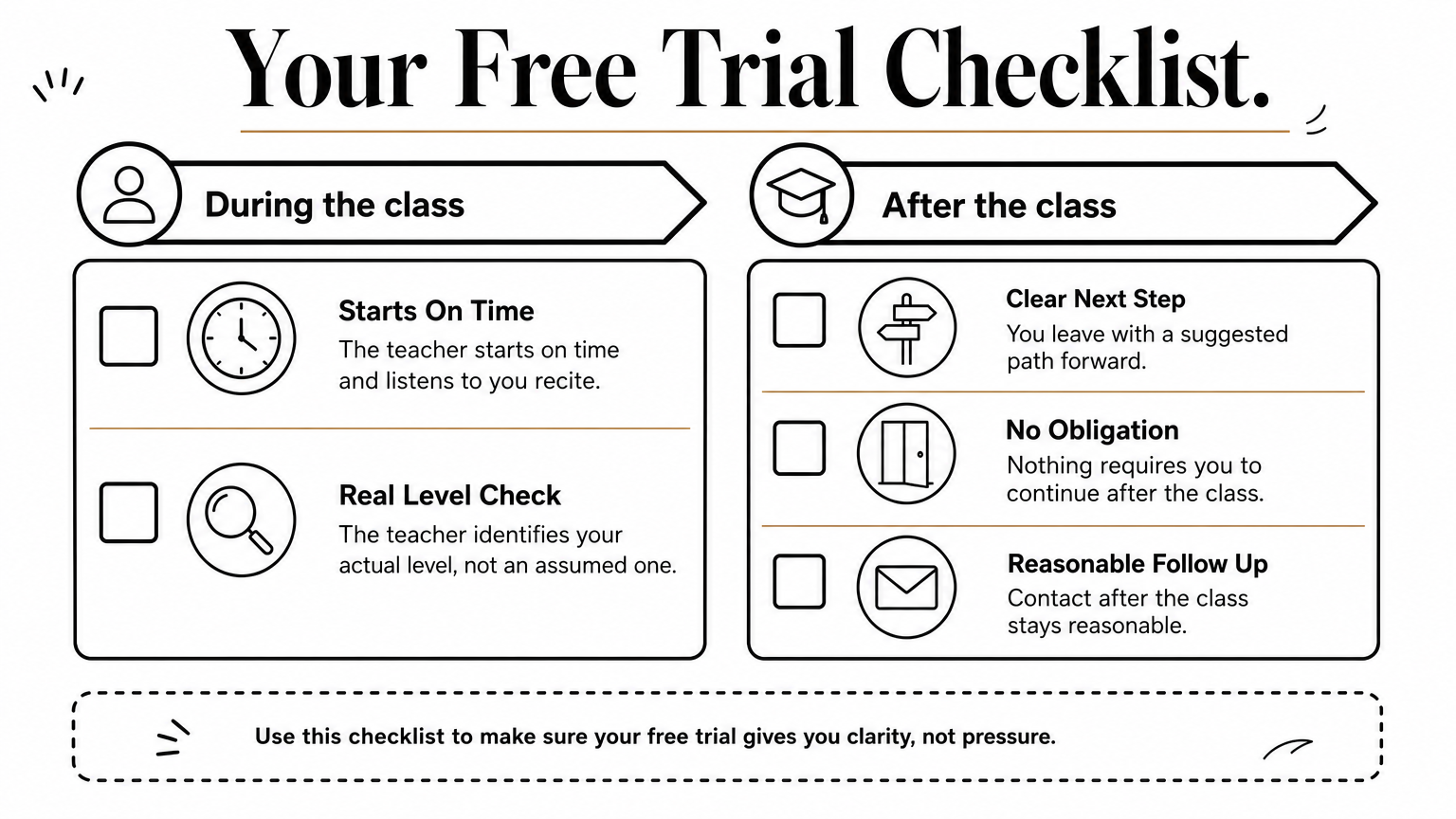
Use the trial as a test with a short checklist:
- Did the teacher start on time and listen to you recite?
- Did they identify your actual level, not assume one?
- Did you leave with a clear next step and a suggested path?
- Was there no obligation to continue?
- Did follow-up contact stay reasonable?
Quranytime Academy offers a free assessment class where a teacher evaluates your level and recommends a path in Quran reading, Tajweed, Arabic, Hifz, or Islamic education. You need no previous knowledge, and you are not obliged to continue. Whichever academy you pick, write down your impressions right after the class, while they are fresh.
5. Parent reviews of online Quran classes for kids
For children, the reviews that matter come from parents and describe engagement, patience, and visible progress. A curriculum looks the same on paper everywhere. What differs is how the teacher keeps a seven-year-old focused and how the academy keeps parents informed.
For a child, the best review is a parent saying the kid looks forward to class.
What reviews should show
Read parent reviews for concrete signals:
- The child asks to attend instead of avoiding class
- The teacher remembers the child’s learning style and weak spots
- Lessons fit around school and homework
- Progress is described in steps, such as Noorani Qaida, then reading, then Tajweed, then memorization
- Parents can sit in or supervise if they wish
Be wary of reviews that praise a "fun" class but never mention a skill gained. Fun without progress wastes a year.
How to check it yourself
Sit in on the first lesson and watch how the teacher handles mistakes. Ask how progress is reported and how often. Check whether the academy lets you request a teacher if the first match is not right. Parents can book a trial for a child at Quranytime Academy, where children’s classes are live and one-to-one. Teenagers and adults can request a trial for themselves. If you prefer a particular kind of teacher, ask before you book.
Choose by evidence, not by star ratings
Online Quran classes reviews help most when you read them for detail: named teachers, specific results, honest criticism, and sources the academy does not control. Then confirm the rest yourself. Verify the teacher’s training, insist on live one-to-one lessons, and test the academy in a free class. For a child, add the parent’s view of patience and progress.
You do not need to find a perfect academy. You need one that passes these five checks and treats your questions seriously. If you want to run the checks on us, book a free assessment class and see how a Quranytime teacher evaluates your level and recommends a path.