
You’ve heard the word Tajweed mentioned in Quran classes or khutbahs, but nobody actually sat down and explained what it means or why it matters. That gap trips up a lot of readers, whether you’re sounding out your first Arabic letters or you’ve been reciting for years without quite nailing the pronunciation. Quran and Tajweed go hand in hand: one is the revealed text, the other is the science that protects how it’s meant to sound.
So what is Tajweed, exactly? It’s the set of rules governing how each Arabic letter is pronounced, where it originates in the mouth or throat, and how it behaves next to other letters. Get these tajweed rules wrong and you can shift the meaning of a word entirely, which is why scholars treat correct recitation as an obligation, not a nice extra.
In this article, we’ll break down what Tajweed in the Quran actually covers, walk through the core rules step by step, and show you how they apply in real recitation. If you’re serious about learning properly, our teachers at Quranytime, many of them Al-Azhar graduates, teach these rules one-on-one so mistakes get corrected as they happen, not months later.
Why tajweed matters for every Quran reciter
Consider two Arabic words that look almost identical on paper but sound worlds apart when spoken aloud: قَلْب (qalb, meaning heart) and كَلْب (kalb, meaning dog). Swap the qaf for a kaf, a mistake tajweed rules are designed to catch early, and you’ve just called someone’s heart a dog inside a recitation meant to honor it. This is the real stakes behind quran and tajweed: it’s not about sounding pretty, it’s about preserving the exact meaning that was revealed, letter by letter.

Mispronunciation can change meaning entirely
Arabic is unusually sensitive to small sound shifts because many letters differ only by where they’re articulated in the mouth or throat. The letters ح (Ha) and ه (ha) sound similar to an untrained ear, but one comes from deep in the throat and the other from the throat’s opening, and they show up in entirely different words with entirely different meanings. Rules of tajweed in Quran recitation exist precisely to train your tongue, lips, and throat to hit these distinctions consistently, not occasionally.
| Letter pair | Example word | Meaning | Common mix-up |
|---|---|---|---|
| ق / ك | قَلْب (qalb) | heart | كَلْب (kalb) means dog |
| س / ص | سَالِح | corrective/sound | صَالِح (sālih) means righteous |
| ذ / ز | ذَٰلِكَ (dhālika) | that | زَٰلِكَ has no meaning, pure error |
| ع / أ | عَالَم (ʿālam) | world | أَلَم (alam) means pain |
The table above only scratches the surface, but it makes a point worth repeating: small sound differences carry real weight in Arabic. That holds true whether you’re reading silently for personal reflection or reciting aloud in prayer where others are listening and following along with you.
Get one letter’s pronunciation wrong in Quran recitation, and you risk turning the word God chose into a completely different word.
Correct recitation is a religious obligation, not a preference
Scholars across the major schools of Islamic jurisprudence agree that reciting with correct pronunciation is fard kifayah, a communal obligation meaning the community as a whole must include people who know it, while applying the rules correctly in your own recitation is considered obligatory for each individual reciter. This isn’t a modern add-on, and it’s why so many students ask whether reciting the Quran incorrectly is sinful. The Prophet Muhammad ﷺ recited in a distinct, measured style, and companions like Ubayy ibn Ka’b were specifically praised for their precision, passing that standard down through unbroken chains of transmission that Al-Azhar-trained teachers still follow today. When you commit to learning quran tajweed under a qualified teacher, you’re not picking up a stylistic preference, you’re stepping into a chain of transmission that stretches back fourteen centuries.
The practical payoff goes beyond obligation
Beyond the religious weight, there’s a practical side that a lot of students only discover after they start applying the rules seriously. Reciting with proper tajweed of Quran actually makes memorization easier, because the rhythmic patterns it creates, the elongations, the pauses, the nasal sounds, give your brain natural anchor points to latch onto. Students working through Hifz programs consistently report that verses stick faster once the tajweed patterns become automatic, rather than when they’re memorizing flat, unadorned text, which is one reason a sustainable memorization routine leans on correct recitation from the start.
Granted, there’s also the listening experience to think about, both your own and anyone praying behind you. A recitation delivered with correct tajweed carries a certain weight and beauty that flat, rushed reading simply doesn’t have, which is part of why reciters trained in tajweed are often asked to lead prayer even in large congregations. If you want that kind of grounded, confident recitation for yourself, working one-on-one with a teacher who catches your specific errors in real time, the way instructors do at Quranytime Academy, gets you there far faster than self-study ever will.
How to learn tajweed step by step
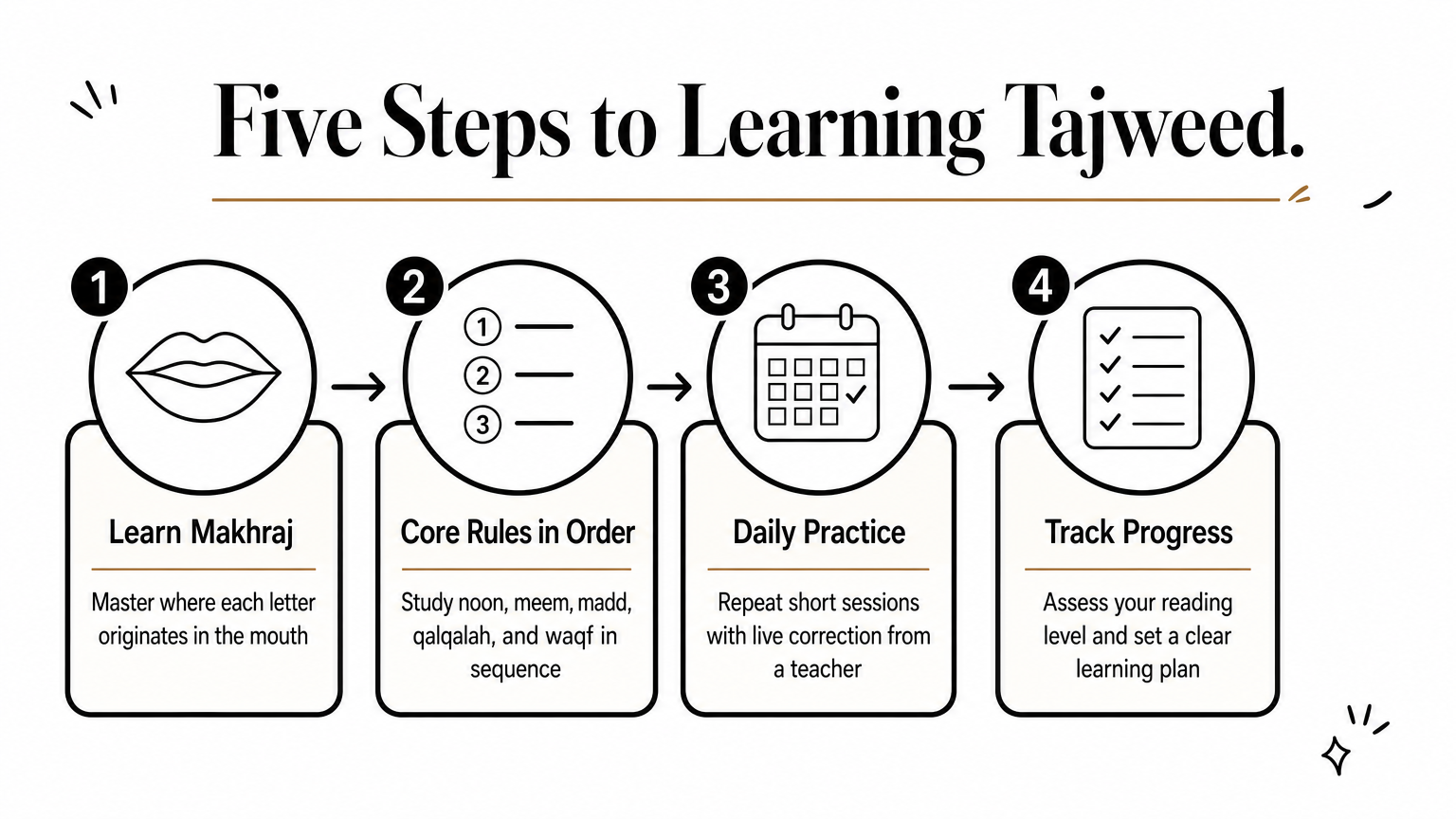
Learning quran reading tajweed isn’t something you absorb by watching a few videos and hoping it sticks, and a practical beginner path for Tajweed makes that clear quickly. It’s a skill built in layers, starting with individual letter sounds and building up to full verses recited with fluency and correct rhythm. Rushing this order is the single biggest reason self-taught students plateau early, mispronouncing letters for years without realizing it because nobody was there to correct them in the moment.
Start with makhraj, the articulation points
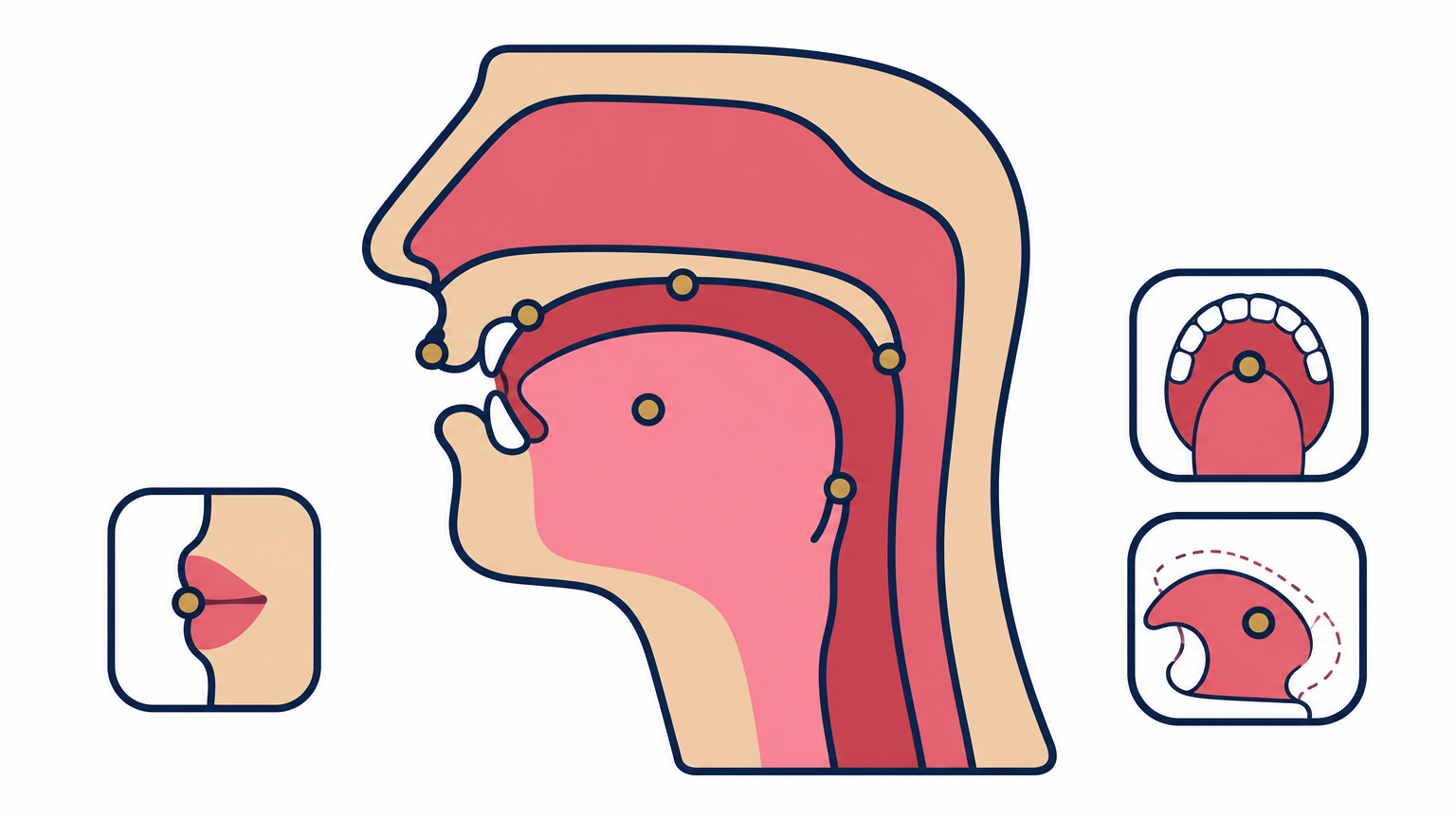
Before you touch a single rule about elongation or nasal sounds, you need to know where each of the Arabic letters and their forms physically originates, whether that’s the throat, the tongue against the teeth, or the lips. This is called makhraj, and it’s the foundation everything else in tajweed for Quran recitation rests on. Skip this step and every rule you learn afterward gets built on shaky ground, because you’ll be applying correct timing to an incorrect sound.
You can’t fix a rule you haven’t learned to hear yet, so train your ear before you train your tongue.
Move into the core rules in sequence
Once your letter pronunciation is solid, which is the usual sign that you’re ready to move from Qaida into recitation rules, work through them in the order most qualified teachers use, since each one builds on the last:
- Rules of noon sakinah and tanween (idghaam, ikhfa, iqlab, izhar)
- Rules of meem sakinah
- Madd, the elongation rules, starting with natural madd before tackling the longer, conditional forms
- Qalqalah, the bouncing sound on specific letters when they carry a sukoon
- Stopping and starting rules (waqf) so you know where a breath naturally belongs
Going in this order matters. Trying to master madd before you’ve internalized basic letter sounds just means you’re layering a new skill on top of an unstable one.
Practice daily with feedback, not just repetition
Repetition alone doesn’t fix bad habits, it cements them. What actually moves the needle is short, consistent daily practice paired with real-time correction from someone who catches the error the moment it happens. A teacher listening live can stop you mid-word and show you exactly where your tongue placement went wrong, something no app or recorded lesson can replicate. This is the exact structure our teachers use in one-on-one Quran Reading & Tajweed sessions at Quranytime, working through each rule with a student until it’s automatic, not just understood in theory.
Track your progress against a clear path
Without a structured path, it’s easy to feel like you’re practicing without actually improving, so it helps to assess your Quran reading level honestly before you go further. A free trial class is worth taking early on, since it lets a qualified teacher assess where your pronunciation currently stands and sketch out a first learning plan for adults showing which rules need the most attention before you move forward.
The main rules of tajweed you should know
Every qualified teacher organizes tajweed rules into a handful of core categories, and once you see them laid out, the whole system stops feeling like a random list of exceptions. Below is a practical rundown of the rules of tajweed you’ll spend most of your early lessons mastering, the same ones covered in our online Quran Tajweed course.
Noon sakinah and tanween: four behaviors, one letter
When a noon carries no vowel (sakinah) or appears as tanween at the end of a word, it changes behavior depending on the letter that follows it. This single rule accounts for a huge share of recitation mistakes, because students often apply the same sound everywhere instead of adjusting for context.
| Rule | What happens | Example letters that trigger it |
|---|---|---|
| Izhar | Noon is pronounced clearly, no change | ء ه ع ح غ خ |
| Idghaam | Noon merges into the next letter | ي ن م و ل ر |
| Iqlab | Noon converts to a meem sound | ب |
| Ikhfa | Noon is hidden, pronounced nasally | remaining 15 letters |
Master noon sakinah and tanween first, because nearly every other tajweed rule you learn afterward assumes you already hear this one correctly.
Meem sakinah and qalqalah
Meem sakinah follows a simpler pattern than noon, with three possible outcomes: idghaam shafawi when followed by another meem, ikhfa shafawi when followed by ba, and izhar shafawi for every other letter. Qalqalah, meanwhile, applies to five specific letters (ق ط ب ج د) whenever they carry a sukoon, producing a short bouncing echo rather than a flat stop. Skipping qalqalah is one of the more common gaps in self-taught recitation, since the letter looks silent on paper but isn’t meant to sound silent at all.
Madd: knowing how long to hold a vowel
Madd governs elongation, and it’s arguably where tajweed in Quran recitation gets its distinctive rhythm. Natural madd (madd asli) holds for two counts, while conditional forms, madd wajib, madd aarid, and madd lazim among them, stretch anywhere from four to six counts depending on what follows the elongated letter. Getting madd timing wrong doesn’t usually change a word’s meaning the way a mispronounced consonant does, but it does flatten the recitation and strip out the cadence that makes it recognizable.
Ghunnah and waqf round out the picture
Ghunnah, the nasal sound carried through certain letter combinations, works alongside noon and meem rules rather than standing alone, adding that characteristic humming quality you hear in trained reciters. Waqf rules tell you where you can pause, where you must pause, and where continuing without a breath actually preserves the meaning better than stopping would. Together these rules complete the toolkit every serious student needs before moving into applied practice.
Tajweed rules with examples for practice
Reading about tajweed rules only gets you so far. You need actual verses in front of you to see how each rule plays out in real recitation, not just in a chart. Below are a handful of examples pulled straight from the Quran that you can practice out loud right now, matching each one against the rule it demonstrates.
Idghaam and ikhfa in real ayahs
Open Surah Al-Fatiha and look at مِن رَّبِّهِمْ style constructions elsewhere in the Quran: whenever noon sakinah meets a raa, the noon disappears entirely and merges into the following letter, an idghaam example you can hear in مَن رَّبُّكُم (Surah An-Naba). Ikhfa shows up constantly too, such as in مِن دُونِ اللَّهِ, where the noon is neither fully pronounced nor fully dropped but held nasally for about two counts before sliding into the daal. Try reciting both phrases slowly, exaggerating the difference between a clean merge and a hidden nasal sound, until your ear can tell them apart without thinking.
If you can’t hear the difference between idghaam and ikhfa in your own recitation, you’re not ready to move past this rule yet.
Qalqalah you can practice on single words
Qalqalah is easiest to isolate because it only touches five letters, so pick out words ending in one of them with a sukoon and practice the bounce in isolation before attempting full verses.
يَقْطَعُونَ - qalqalah on the qaf (ق)
أَحَدْ - qalqalah on the daal at a stop (د)
الْفَلَقْ - qalqalah on the qaf at the end (ق)
Say each word twice, once with a flat stop and once with the bounce, so you can feel the physical difference in your throat and tongue. This contrast drill is one teachers use constantly in early tajweed for Quran lessons because it builds muscle memory fast.
Madd lengths side by side
Madd is where students most often guess instead of counting, so practicing verses with mixed madd lengths side by side helps fix that habit.
| Verse example | Madd type | Count |
|---|---|---|
| قَالُوا | Natural madd | 2 counts |
| جَاءَ | Madd wajib muttasil | 4-5 counts |
| الضَّالِّينَ | Madd lazim | 6 counts |
Recite each line while tapping your finger once per count, which forces consistency instead of relying on how the elongation "feels" that day. Practicing quran reading tajweed this way, with actual counted repetition rather than passive listening, is exactly the drill our teachers walk students through live, correcting timing the moment it slips.
Common tajweed mistakes and how to fix them
Even dedicated students fall into the same handful of traps, and working through a checklist of common Quran reading errors early saves years of unlearning bad habits later. Most mistakes in quran and tajweed recitation trace back to a small number of root causes: rushing, guessing at sounds instead of learning the correct articulation point, or practicing alone without anyone to catch the error in real time.
Flattening letters instead of articulating them
Beginners often collapse similar-sounding letters into one generic sound, treating ت and ط as interchangeable or softening ض into a plain د, one of the hardest Arabic sounds for English speakers to produce. This happens because the ear hasn’t been trained yet to notice the difference, not because the student isn’t trying. Recording yourself and comparing the playback against a qualified teacher’s pronunciation exposes this gap fast, far faster than reading a description of where the letter should originate.
A flattened letter feels like a small shortcut, but in Arabic it often changes the word into something else entirely.
Skipping ghunnah or rushing madd counts
Another frequent issue in rules for tajweed practice is treating elongation as optional or guessing the count instead of measuring it. Students under time pressure, especially those memorizing quickly for Hifz, tend to shave a beat off madd lazim or skip the nasal hum in ghunnah entirely because it’s easier to move fast than to hold the sound. Fixing this means slowing down deliberately and tapping out counts by hand until the timing becomes automatic rather than approximate.
Ignoring waqf and running sentences together
A less obvious but common mistake is pausing wherever breath runs out instead of where the text actually allows a pause. This can change meaning by joining a phrase to the wrong clause, or it can just make the recitation sound breathless and disjointed. Learning the waqf symbols properly, and practicing with a teacher who points out where a pause is required versus merely permitted, clears this up quickly.
| Mistake | Why it happens | Fix |
|---|---|---|
| Flattened letter sounds | Ear not yet trained to distinguish similar letters | Record and compare against a teacher’s recitation |
| Rushed or skipped madd | Prioritizing speed over accuracy | Count elongation aloud, tap per beat |
| Missing ghunnah | Nasal sound treated as optional | Isolate noon/meem words and exaggerate the hum |
| Incorrect waqf placement | Pausing for breath instead of meaning | Study waqf symbols with guided correction |
What ties every one of these fixes together is feedback that happens in the moment, not after the fact. This is exactly why self-taught tajweed quran rules study tends to stall: you can’t hear your own blind spots, and a recorded lesson can’t stop you mid-syllable the way a live teacher can. One-on-one correction, the kind built into every Quranytime lesson, is what actually closes these gaps instead of just naming them.
Tools and resources to practice tajweed
Good tools speed up learning, but they don’t replace a trained ear listening to yours. Before you invest time in any app or workbook, understand what each resource is actually good for, because mixing up the roles of these tools is where a lot of self-taught students waste months. Below is a rundown of what actually helps when you’re learning quran tajweed, and what only feels like progress.
What a tajweed quran actually is
A lot of students ask what is a tajweed quran and expect some special edition with extra text. It’s simpler than that: it’s a standard mushaf printed with color-coded letters marking madd, ghunnah, qalqalah, and the noon/meem rules, so you can see which rule applies before you even open a textbook. These editions are genuinely useful for beginners because they turn an abstract rule into something visual you can match against the sound you’re producing. The catch is that colors only tell you the rule exists, not whether you’re executing it correctly, which is a gap no printed page can close on its own.
Apps and recordings have a ceiling
Recitation apps and recorded lessons are fine for exposure, hearing how a fluent reciter handles madd or ikhfa gives your ear a reference point worth having. But they can’t stop you mid-word, and they can’t tell you that your qaf sounds like a kaf. Treat them as supplementary listening, not your primary method for learning tajweed quran, because passive listening builds recognition, not correction.
A color-coded mushaf shows you where the rule is, but only a live teacher can tell you whether you actually got it right.
Building a practice routine that sticks
The most effective students combine a handful of resources into a simple home practice routine between lessons rather than relying on one:
- A color-coded tajweed mushaf for visual reference during reading
- A recording of yourself reciting, compared weekly against a teacher’s correction
- Short daily practice sessions, 15-20 minutes, rather than long infrequent ones
- A structured course that sequences the rules instead of jumping around
- Live, one-on-one correction from a qualified teacher
That last point is the one students underestimate most. Tools sharpen awareness, but only a teacher listening in real time catches the specific error you keep making without realizing it. Our Quran Reading & Tajweed course at Quranytime pairs students with Al-Azhar-trained teachers who use exactly this combination, structured lessons backed by live correction, so the tools you’re using at home actually translate into better recitation instead of just more familiarity with the rules on paper.
Continuing your tajweed journey
Getting quran and tajweed right isn’t a weekend project. It’s a skill you build letter by letter, rule by rule, with someone catching your mistakes before they turn into habits. You now know why mispronunciation matters, how the core rules fit together, and where self-study alone tends to stall out.
What separates students who actually improve from those who stay stuck is feedback in the moment, not another app or another chart. A teacher who hears your qaf slip toward a kaf, right as it happens, saves you months of unlearning later.
If you’re ready to stop guessing and start correcting, book a free Quran and Arabic trial class with Quranytime Academy and let an Al-Azhar-trained teacher map out exactly where your recitation stands and what to work on next.