
The best Quran with tajweed PDF is the one whose line layout and script match the mushaf you already use, with a readable color key and text that stays sharp when you zoom. Pick a 13-line Indo-Pak file if you learned on South Asian mushafs. Pick a 15-line Uthmani file if you want the Madinah page standard. Choose a 16-line file for compact pages, a version with translation if you do not read Arabic yet, and a color-coded Quran paired with a rules guide if you are starting tajweed from zero.
Searching for these files gives you dozens of results that look identical. Some are blurry scans, some use colors with no key, and some change the page breaks, so your teacher says "open page 40" and your screen shows something else. Choosing the wrong file costs you weeks of confusing practice.
This article does not host files. It compares five formats so you know what to look for before you open any PDF. At Quranytime Academy, our teachers have guided students through Tajweed one-to-one for over 10 years, and the advice below comes from what helps learners recite correctly.
1. 13-line Indo-Pak script with color-coded tajweed
The 13-line Indo-Pak mushaf is the classic South Asian layout, and in its color-coded form each tajweed rule gets its own color. It is the most common answer when people search for a color coded tajweed Quran PDF in Indo-Pak fonts.

What it is
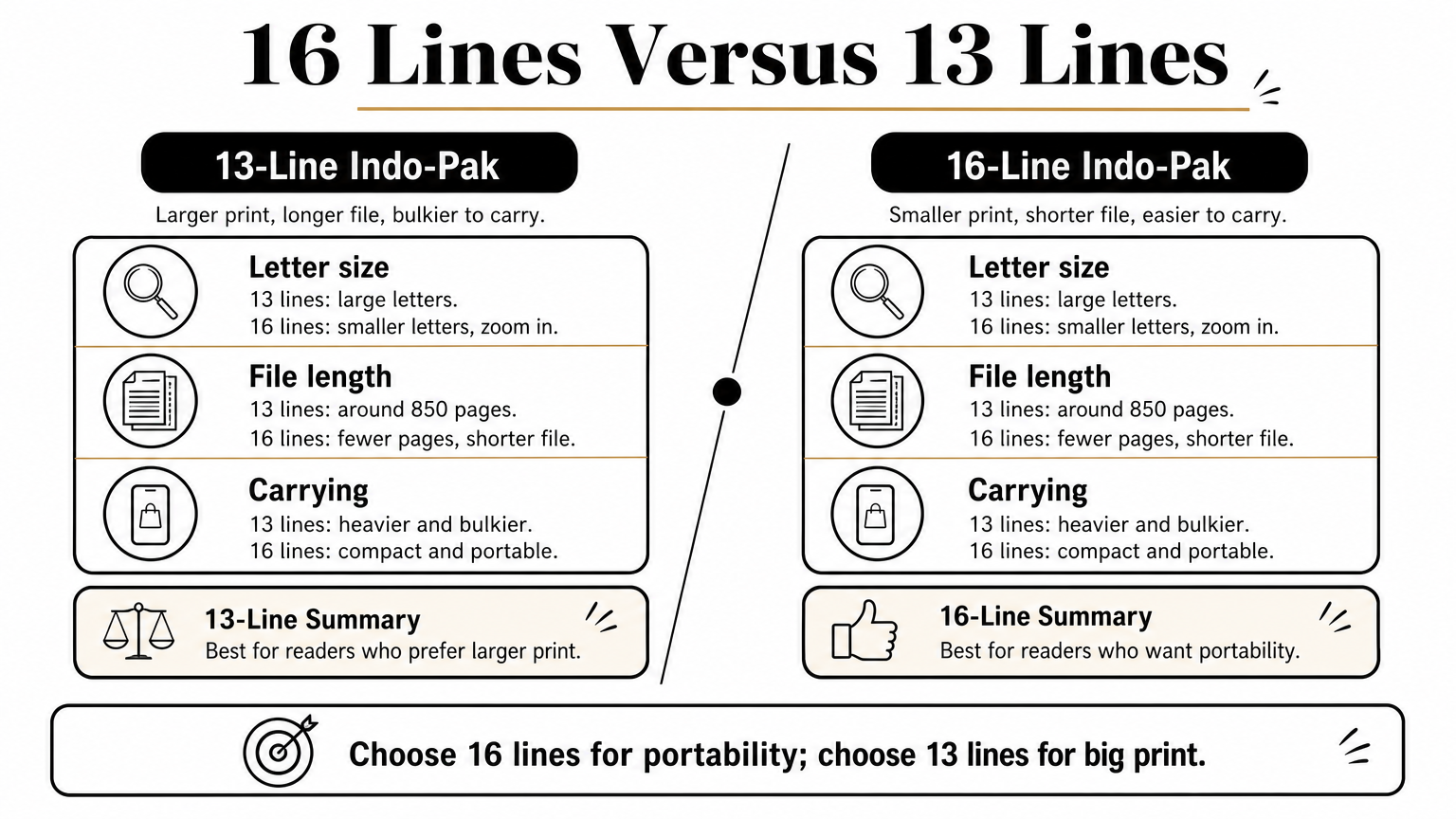
This layout has 13 lines per page in the Indo-Pak script, with large, rounded letters. Because the text is big, the file often runs to around 850 pages. Each page holds less text, so each screen feels light, and the colors are easy to see even on a phone.
The 13-line Indo-Pak file is the easiest to read on a small screen, but it is also the longest.
Who it suits
This format fits readers who already know the Indo-Pak script. It also helps beginners who want big letters and few lines per page.
- Learners who studied Qaida and Quran in a South Asian tradition
- Children and adult beginners who tire on dense pages
- Students whose teacher uses a printed 13-line mushaf
What to check before you use it
Match the page numbers to your printed copy if your teacher uses one. Zoom to 200% and confirm the colors do not bleed into the letters. Also stay with one script while learning, because waqf marks and vowel signs differ slightly from the Madinah style.
2. 15-line Uthmani script with color-coded tajweed
The 15-line Uthmani file follows the Madinah mushaf standard and is the safest choice if you want a layout most teachers and apps share. It is also what many people mean when they search for a Quran with tajweed rules in Arabic.
What it is
It has 15 lines on each of 604 pages in the Uthmani script, and the recitation is Hafs from Asim. In the Madinah layout, every page ends at the end of a verse, so you never start a page mid-verse. In a color-coded edition, the rules sit directly on the letters.
A 15-line, 604-page file gives you the most widely shared page numbering.
Who it suits
This is the right pick if you want to follow the same pages as most recitation apps and printed copies.
- Learners who want consistent page numbers across books and apps
- Readers moving from Indo-Pak to the Uthmani style
- Students preparing for recitation with Arabic-speaking teachers
What to check before you use it
Confirm the file states Hafs as its riwaya. Look for a printed color key on the first pages, because publishers choose colors differently. Check that the text is real, searchable text or a high-resolution scan, since low-resolution scans blur small marks like the sukoon.
3. 16-line color-coded Quran PDF
A 16-line color-coded Quran fits more text on each page, so the file is shorter and easier to carry. It usually uses the Indo-Pak script, and it is the middle ground between the big 13-line pages and the dense 15-line Uthmani pages.
What it is
Sixteen lines per page means fewer pages than the 13-line edition, and each page has smaller letters. Printers in South Asia have long produced this layout. In a color-coded version the tajweed colors must stay visible even with the tighter line spacing.
Choose 16 lines when you want portability and are comfortable zooming in.
Who it suits
This format works for readers who already recite fluently and now want to catch their mistakes.
- Intermediate readers refining recitation
- Students who read on tablets or laptops with larger screens
- Learners who want a shorter file for study and revision
What to check before you use it
Open a page full of madd and ghunnah rules and see whether the colors overlap with the diacritics. Verify that the page breaks match your teacher’s mushaf, which matters if you are memorizing by page. Test it on your phone first, since the smaller print can make colors harder to tell apart.
4. Color-coded tajweed Quran with translation
A color-coded Quran with translation gives you the tajweed colors plus the meaning, so you understand what you are reciting. Editions with English or Urdu translation and with transliteration are the ones that appear most often in searches.
What it is
The Arabic text carries the tajweed colors, and the translation sits under each verse or on the facing side. Some files add transliteration, which writes the Arabic sounds in English letters, and some color the transliteration to show tajweed too.
Translation helps you understand the Quran, and transliteration should only be a bridge to the Arabic letters.
Who it suits
This is the best pick for readers in the United States who are new to Arabic, including new Muslims and heritage learners.
- Adults who want to read and understand at the same time
- Families reading together with children
- Beginners who still need support with Arabic letters
What to check before you use it
Choose a reputable translator and avoid files that do not name one. Do not let transliteration replace learning the Arabic script, because it cannot show every sound accurately. Also expect a larger file, so check that it opens smoothly on your device.
5. Color-coded Quran plus a tajweed rules guide
A color-coded Quran works best when you pair it with a rules guide that explains what each color means. The guide is usually a separate PDF book that moves from simple rules to advanced ones.

What it is
The Quran file shows the rule on the page, and the guide explains how to apply it. Publishers choose their own colors, so there is no universal standard, but the table below shows what many editions use. Always trust the key in your own file over any general chart.
| Rule | What it marks | Common color |
|---|---|---|
| Ghunnah | Nasal sound held for about 2 counts | Green |
| Qalqalah | Echoing bounce on certain letters | Blue |
| Madd | Elongation of 2, 4 to 5, or 6 counts | Shades of red or orange |
| Silent letters | Written but not pronounced | Grey |
| Ikhfa and idgham | Merging or hiding the noon or tanween sound | Varies by publisher |
A color only tells you that a rule exists; the guide and a teacher tell you how long and how strong to make it.
Who it suits
This pairing suits anyone learning tajweed from the beginning, and it works best with feedback from a person.
- Adult beginners who want a clear order of rules
- Parents helping a child practice at home
- Learners whose recitation needs correction, not just information
What to check before you use it
Pick a guide that teaches rules in order, with examples from the Quran. Make sure its color names match your Quran file. A PDF cannot hear you, so book live correction with a teacher when you can, since mistakes you cannot hear stay with you.
Start with one file and a teacher
Match the file to your habits: 13-line Indo-Pak for big South Asian text, 15-line Uthmani for the Madinah standard, 16-line for compact pages, translation for understanding, and a rules guide for learning the colors. Whichever you pick, check the color key and page numbering before you commit.
A PDF shows you the rule, but only a teacher can tell you whether you are saying it correctly. If you want that feedback, book a free trial assessment class at Quranytime Academy and a teacher will listen to your reading and suggest a path.