


You’re reciting Quran and you hit a word with a small squiggly line over it, or two letters that seem to demand you stretch your voice, and you’re not sure for how many counts. That hesitation breaks your flow and, worse, can change the meaning of what you’re reciting. Searching rules of madd in tajweed pdf usually means you want something you can save, print, and keep beside your mushaf while you practice.
This article answers that search directly. You’ll get a clear breakdown of every madd type, from the natural two-count stretch to the longer six-count rules, with real examples pulled from actual ayahs so you can hear and see the difference. We also include a madd tajweed rules chart you can reference at a glance, plus notes for readers searching for the rules of madd in tajweed pdf in urdu, since many students prefer explanations in their own language before applying them to Arabic text.
Whether you’re memorizing Quran, brushing up your Tajweed after years away from it, or just starting to read with confidence, this guide gives you a structured path instead of scattered rules. If you’d rather have a teacher walk through these examples with you live, Quranytime’s live one-on-one Tajweed lessons cover exactly this.
Why Madd rules matter for accurate Quran recitation
Madd, meaning elongation, is one of the first beginner Tajweed rules every student learns because it’s also one of the easiest to get wrong. The word itself comes from an Arabic root meaning "to stretch" or "to extend," and in Quranic recitation it refers to holding a vowel sound for a set number of counts instead of pronouncing it quickly. Skip a required stretch, or add one where it doesn’t belong, and you’re no longer reciting the ayah the way it was revealed, which raises the question of whether a mispronounced recitation carries sin. That’s the core reason accurate recitation depends so heavily on getting madd right, and why so many students keep a rules of madd in tajweed pdf on hand while they drill.
Meaning and grammatical precision
Arabic is a language where vowel length and pronunciation carry grammatical weight, not just style. Shortening a long vowel can shift a word’s tense, number, or even its part of speech in ordinary Arabic speech, and while the Quran’s text is fixed and protected, mispronouncing madd still distorts how the recitation sounds and how a listener perceives it. A teacher trained in Tajweed will immediately notice when a two-count stretch gets rushed into one, because it changes the rhythm the ayah was designed to carry. This is exactly why what Tajweed means for accurate recitation treats madd as a rule, not a suggestion.
Madd isn’t decoration in Quran recitation, it’s structural, and getting the count wrong changes how the ayah is meant to be heard.
Fluency and confidence while reciting
Beyond precision, madd rules give your recitation a natural rhythm. Once you internalize how long to hold each stretch, you stop hesitating mid-ayah and start reciting with the flow that Tajweed is meant to produce. Reciters who skip this step often sound choppy, pausing awkwardly because they’re unsure whether a letter needs two counts or six. Practicing madd consistently removes that guesswork entirely, and it’s often the single biggest jump in confidence new students report after a few weeks of focused practice.
Respecting how the Quran was transmitted
Finally, madd rules aren’t a modern invention layered onto the text. They come from the chain of recitation passed down from the Prophet Muhammad ﷺ through generations of qualified reciters, each verifying pronunciation against their own teachers. Following these rules connects your recitation to that same chain rather than to guesswork or personal habit. Quranytime’s Quran Reading & Tajweed course walks students through this transmission-based approach with a live teacher correcting counts in real time, which is far more reliable than self-checking against a static PDF alone.
The types of Madd in Tajweed explained with examples

Every stretch in Quranic recitation falls into one of two broad categories: Madd Asli (the natural, original madd) and Madd Far’i (secondary madd caused by a hamzah or sukoon following the stretch letter). Madd Asli is the baseline two-count elongation that happens whenever one of the three madd letters, alif, waw, or yaa, follows a matching vowel with no extra letter after it. Everything else builds on top of this baseline, which is why students memorize Asli first before tackling the more complex secondary rules.
Learn the two-count natural madd first, because every other rule in Tajweed is just a variation built on top of it.
Madd Asli: the natural two-count stretch
You’ll find Madd Asli constantly in the Quran, since it occurs in ordinary words with no special trigger. Take the word "qaala" (قَالَ), where the alif after the fatha gets held for exactly two counts, no more, no less. This same pattern appears in "yaqoolu" (يَقُولُ) with waw, and in "feehi" (فِيهِ) with yaa. Recognizing Madd Asli quickly builds the rhythm you’ll rely on for the rest of your recitation.
Madd Far’i: the secondary types
Once a hamzah or sukoon follows the madd letter, the rule changes and the stretch extends beyond two counts. Six main subtypes exist, each triggered by a specific letter combination:
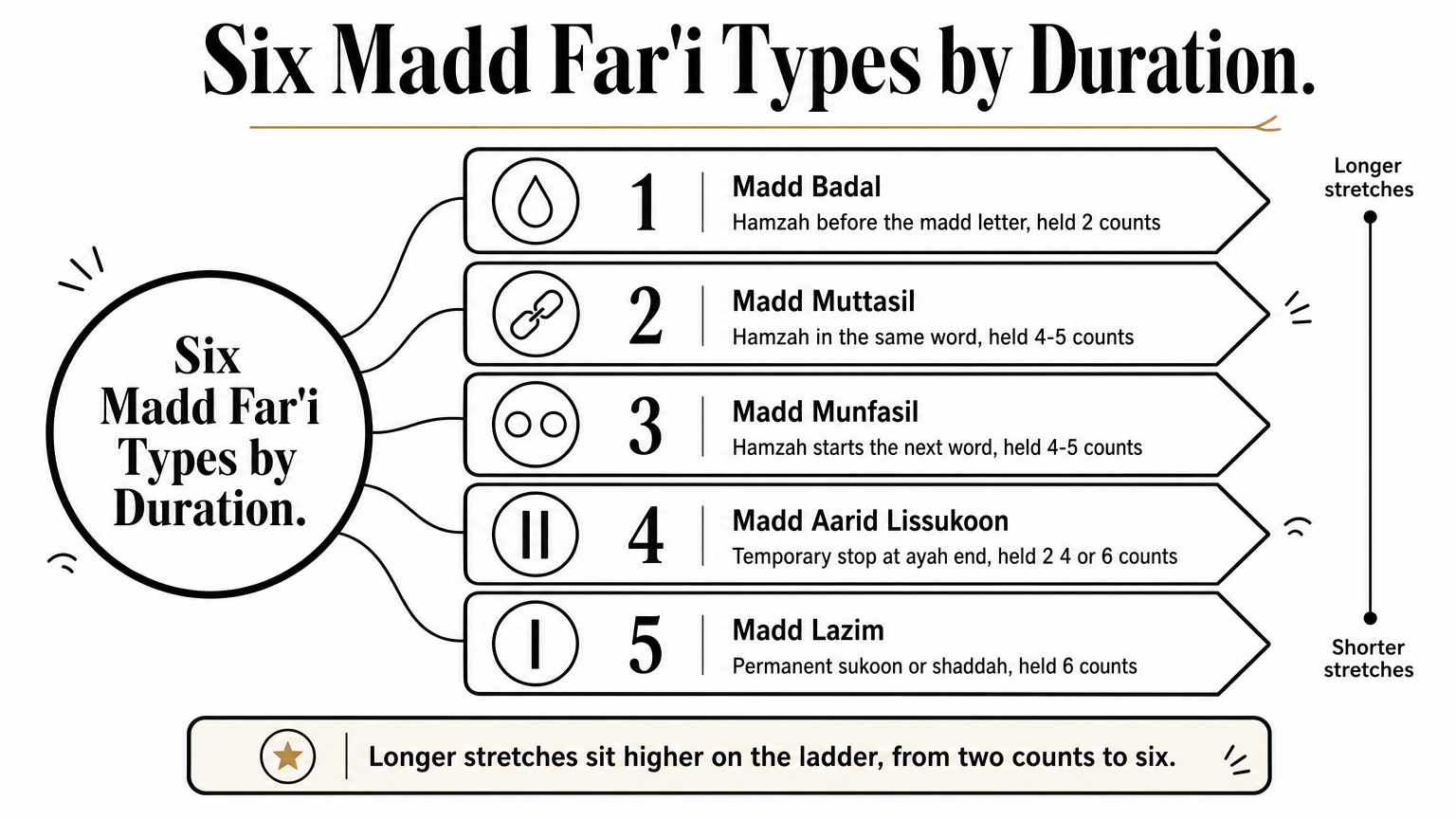

| Type | Trigger | Duration | Example |
|---|---|---|---|
| Madd Muttasil | Hamzah in the same word | 4-5 counts | جَاءَ |
| Madd Munfasil | Hamzah in the next word | 4-5 counts | يَا أَيُّهَا |
| Madd Lazim | Permanent sukoon or shaddah | 6 counts | الضَّالِّينَ |
| Madd Aarid Lissukoon | Temporary stop at end of ayah | 2, 4, or 6 counts | نَسْتَعِينُ |
| Madd Badal | Hamzah before the madd letter | 2 counts | آمَنُوا |
| Madd Leen | Waw or yaa before sukoon at a stop | 2, 4, or 6 counts | خَوْف |
Recognizing these six types by sight is what separates fluent reciters from those still counting on their fingers mid-ayah.
How to apply Madd rules correctly when reciting
Knowing the six types on paper is one thing, applying them while your eyes move across the mushaf is another skill entirely. Most students who download a rules of madd in tajweed pdf and study it alone hit the same wall: they understand the rule but can’t execute it at speed. The fix isn’t more reading, it’s structured practice that trains your mouth and ears together.
Count with your fingers first
Start slow. Before you recite a passage, scan it for madd letters and mark the count above each one, two counts for Asli, four to six for the Far’i types. Then recite while tapping a finger for each count, out loud, until the timing becomes automatic. This feels mechanical at first, but it’s exactly how qualified teachers train beginners before letting them recite at natural speed, and it fits neatly into a short daily Tajweed practice routine at home.

Count out loud with your fingers until the stretch becomes instinct, not a calculation you make mid-ayah.
Listen before you recite
Always listen to one of the great Quran reciters perform the passage before attempting it yourself. Your ear catches subtleties, like how Madd Aarid Lissukoon shortens or lengthens depending on where the reciter chooses to stop, that no written rule fully captures. Pair listening with immediate repetition, saying the same phrase right after you hear it, rather than listening passively across an entire surah.
Get live correction, not just self-checking
A PDF or chart can’t hear you. It can’t tell you that your four-count Muttasil actually landed at three, or that you rushed a Lazim madd under pressure to keep pace. That’s the gap a live teacher fills, catching timing errors in real time before they become habits. Quranytime’s Quran Reading & Tajweed course pairs you with an Al-Azhar-trained instructor who corrects your counts ayah by ayah, something no static reference document can replicate.
Madd rules chart: durations and counts at a glance
A single reference table saves you from flipping between definitions every time you hit an unfamiliar letter combination. Below is the complete madd tajweed rules chart most students print and keep beside their mushaf, covering every type discussed above along with the exact count each one demands. Keeping this table handy is often more useful than a full rules of madd in tajweed pdf, since you can scan it in seconds mid-recitation instead of searching through paragraphs of explanation.
| Madd Type | Category | Trigger Letter/Condition | Count (Harakat) | Notes |
|---|---|---|---|---|
| Madd Asli | Natural | Alif, waw, or yaa with no hamzah/sukoon after | 2 | Baseline stretch, always applies |
| Madd Muttasil | Secondary | Hamzah in the same word after the madd letter | 4-5 | Obligatory, never shortened |
| Madd Munfasil | Secondary | Hamzah starts the next word | 4-5 | Some qira’at allow 2 counts |
| Madd Lazim | Secondary | Permanent sukoon or shaddah after the madd letter | 6 | Longest and most fixed duration |
| Madd Aarid Lissukoon | Secondary | Temporary sukoon from stopping at ayah end | 2, 4, or 6 | Reciter chooses, but must stay consistent |
| Madd Badal | Secondary | Hamzah comes before the madd letter | 2 | Easy to confuse with Asli |
| Madd Leen | Secondary | Waw or yaa with sukoon, before a stop | 2, 4, or 6 | Only applies when pausing |
Counting consistently across a full session matters more than which exact number you pick for the flexible types. Switching between two and six counts on the same Aarid Lissukoon word within one recitation sounds jarring even if both numbers are technically valid.
Pick a count for the flexible madd types and stay consistent within a single recitation, since switching mid-surah sounds worse than choosing the shorter option every time.
Downloading this chart is a fine starting point, but treat it as a memory aid, and pair it with 42 interactive Tajweed lessons with listening exercises rather than relying on it instead of hearing the sounds performed correctly by someone qualified to correct you.
Common mistakes reciters make with Madd
Even students who’ve memorized every rule in a rules of madd in tajweed pdf still trip over the same handful of errors once they’re reciting live. Recognizing these patterns in your own recitation, ideally against a checklist of common Tajweed reading problems, is often faster progress than re-reading definitions.
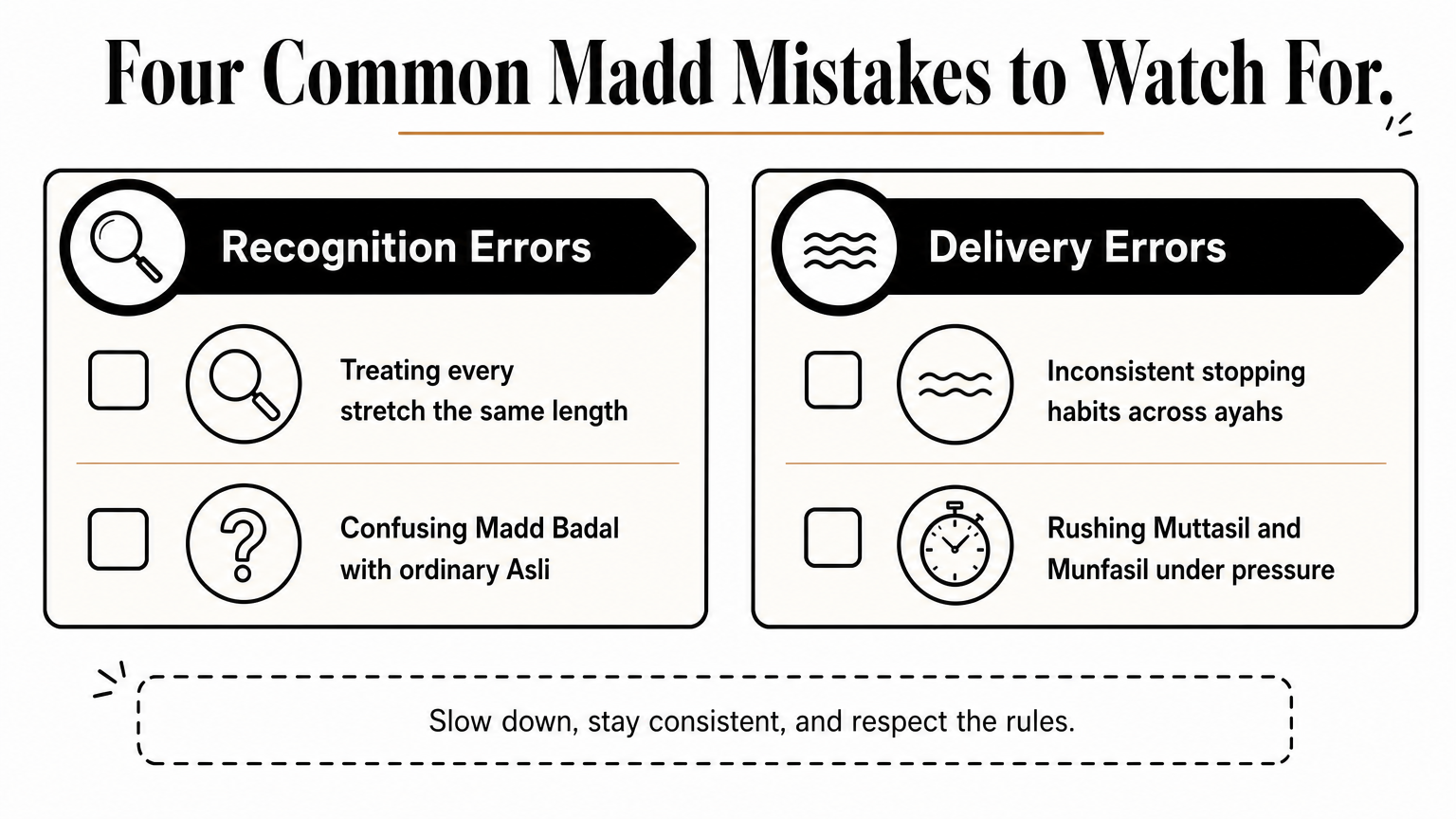
Treating every stretch the same length
Beginners frequently apply one default count, usually two, to everything, flattening a Madd Lazim down to the same length as a Madd Asli. This happens because counting under pressure is hard, and the brain defaults to the simplest option. The fix is slow, deliberate drilling on Lazim words specifically, since six counts feels unnatural until you’ve repeated it dozens of times.
Confusing Madd Badal with ordinary Asli
Because both last two counts, students often stop noticing the hamzah-before-madd-letter pattern that defines Madd Badal, treating words like آمَنُوا as if they were plain Asli. The count ends up correct by accident, but the reciter hasn’t actually recognized the rule, which becomes a problem the moment a less common Badal word appears mid-surah.
Inconsistent stopping habits
Madd Aarid Lissukoon and Madd Leen both allow flexible counts, and that flexibility tempts reciters into changing their choice from ayah to ayah without noticing. One stop lasts two counts, the next lasts six, purely by habit rather than intention.
The most common Madd mistake isn’t picking the wrong count, it’s picking inconsistently across a single recitation.
Rushing Muttasil and Munfasil under pressure
When reciting quickly, especially in group settings or during Taraweeh, reciters shorten Madd Muttasil and Madd Munfasil well below their required four counts just to keep pace with everyone else. This is the mistake a live teacher catches fastest, since a chart alone can’t hear the shortfall happening in real time. Quranytime’s Quran Reading & Tajweed course exists specifically to correct habits like this before they calcify.
Putting Madd rules into practice
Mastering the rules of madd in tajweed pdf you’ve just worked through comes down to repetition, not memorization alone. You now know the two broad categories, the six Far’i subtypes, and the counts each one demands, so the next step is applying them out loud, daily, until the timing stops feeling like arithmetic and starts feeling instinctive. Keep the chart nearby, but don’t mistake it for a substitute for a trained ear correcting your mistakes in real time.
Quranytime built its Tajweed program around exactly this gap between reading a rule and reciting it correctly. Nothing replaces a qualified teacher hearing your Muttasil, Lazim, and Leen counts and telling you, ayah by ayah, where you’re rushing or flattening a stretch. If you’re ready to move past the PDF stage, book a free trial lesson with a Tajweed teacher and get matched with an instructor who can start correcting your madd today.