

Tajweed idgham rules tell you how to merge a noon sakinah (نْ) or tanween into the first letter of the next word. Idgham means "merging" in Arabic. When a noon sakinah or tanween ends one word and one of the six letters ي ر م ل و ن begins the next, the noon sound disappears into that letter, and you pronounce the letter with a shaddah. Four of the letters (ي ن م و) add a nasal sound called ghunnah. The other two (ل ر) do not.
This guide covers why the rule matters, a step-by-step method to apply it, the six letters and the two types, and Quranic examples with references. It also covers related forms of idgham, the cases where idgham does not apply, and the mistakes students make most often.
Quranytime Academy teaches tajweed in live, one-to-one lessons with Al-Azhar graduates who hold Ijazah. This article gives you the rule in the same order a teacher would, so you can use it as a reference between lessons.
Why idgham matters when you recite the Quran
Idgham matters because it is one of the four treatments of noon sakinah and tanween, and skipping it breaks the connected flow of recitation. The Quran is read with the sounds joined, and idgham is where that joining is most audible.
What idgham does to your recitation
Noon sakinah and tanween can be treated four ways: izhar (pronounced clearly), idgham (merged), iqlab (turned into a meem), and ikhfa (concealed). The letter that follows decides which one applies. Idgham is the treatment that removes the noon sound and fuses two words into one stressed sound.
What goes wrong without it
If you pronounce the noon clearly in مَن يَقُولُ, you split a sound the Quran joins. This is a subtle recitation error, not a change of words, but it is exactly the kind of detail tajweed exists to correct. The opposite mistake also happens, such as adding a nasal sound where none belongs.
Noon sakinah and tanween occur constantly, so the idgham rules in tajweed come up again and again in every juz. Learn them once and they pay off in every surah you read.
Idgham dissolves the noon into the letter that follows, so two words are read as one connected sound.
How to apply idgham rules step by step
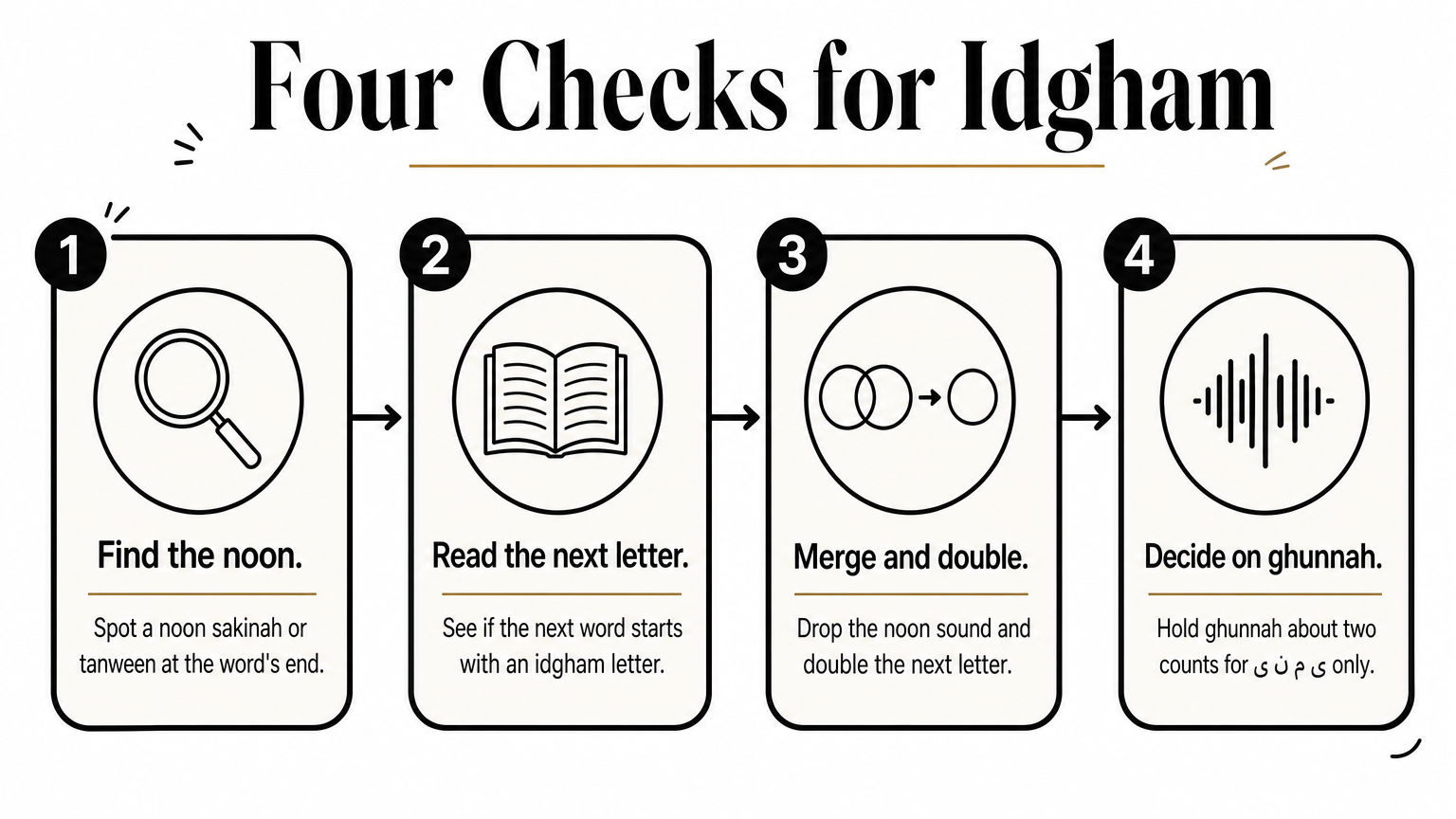
You apply idgham with four checks: find the noon sound, read the next word’s first letter, merge, then decide on ghunnah. Run them in this order every time you meet a noon sakinah or tanween.
A four-step check
- Find a noon sakinah or tanween at the end of a word.
- Check that the next word begins with ي, ر, م, ل, و or ن.
- Drop the noon sound and double the next letter, as the shaddah shows.
- Add ghunnah of about two counts if the letter is ي, ن, م or و. Add none for ل or ر.
Here is the method on two real phrases. In مِن رَّبِّهِمْ (2:5), the noon of min meets ra, so it merges with no ghunnah and you read mir-rabbihim. In مَن يَقُولُ (2:8), the noon meets ya, so it merges with ghunnah and you read may-yaqulu. In most printed mushafs, the idgham letter carries a shaddah and the noon carries no sukoon, which gives you a visual cue.
When idgham does not apply
Idgham applies only when the noon sakinah or tanween and the merging letter are in two separate words. When both sit inside one word, you pronounce the noon clearly. The Quran has four such words: دُنْيَا (dunya), صِنْوَانٌ (sinwan, 13:4), قِنْوَانٌ (qinwan, 6:99), and بُنْيَانٌ (bunyan, 61:4).
Idgham also needs continuous reading. If you stop on the first word, there is nothing to merge, and the rules of stopping take over.
If the noon and the next letter share a word, read the noon clearly. Idgham needs two words.
The six idgham letters and the two types
The idgham letters are ي ر م ل و ن, memorized as the word yarmaloon (يرملون). They split into two types, depending on whether the merge carries a nasal sound.
| Type | Letters | Ghunnah | Memory word |
|---|---|---|---|
| Idgham with ghunnah | ي ن م و | Yes, about two counts | yanmu (ينمو) |
| Idgham without ghunnah | ل ر | No | Lam and ra |
Idgham with ghunnah: ya, noon, meem, waw
With these four letters, you merge the noon and hold the nasal sound for about two counts while the letter is doubled. With noon and meem, the merge is complete, and the doubled letter itself carries the ghunnah. With ya and waw, scholars call it incomplete idgham, because the nasal trait of the noon stays in the sound and flows through the letter.
Idgham without ghunnah: lam and ra
With lam and ra, the noon vanishes completely and you add no nasal sound. You simply double the lam or ra. Many students add ghunnah out of habit, so keep the sound clean and check it against a teacher or a trusted reciter. Tanween follows exactly the same rule as noon sakinah.
Ya, noon, meem, and waw keep the nasal sound. Lam and ra never do.
Idgham examples from the Quran
These examples cover each letter, and two tanween examples show the rule works the same way across words. Read each one aloud while following the transliteration.

Examples with ghunnah
Each phrase below has a noon sakinah or tanween merging into ya, noon, meem, or waw. Hold the nasal sound for two counts in each.
| Letter | Example | Reference | Sounds like |
|---|---|---|---|
| ي | مَن يَقُولُ | 2:8 | may-yaqulu |
| ن | مِن نَّارٍ | 7:12 | min-nar |
| م | مِن مَّاءٍ | 86:6 | mim-ma’in |
| و | مِن وَالٍ | 13:11 | miw-walin |
| ن (tanween) | يَوْمَئِذٍ نَّاعِمَةٌ | 88:8 | yawma’idhin-na’imah |
Examples without ghunnah
Lam and ra give the answer to the question of idgham without ghunnah. The merge is complete and purely oral, with no nasal sound at all.
| Letter | Example | Reference | Sounds like |
|---|---|---|---|
| ل | هُدًى لِّلْمُتَّقِينَ | 2:2 | hudal-lil-muttaqin |
| ر | مِن رَّبِّهِمْ | 2:5 | mir-rabbihim |
| ر (tanween) | رَءُوفٌ رَّحِيمٌ | 2:143 | ra’ufur-rahim |
Practice each phrase until the noon is gone and only the doubled letter remains.
Related forms of idgham and common mistakes
Tajweed uses the word idgham for other merges too, and mixing them up with the noon rule is common. After that, a short list of mistakes shows what to correct first.
Four other forms of idgham
These forms follow different conditions from the noon sakinah rule, but they share the same idea of one letter merging into another.
| Form | What merges | Example | Reference |
|---|---|---|---|
| Idgham shafawi | Meem sakinah into meem, with ghunnah | لَهُم مَّا يَشَاءُونَ | 39:34 |
| Mutamathilayn | Two identical letters | اضْرِب بِّعَصَاكَ | 2:60 |
| Mutajanisayn | Same articulation point, different traits | قَد تَّبَيَّنَ | 2:256 |
| Mutaqaribayn | Close articulation points | وَقُل رَّبِّ | 17:24 |
Mistakes to avoid
Most errors come from a short list. Check yourself against it when you record your recitation.
- Pronouncing the noon clearly before one of the six letters.
- Adding ghunnah to lam or ra.
- Cutting ghunnah short on ya, noon, meem, or waw.
- Merging inside a single word such as dunya.
- Applying idgham when you stop between the two words.
Record yourself reading a page, mark every noon sakinah and tanween, and listen for the merge. A teacher can then confirm what your own ear misses.
Most idgham errors are the same five mistakes, so check for them every time you review your recitation.
Practice idgham with a teacher
Idgham comes down to one rule. When a noon sakinah or tanween meets ي ر م ل و ن in the next word, the noon merges into that letter. Ya, noon, meem, and waw carry ghunnah, lam and ra do not, and words like dunya stay unmerged because the noon and letter share a word.
Reading about the rule gets you started. Hearing your own recitation corrected is what makes it automatic. If you want a teacher to check your idgham and the rest of your tajweed, book a free assessment class. In a live one-to-one session, we assess your level and match you with a teacher and learning path that fit.
A seven-day idgham practice lab
Recognising a rule on paper and producing it comfortably in connected recitation are different skills. Use this short practice lab to discover where your difficulty actually occurs. You need your usual mushaf, a recording device, and a passage your teacher has already checked. Work with a small selection rather than attempting to correct an entire page at once. The aim is a repeatable improvement you can hear, not a high repetition count.
Day 1: collect a baseline without interrupting yourself
Record a short, familiar passage at your normal learning pace. Do not restart every time you feel uncertain. Afterwards, listen once while following the text. Mark the places you want to ask your teacher about, using a separate notebook rather than altering the printed Quran text. Write a specific question such as “Am I adding an extra vowel here?” instead of “Was everything correct?” A focused question makes feedback easier to apply.
Day 2: separate recognition from performance
Before reciting, identify the relevant letter sequence in the examples your teacher selects. Explain aloud what you expect to happen when the words are connected. Then recite. If your explanation is uncertain, revisit the rule first. If your explanation is accurate but the sound is inconsistent, spend your time on listening and supervised imitation. Re-reading the same definition will not necessarily solve a movement or timing problem.
Day 3: work on one correction
Choose one comment from your teacher and turn it into an observable task. For example, your task might be to avoid inserting a vowel or to make the transition smoother. Listen to the teacher’s model, repeat the short phrase, and return to the complete verse. Do not invent a new pronunciation from an English transliteration. Arabic sound details require listening, and a written approximation cannot capture every distinction.
Day 4: test the transition in context
A phrase can sound comfortable in isolation and become difficult when surrounded by other words. Practise the selected phrase within the complete verse, using the stopping and starting points your teacher approves. Do not join words across an actual stop simply to demonstrate a rule. If you become short of breath, ask for suitable stopping guidance instead of racing through the passage or forcing the last part.
Day 5: compare recordings with one question
Make a fresh recording and compare it with your baseline. Listen for the single correction you chose, not for a vague impression of beauty or speed. Can you hear the same issue in both recordings? Is the improvement reliable, or did it happen only once? Record your observation honestly. If you cannot hear the difference, bring both clips to your teacher rather than assuming that a smoother-sounding recording must be more accurate.
Day 6: try a teacher-selected unfamiliar example
Ask your teacher for another example of the same feature. First identify it, then read it in context. This checks whether you learned a transferable skill or merely memorised the sound of one familiar phrase. Keep the new task short. When several errors appear together, return to the earlier example and stabilise the original correction before adding more material.
Day 7: decide what happens next
Review your notes with your teacher. Move a consistently accurate feature into ordinary revision, keep an inconsistent feature in focused practice, and ask for a fresh explanation when the rule itself remains unclear. This is a learning decision, not a grade on your worth or effort. A useful week may end with fewer examples and a much clearer understanding of the one change you need.
Reusable recitation feedback log
Copy these prompts into a notebook for each practice session. Keep entries short enough that recording progress does not replace reciting. A parent can write the child’s own observation and the teacher’s feedback without trying to judge unfamiliar tajweed details independently.
| Prompt | What to record |
|---|---|
| Passage | Surah, verse number, and the short phrase assigned by the teacher |
| My prediction | The feature I expect when reading the words together |
| Teacher’s correction | One concrete change in the teacher’s own wording |
| Listening observation | What I heard in today’s recording compared with the baseline |
| Next lesson question | The exact point that still needs confirmation |
For pronunciation foundations alongside this practice, review our guide to Arabic articulation points. Keep articulation study and this feedback routine connected: your teacher can help identify whether an apparent rule error starts with the underlying letter sound.