
The best tajweed rules book depends on how well you read Arabic today. If you are starting out, Taysir al-Tajwid by Anisa Najam is the clearest first book, and Safar Publications’ Rules of Tajwid gives you the most practice per rule. If you still struggle to join letters, The Sweetness of Recitation starts from the alphabet. Intermediate readers should move to Kareema Czerepinski’s three-part set, and advanced students to Illustrated Tajweed. Children get the most from The Ultimate Tajweed Workbook.
Most Tajweed books fail readers in one of two ways. They are too thin to explain why a rule works, or they assume you already read Arabic fluently. This list sorts six English-language options by level, shows what each covers and where it falls short, then helps you choose between print and a free PDF.
At Quranytime Academy we teach Tajweed one-to-one. A book gives you the rules, but only a listener can correct your pronunciation. Use the picks below as your reference and a teacher as your correction.
1. Taysir al-Tajwid by Anisa Najam
Taysir al-Tajwid, titled Tajwīd of the Glorious Qur’ān Made Easy, is the best first Tajweed book for most adults. It is short, well sequenced, and covers the basics without burying you.
What it covers and who it suits
The book is a 92-page hardback that walks through the core Tajweed rules in a logical order. It adds notes and short excerpts from classical Tajweed texts, plus motivating quotes from the Quran and Hadith. It also includes Makharij practice poems, which are rare in beginner books, and it gives extra attention to starting and stopping, an area many learners neglect. Video lessons and a full book walkthrough are offered alongside it.
It suits adult beginners and teachers who want a compact text to teach from. You should already be able to sound out Quranic script, because the book teaches rules, not the alphabet.
If you want one short book that covers the basics of Tajweed from start to finish, start here.
Strengths and limits
Teachers who use it point out a few weak spots. Treat them as reasons to study with a guide, not as dealbreakers.
- Strength: a clear sequence and a simple, direct style that is easy to finish.
- Strength: classical excerpts that show why each topic matters.
- Limit: some Arabic text and terms appear without vowel marks, which hurts new readers.
- Limit: some word choices and translations confuse students, so a teacher helps.
2. Safar Publications Rules of Tajwid
Rules of Tajwid from Safar Publications is the best pick if you learn by repetition. It belongs to the Learn to Read series and gives each rule about three pages, with a lot of practice.

What it covers and who it suits
Because each rule gets only three pages, this is a practice book first and a reference second. You meet a rule, then drill it until your eye and tongue agree. Safar publishes the series for both the Madinah script and the IndoPak script. Choose the one that matches the mushaf you read from, or the examples will look unfamiliar.
It suits beginners who already know the Qa’idah and want structured drills. If you still need the basics of reading, the Safar series also includes a Qa’idah and a Juz’ ‘Amma book, and they sell the three together as a Learn to Read bundle.
Match the script edition to your mushaf before you buy, because a Madinah book will frustrate an IndoPak reader.
Strengths and limits
- Strength: heavy practice, so rules move from your head into your recitation.
- Strength: two script editions and companion books in the same style.
- Limit: short coverage per rule means you may want a fuller text, such as pick 5, for the reasons behind each ruling.
- Limit: drills need a listener to confirm that you are pronouncing them correctly.
3. The Sweetness of Recitation textbook
The Sweetness of Recitation (Halawat al-Tilawah) is the best choice if you read slowly and want to build fluency and Tajweed together. It bridges the gap between learning to read and learning to recite.
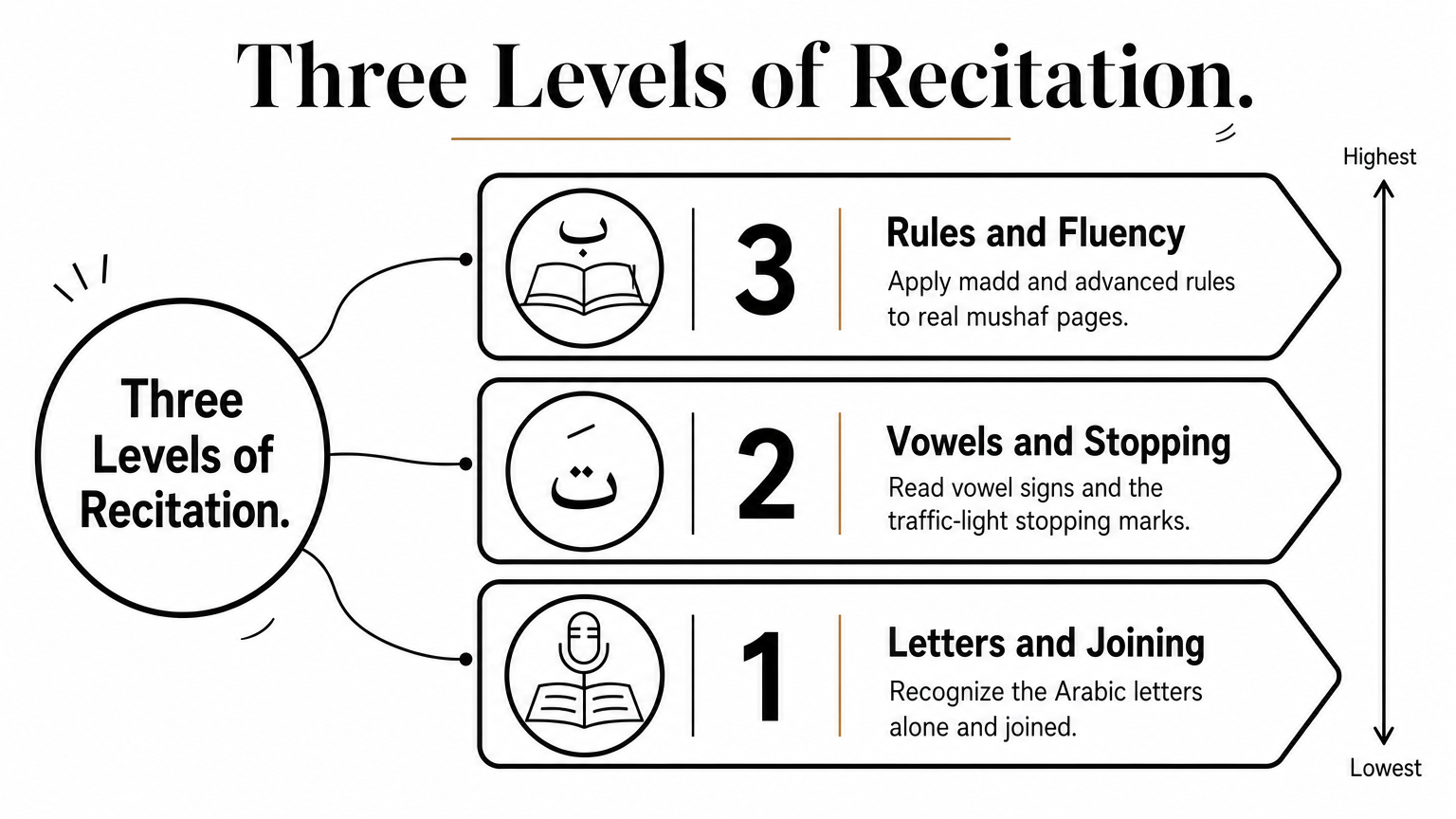
What it covers and who it suits
Muhammad Najmul Alam and Fatima Zahra Najam wrote it in three levels. It starts with the Arabic letters on their own and joined, then vowels and symbols, then stopping. The next stages cover the basic Tajweed rules, more on stopping, and the madd rules. It finishes with some advanced rules and the virtues of recitation.
It suits learners who can recognize letters but stumble when reading, and teachers who need a graded course. Each level comes with clear objectives and guidance for the teacher.
This is the book for people whose real problem is fluency, not a missing rule.
Strengths and limits
- Strength: reminder boxes, exercises, and images of the mushaf that apply each rule to real text.
- Strength: a traffic light system that makes the rules of stopping (waqf) easy to remember.
- Limit: the order of concepts could be tighter, since related ideas are not always grouped.
- Limit: some translations are loose, such as "echo" for Qalqalah, and examples could feel more modern for young learners.
4. The Ultimate Tajweed Workbook for children
The Ultimate Tajweed Workbook by Iqrah Razzaq is the best activity book for children learning Tajweed. It is built as a hands-on, fun paperback that covers the basic rules.
What it covers and who it suits
This is a workbook, not a textbook. Children practice the basic Tajweed rules through activities instead of reading long explanations. It works best beside another book or a lesson, which is how most teachers use it.
It suits parents and teachers of young students, and it is a good way to keep a child engaged between lessons. Adult beginners can use it too if they like learning through exercises, though it is clearly pitched at younger readers.
A workbook only helps when a main text or a teacher supplies the explanation, so buy it as a companion.
Strengths and limits
- Strength: activities turn repetition into play, which keeps children coming back.
- Strength: it fits beside any main Tajweed book.
- Limit: it covers the basic rules only, so older students will outgrow it.
- Limit: it does not replace live correction of a child’s pronunciation.
5. Tajweed Rules of the Quran by Czerepinski
Kareema Czerepinski’s Tajweed Rules of the Quran is the best English study set for intermediate learners. It comes in three parts, and Darussalam sells it as a set.

What it covers and who it suits
The set is designed for study with a teacher, and its publisher says the student is expected to have a basic grasp of Arabic before starting. It is an English-language commentary on al-Jazariyyah, the well-known Tajweed poem. A second edition of Part 1 is available, so confirm which edition your teacher uses before you buy.
It suits students who already read the Quran with reasonable accuracy and now want depth. Because the parts build on each other, it works best when you study them in order over months, not weeks.
Buy this set when you can already read the Quran and want the detailed reasoning behind each rule.
Strengths and limits
- Strength: thorough coverage across three parts, widely used by teachers.
- Strength: the Jazariyyah commentary connects your study to a classical text.
- Limit: it assumes Arabic knowledge, so true beginners will get lost.
- Limit: the volume of material can feel heavy without a study plan and a teacher.
PDF copies of the set are hosted on some Islamic education sites. A print edition is still easier to annotate and keeps your page numbers aligned with your teacher’s.
6. Illustrated Tajweed by Ayman Rushdi Swaid
Illustrated Tajweed (al-Tajwīd al-Muṣawwar) by Dr. Ayman Rushdi Swaid is the best advanced reference textbook in English. It is also the most expensive pick here.
What it covers and who it suits
Asiya Muhammad Akyurt translated it into English. It is a hardback with illustrations and QR codes next to the original Arabic text. The first English edition came out in two volumes in 2019, and a newer edition is now sold by a number of stores, so check which one you are buying. Many teachers see it as a modern successor to Czerepinski’s set, and it has become a standard textbook.
It suits advanced students and teachers, and learners who have finished a beginner book such as pick 1. It is not the place to start.
Reach for this book after a beginner text, not before.
Strengths and limits
- Strength: illustrations and QR codes add interactive support to the written rules.
- Strength: comprehensive coverage that works as a long-term reference.
- Limit: hard to follow without a teacher, and Tajweed is passed on through authorized teachers, not books alone.
- Limit: the organization makes it harder to find a specific topic quickly.
How to choose a Tajweed book that fits you
Choose by your reading level first, then by format. A beginner who buys an advanced book stalls, and an advanced reader who buys a workbook gets bored.
What a good Tajweed book should cover
Whatever level you pick, check that the table of contents covers the same core topics:
- Makharij (where each letter comes from) and the letter attributes
- Rules of noon sakinah and tanween
- Rules of meem sakinah
- Madd and its types
- Qalqalah
- Heavy and light letters
- Rules of stopping and starting
Tajweed rules books compared by level
| Book | Level | Best for | Format |
|---|---|---|---|
| Taysir al-Tajwid | Beginner | A short, complete first overview | 92-page hardback |
| Safar Rules of Tajwid | Beginner | Rule-by-rule practice | Madinah or IndoPak script |
| The Sweetness of Recitation | Beginner to intermediate | Moving from reading to reciting | Three-level textbook |
| The Ultimate Tajweed Workbook | Children | Activities beside a main book | Paperback |
| Czerepinski’s set | Intermediate | Detailed study with a teacher | Three parts |
| Illustrated Tajweed | Advanced | Long-term reference | Hardback with QR codes |
Free PDF, print, and why you still need a teacher
Free PDFs are a fair way to start. Established teachers such as Qari Saleem Gaibie offer free Tajweed books, and some publishers’ older titles circulate as Tajweed rules PDFs. Check the author, and make sure the script matches your mushaf. Print costs money, but you can annotate it, and a bound book keeps you off your phone.
Whichever format you choose, a book cannot hear you. Tajweed depends on mouth movement and sound, and it has traditionally passed from teacher to student. If you want a guide for the rules in your book, our Quran Tajweed lessons pair you with a one-to-one teacher who corrects errors as you recite.
Pick one book and add a teacher
A good Tajweed book matches your reading level. Taysir al-Tajwid or Safar’s Rules of Tajwid suits most beginners, The Sweetness of Recitation fixes fluency, Czerepinski and Illustrated Tajweed serve deeper study, and the workbook keeps children engaged. Pick one, finish it, and only then move up a level.
Reading the rules is half the work. The other half is hearing yourself corrected. If you are unsure which level fits you, book a free assessment lesson with Quranytime Academy. A teacher will discuss your current level and recommend a next step.