
The tajweed rules of Raa tell you when to pronounce the letter ر with a full, heavy sound (tafkheem) and when to pronounce it with a thin, light sound (tarqeeq). In most words the vowel on the Raa decides. Fatha and damma make it heavy, and kasra makes it light. When the Raa has a sukoon, you look at the letter before it. A short list of exceptions covers the rest, including six words where both readings are allowed.
Most Arabic letters are fixed. Seven are always heavy, and the others are always light. Raa is different, as is the Laam in the name Allah, because its sound depends on its surroundings. That is why learners need a method, not just a list to memorize. At Quranytime Academy, our Al-Azhar-trained teachers teach these rules in live one-to-one classes, so this guide follows the order a teacher would use.
Below you will find why the rules matter, a four-step check you can apply to any word, the tricky cases, the words that allow both readings, and a practice routine. The rules follow the Hafs recitation from Asim, which most printed Qurans use.
Why the rules of Raa matter for your recitation
Raa matters because it is a conditional letter. Its sound changes with its vowel and its neighbors, so you cannot learn it once and apply it everywhere. A wrong choice is a tajweed error even when every other letter in the word is perfect.
Raa is a conditional letter
The seven heavy letters are خ ص ض غ ط ق ظ. They are always heavy, and every other letter is light, except Raa and the Laam in Allah. Raa has no default. Its heaviness depends on its own vowel, and when it has a sukoon, on the letter before it and sometimes the letter after it.

You can feel the difference in your mouth. In a heavy Raa, the back of your tongue rises toward the roof of your mouth and the sound fills the mouth. In a light Raa, the tongue stays low and relaxed, and the sound is thin and clear.
What goes wrong when you ignore the rules
Two habits are common among learners. Some read every Raa heavy because it feels safe. Others read every Raa light because it is closer to the English r. Both are mistakes.
Take رِزْقٌ (rizq, provision). It must be light. A heavy Raa there changes the quality of the letter, even though the spelling and meaning stay the same. Knowing the rules lets you hear these errors in your own recitation before a teacher has to point them out.
Raa has no fixed sound, so every Raa you meet needs a quick decision based on its vowel and its neighbors.
How to decide if Raa is heavy or light in four steps
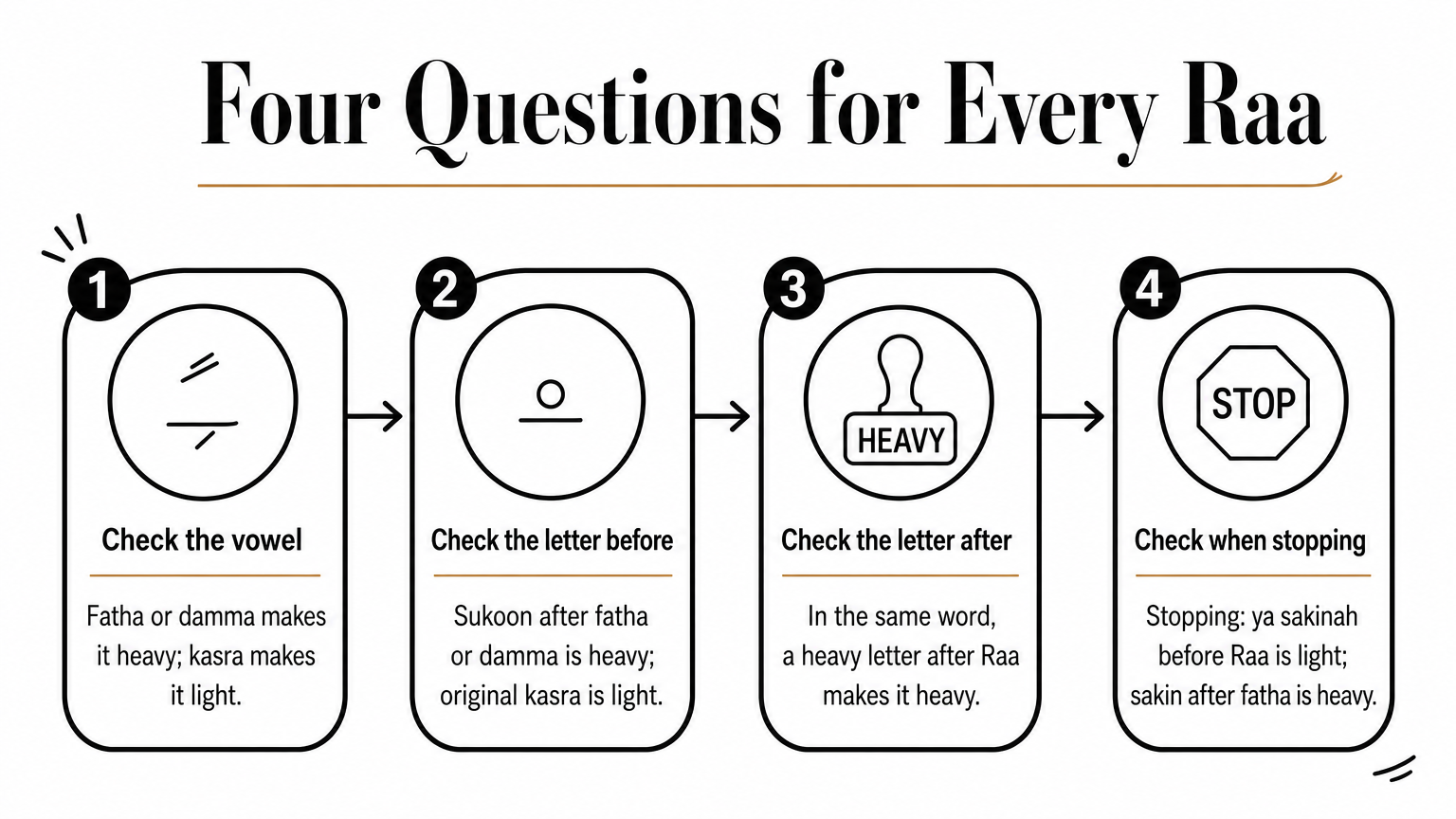
Check four things in order: the vowel on the Raa, the letter before a Raa with sukoon, any heavy letter after it, and whether you are stopping on the word. Stop at the first step that gives you an answer.
The four-step check
- Look at the vowel on the Raa. Fatha, fathatayn, damma, or dammatayn makes it heavy. Kasra or kasratayn makes it light. If the Raa carries a vowel, you are done.
- If the Raa has a sukoon, look at the letter before it. A fatha or damma makes it heavy. An original kasra in the same word makes it light. A hamzatul wasl, or a kasra that belongs to the previous word, makes it heavy.
- If the Raa follows a kasra, look at what comes next in the same word. A heavy letter right after the Raa makes it heavy.
- If you stop on the word, the last Raa becomes sakin. A ya sakinah before it makes it light. A sakin letter after a kasra makes it light. A sakin letter after a fatha or damma makes it heavy.
Reference table with Quran examples
The table gives each situation with a Quranic word you can check against your mushaf.
| Situation | Ruling | Example |
|---|---|---|
| Raa with fatha or fathatayn | Heavy | رَحْمَةٌ، رَسُولًا |
| Raa with damma or dammatayn | Heavy | رُوحٌ، رُسُلٌ |
| Raa with kasra or kasratayn | Light | رِزْقٌ، قَدِيرٍ |
| Raa sakinah after fatha | Heavy | مَرْيَمَ |
| Raa sakinah after damma | Heavy | الْقُرْآنُ |
| Raa sakinah after original kasra, no heavy letter after | Light | فِرْعَوْنَ، مِرْيَةٍ |
| Raa sakinah after kasra, heavy letter after in the same word | Heavy | قِرْطَاسٍ، مِرْصَادًا، فِرْقَةٍ |
| Raa sakinah after hamzatul wasl | Heavy | ارْجِعُوا |
| Stopping: Raa after ya sakinah | Light | خَبِيرٌ، الْخَيْرِ |
| Stopping: Raa after a sakin letter that follows a kasra | Light | ذِكْرٌ، حِجْرٍ |
| Stopping: Raa after a sakin letter that follows a fatha or damma | Heavy | الْقَدْرِ، النَّارِ |
Worked examples
Run four words through the steps.
- رِزْقٌ: the Raa has a kasra. Step 1 gives light.
- مَرْيَمَ: the Raa has a sukoon and the mim before it has a fatha. Step 2 gives heavy.
- فِرْعَوْنَ: the Raa has a sukoon, the fa has an original kasra, and ع is not a heavy letter. The result is light.
- الْقَدْرِ when you stop: the Raa becomes sakin, the dal before it is sakin, and the qaf before that has a fatha. The result is heavy.
Ask four questions in order, and almost every Raa in the Quran resolves by the second or third one.
Tricky cases that cause most mistakes with Raa
Most errors come from three situations: a kasra that is not original to the word, a heavy letter that sits in the wrong place, and the switch between continuing and stopping. Each has a clear rule once you see it.
Hamzatul wasl and kasra from a previous word
A kasra only makes a sukoon Raa light when it is original and in the same word. Two things look like a kasra but do not count. The first is the helper vowel on hamzatul wasl when you start a word such as ارْجِعُوا. The second is a kasra on the last letter of the previous word.
Both cases give a heavy Raa:
- ارْجِعُوا and ارْتَضَىٰ, where the kasra only exists when you begin on the hamza.
- قَالَ رَبِّ ارْجِعُونِ and أَمِ ارْتَابُوا, where the kasra on ب or م belongs to the word before.
Heavy letters near Raa: when they count
A heavy letter matters only when it comes right after a sukoon Raa that follows a kasra, in the same word. Then the Raa turns heavy, as in مِرْصَادًا and قِرْطَاسٍ. If the heavy letter starts the next word, it does not count. فَاصْبِرْ صَبْرًا keeps a light Raa, because the ص belongs to a different word.
A heavy letter before a Raa that has its own kasra changes nothing. قَرِيبٌ and طَرِيقًا stay light. The usual slip is letting the heavy letter spill its weight onto the Raa, so keep the back of your tongue down.
Continuing versus stopping
The same word can change ruling when you stop on it, because the final Raa takes a sukoon and the stopping rules apply.
| Word | Continuing | Stopping |
|---|---|---|
| خَيْرٌ | Heavy (Raa has damma) | Light (ya sakinah before it) |
| عَذَابَ النَّارِ | Light (Raa has kasra) | Heavy (alif sakinah after fatha) |
Heavy letters count only inside the same word, and a kasra counts only when it is original to that word.
Words where both readings of Raa are allowed
In the Hafs recitation, six words allow both a heavy and a light Raa. In five of them tarqeeq is preferred, and in one tafkheem is preferred. Each is a case where two rules pull in opposite directions, so both readings are authentic.
The six words
| Word | Where and when | Preferred |
|---|---|---|
| فِرْقٍ | Ash-Shu’ara, whether you stop or continue | Tarqeeq |
| الْقِطْرِ | Saba, when you stop | Tarqeeq |
| فَأَسْرِ | As in Hud, when you stop | Tarqeeq |
| يَسْرِ | Al-Fajr, when you stop | Tarqeeq |
| نُذُرِ | Al-Qamar, when you stop | Tarqeeq |
| مِصْرَ | As in Yusuf, when you stop | Tafkheem |
Which reading to choose
Pick the preferred reading and use it consistently. Both readings are valid, but the preferred one is what most teachers expect, especially from beginners. If your teacher uses the other one, follow your teacher.
These words are rare, and they are advanced material. Master the main rules first. Once your ordinary Raa decisions are automatic, these six will be easy to memorize.
Six words allow both readings, and the safe default is tarqeeq for five of them and tafkheem for Misr.
How to practice Raa until it comes naturally
Practice works best when you fix the sound first and then train the decision. Rules you only read will not hold up while you recite at normal speed.
Get the sound right first
The Raa comes from the tip of the tongue, slightly toward its back, touching the gum above the upper front teeth. This is a little behind where noon is made. The tongue has a natural tendency to repeat the tap, called takreer. Do not roll it. Use one quick, light tap.

Then train the two colors separately. For tafkheem, raise the back of the tongue toward the palate. For tarqeeq, keep it low. Say رَ and رِ slowly until the difference is clear in your own mouth.
A simple practice routine
- Learn the table above in this order: vowel on the Raa, then sukoon cases, then stopping cases.
- Take a short surah and mark every Raa with H or L in pencil before you read.
- Read it slowly, then at normal speed, keeping the colors consistent.
- Record your recitation and compare with a skilled reciter, listening only to the Raa.
- Have a teacher check your recording, because a live listener catches errors you cannot hear yourself.
A teacher matters most at step 5. In Quran Tajweed lessons at Quranytime Academy, your teacher listens to you live, corrects the Raa as you recite, and keeps your practice on the rules you actually need.
Fix the tongue position first, then train the decision, and have someone qualified listen to you.
Putting the rules of Raa into practice
The rules of Raa come down to one habit: ask what vowel the Raa has, what comes before it if it has a sukoon, and whether you are stopping. Fatha and damma give a heavy Raa, and kasra gives a light one. Hamzatul wasl and a kasra from another word do not count as original. A heavy letter after the Raa counts only in the same word. Six words allow both readings.
Apply the four-step check to a short surah this week and mark each Raa before you read. If you want a teacher to hear your Raa and tell you exactly what to fix, sign up for a free assessment class. A live one-to-one session will show your current level and the right next step.