
A tajweed rules PDF in Malayalam is a written guide that explains, in Malayalam, how to pronounce every letter of the Quran correctly. Tajweed means giving each letter its proper exit point, its qualities, and its correct length. A useful guide covers five basics: letter exits (makharij), letter qualities (sifaat), the rules of noon sakinah and meem sakinah, madd (prolongation), and qalqalah. It also pairs each rule with fully vowelled Arabic examples.
This article does not hand you a file. It shows you what a good guide must contain, how to check any file before you trust it, and the basic rules in one table. It then walks you through practicing them on real verses. The same checks apply whether you search for Quran tajweed rules in Malayalam PDF form or pick up a printed book.
Quranytime Academy teaches Quran reading and Tajweed live, one-to-one, with teachers who are Al-Azhar graduates and Ijazah holders. A guide teaches the rules, but only a listener can tell you whether you apply them.
Why a Malayalam tajweed guide helps your recitation
A Malayalam guide helps because you learn each rule in the language you think in, so the explanation never competes with the Arabic you are trying to pronounce. It works best as a reference you return to, not as your only teacher.
What tajweed protects
Tajweed protects both the sound and the meaning of the words. Scholars usually separate clear mistakes, such as changing a letter or a vowel in a way that can change the meaning, from subtle mistakes, such as shortening a madd or skipping a nasal sound. Many scholars treat studying the detailed rules as a communal duty. They treat reciting without clear mistakes as a duty on every reader. Ask a qualified teacher how this applies to your situation.
What a PDF cannot do
A PDF gives you rules, not sound. It cannot hear your throat letters, correct your madd length, or notice that you always soften a heavy letter. Tajweed has been passed on by listening and repeating, which is why recitation teachers hold Ijazah, a chain of authorization back to the Prophet, peace be upon him.

Use a Malayalam PDF to understand the rules, and use a listener to confirm you apply them.
How to choose and study from a Malayalam tajweed PDF
Choose a guide that names its author, shows vowelled Quranic examples, and treats Malayalam letters as support, not as a replacement for Arabic. Then study one rule at a time, aloud.
Five checks before you trust a file
Free files from file-sharing pages are often scans of unknown origin. They may contain typing errors or leave out the examples. Check each of these before you invest time:
- It names its author or institution, so you can verify who wrote it.
- Every Arabic example is fully vowelled and taken from the Quran, in the Hafs ‘an ‘Asim reading, the one most widely printed today.
- It includes a diagram of the makharij and states madd lengths in counts.
- It does not rely on Malayalam transliteration alone. Malayalam script cannot separate heavy letters like ص from light ones like س, so a transliteration-only guide will mislead you.
- Its examples match a color-coded mushaf, which you can use as a quick cross-check.
A weekly routine that works
A steady routine beats a long first weekend. Here is a plan that suits beginners:
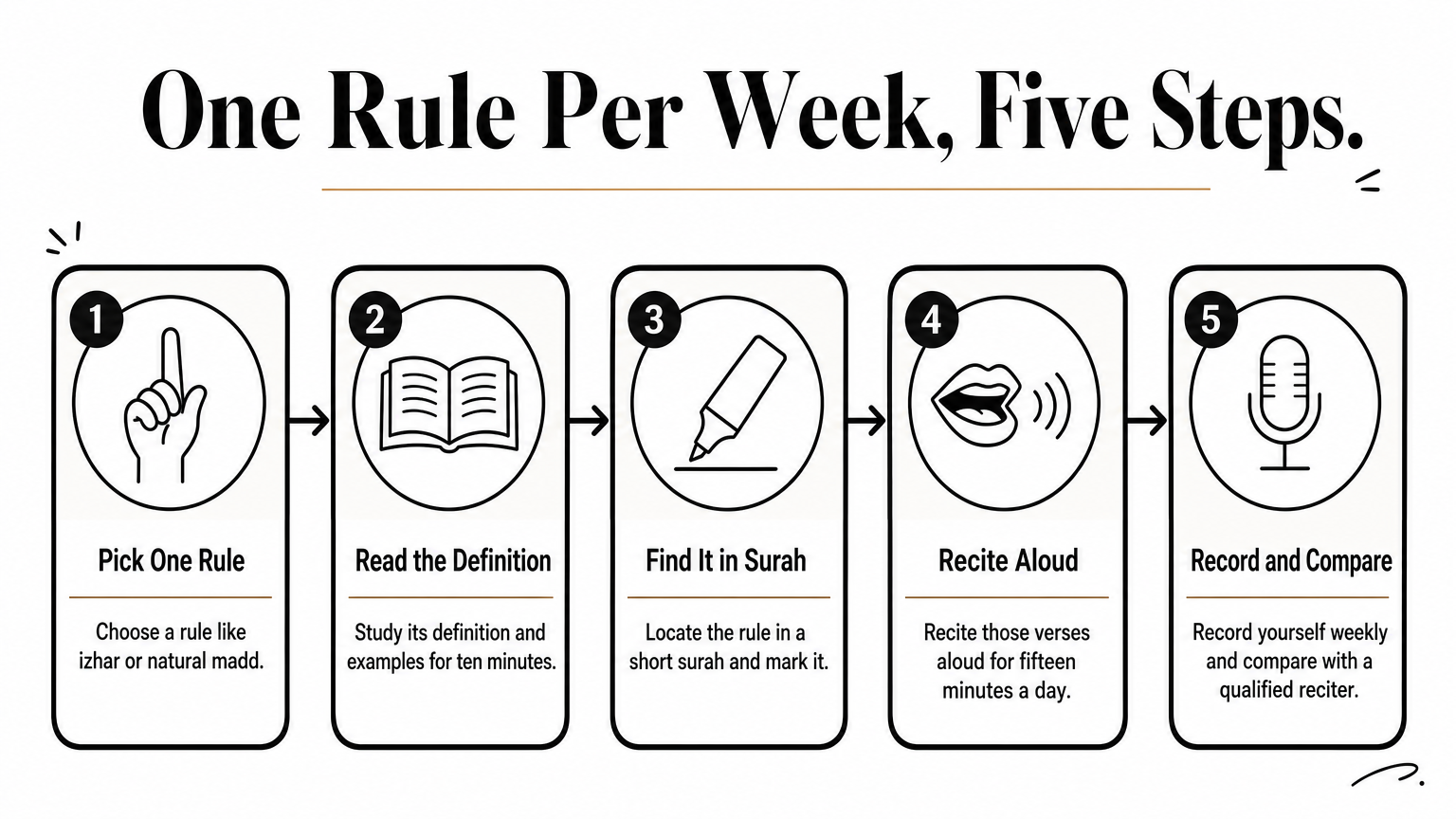
- Pick one rule per week, such as izhar or natural madd.
- Read its definition and examples in your guide for ten minutes.
- Find the same rule in a short surah and mark it in your mushaf.
- Recite those verses aloud for fifteen minutes a day.
- Record yourself once a week and compare with a qualified reciter.
One rule per week, practiced aloud, teaches more than a whole book skimmed once.
The basic tajweed rules a good PDF covers
Nearly every beginner guide in Malayalam or English covers the same core: noon sakinah and tanween, meem sakinah, madd, qalqalah, and heavy and light letters. These are what people mean when they ask for the basic rules.
Why lists of four or seven rules differ
There is no single official count. Some books call the four noon sakinah rules "the four rules of tajweed". Others group seven topics, for example makharij, sifaat, noon, meem, madd, qalqalah, and the lam and raa. Both are only ways of organizing the same material, so judge a guide by what it explains, not by its headline number.
The core rules at a glance
| Rule | Letters or trigger | What you do |
|---|---|---|
| Izhar (noon sakinah, tanween) | ء ه ع ح غ خ | Pronounce the noon clearly, with no nasal hold |
| Idgham | ي ر م ل و ن | Merge into the next letter, with ghunnah for ي ن م و and without it for ل ر |
| Iqlab | ب | Turn the noon into a hidden meem, with ghunnah |
| Ikhfa | The other 15 letters | Hide the noon with a nasal sound of about 2 counts |
| Meem sakinah | ب, م, or any other letter | Ikhfa before ب, idgham before م, izhar before the rest |
| Natural madd | A madd letter with no hamza or sukun after it | Hold for 2 counts |
| Madd muttasil and munfasil | A hamza after the madd letter, in the same word or the next | Hold for 4 to 5 counts |
| Madd lazim | A permanent sukun after the madd letter | Hold for 6 counts |
| Qalqalah | ق ط ب ج د with sukun | Add a slight echo |
| Heavy letters | خ ص ض غ ط ق ظ | Pronounce with a full mouth |
If a guide skips any row, treat it as incomplete. If it gives different counts for madd lazim, check its source against your teacher’s.
The basic rules fit in ten rows, so a guide that needs fifty pages to explain them is padding.
Practice the rules on short verses
Practice works best on short, familiar verses, because you already know the words and can focus on the rule. Use the examples below as your first drill.
Six examples to mark in your mushaf
| Phrase | Where | Rule |
|---|---|---|
| أَنْعَمْتَ | Al-Fatiha 1:7 | Izhar, noon before ع |
| مِن بَعْدِ | Common in the Quran, for example 2:27 | Iqlab, noon before ب |
| مَن يَقُولُ | Al-Baqarah 2:8 | Idgham with ghunnah |
| مِن شَرِّ | Al-Falaq 113:2 | Ikhfa, noon before ش |
| أَحَدٌ | Al-Ikhlas 112:1 | Qalqalah when you stop on the dal |
| إِنَّا أَعْطَيْنَاكَ | Al-Kawthar 108:1 | Madd munfasil, 4 to 5 counts |

Say each phrase slowly three times. Then read the whole verse and listen for the rule as it arrives.
When a PDF is not enough
If you still cannot hear the difference between izhar and ikhfa after a few weeks, a live teacher will fix it in one session. At Quranytime Academy, one-to-one teachers correct pronunciation as you recite and build the rules into your reading step by step. You do not need any prior knowledge to begin, and adults and children both start with an assessment of their current level.
A rule you can explain but cannot yet hear is a rule you have only half learned.
Where to go from here
A tajweed rules PDF in Malayalam is worth using if it names its author, uses vowelled Quranic examples, and covers noon and meem sakinah, madd, qalqalah, and heavy letters. Study one rule a week, mark it in your mushaf, and say it aloud until it feels natural. The ten rows in the table above are the basics, and the six verse examples are your first practice set.
Reading gets you the rules, and listening gets you the sound. If you want a teacher to hear your recitation and tell you exactly which rule to fix first, book a free one-to-one assessment class. The team will check your level, match you with a teacher, and recommend a learning path.