


You open a Mushaf and see words painted in red, green, blue, and gray. It looks beautiful, but without the key, the colors mean nothing. If you are shopping for a print copy or hunting for a free PDF, you also want to know which edition is worth your time.
Here is the short answer. The holy Quran color coded Tajweed rules use color to mark how a letter must be pronounced: madd (elongation) is usually shown in reds, ghunnah and noon sakinah rules in greens, and qalqalah in blue. Silent or unpronounced letters are often gray. Exact shades vary by publisher, so always check the color legend printed in the first pages of your edition.
Below, we break down what each color means, how to read it while reciting, and what to look for in a printed copy or a PDF. At Quranytime Academy, our Al-Azhar-trained teachers use these editions daily with beginners, so we also cover how to use the colors as a guide, not a replacement for a teacher.
Why a color-coded Tajweed Quran helps your recitation
Most learners do not struggle with the letters. They struggle to remember which rule applies where. Color coding turns rules into visual cues, so you see the Tajweed rule at the exact spot it applies.
It trains your eye as you read
Think of a traffic light. You do not recite a rule before you stop, you react to the color. The same happens with the holy Quran color coded Tajweed rules: a red madd tells you to stretch the vowel before doubt creeps in. In our classes, the pattern becomes automatic within a few weeks of daily reading.
Beginners gain the most. Adults with little Arabic often freeze at a noon sakinah because they cannot tell which of four rules applies. With color, the answer is visible at a glance, and your confidence grows page by page.
At a glance, you can spot four things and keep reciting without stopping to look up a rule:
- How long to stretch a vowel (madd)
- When to add a nasal sound (ghunnah)
- When to echo a letter (qalqalah)
- Which letters to leave silent
What the colors cannot do
Colors show where a rule applies, not how it sounds. A green ghunnah still needs the right nasal tone, held for the right length. Only a qualified teacher can hear your mistakes and correct your makharij, the points of articulation for each letter.
Colors tell you which rule applies; a teacher confirms you are pronouncing it correctly.
Use the colors as a self-check instead. Read one page aloud, mark every colored word you hesitated on, and bring that list to your next lesson. That habit makes each lesson more focused and your practice time more productive.
How to read the colors in a Tajweed Quran

Reading the holy Quran color coded Tajweed rules is easier than it looks once you know where to look. The color sits on the letter that carries the rule, so you rarely need to analyze the whole word. Uncolored letters are read normally, exactly as you already know them.


The color marks the letter that carries the rule; everything else is read as usual.
Start with the legend
Before you read a verse, find the color key in the front pages of your edition. Publishers choose different shades, so a pink in one Mushaf may be a red in another. Spend two minutes to match each color to its rule, then keep a bookmark on that page for your first week of reading.
Follow a four-step routine
Use the same routine for every word, and it will feel automatic within days. Going slowly at first builds steadier fluency than rushing through a page.
- Read the word with its normal letters and vowels.
- Spot any colored letter or mark.
- Recall the rule from your legend.
- Apply the rule, then keep going without pausing.
If a colored letter still confuses you, underline it lightly in pencil and ask your teacher at the next lesson.
What each color means: a practical color guide
Most editions follow a similar pattern, so this guide covers the holy Quran color coded Tajweed rules you will meet in the majority of printed Mushafs and PDFs. Treat it as a quick reference, and check your own legend first.
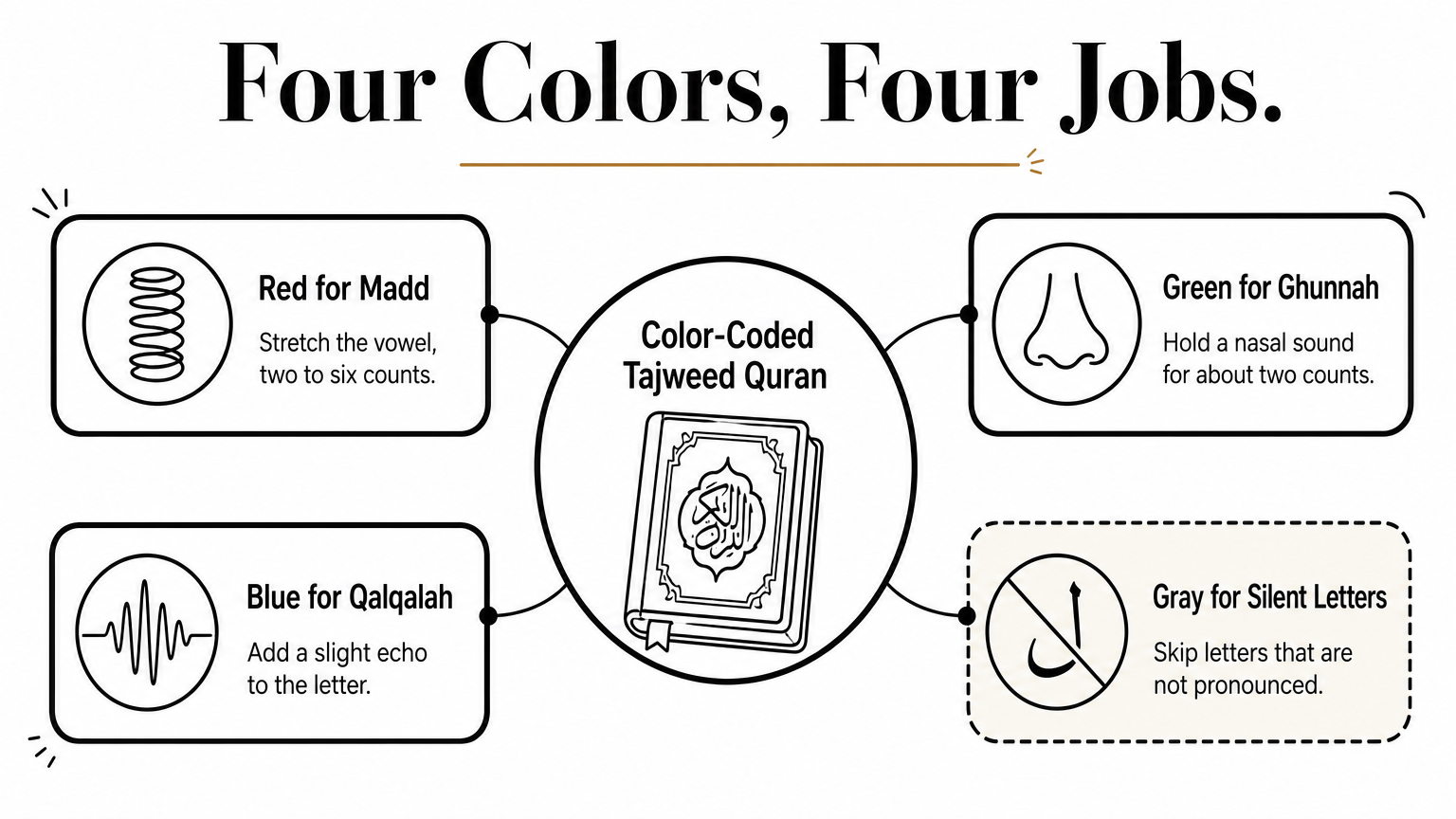
The core colors at a glance
| Color | Rule it marks | What you do |
|---|---|---|
| Red (dark to light) | Madd | Stretch the vowel, 2 to 6 counts |
| Green | Ghunnah, ikhfa, idgham with ghunnah | Hold a nasal sound for about 2 counts |
| Blue | Qalqalah | Add a slight echo to the letter |
| Gray | Letters not pronounced, like the lam in sun-letter words | Skip the letter |
Darker reds usually signal longer madds. Natural madd gets two counts, while the heaviest madds reach six counts. Your legend tells you which shade is which.
Where editions differ
Publishers disagree on a few details. Some show idgham in gray, others in green, and some add orange or purple for ikhfa or iqlab. The rule stays the same, only the paint changes.
Pick one edition and stay with it for your first months.
Learn one legend well instead of memorizing every publisher’s palette.
Switching between editions mid-way makes you relearn the key and slows your progress.
How to choose a color-coded Quran, print or PDF
Buying a color coded Tajweed Quran or downloading a free PDF comes down to a few simple checks. The wrong edition costs you months of confusion.

What to look for in a print copy
Open the first pages before you buy. You want a printed color legend and the Hafs recitation, the riwayah most teachers use. Then check three more things:
- Paper thick enough that colors do not bleed through
- Font size you can read comfortably for 20 minutes
- Color key repeated or easy to find, not buried
What to check in a free PDF
File quality varies widely. Choose a PDF from a recognized publisher or Islamic institution, because a text error in a copy can slip into your recitation without you noticing.
A good edition has a legend you can read and text you can trust.
Zoom to 200 percent on your screen. Letters should stay sharp and colors should match the legend. Make sure the legend is included, and test the file on your phone if you plan to read there. Print the legend page and keep it beside you while you read.
Common mistakes and how to move beyond the colors
Even with the holy Quran color coded Tajweed rules in front of you, a few habits slow your progress. Spotting them early saves months of relearning.
Mistakes that slow learners down
Most common Tajweed mistakes come from trusting the paint too much. Colors show the rule, not the sound, so check yourself against these three:
- Stretching every red madd too long because it looks dramatic
- Skipping uncolored letters, which still need correct makharij
- Switching editions, so one shade means two different rules
How to move beyond the colors
Weaning yourself off color works best in stages. Read a familiar page in a plain black-text Mushaf, then check it against your colored copy. The goal is to recall the rule itself, not the shade.
Colors are training wheels: use them to learn the rules, then ride without them.
Try one page a day for two weeks. Record yourself, listen back, and send the recording to your teacher. Once you miss almost no colored spots, move to the next page.
Reading with confidence, with or without colors
The holy Quran color coded Tajweed rules give you a map you can read at a glance. Red marks madd, green marks ghunnah and noon sakinah rules, blue marks qalqalah, and gray marks silent letters. Learn one legend well, pick an edition with a clear key, and let the colors point you to the rule at the exact spot.
Still, colors are training wheels. They show where a rule applies, but only a teacher can confirm how it sounds. Record yourself, note the words you hesitate on, and keep working toward a plain Mushaf until the rules live in your memory, not on the page.
If you want a teacher to hear your recitation and match you with the right path, book a free assessment class at Quranytime Academy. One short session shows you your level, and your next step becomes clear.