
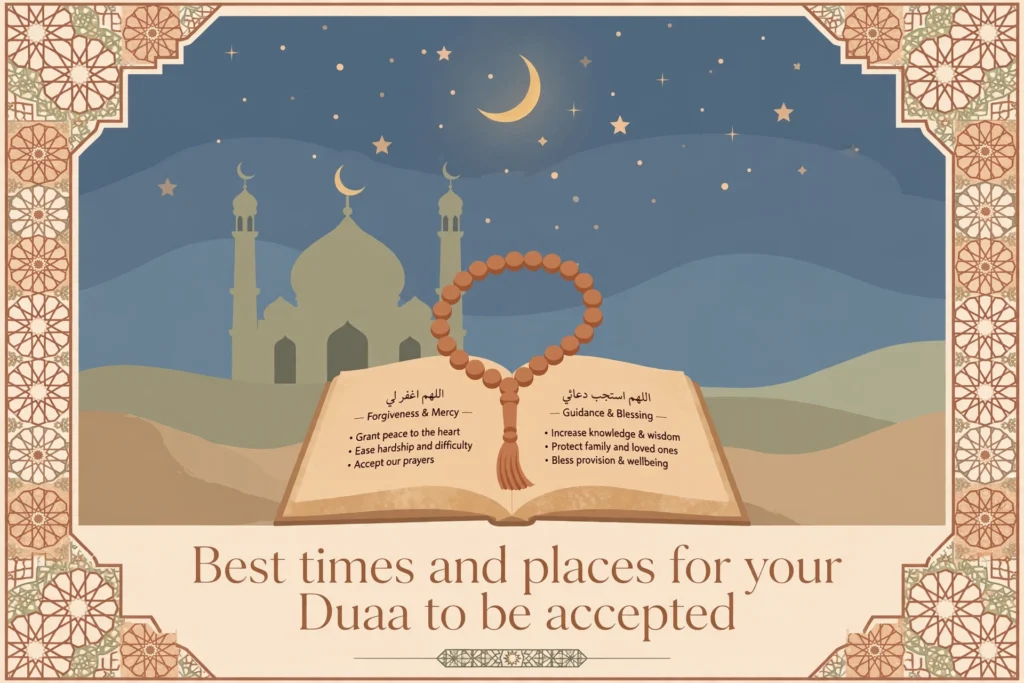
Every believer knows the feeling: a need you can’t carry alone, a decision you can’t see through, a person you’re worried about — and your hands go up almost before you’ve decided to raise them. Duaa is the believer’s direct line to Allah, open at every hour, in every place. No appointment, no intermediary, no formula required.
And yet the Quran and Sunnah point to certain times and states in which duaa is especially hoped to be answered. Knowing them doesn’t turn prayer into a transaction — it helps you show up, heart present, at the moments Allah has honoured. Here they are, together with how to ask well and how to wait well.
First: what makes a duaa sincere?
The door is always open, but the etiquette of asking matters. The scholars gather it from the Sunnah:
- Begin with Allah, not with the request. Praise Him, acknowledge His favours, then send blessings (salawat) upon the Prophet Muhammad ﷺ before you ask.
- Ask with a present heart. The Prophet ﷺ said Allah does not answer a duaa from a heedless, distracted heart. Slow down; know Who you are addressing.
- Keep your provision halal. A well-known hadith describes a traveller raising his hands to the sky while his food and drink are unlawful — and asks how such a one will be answered. Honest earnings are part of the etiquette of duaa.
- Repent first. Istighfar clears the road. Confess the wrong, intend to leave it, then ask.
- Ask for good in both worlds — faith, guidance, forgiveness, health, family, and the home of the Hereafter — not only for the thing in front of you.
The best times for duaa
The last third of the night
The crown of them all. Allah descends to the lowest heaven in the last third of the night and calls: who is asking, that I may give; who is seeking forgiveness, that I may forgive. Even twenty minutes before Fajr, prayed from your bed or your prayer mat, is time the righteous have guarded for centuries.
In sujood — while your forehead is on the ground
“The closest a servant is to his Lord is while he is prostrating, so make much duaa then.” Inside the prayer and in extra prostrations alike, sujood is the posture of nearness — pour out what you carry there.
Between the adhan and the iqamah
A short window many waste in conversation. The Prophet ﷺ said duaa between the call to prayer and the iqamah is not rejected. Arrive at the masjid early, or pause at home, and use those minutes.
The hour on Friday
There is an hour on Friday — many scholars place it in the last part of the afternoon, after Asr — in which a Muslim who asks Allah for good will be granted it. Guard Friday’s last hour the way you guard an appointment.
While fasting, and at the moment of breaking the fast
The fasting person’s duaa is among those not rejected, and the moment just before Maghrib — food in front of you, body tired, heart soft — is one of the day’s sweetest windows. Don’t spend it scrolling.
When rain falls
Rain is mercy arriving visibly, and duaa at its fall is encouraged. Step to the window, raise your hands, ask.
While travelling
The traveller’s duaa is answered — distance, humility and dependence make the heart honest. Journeys are duaa opportunities, not just logistics.
The Day of Arafah and the nights of Ramadan
The best duaa of the year is the duaa of Arafah, and the last ten nights of Ramadan hide Laylatul Qadr, a night better than a thousand months. These seasons get their own planning — see our guide to the special days for Muslims during the year.
The best places and states
Duaa can be made anywhere clean and respectful — your home, your car, your desk before a hard meeting. Place matters less than presence. Still, some states soften the heart wherever you are:
- In the depths of the night prayer (Qiyam), when the house is quiet.
- After the obligatory prayers, while the heart is still in worship.
- In the masjid, and above all in the two Holy Sanctuaries for those blessed to visit.
- While remembering Allah in a gathering — angels surround circles of dhikr, and duaa made there is raised in good company.
- For someone else, in their absence. The duaa of a Muslim for his brother in his absence is answered — and an angel says “Ameen, and for you the same.” The fastest way to have your own needs prayed for is to pray for others.
A simple daily duaa routine
Grand plans collapse; small habits survive. Try this:
- Two anchors a day — a few minutes after Fajr and a few before Maghrib (or at iftar). Hands up, phone away.
- A written list on your phone or in a notebook: your faith, your parents, your family, your teachers, your specific needs, the ummah. Lists stop the mind wandering.
- One duaa for someone else every day — a friend in difficulty, a teacher, a stranger whose hardship you saw.
- End with salawat upon the Prophet ﷺ, as you began.
After you ask: the patience of duaa
Your duaa is answered in one of three ways, the Prophet ﷺ taught: Allah gives what you asked, or averts from you a harm equal to it, or stores it for you in the Hereafter. A delay is not a refusal. What ruins duaa is haste — saying “I prayed and was not answered” and giving up.
So keep asking, and pair the asking with action: take the lawful steps available to you, study for the exam, apply for the job, book the class. Duaa is not a substitute for effort; it is the blessing poured over it. Many of our students tell us their journey began with a duaa for guidance — and the answer arrived as the discipline to learn. If that is where you are, our Quran and Arabic courses are one-to-one, and the first 3 trial classes are free.
Book your free trial classes — and may Allah answer you with better than you asked.
FAQs
What is the single best time to make duaa?
The last third of the night is the most emphasised in the Sunnah — the time when Allah calls out to those who ask. After that, duaa in sujood is singled out as the moment a servant is closest to his Lord.
Can I make duaa in my own language?
Yes. Outside the formal recitation of the prayer itself, you may ask Allah in any language you speak. Sincere words from a present heart matter more than polished Arabic — though learning the Quranic duaas in Arabic adds their exact, blessed wording to your own.
Is duaa accepted at any time, or only these times?
At any time. The times listed here are moments of special hope, not opening hours. A duaa whispered in a traffic jam reaches the same Lord as one made on the night of Qadr.
Why hasn’t my duaa been answered yet?
It may already have been answered differently — as protection from a harm you never saw, or stored for the Hereafter, where it will be worth more. It may also be waiting for its appointed time. The one thing the Sunnah warns against is abandoning duaa out of haste.
Should I raise my hands when making duaa?
Raising the hands is from the Sunnah in most situations and is itself an expression of neediness before Allah. It is not done after the obligatory prayers as a fixed congregational ritual in the view of many scholars, and hands are not raised in sujood or within the prayer’s recitations — but in your personal duaa, raise them and ask.