
When a still mīm (مْ) appears in Quran recitation, the next letter tells you how to pronounce it. The three meem sakinah rules are ikhfa shafawi before ب, idgham shafawi before م, and izhar shafawi before the remaining letters. Learning that one-letter check helps you avoid hiding a mīm that should be clear, or separating two mīms that should join.
Quick check: locate مْ, look at the letter immediately after it while continuing the recitation, then choose: bāʾ = conceal with the taught nasal quality; another mīm = merge the two; any other letter = pronounce the mīm clearly. If you intentionally stop before the next word, do not apply a cross-word rule as if you had joined the words.
What does meem sakinah mean?
Mīm sākinah (مْ) means the Arabic letter mīm, م, carrying sukūn: it has no vowel of its own. In a connected phrase, its relationship with the next pronounced letter determines which of the three rules applies. The word shafawi means “of the lips,” because the sound of mīm is made with the lips.
This is a different system from the rules of nūn sākinah and tanwīn. Those rules concern a still nūn or tanwīn and have four familiar categories; the mīm system has three, with ب and م as its two special triggers. Quranytime’s guide to nūn sākinah and tanwīn covers the separate n-sound rules, so keep the two checklists distinct.
The three meem sakinah rules at a glance
Use the chart to choose the rule: first find the still mīm, then identify the following letter. The action applies when the words are connected in recitation.
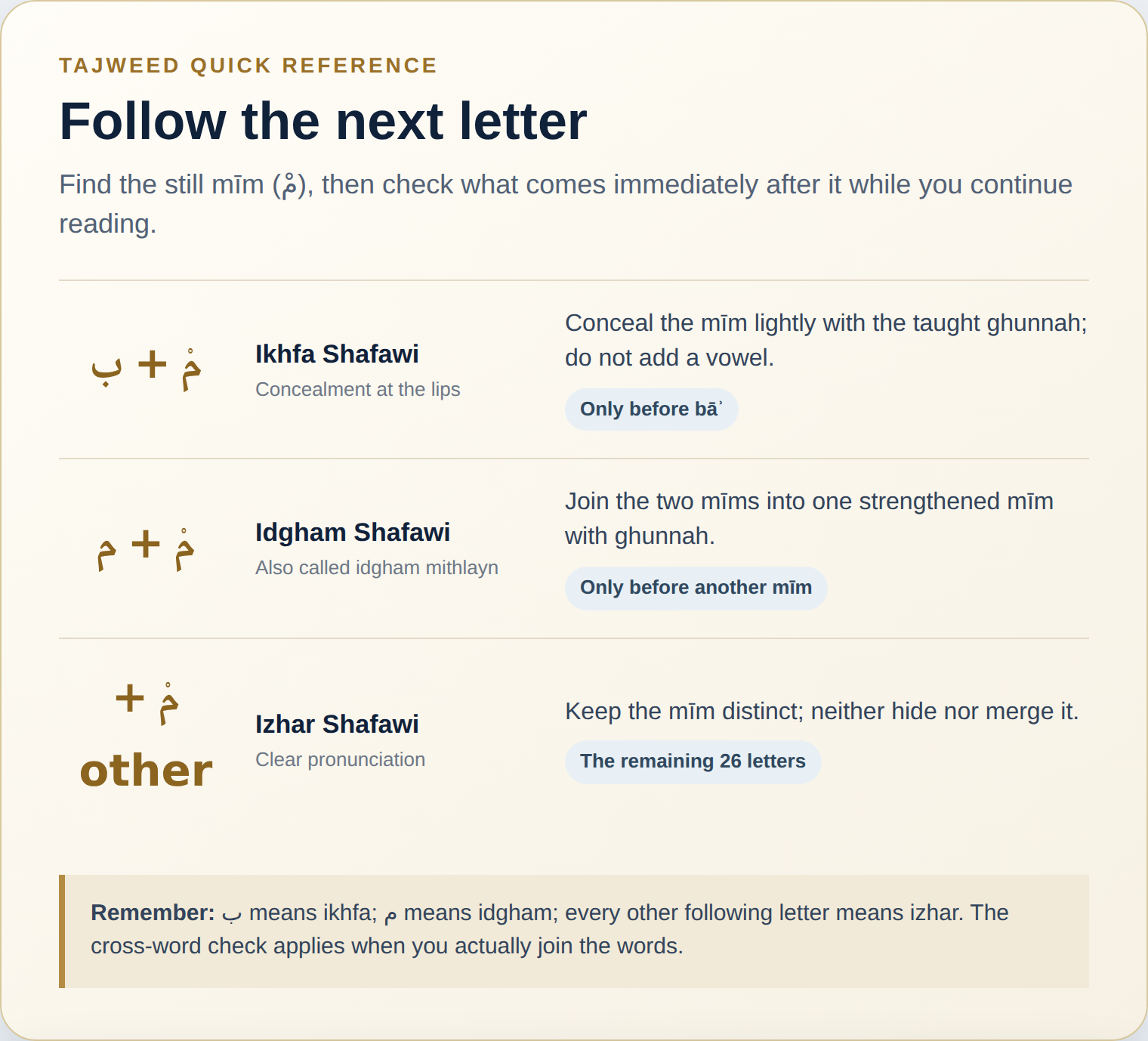
- ب after مْ — ikhfa shafawi: conceal the mīm lightly with the ghunnah taught for this rule; do not turn it into a fully separate, sharp mīm followed by bāʾ.
- م after مْ — idgham shafawi: merge the first still mīm into the following mīm. The result is heard as one strengthened/doubled mīm with ghunnah, rather than two disconnected mīm sounds. Some lessons call this idgham mithlayn.
- Any other following letter — izhar shafawi: make the mīm clear before moving to the next letter. The rule adds no concealment or merging; it does not mean removing the ordinary nasal quality that belongs to the letter mīm.
Use the next letter as the decision key—not the English meaning, the word boundary by itself, or a guess about whether a sound “feels nasal.” A second mīm is the only idgham trigger, and bāʾ is the only ikhfa trigger in this three-rule system.
Read one Quran example for each rule
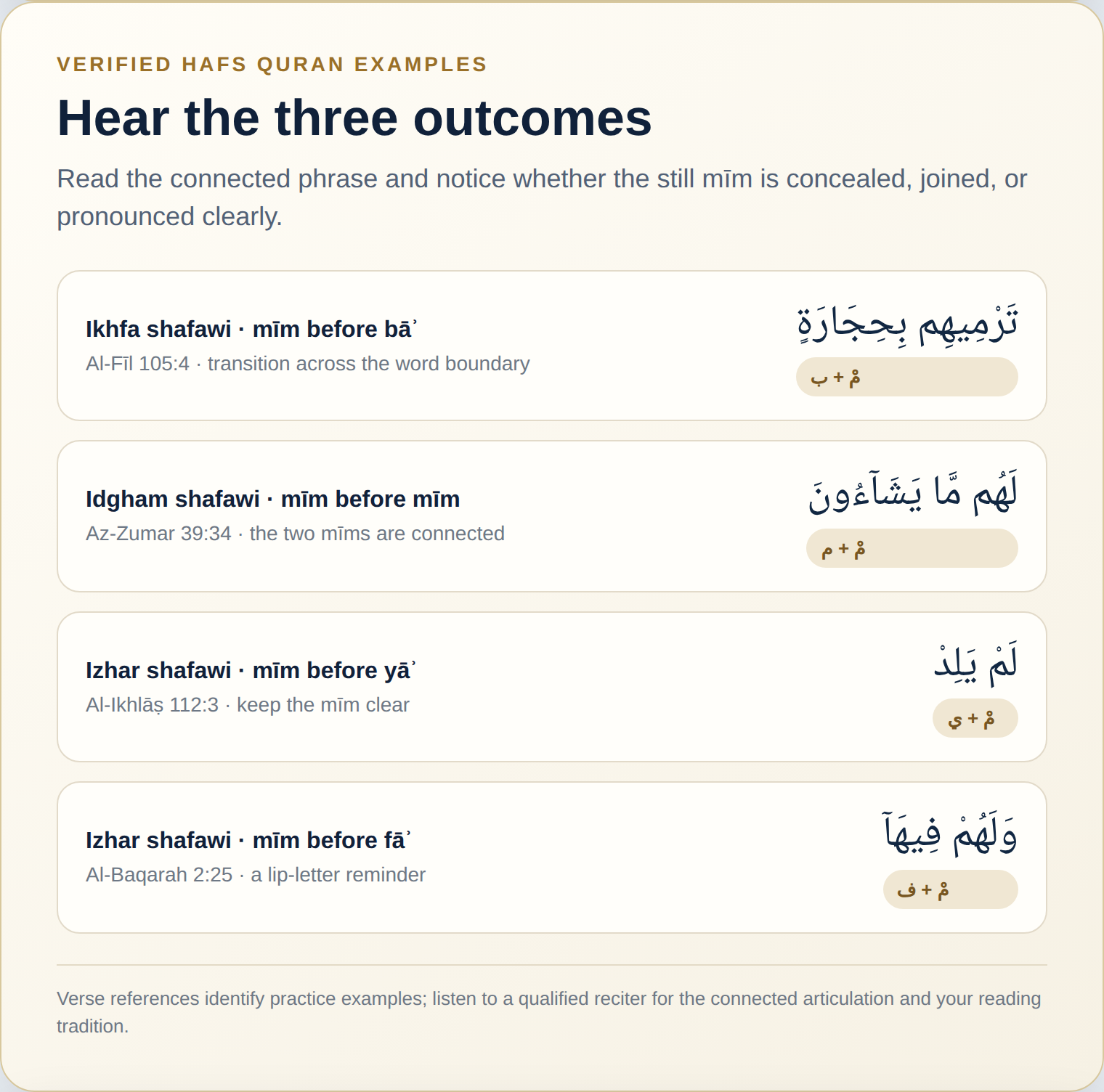
The examples below come from the Hafs text. Read them as connected phrases for the rule to apply. The exact sound is best learned by listening to a qualified reciter and having a teacher check your own reading.
1. Ikhfa shafawi: still mīm before bāʾ
In Al-Fīl 105:4, the phrase is تَرْمِيهِم بِحِجَارَةٍ (tarmeehim biḥijārah). The mīm at the end of tarmeehim meets bāʾ at the start of the next word when you continue. Conceal it with the rule’s taught nasal quality while keeping the transition controlled. Do not insert a short vowel between the words or pronounce an extra, fully separated mīm.
This short verse is a useful place to listen and repeat because the meeting happens across a word boundary. Quranytime’s focused ikhfa-shafawi example before bāʾ gives more practice with this one member of the system.
This example also shows why the next-letter test applies only when joining. If you pause after tarmeehim, do not carry ikhfa across the silence into the following bāʾ; treat the word ending as a stop. When continuing, make the connection as demonstrated by your reciter, without inserting an extra vowel.
2. Idgham shafawi: still mīm before another mīm
In Az-Zumar 39:34, notice لَهُم مَّا يَشَآءُونَ (lahum mā yashāʾūn). The first mīm in lahum is still; the next word begins with another mīm. Join them into one strengthened mīm with the ghunnah taught for idgham. Do not read a crisp pause or add a vowel between the two mīms.
This rule is limited to mīm meeting mīm. It is not the nūn-and-tanwīn idgham described in other Tajweed lessons. If you are working on the nasal sound itself, Quranytime’s listening guide to ghunnah can help you notice the sound, but the teacher’s recitation remains the model for timing and articulation.
3. Izhar shafawi: a clear mīm before the other letters
Al-Ikhlāṣ 112:3 includes لَمْ يَلِدْ (lam yalid). Here the still mīm is followed by yāʾ, so pronounce the mīm clearly and move into yāʾ without hiding or merging the sound. Al-Baqarah 2:25 gives a useful lip-letter reminder in وَلَهُمْ فِيهَا: when continuing, the mīm at the end of lahum meets fāʾ. Fāʾ does not change the classification; it remains izhar shafawi.
Pay particular attention before و and ف. Both involve the lips, so learners may accidentally blur the mīm into the next sound. Keep the mīm distinct, but do not insert an extra vowel or unnaturally lengthen it.
How to tell izhar, idgham, and ikhfa apart
All three rules begin with مْ, so it is easy to remember the names but still hesitate while reading. Make the following letter do the work. If it is ب, choose ikhfa. If it is م, choose idgham. If it is anything else, choose izhar. Then listen for the difference between the three outcomes: concealed, merged, and clear.
That comparison is more helpful than trying to memorize a long list of “special letters”: this system has only two exceptional followers. The Mīm remains a lip sound in all three cases, but the transition into the next letter changes. For a wider introduction, see Quranytime’s beginner guide to Tajweed; this article narrows the focus to the still mīm.
At a word boundary, the following letter triggers a rule only if the recitation continues into that word. If you pause intentionally, do not hide or merge the final mīm toward a letter that is not being read yet. The rule depends on the sound sequence you actually recite, not merely on neighboring words printed on the page.
One specialist learner reference likewise organizes the rule around the three next-letter outcomes; compare its meem-sakinah rules and examples, then confirm your own articulation by listening to a qualified teacher.
Common mistakes to listen for
- Using the wrong trigger: ikhfa shafawi is before ب, idgham shafawi is before م, and the remaining letters take izhar shafawi.
- Adding a vowel after the still mīm: the sukoon means the letter has no vowel of its own. Do not invent one to make the transition easier.
- Splitting two mīms: before another mīm, avoid a gap that makes the joined sound two unrelated syllables.
- Over-hiding before wāw or fāʾ: their lip articulation can make the mīm seem less distinct. Keep the mīm audible and do not carry its sound into the next letter.
- Overstating timing: many beginner explanations use a two-count cue for ghunnah in the relevant rules. Treat counting as a practice aid, not a stopwatch or a substitute for the measured model in your riwāyah and class.
- Applying a joined-word rule after stopping: the following letter matters only if you are actually continuing into it. A deliberate waqf changes the sequence.
If these checks are hard to remember, use a brief Tajweed mistake checklist after reciting, and focus on one repeated issue at a time. Avoid interrupting every line to self-correct; finish a small passage, then review the point your teacher asked you to notice.
A short listening and practice routine
Choose one example for each rule and practise in this order:
- Mark the still mīm. Find مْ in the mushaf and look only at the next letter.
- Name the rule before reading. Say “bāʾ: ikhfa,” “mīm: idgham,” or “other: izhar.” This makes recognition automatic.
- Listen, then imitate. Hear a reliable model at a comfortable speed. Read the same phrase slowly enough to distinguish the mīm, then return to a natural pace without forcing extra length.
- Record one short attempt if useful. Compare the transition, not the beauty of your voice. Ask a teacher whether the mīm was clear, joined, or concealed as intended.
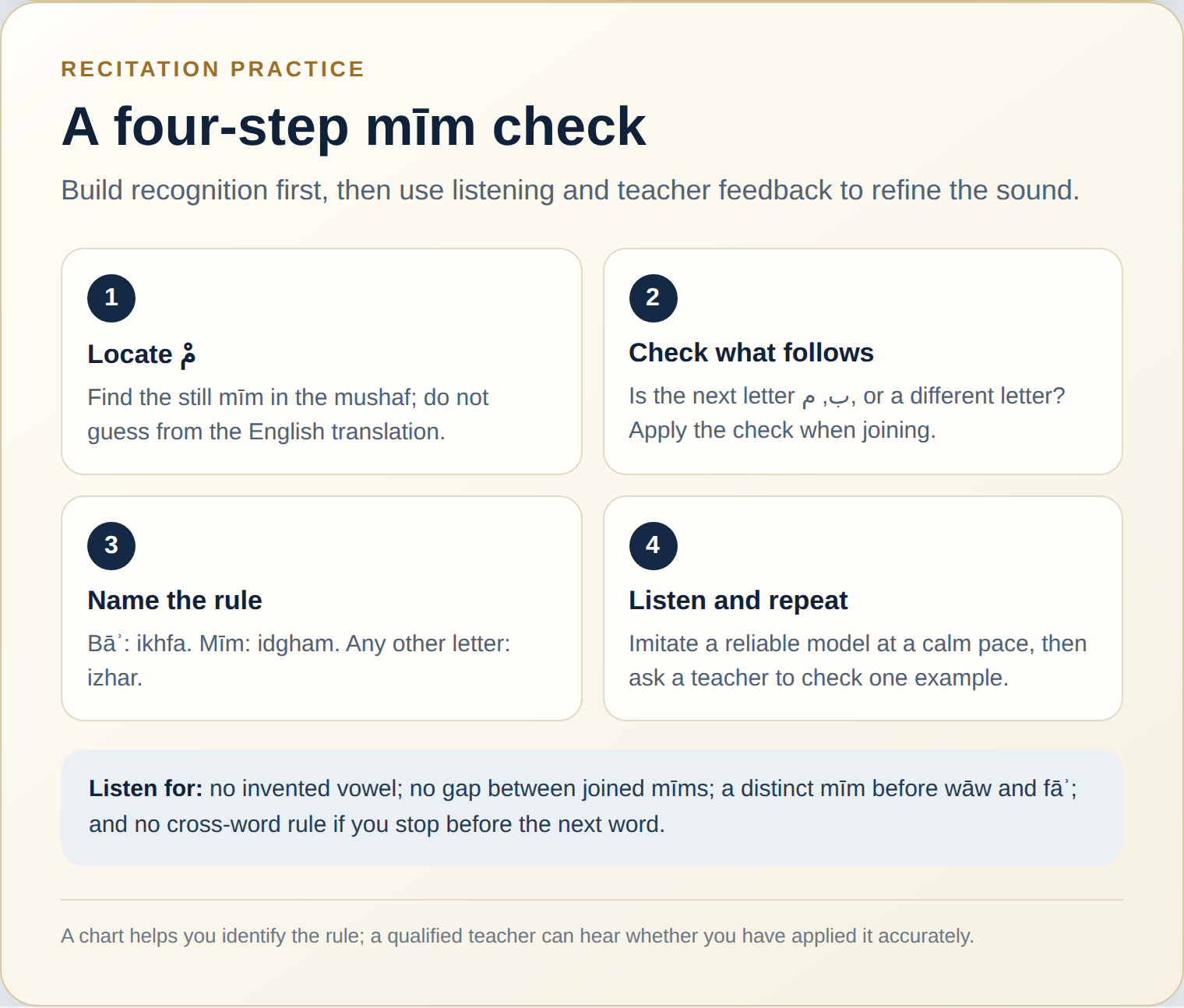
For teacher feedback, Quranytime explains how to record Quran recitation for useful review. You can also book a free Quran and Arabic trial class and ask a teacher to listen to one example at a time. A written chart can help you choose the rule; only listening can show whether the sound is being produced well.
A safe rule to remember
When you see مْ, check what follows: ب means ikhfa shafawi, م means idgham shafawi, and any other letter means izhar shafawi. Practise the contrast with Quran examples, keeping a connected rule separate from a pause. The article’s video lesson below can help you hear the three categories, but use your own teacher and reading tradition for correction. If you want a structured foundation, explore Quranytime’s online Quran Tajweed learning options.