

Ikhfa Shafawi is the Meem Sakinah rule to recognize when a silent Meem (مْ) is followed by Ba (ب). It is a small sequence, but it deserves careful attention because the sound sits between a fully clear Meem and a complete merge. The aim is to soften and conceal the Meem with ghunnah, then move naturally into Ba without inserting a new vowel or separating the two letters too sharply.
The name gives a useful clue: shafawi refers to the lips. Both Meem and Ba are made with the lips, so this rule is heard and felt as a controlled lip transition. In everyday reading, you may meet it inside a phrase or across the boundary between two connected words. Learning to spot that next Ba quickly is more useful than memorising a long list of examples.
The fast next-letter decision
When you see a Meem with sukoon, do not begin by asking which page or surah you are reading. Look one letter ahead. If the next letter is Ba, you have Ikhfa Shafawi. That quick check can become an automatic habit:
- Find the silent Meem (مْ).
- Check the following letter, including the first letter of the next word.
- If it is Ba (ب), soften the Meem with ghunnah and transition into Ba.
- If it is not Ba, use the appropriate Meem Sakinah rule instead.
This is also why a word boundary matters. In connected reading, the final Meem of one word and the opening Ba of the next word form the relevant sequence. Your eye should travel across the space rather than stopping at the end of the first word. A helpful way to build that reflex is to scan for مْ, then immediately inspect the next letter before you start the phrase.
How to recite Meem Sakinah before Ba
Recite the Meem neither as a fully separate, clearly released M nor as a full merge into the Ba. Instead, keep the lips poised for the transition, allow the nasal quality of ghunnah to be heard, and then enter the Ba cleanly. Many beginner classes use approximately two counts as a practice cue for the ghunnah. Treat that as a helpful timing guide, not as a license to stretch the sound mechanically; your qualified teacher and recitation tradition should guide the final length and quality.
Do not add a short vowel after the Meem to make the movement feel easier. The Meem remains sakin. The softness comes from concealment and ghunnah, not from saying “ma,” “mi,” or “mu” before the Ba. At the same time, avoid pressing the lips so firmly or holding the sound so long that the phrase becomes hesitant. The best result is stable, light, and connected.
Some teachers may describe or demonstrate the amount of lip spacing slightly differently. That variation should not become a reason to invent a separate technique. Follow your qualified teacher’s model, keep the Meem without a new vowel, and listen for a smooth transition rather than trying to measure a tiny physical gap on your own.
Two Quran examples across connected words
In تَرۡمِيهِم بِحِجَارَةٖ from Al-Fil 105:4, the final Meem of تَرۡمِيهِم is followed by Ba at the start of بِحِجَارَةٖ. When you continue without stopping, this is the Meem-to-Ba sequence to practise: soften the Meem with ghunnah, then move into the Ba.
A second example is عَلَيۡهِم بِمُصَيۡطِرٍ from Al-Ghashiyah 88:22. Again, the Meem at the end of عَلَيۡهِم meets the Ba beginning بِمُصَيۡطِرٍ when the two words are linked. Read the phrase slowly first, then repeat it at a comfortable pace while keeping the connection intact.
The relevant letters can sit on opposite sides of a word space. For a wider review, keep the Tajweed rules chart nearby, and use the Tajweed rules in the Quran guide to place this rule in the larger reading system.
Identify the three Meem Sakinah patterns
Ikhfa Shafawi becomes easier when it is compared with the other two common patterns involving Meem Sakinah. The next letter supplies the decision:
- Meem before Ba: Ikhfa Shafawi — conceal or soften the Meem with ghunnah before entering Ba.
- Meem before Meem: Idgham Shafawi — the first Meem merges into the following Meem.
- Meem before any other letter: Izhar Shafawi — pronounce the Meem clearly, without the concealment used before Ba.
Before you read a Meem Sakinah, make the next-letter check first. This prevents treating every Meem at the end of a word as if it should sound the same. Use the comparison card below before longer practice.
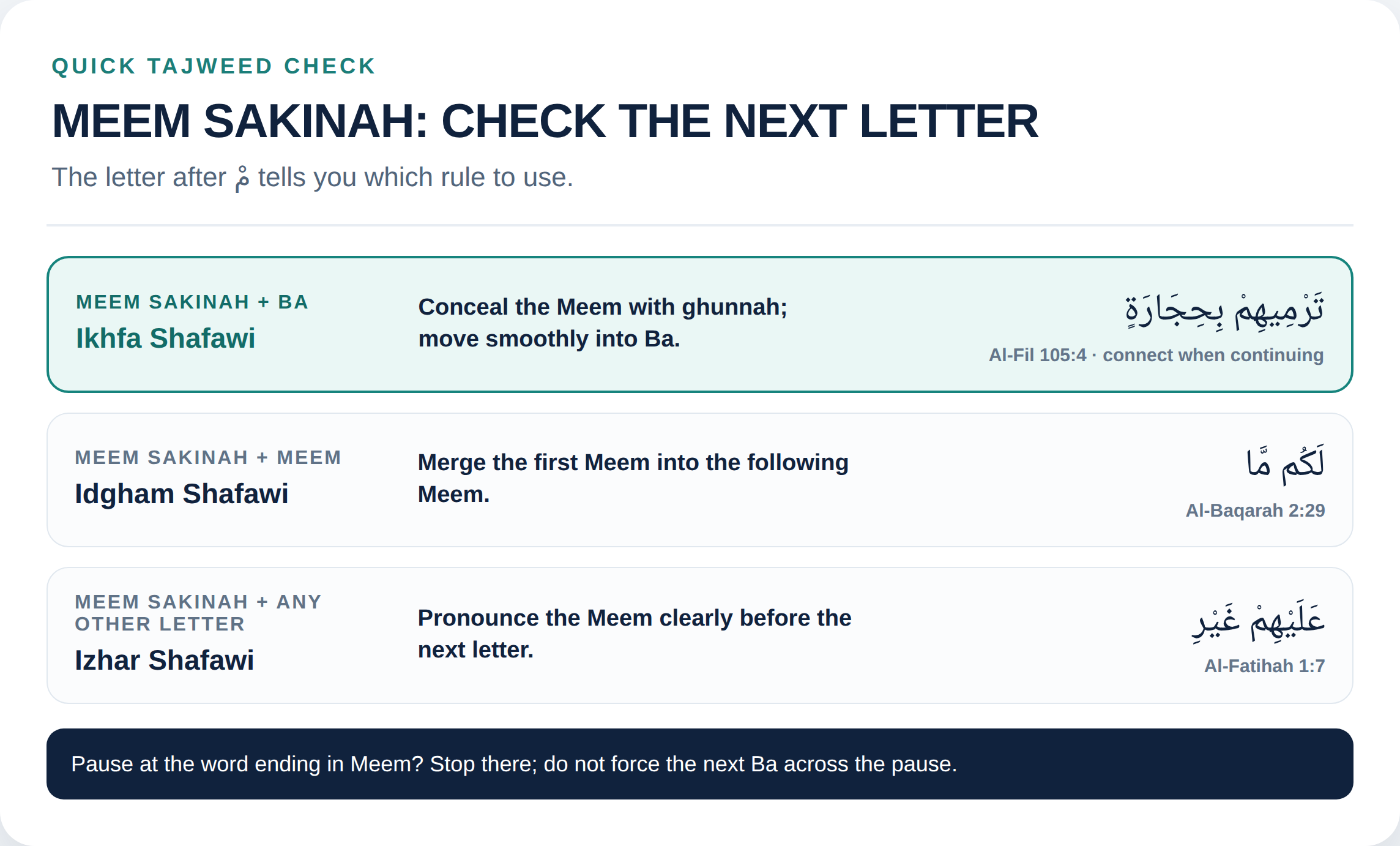
For a broader beginner foundation, revisit what Tajweed means for beginners. If stopping signs are affecting how you interpret a word boundary, review the six Quran waqf signs. These supporting skills help you decide whether the Meem and Ba are actually being read as one connected sequence.
Pause versus continue: the boundary changes the task
Ikhfa Shafawi applies when the Meem Sakinah is followed by Ba in connected reading. If you stop at the word ending in Meem, do not force the next Ba across that pause. The reciter has chosen to end the sound at the Meem, so the next word is no longer being joined to it in that moment. When you resume, begin the following word according to its own opening sound.
Practise both choices deliberately. First, read the phrase with a connected flow and listen for the softened Meem before Ba. Then stop at the Meem-ending word, observe the pause, and start the next word separately. This contrast teaches your eyes and ears that punctuation, stopping signs, and intentional waqf can change which sequence you are actually reciting. Do not turn a needed pause into a forced connection just to display the rule.
Listening checks that take less than a minute
A good self-check does not require recording an entire page. Choose one phrase containing Meem before Ba and ask three questions:
- Did I keep the Meem sakin, or did I accidentally add a vowel?
- Was there a brief, controlled ghunnah rather than a sharply released M?
- Did the sound move into Ba without disappearing into a complete merge?
Record one connected attempt and one paused attempt, then compare only the target transition. If the first version sounds like “Meem, space, Ba,” make the lip movement smaller and keep the nasal tone steady. If the Meem disappears completely, slow down and make sure its presence can still be heard before Ba. Do not chase volume; the goal is accuracy and ease.
Use the lesson below as a listening and demonstration prompt, then compare what you hear with the model given by your own teacher. Its practical value is in hearing the transition repeatedly, not in replacing guided correction.
A short practice routine
Begin with the two verified examples above. Read each phrase three ways: once very slowly, once at a natural teaching pace, and once in the surrounding ayah. On the second round, put a light pencil mark under the Meem and a small cue above the following Ba. On the third, remove the marks and see whether your next-letter decision has become automatic.
Next, make a three-column exercise from your reading: Meem before Ba, Meem before Meem, and Meem before another letter. Add a few examples under each heading, but check them with a qualified teacher rather than assuming that every visually similar sequence has the same treatment. This turns recognition into a useful reading skill instead of an isolated definition.
For independent work, follow a between-lessons Tajweed practice routine. Use Quran audio repeat practice for short, focused loops, and send a careful sample through recitation recording and teacher feedback when you need confirmation of lip movement or ghunnah. Keep sessions short enough that you can hear the target clearly; rushing through a full page can hide a small mistake.
Common mistakes to correct gently
Making a clear, released Meem: This can create a noticeable break before Ba. Return to the idea of a softened lip transition and keep the ghunnah controlled.
Merging everything into Ba: The Meem should not vanish. Slow down until you can hear its nasal presence, then restore a natural pace.
Adding a vowel: Avoid turning مْ into a new syllable. The rule does not permit inserting a kasrah, fathah, or dhammah sound to bridge the two letters.
Applying the rule after a stop: If you intentionally stop at the Meem-ending word, do not carry the next Ba across the pause. Review the Tajweed mistakes checklist if this confusion appears often.
Rushing the transition: Smoothness is not the same as speed. Aim for an unforced connection, and use fluency practice without rushing to build steadiness.
Keep the rule practical
The essential habit is simple: see Meem Sakinah, check the next letter, and decide before you recite. Ba calls for Ikhfa Shafawi in connected reading; Meem calls for Idgham Shafawi; other letters call for Izhar Shafawi. Then let your teacher refine the details of ghunnah, timing, and lip spacing according to your recitation tradition.
With brief listening checks and repeated practice on real word boundaries, Ikhfa Shafawi becomes a quiet part of fluent recitation rather than a pause for uncertainty. Keep the Meem present but concealed, do not add a vowel, respect the choice to stop, and let accurate repetition make the next-letter decision automatic.
For the single external rule reference used in this explanation, see Mualim al-Qur’an Lesson 6: Ikhfa’ Shafawi (Meem Saakin), identified on its site as a lesson from the Islamic Information Center at Sultan Qaboos Grand Mosque.