
How to Track Quran Memorization Progress Beyond Page Counts
A page count can tell you what you planned to learn. It cannot tell you what you can recall when the Mushaf is closed, which part still needs correction, or whether older passages are holding up. If you are asking how to track Quran memorization progress, start with a record that answers those questions—not a streak chart that only says you showed up.
For Hifz, progress is not one number. Keep separate notes for new memorization, recall, corrections, and revision. Treat them as learning signals to discuss with your teacher, not as a grade, a certificate, or a measure of your worth. There is no universal score that proves a passage is secure for every learner.
What should a Hifz progress tracker measure?
Four simple categories are enough for most learners. They prevent a common mix-up: marking a passage “done” because it was read several times, even though it has not yet been recalled without looking or checked again later.
- New memorization. Record the surah and ayah range you are working on and whether it has been introduced, practised, or checked. This is a description of the work in progress, not a promise that a certain amount should be learned each day.
- Recall evidence. Note whether you recited with the Mushaf open, from memory with no cue, or after a small prompt. If you can, record whether the check was immediate or after a teacher-agreed interval. Those are different conditions, so do not combine them into one unexplained tick.
- Correction needs. Write down the location and type of correction: for example, a sequence mix-up, an omitted word, or a pronunciation point your teacher identified. “Bad today” is not useful data; a precise note gives you something to review.
- Revision health. Keep track of what happened when you returned to recent and older memorization. A new passage can feel familiar while older material is less steady. A separate Hifz revision guide can help you think about review, while the tracker records what your checks actually show.
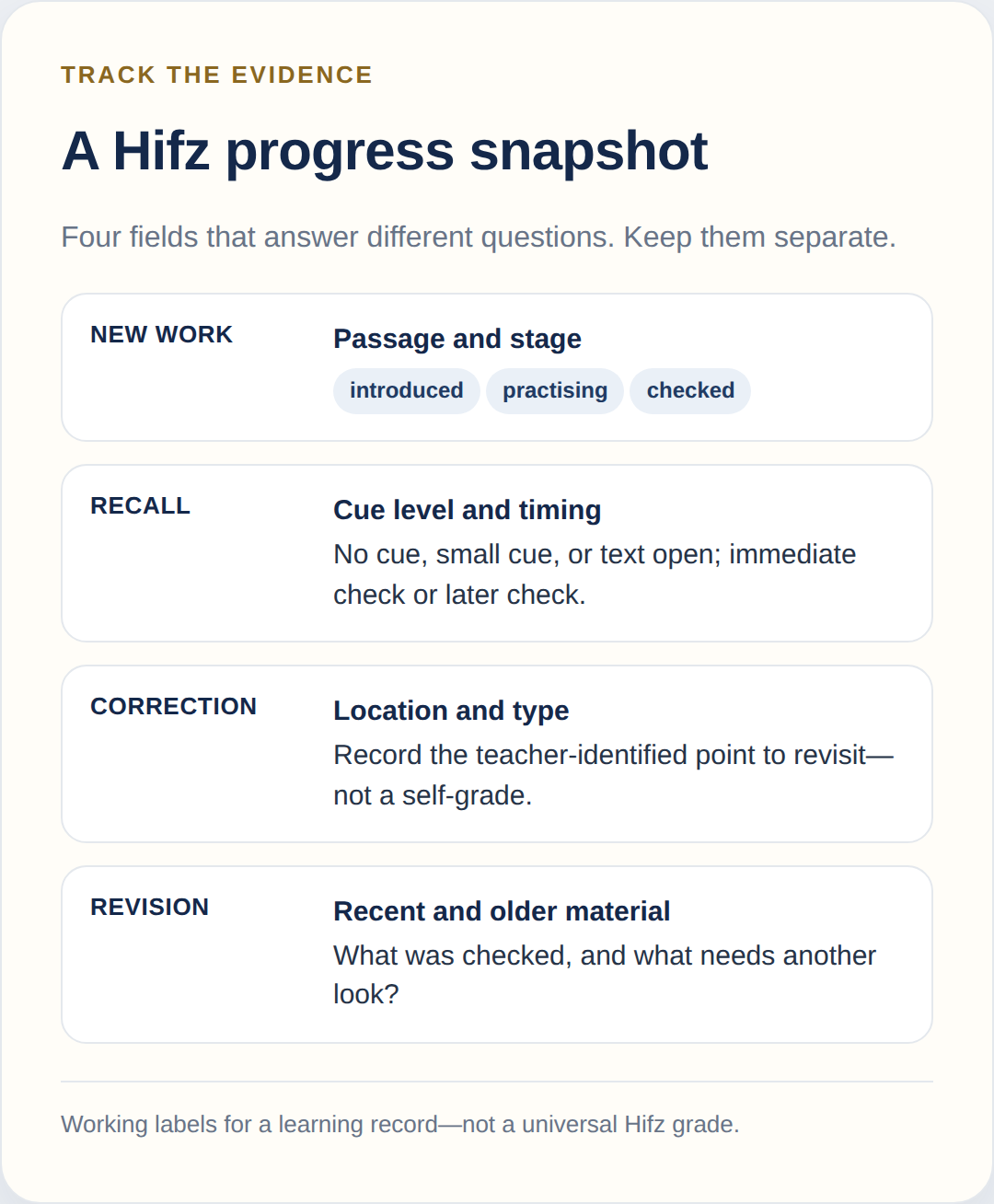
These are working labels, not a formal Hifz standard. If your teacher uses different terms or a particular review method, use that method. The point is to make your next conversation clearer, not to replace instruction with a spreadsheet.
Record the check, not just the practice time
Minutes spent and repetitions completed can describe effort, but they do not show what came back from memory. Carnegie Mellon University’s teaching resource describes retrieval practice as recalling information from memory and notes that feedback can help learners correct errors. That is general education guidance, not research on Quran memorization, Tajweed, or Hifz standards. It supports a modest idea: include a recall check and note what feedback was needed, rather than treating time spent as proof of learning. Read Carnegie Mellon’s overview of retrieval practice.
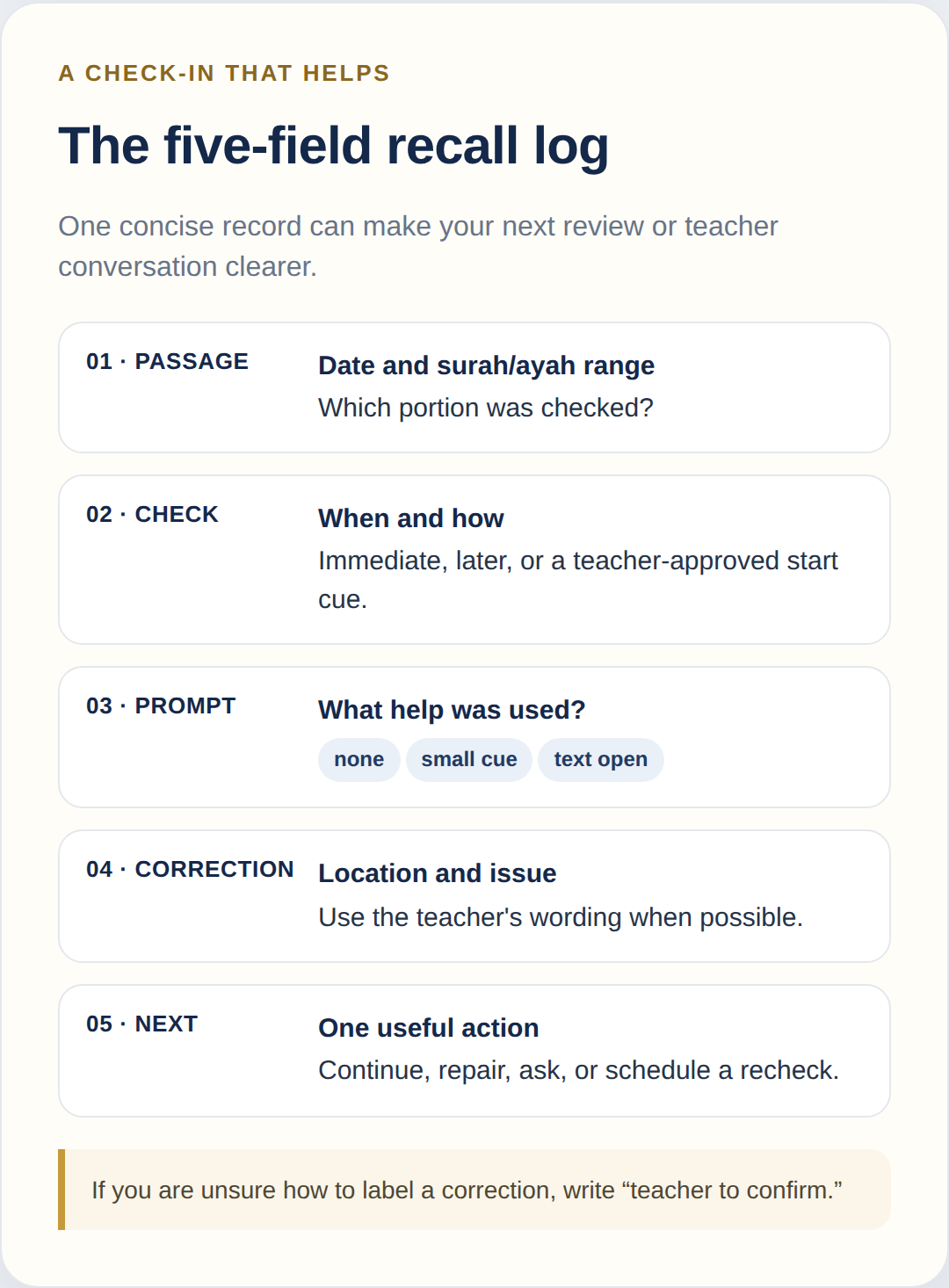
A useful log can fit on a single line. Write the date and passage; identify the kind of check; note what cue, if any, was used; record the correction; then write the next step you and your teacher agreed on. Do not create a complicated scoring system unless it answers a question you actually have.
For the check itself, choose a prompt that matches your goal. An immediate recitation can show how the lesson went today. A later recitation can show what remains after time away. A teacher-approved start from somewhere other than the beginning can test whether recall depends on a single opening cue. Quranytime’s guide to random-start retrieval cues explains that practice in more detail. Use the cue your teacher considers appropriate; the tracker is not a reason to test yourself in a way that creates confusion.
If listening is part of your learning, record it separately from recall. Hearing a passage can support familiarization, but a listening session and a recitation from memory are not the same check. The site’s listen-and-repeat practice guide may help you plan that part without counting audio time as independent recall.
Turn your notes into a helpful next step
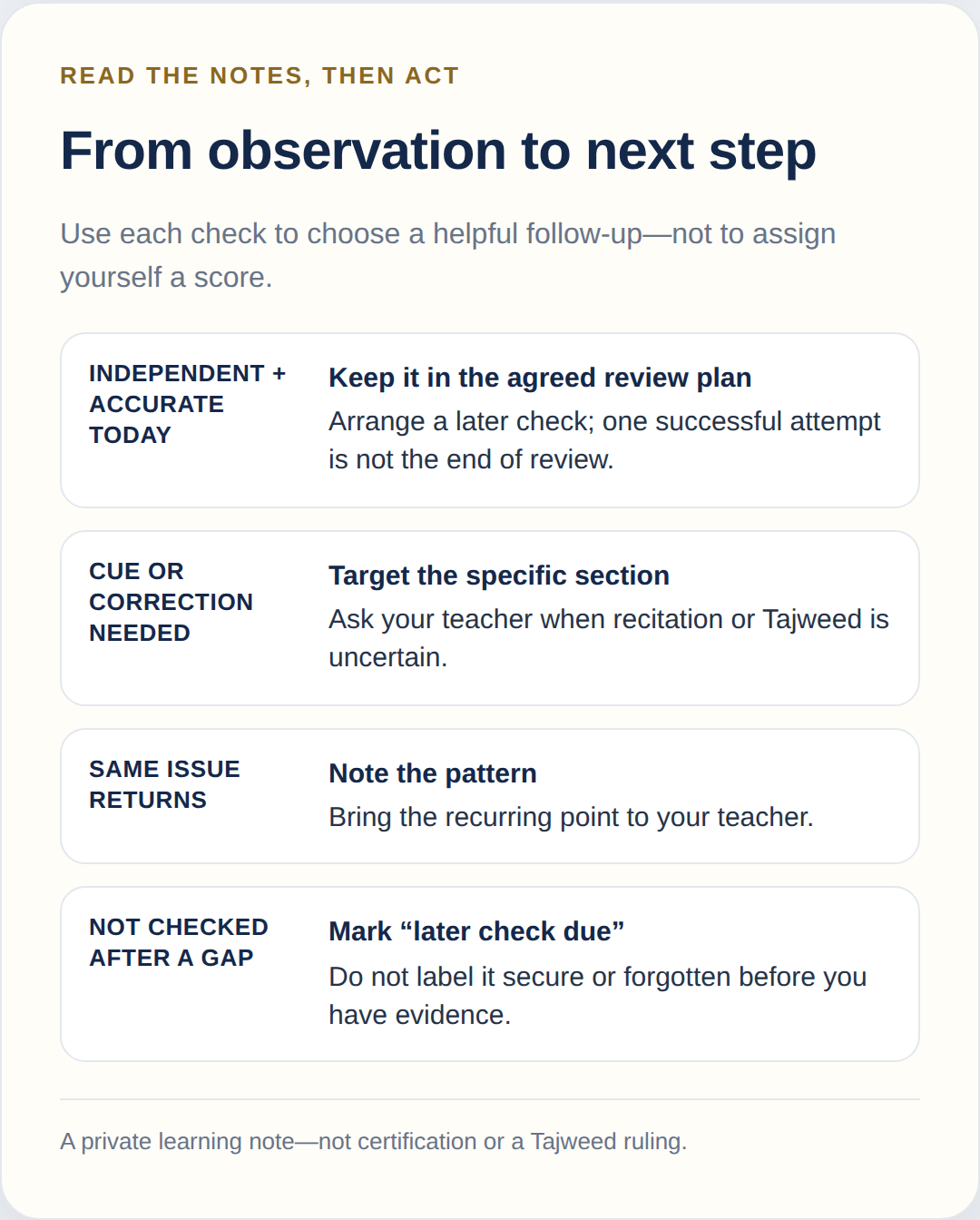
A tracker is useful only if it changes what you do next. After a check, ask: What did I recall without help? Where did I need a cue? Did a correction happen once, or has the same kind of error appeared again? What should be checked later? The answer may be “continue the plan,” “repair this section,” or “ask my teacher to listen.” It does not have to be a score.
- Accurate without a cue today: note the conditions of the check and keep the passage in the review plan your teacher gave you. One successful attempt is encouraging evidence, but it is not a reason to remove all future review.
- A cue or correction was needed: write down the exact point and practise that part with guidance. If the correction involved pronunciation or Tajweed, ask your teacher rather than deciding from a self-score.
- The same difficulty returns: mark the pattern and bring it to your teacher. A repeated sequence mix-up, for example, may need a different kind of explanation than a passage that simply has not been reviewed recently. The guide to reviewing similar Quran verses discusses one common source of mix-ups.
- The passage has not been checked after a gap: label it “later check due,” rather than “secure” or “forgotten.” Your next review can provide better evidence.
Use the notes to guide a conversation, not to overrule your teacher. If you move between teachers, a clear record of passages, corrections, and checks can make the transition easier; Quranytime’s Hifz teacher handover guide suggests what learning information may be useful to share.
Keep progress separate from pace
One reason page totals feel attractive is that they are easy to compare. But learners may have different passages, starting points, recitation needs, review loads, and teacher guidance. A progress record should help you see your own learning more clearly, not rank you against another person.
Likewise, a tracker should not quietly become a quota. If you are deciding how much new material fits alongside revision, use the separate guide to choosing a daily memorization amount; this article is about evidence and follow-up, not choosing a target. If you need a broader method overview, Quranytime’s Hifz techniques guide covers approaches to discuss with your teacher. A 30-day memorization planner is a different tool again: it helps structure practice, while a progress log records what happened during it.
Keep the tracking system light enough to maintain. If every check requires a long form, you may stop using it. Most days, a passage, cue level, correction, and next action are enough. Add detail only when it helps answer a real question, such as whether you are relying on an opening prompt or repeatedly mixing up a particular transition.
A short review you can do with your teacher
Bring a few recent entries and look for patterns rather than judging a single difficult session. Which passages came back without help? What kind of correction appears most often? Did recent review remain manageable while you worked on new material? Is there a section that should be checked again after more time? These questions are more useful than “How many pages did I finish?” when deciding where support is needed.
If you are unsure how to label a correction, leave the field open and ask. For example, write “teacher to confirm” rather than guessing whether an error was in wording, sequence, or pronunciation. You can also compare your record with any teacher-approved plan; if your teacher has already set a different way to check progress, follow that instruction. A free Quran and Arabic trial class can be a way to discuss your reading and ask what kind of progress record would suit your current level.
Make the record useful, then keep it simple
To track Hifz progress, record what you are learning, how you recalled it, which corrections were needed, and what should happen next. Check more than page totals, but do not turn every recitation into a test or treat a color, number, or streak as a verdict. A clear note can help you and your teacher see what is steady, what needs another look, and where a small adjustment may help.
Start with one passage and a few honest fields. Let the teacher guide the checks that involve recitation accuracy and Tajweed. As your record grows, keep only the details that help you make a better next decision. That is a more useful picture of progress than a page count on its own.