

Weekly Hifz Plan for Beginners: New, Review & Catch-Up
A weekly Hifz plan for beginners should answer three practical questions: what small portion will I work on, when will I return to it, and where will older memorization fit? It should not turn every day into a quota. A useful plan is a starting arrangement you can test against your reading, available time, revision load, and a teacher’s feedback.
The example below is a learning template, not a religious rule or a promise about how quickly anyone will memorize. Move the sessions to fit your week. If you are still learning to read the Quran accurately, begin with the reading foundations and readiness questions in Quranytime’s guide to starting Hifz and ask a qualified teacher to help you choose what to work on first.
Take a quick baseline before you fill in the week
Before adding boxes to a calendar, check what your week can actually hold. A plan made for an imaginary free afternoon will be hard to use on an ordinary Tuesday. Write down four things: the days or windows you can usually protect; the passage you are currently learning; any recent or older material that already needs review; and the kind of correction or listening support you can access.
Reading comfort matters too. If you are still stopping often to work through unfamiliar words or pronunciation, the new portion may need to be smaller while reading becomes steadier. That is not lost time; it is information that helps you choose a manageable next step. Your daily memorization amount should come from what you can learn and revisit with care, not from someone else’s page count.
Then choose a small number of repeatable study windows. A session does not have to happen at the same clock time every day. Some learners prefer a quiet morning; others have a dependable window later on. Quranytime’s guide to finding a Hifz time that fits can help you test a realistic slot and choose a backup when the first one is unavailable.
Build the week around return visits, not just new material
New memorization is the visible part of Hifz, but it cannot be the whole weekly plan. Include a return to the new passage soon after learning it, another chance to recall it after some time has passed, and a place for older material. The exact spacing and amount should suit your level and teacher’s method. If you already have a revision system, keep it; this template is meant to make room for it, not replace it. See the separate Hifz revision schedule guide for a deeper look at new, recent, and older review.
A simple distinction keeps the plan from becoming three names for the same task: new work is the passage you are currently learning; recent review is material learned lately; older review is material already in your Hifz that still needs periodic return. Your teacher may use different labels. Use the terms they use, and make sure the calendar gives each category room without assuming the same amount for everyone.
Here is one flexible seven-session pattern. “Session” can mean a short practice window, not a full hour. If your week only allows three or four sessions, spread the steps across those windows rather than trying to squeeze every row into the same day.
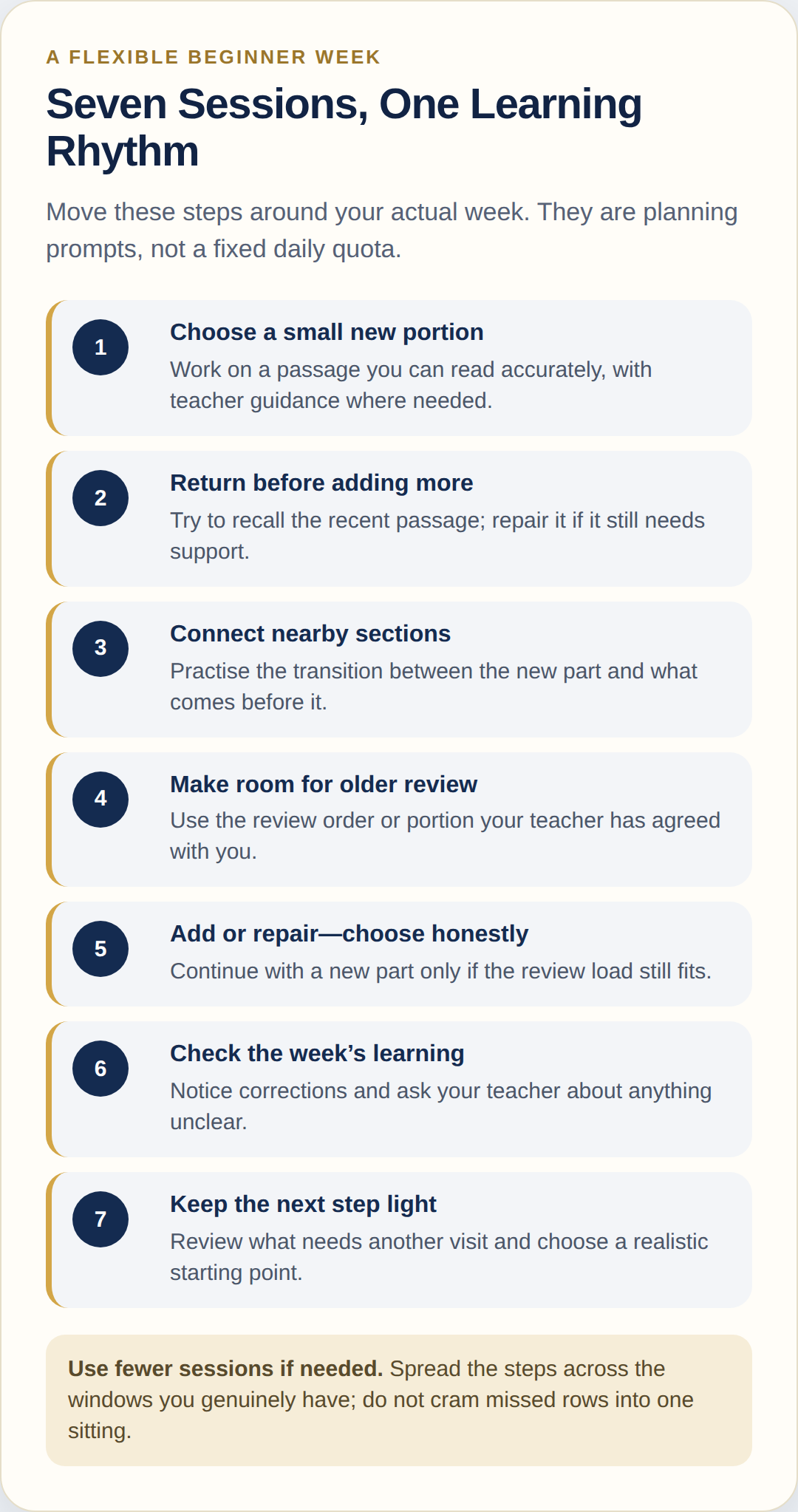
The order matters more than the day labels. Return to the recent passage before introducing more. If it comes back accurately under the check your teacher uses, you may continue with the planned portion. If it needs repeated prompting or correction, spend the next session repairing it instead. A weekly plan should respond to what happened, not insist that the calendar was right.
Keep each session simple enough to repeat
Beginners often make a plan complicated before they know which part is difficult. Try a clear sequence instead: first recall the recent passage without looking, then review the agreed older material, then work on a small new section if there is room. Finish by joining the new section to what comes before it and noting one question or correction to revisit.
This is a practical structure, not a universal method. Your teacher may use a different order or a particular recitation check. Follow that guidance, especially for pronunciation, Tajweed, and where one passage should connect to another. Do not count repetitions as proof that a passage is secure; notice what you can recite and what still needs support.
Research on learning in school settings has found broad value in practice testing and spreading study sessions across time. That work does not prescribe a Quran memorization schedule, but it offers a modest planning idea: make space to recall material again later rather than relying only on one long first sitting. The Association for Psychological Science’s overview of effective learning techniques summarizes that research and its general academic context.
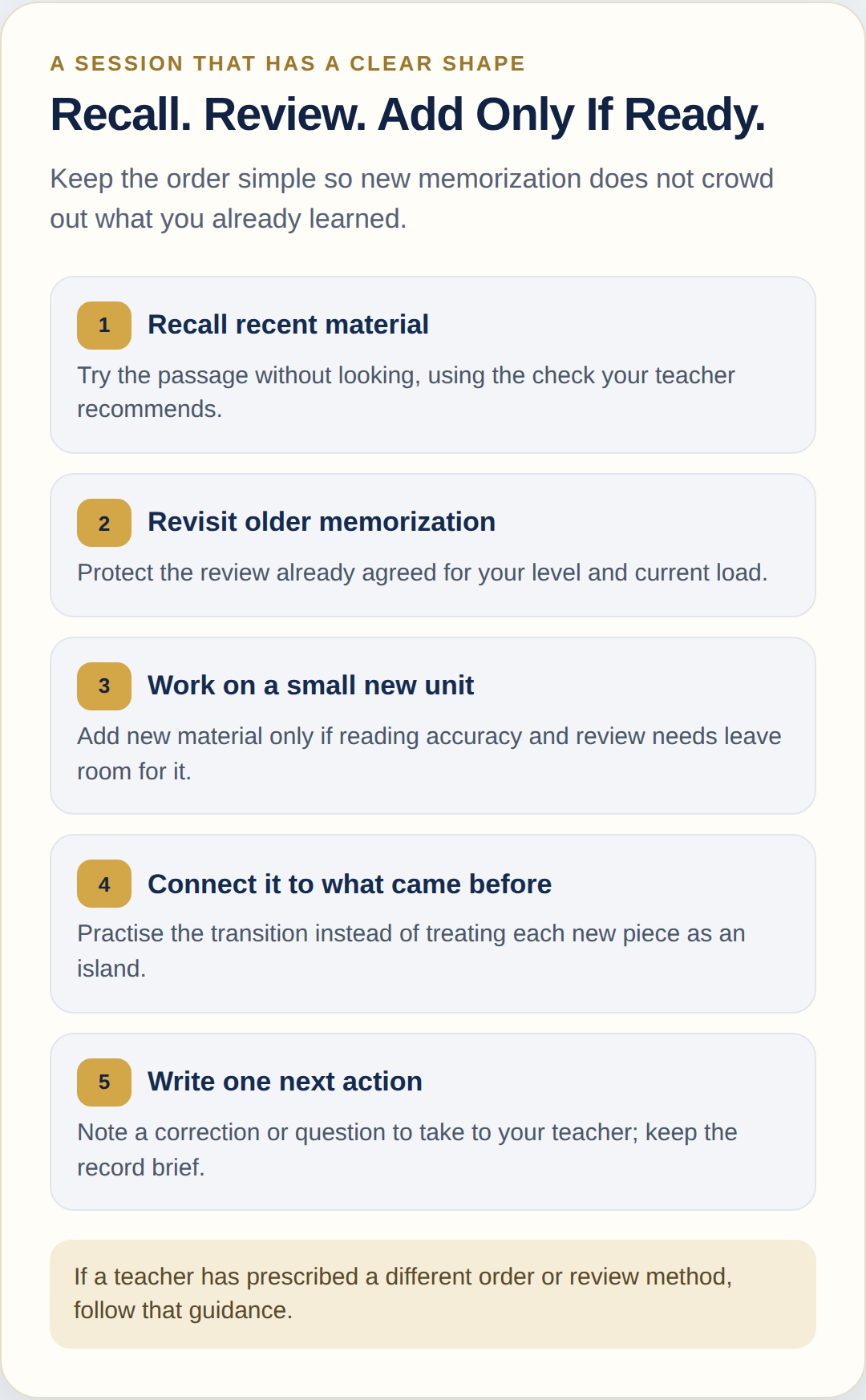
Keep the record brief. A date, passage, one note about recall, and the next action are often enough. If you want a fuller way to notice recall, corrections, and revision health, use the separate Quran memorization progress guide. This article is about arranging a week; the tracker article is about recording what your checks show.
Make a lighter version for a busy week
A plan needs a smaller setting for weeks when work, family, travel, or illness changes the time available. Decide in advance what you will protect if you cannot do everything. For example, your minimum version might be to return to the most recent passage and a short agreed review, while postponing new material until your next suitable session. Another learner may agree on a different minimum with a teacher.
Do not treat this smaller version as a failure or as a new permanent target. It is a way to keep the plan honest when circumstances change. The point is to preserve a useful learning sequence, not to maintain a streak. If interruptions have already made it hard to restart, Quranytime’s guide to staying consistent with Quran memorization covers how to return without creating a backlog of “missed” work.
What to do when the week slips
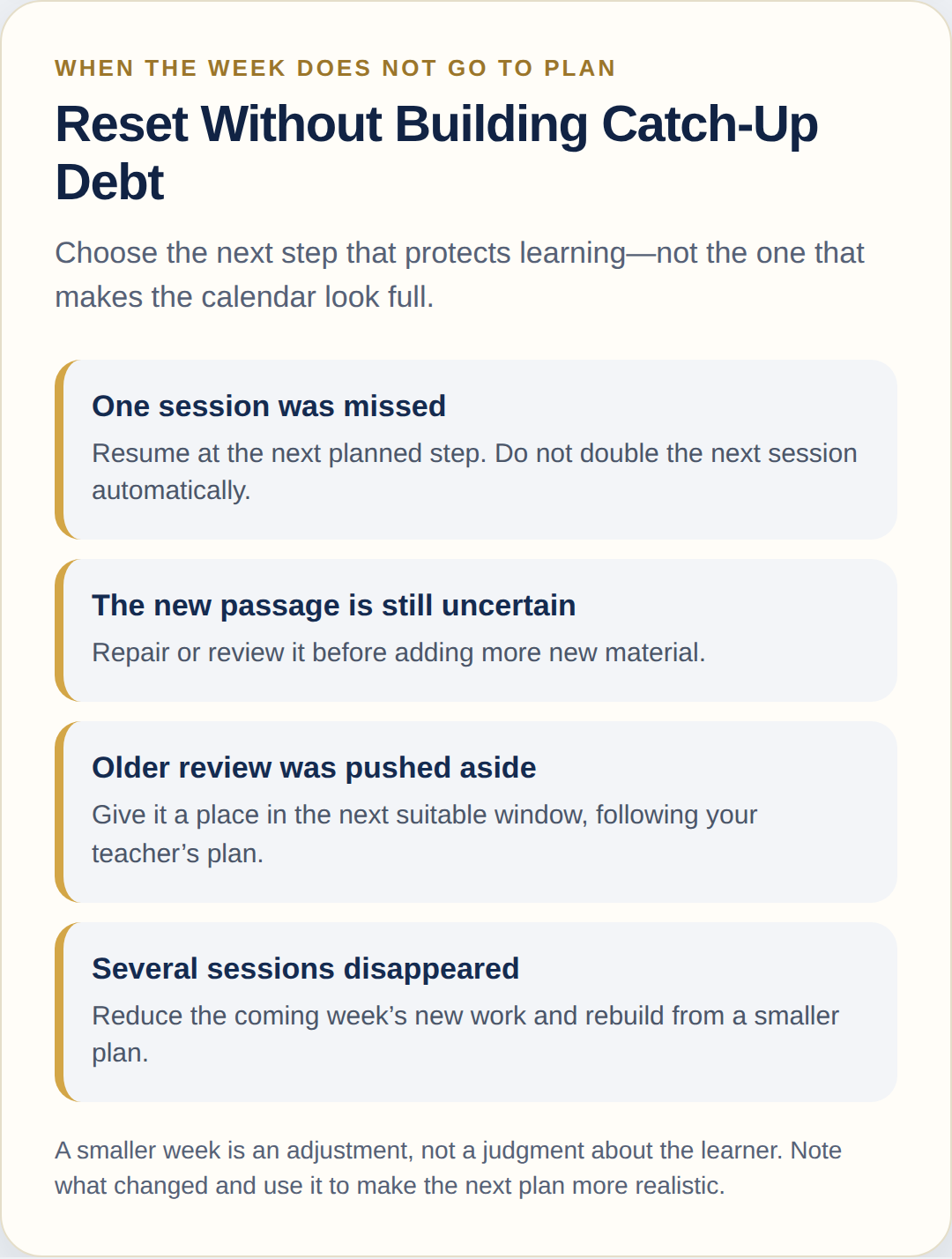
When a session is missed, resist the urge to double the next one automatically. First ask what was missed: new learning, recent recall, older review, or a teacher check. Then choose the next step that protects the learning rather than the schedule. If the new portion is still uncertain, review it before adding more. If older material has been pushed aside, use the next available window to bring it back. If several sessions disappeared, reduce the coming week’s new work and rebuild from a smaller plan.
This is a reset, not a catch-up debt. Add a brief note about what made the plan difficult—an unrealistic window, a passage that needed more correction, or a week with less time than expected. One note can help you change the plan instead of blaming yourself. For a broader month-long framework, the 30-day Quran memorization planner gives another structure; it should be adapted to your own schedule rather than followed as a fixed promise.
Review the plan before making it bigger
At the end of the week, take a few minutes to ask: Did I return to the new passage? Did older review still fit? Which correction came up more than once? Was the session window realistic? What should be smaller, moved, or removed next week? These questions are more helpful than asking only how many pages were completed.
Try the pattern for a short period before expanding it. If it is manageable and the recitation checks are going well, discuss a careful next step with your teacher. If the same part remains difficult, change the portion or review plan before increasing it. The Hifz calculator can show how different study assumptions affect a rough estimate, but no tool can promise a completion date or replace a teacher’s assessment of recitation and retention.
If you would like help choosing a first passage, checking your reading, or making a weekly plan that fits your level, you can book a free Quran and Arabic trial class. Bring the time windows you have and the material you already know; that gives the teacher something concrete to work with.
A weekly plan should serve the learning
Start with the sessions you can genuinely protect. Give recent and older memorization a place in the week, add new material only when the plan can support it, and keep a smaller version ready for busy periods. A clear weekly Hifz plan is not a race against another learner’s schedule. It is a practical arrangement you can review, adjust, and discuss with a qualified teacher.