

If you are starting Hifz in 2027, the first question is not how many pages you can memorise. It is what support and reading practice will help you begin accurately and keep learning manageable. New learners need a clear starting point, a teacher who can hear and correct recitation, a portion suited to their level, and a plan for returning to what they have learned.
This article is a getting-started guide: it explains readiness, first sessions, and the early decisions that make Hifz easier to continue. It is separate from a yearlong Quran memorization plan. You do not need to decide your full timeline before your first lesson, and there is no single pace that every child or adult should follow.
What “ready to start Hifz” really means
Readiness is not a pass-or-fail test. It is a way to identify what should happen first. One learner may already read confidently and be ready to discuss a small memorization portion with a teacher. Another may need help joining letters, recognising vowels, or correcting pronunciation before new memorization becomes the main focus. Both can begin a learning path; their first steps are simply different.
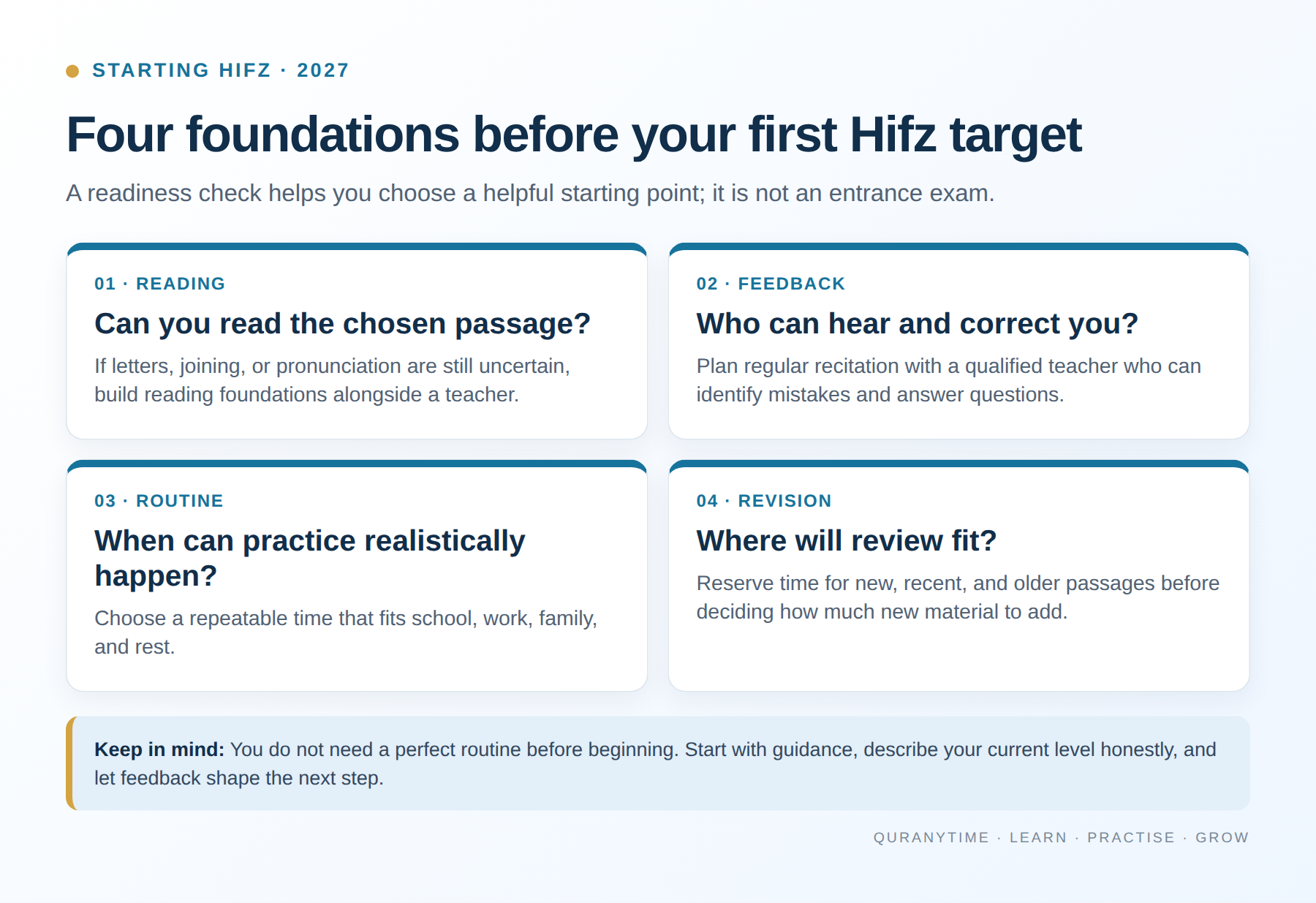
Before setting a target, check four foundations:
- Reading: Can the learner read a short passage in the chosen script with reasonable comfort, or are there reading sounds and joins that need attention first?
- Feedback: Is there a qualified teacher who can listen to recitation, correct pronunciation, and help select a suitable first portion?
- Routine: When can practice realistically fit around work, school, family, and rest?
- Revision: Where will the learner revisit new and older passages, rather than only moving forward?
If the learner is still developing basic reading skills, talk about that openly. A Quran reading and Tajweed learning path can help you explore the difference between reading foundations and later recitation goals. The teacher can explain whether you should work on reading first, combine it with a small Hifz target, or review a familiar passage while building accuracy.
Choose a teacher and describe your starting point
Hifz involves reciting from memory, so feedback needs to come from someone who can hear the learner. A teacher can identify errors that are hard to catch alone, help distinguish passages that sound similar, and recommend a realistic amount of new work. Ask about the teacher’s experience with the learner’s age and level, how corrections are given, and what the learner should practise between lessons.
When you meet a teacher, share what the learner can do now rather than what you think they should already know. Mention previous memorization, reading habits, available practice time, and any sounds that feel uncertain. If you are returning after a break, explain which parts still feel familiar and which need a fresh assessment. Quranytime’s page about its Quran teachers provides information about the academy’s teaching team; use a first conversation to ask how the lessons will fit your needs.
A starting lesson should leave you with a clearer next step. You can ask: Which reading skill should I focus on first? What small portion is appropriate? How will we check it? What should I review before the next meeting? What should I do if I cannot recall a passage? These questions help turn a broad goal into practice you can actually begin.
Select a first portion with guidance
There is no one surah or page that every new learner must start with. Some teachers begin with familiar or shorter passages; others consider the learner’s current reading, prior memorization, age, and lesson aims. Ask the teacher to explain why a selected portion suits the learner. Keep the amount small enough to read accurately and return to after the lesson.
Choose one mushaf edition and use it consistently unless your teacher recommends a change. Page layouts can differ between editions, so frequent switching may make it harder to remember where passages appear. If you use audio, choose a reliable reciter and follow the same text while listening. Audio repetition can support familiarity, but it does not replace live correction of the learner’s own recitation.
Quranytime’s Quran memorization learning path explains its Hifz focus. The right portion and pace should still be discussed with a teacher who can assess the learner directly; a general online recommendation cannot see how you read or where you need help.
What a first Hifz session can look like
A first session is a chance to establish a starting point, not to prove that you can memorise a large amount quickly. The exact sequence will depend on the learner. Here is one practical outline you can discuss with a teacher.
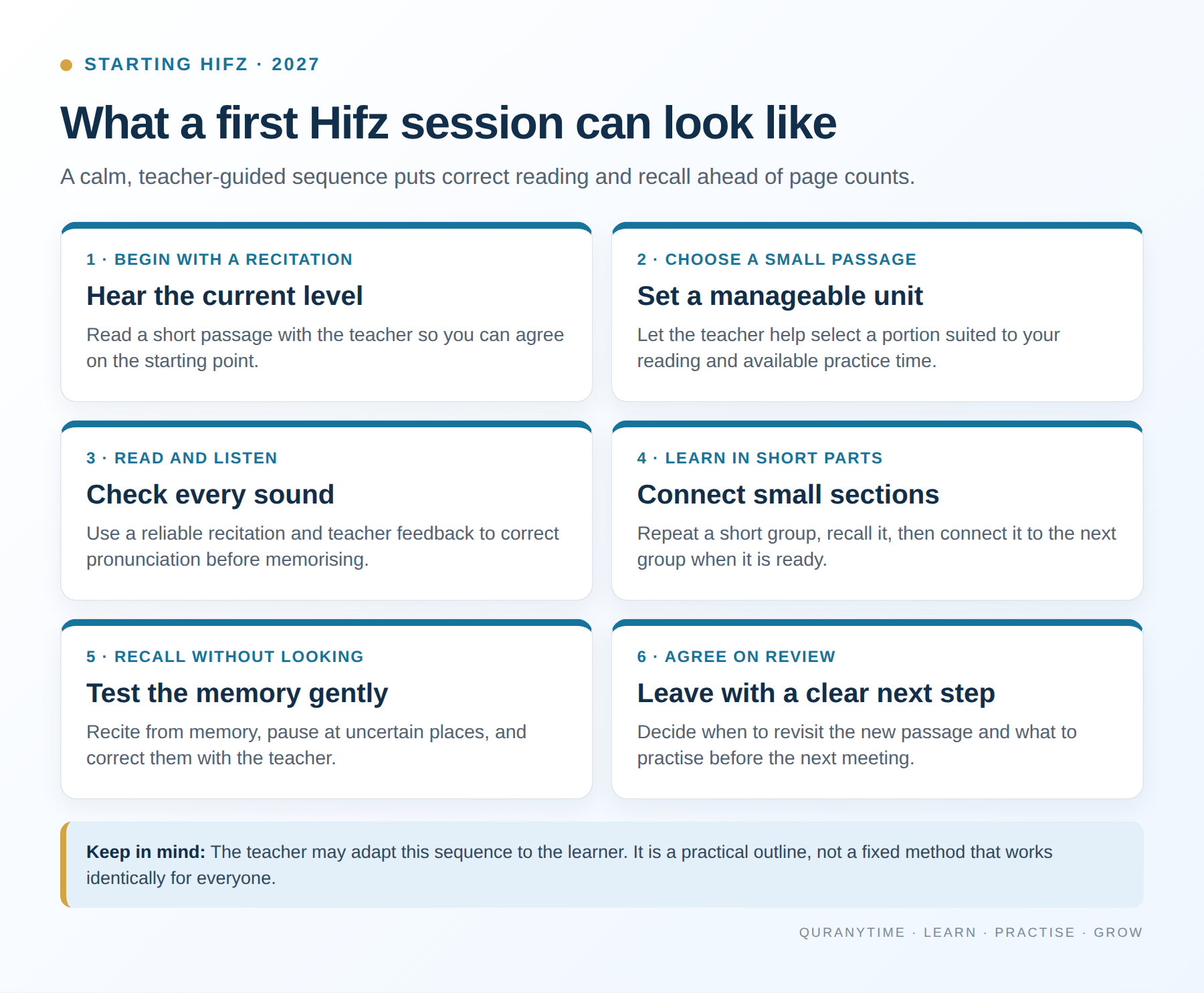
- Read or recite a short passage. This lets the teacher hear the learner’s current reading and identify anything that needs correction.
- Agree on a manageable unit. Choose a portion that suits the reading level and the time available for practice.
- Check pronunciation and wording. Listen to an accurate model if helpful, read while following the text, and ask about uncertain sounds before memorising them.
- Learn in small parts. Repeat a short phrase or group, then try recalling it. Connect it to the next group only when the learner is ready.
- Recite from memory. Try without looking, pause at the difficult point, check the text, and correct it with the teacher’s help.
- Plan the next review. Decide when the new portion will be revisited and what the learner should practise before the next session.
Some students need more time on steps one through three; others may already read comfortably and move sooner to recall. A good first session adapts to the learner rather than forcing the same amount on everyone.
Practise connections, not only separate verses
A beginner may recall each verse when prompted but hesitate when moving from one verse to the next. Treat these joins as a separate practice task. After learning a small portion, recite its ending together with the opening of the following portion, using the wording and pronunciation already checked by your teacher. Then try the whole agreed passage without looking, rather than always restarting at its first line.
Ask your teacher where to pause and how to resume if you lose your place. Do not invent stopping points simply because a phrase is difficult. If two passages sound similar, note the point of confusion in a separate notebook and ask which wording belongs in the passage you are learning. A brief correction note is more useful than repeatedly guessing.
For a simple progress check, return to the passage in a later session and notice whether the same connection still needs help. Tell the teacher exactly where recall breaks down. This gives your next lesson a practical focus without increasing the amount of new memorization or turning the first weeks into a speed test.
Build review into Hifz from the beginning
A common beginner mistake is to treat memorization as a one-way journey: learn a passage, move to the next one, and assume the earlier passage will remain secure. Instead, plan to return to the new passage after the lesson, then keep reviewing it as you add material. As the memorized portion grows, older review becomes more important too.
A helpful way to describe the work is new lesson, recent revision, and older revision. The exact proportions should depend on the learner’s amount memorized and teacher feedback. If recall is weak, reduce new work and give review more room. If the learner is building reading accuracy, the teacher may decide that a smaller new portion or reading practice should take priority.
Research on learning in general supports spacing retrieval practice rather than relying only on one long, massed session. A meta-analysis of 29 studies reported a retention benefit for spaced retrieval compared with massed retrieval, while finding no overall advantage for progressively expanding intervals over evenly spaced ones. These studies were not conducted specifically on Quran memorization, so they do not prescribe an exact Hifz schedule. They support a modest practical idea: return to material across separate sessions and adjust the timing to the learner. The ERIC review summary describes the research and its limits.
Keep the first routine small and repeatable
Do not begin by planning an ideal week with long sessions at every available time. Start with practice windows you can actually protect. A simple routine could include a short new-lesson session on planned days, a brief recall of the newest passage, and a separate slot for older review. The teacher can help you decide how often each task should happen.
Choose a cue that makes it easier to begin: after breakfast, before a regular class, or at another quiet time that fits the household. Keep the mushaf and any notes in one place. At the end of practice, write down the passage, one correction, and the next review time. If you miss a session, resume with a manageable task rather than trying to complete all missed work at once.
For a child, parents can support the routine by preparing the environment, encouraging honest questions, and praising careful effort. Avoid comparing siblings or classmates. For an adult, choose a plan that respects work and family responsibilities; Quranytime’s pages for Quran classes for kids and Quran classes for adults describe different learner contexts. These are not a substitute for a personal assessment, but they can help you identify the right conversation to have.
If Hifz feels difficult, adjust the next step
A hard session does not tell you that you cannot memorise. It tells you to look more carefully at what is making the task difficult. A pronunciation issue needs different support from a weak review habit. A teacher can help you identify which part of the routine should change.
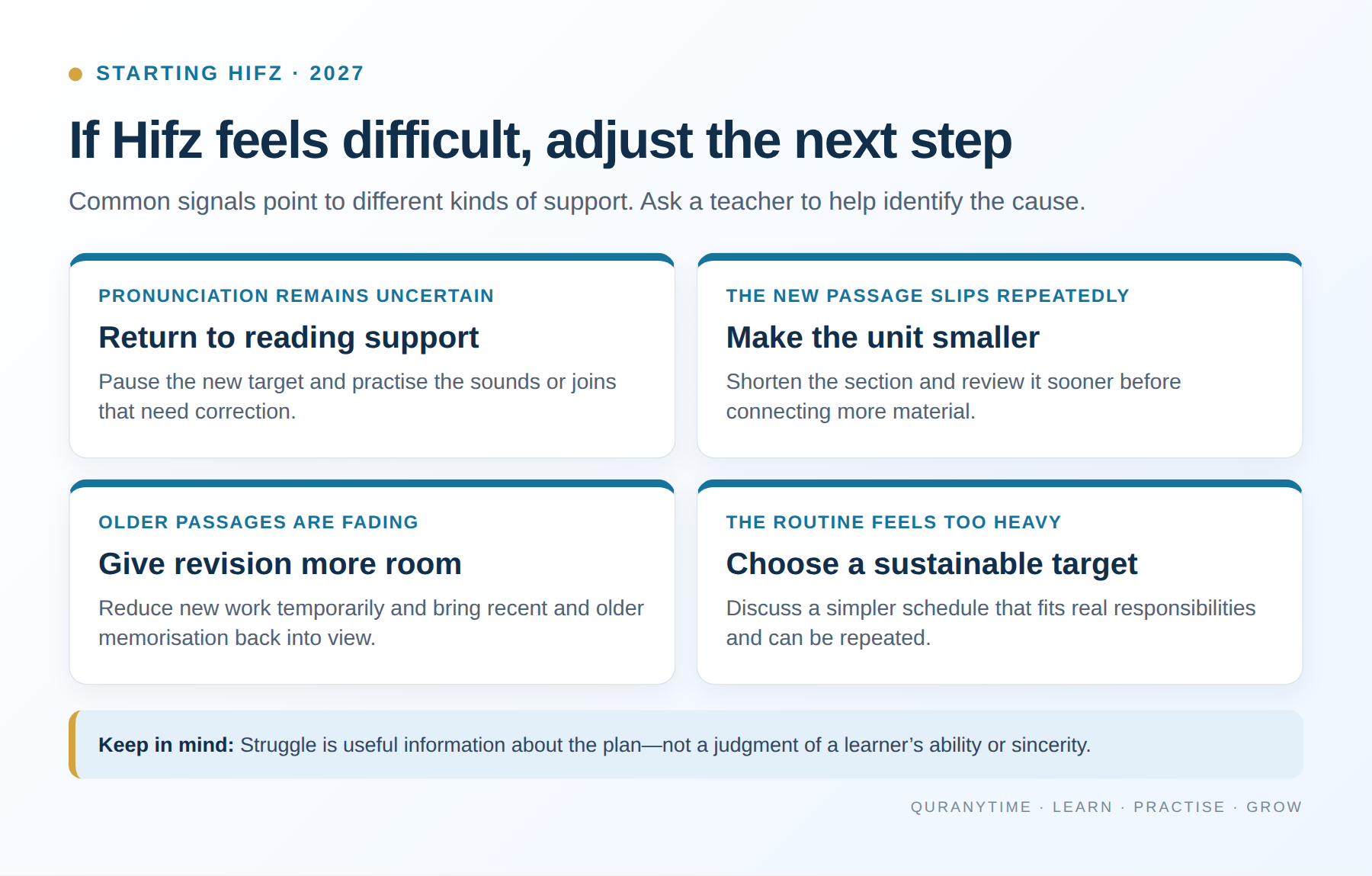
- Pronunciation is uncertain: return to reading and ask the teacher to correct the specific sounds or joins before adding more.
- The new portion keeps slipping: divide it into smaller units and revisit it sooner before connecting additional material.
- Older memorization is fading: reduce the amount of new work temporarily and give revision more space.
- The routine feels too heavy: discuss a smaller, repeatable target and a more realistic practice time.
Make one adjustment at a time where possible, then see whether it helps. Avoid adding extra hours or a much larger portion just because progress feels slow. Hifz is not a race between learners. Careful, corrected practice is a more useful starting point than a target chosen to impress someone else.
Common questions before beginning
Do I need perfect Tajweed before starting Hifz? Ask a qualified teacher to assess your reading. If you need help with letters or pronunciation, that should be part of the plan. Do not use a blog checklist as a personal recitation assessment.
Should I memorise independently before finding a teacher? You can become familiar with a passage through careful listening and practice, but regular feedback helps correct pronunciation and recall. If possible, discuss the starting point with a teacher before setting a larger target.
How much should a beginner memorise each day? There is no universal amount. Begin with a small unit that can be read accurately, recalled, and reviewed. The teacher should consider the learner’s current level and routine.
Can children and adults use the same Hifz plan? They may share principles such as accurate recitation and regular review, but lesson pace and support should match the learner’s age, schedule, reading experience, and learning needs.
Your next step for starting Hifz in 2027
Start by describing the learner’s reading level and goal, then ask a qualified teacher to recommend the first practice focus. If you want to compare available pathways, review Quranytime’s online Quran classes. You can also bring your questions to the free Quran and Arabic assessment, including whether to focus first on reading, Tajweed, or a small Hifz portion.
The first milestone is not a large page count. It is a clear, accurate practice routine that includes teacher feedback and a plan to review what you learn. As your experience grows, you can adjust the goal and pace with evidence from your own recitation.