

How to Test Your Quran Memorization Accurately
A useful Hifz self-test is not a race or a score. It is a fair way to notice what you can recite without looking, where a prompt helps, and which points need correction or another review. To test your Quran memorization accurately, close the Mushaf, use a passage and starting point chosen before you begin, recite aloud, record specific errors, and check again later. A single successful run is helpful evidence, not proof that a passage will always stay secure.
This guide is for learners who want to check their own practice between teacher sessions. It can help you prepare better questions and track changes, but it cannot replace a qualified listener for pronunciation, Tajweed, or wording. Treat an uncertain answer as information about what to practise next—not as a judgment about your ability or faith.
Why a self-test should be different from rereading
When the Mushaf is open, familiar wording can feel easier to remember than it is. Looking at the next line, hearing the passage, or reciting immediately after practice may provide useful support, but those conditions do not show the same thing as recalling without that support. A self-test asks you to retrieve the passage before you see or hear it.
Carnegie Mellon University’s Eberly Center describes retrieval practice as recalling information from memory and notes that feedback can make practice more useful. That is general learning guidance, not research specific to Quran memorization, recitation, or Tajweed. For Hifz, use it modestly: a recall attempt can help you find what to review, while accurate recitation and religious text still need careful verification.
Set up a fair test before you start
First, decide what you are checking. Is the passage recent, or has it been in your older revision for a while? Choose a manageable range that you can identify precisely in your Mushaf. Keep the same edition or page references in your notes when possible, because page layout differs between editions.
Next, choose the test points before reciting. You might recite a connected section from its beginning, then try one or two teacher-approved starting points later in the passage. The second check can show whether you rely only on the opening cue. Do not cut into a verse or choose a stopping point that could make the recitation unclear; ask your teacher which starts and transitions are appropriate. Quranytime’s guide to teacher-approved random-start practice explains that focused retrieval cues should support—not replace—ordinary connected revision.
Give yourself a little space from the last practice session. You do not need to follow a fixed number of hours or days; choose a later point that fits your normal revision plan. Testing immediately after studying can still tell you something, but it is a different check from returning to the passage after time has passed. A balanced Hifz revision schedule can help you place brief checks alongside new work, recent revision, and older review.
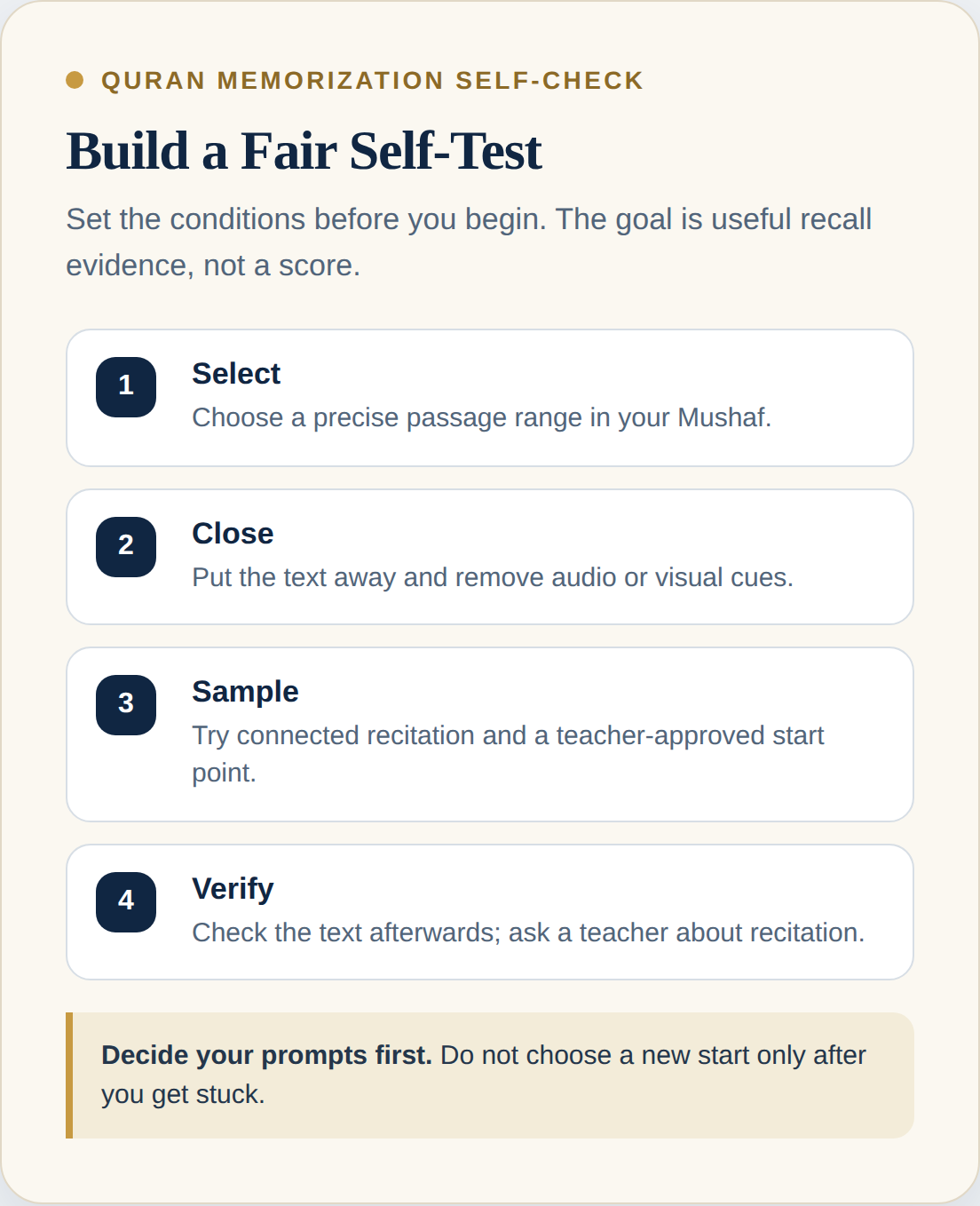
A practical six-step self-test
1. Choose a passage and a clear condition
Write down the passage reference and what kind of check you are doing: connected recitation, a teacher-approved start point, or a transition between two sections. Keep the conditions simple. Put the Mushaf out of view and avoid listening to the passage as a prompt while you are testing recall. If a family member or teacher is helping, agree in advance whether they will give a cue or simply listen.
2. Recite aloud at a steady pace
Begin from the selected point and continue as far as you can without forcing the next words. A calm pace makes it easier to notice where the difficulty occurs. If you pause, do not immediately look down and call the whole test a failure. Mark the pause, try the next teacher-approved cue if that is part of your plan, and return to the Mushaf when you need to verify the wording.
3. Record what happened, not just “good” or “bad”
Make a brief note of the kind of help you needed. Did you recite independently? Did you need an opening word or another cue? Did you return to the text? Was the issue a skipped phrase, a transition, a similar verse, or a pronunciation question? A short note is more useful than a broad label such as “weak memory.” If you are already using a Quran memorization progress record, add the test condition and correction rather than only counting pages.
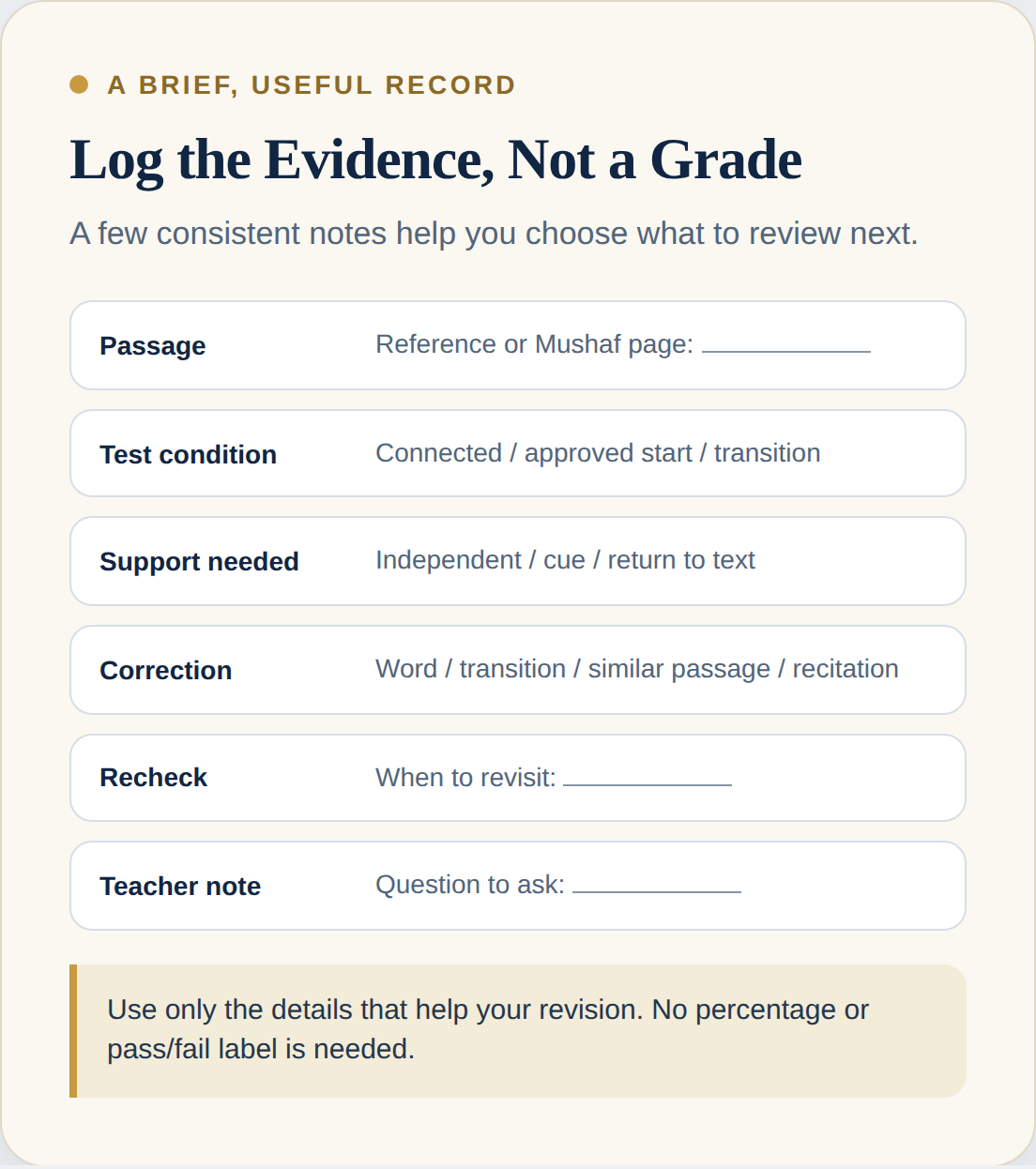
4. Verify every uncertain point
After the attempt, open the Mushaf and check the passage carefully. Do not rely on your memory to decide whether an uncertain word, ending, or transition was correct. Note the correction in a way you can find again. If the issue involves recitation accuracy or Tajweed, ask a qualified teacher instead of trying to judge it from a written checklist alone.
Some learners confuse passages with similar wording. If that happens, identify the exact place where the two become difficult to distinguish and bring it to your teacher. A focused comparison is more useful than repeatedly restarting a large section; see Quranytime’s guide to revising similar Quran verses without mixing them up.
5. Revisit the passage later
After you correct an error, practise the relevant portion in context. Then return to it during a later revision session rather than repeating it until it feels familiar in the same sitting. There is no universal interval that fits every learner or passage. Keep the recheck within your existing plan and adjust with your teacher if the same difficulty returns.
If you are working on a new passage, smaller sections may make the correction easier to isolate. Quranytime’s guide to chunking Quran memorization is a useful companion for planning those sections. When you decide how much new work to add, keep the correction and later review time in view; the guide to choosing a manageable daily amount explains why a page count alone is not a measure of secure recall.
6. Ask for teacher feedback when the question is about recitation
Self-checking can help you organise your practice, but it cannot reliably confirm every recitation detail. If you are unsure about a sound, vowel, stopping point, or correction, note the question and bring it to your teacher. If you are changing teachers, a clear handover of passages and corrections can help preserve what has already been checked; Quranytime’s Hifz teacher handover guide offers a practical record format.
How to read the result without turning it into a score
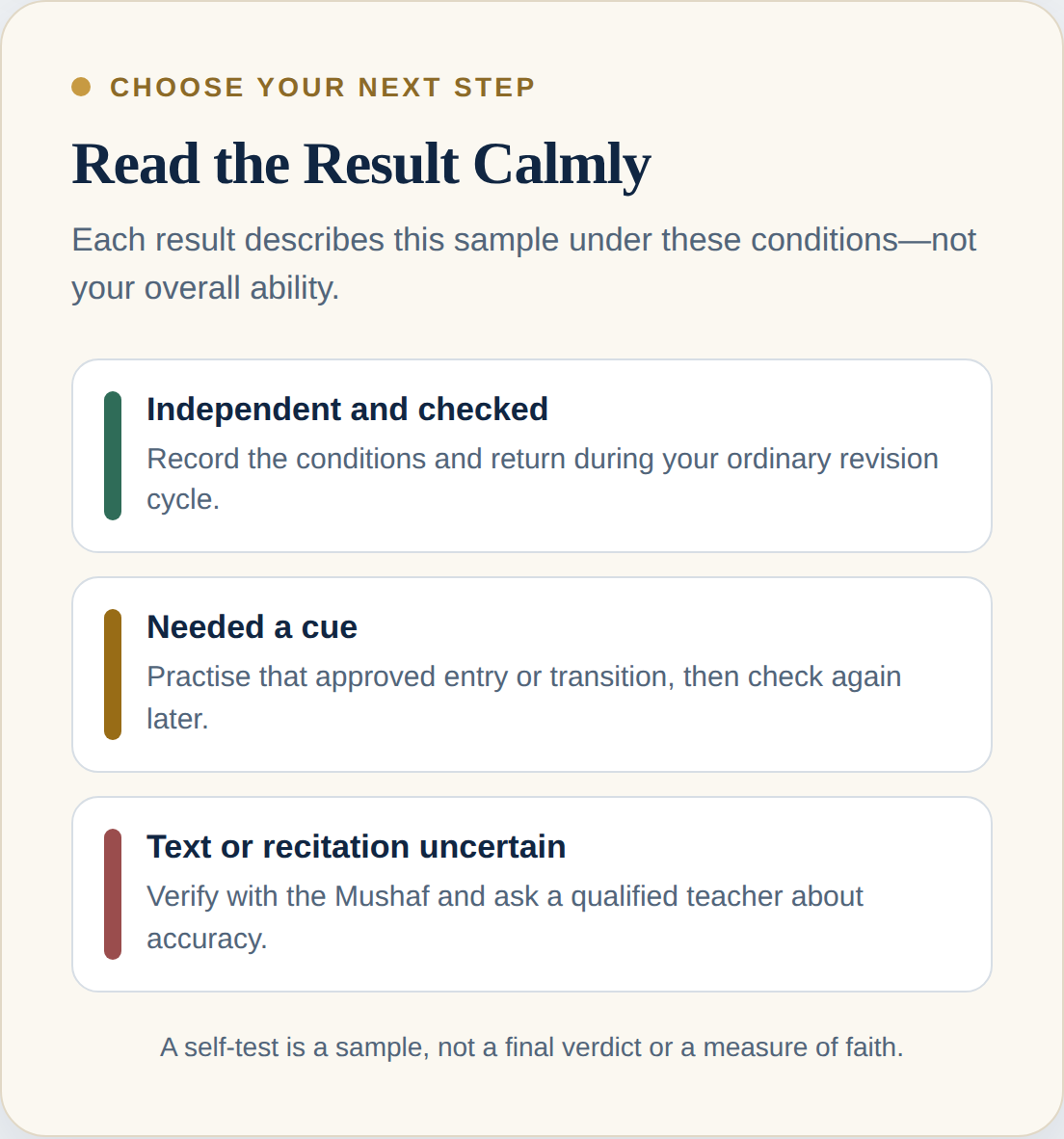
It can help to sort a test into three plain-language outcomes. These are practice notes, not grades or religious judgments:
- Independent and checked: You recited the selected section without a prompt, then verified it. Record the conditions and return to it in your ordinary revision cycle.
- Needed a cue: You could continue after a permitted prompt or a different starting point. Mark the specific cue and practise that entry or transition with guidance.
- Needed the Mushaf or a teacher: You paused, were uncertain, or found a correction. Verify the text, ask for recitation feedback where appropriate, and repair the relevant passage before making the test harder.
These categories help you choose a next step; they do not tell you how much of the Quran you “really know.” A short test samples a passage under particular conditions. It cannot prove that every other section is equally strong, and one difficult check does not erase earlier work.
Common self-testing mistakes to avoid
Testing only from the beginning. A familiar opening can carry you; include connected recitation and a few teacher-approved start points.
Testing right after rehearsal. Immediate recall is useful, but return later too. Use your normal revision plan; no fixed interval fits everyone.
Counting repetitions. The number alone does not show what you can recall accurately later. Record what worked, what needed help, and what you will recheck.
Using a recording as the only judge. A private recording can reveal pauses, not verify recitation. Keep it private and ask a qualified teacher about accuracy.
Turning a test into punishment. If a passage is difficult, verify it, isolate the transition, or ask for correction. A flexible weekly Hifz plan can make room for review without catch-up debt.
Keep the check small and useful
A self-test works best when it answers one practical question: what should I review next, and what kind of help would make that review accurate? Pick a passage, state the conditions, try recall without looking, verify what was uncertain, and revisit it later. When results are unclear, a teacher can help decide whether to focus on a starting point, a transition, similar wording, recitation correction, or the wider plan.
If you would like a teacher to help assess your current reading and memorization needs, you can book a free Quran and Arabic trial class. Bring a specific question or passage reference if you have one; the aim is to get useful guidance for your next step, not to receive a score.
For a general explanation of retrieval practice and feedback in educational settings, see Carnegie Mellon University’s Eberly Center overview. It discusses learning contexts broadly; it is not a study of Quran memorization or Tajweed.