

Chunking Method for Quran Memorization: A Practical Guide
Memorizing a passage can feel straightforward while it is read from the beginning, then become surprisingly difficult when two sections have to meet. One part is familiar; the next one is familiar too; the words between them still slip. A useful chunking method for Quran memorization treats those joins as part of the learning, not as an afterthought.
Here, a “chunk” means a connected portion that you can practise as one unit before joining it to the next. It is a study aid, not a fixed rule about how many words, lines, or verses everyone should learn. The appropriate boundary depends on the passage, the learner’s reading, and recitation guidance. Keep the same mushaf or text edition during practice when you can, and ask a qualified Quran teacher to help choose safe starts, stops, and pause points. Never cut a passage at an arbitrary line ending just because it is convenient on the page.
If you are new to Hifz, first review the broader Quran memorization guide and the first steps for starting Hifz. This article focuses more narrowly on what to do inside one passage: choose a workable unit, learn it, connect it, and check where the connection needs attention.
1. Start with a passage you can read accurately
Before memorizing, read the selected passage from the mushaf and make sure its words and recitation are within your current ability. If a sound, vowel, or stopping point is uncertain, pause and ask a teacher to correct it before trying to commit the passage to memory. Repeating an error can make it feel familiar without making it correct.
Then agree on the scope. A teacher can identify where a learner may begin and end for practice, especially when a phrase runs across a verse boundary or the page layout suggests a break that is not a suitable recitation point. Write down the surah and verse reference, or another reliable locator, so you can return to exactly the same place. Do not rely on a vague note such as “the middle of the page.”
2. Choose a chunk by more than line length
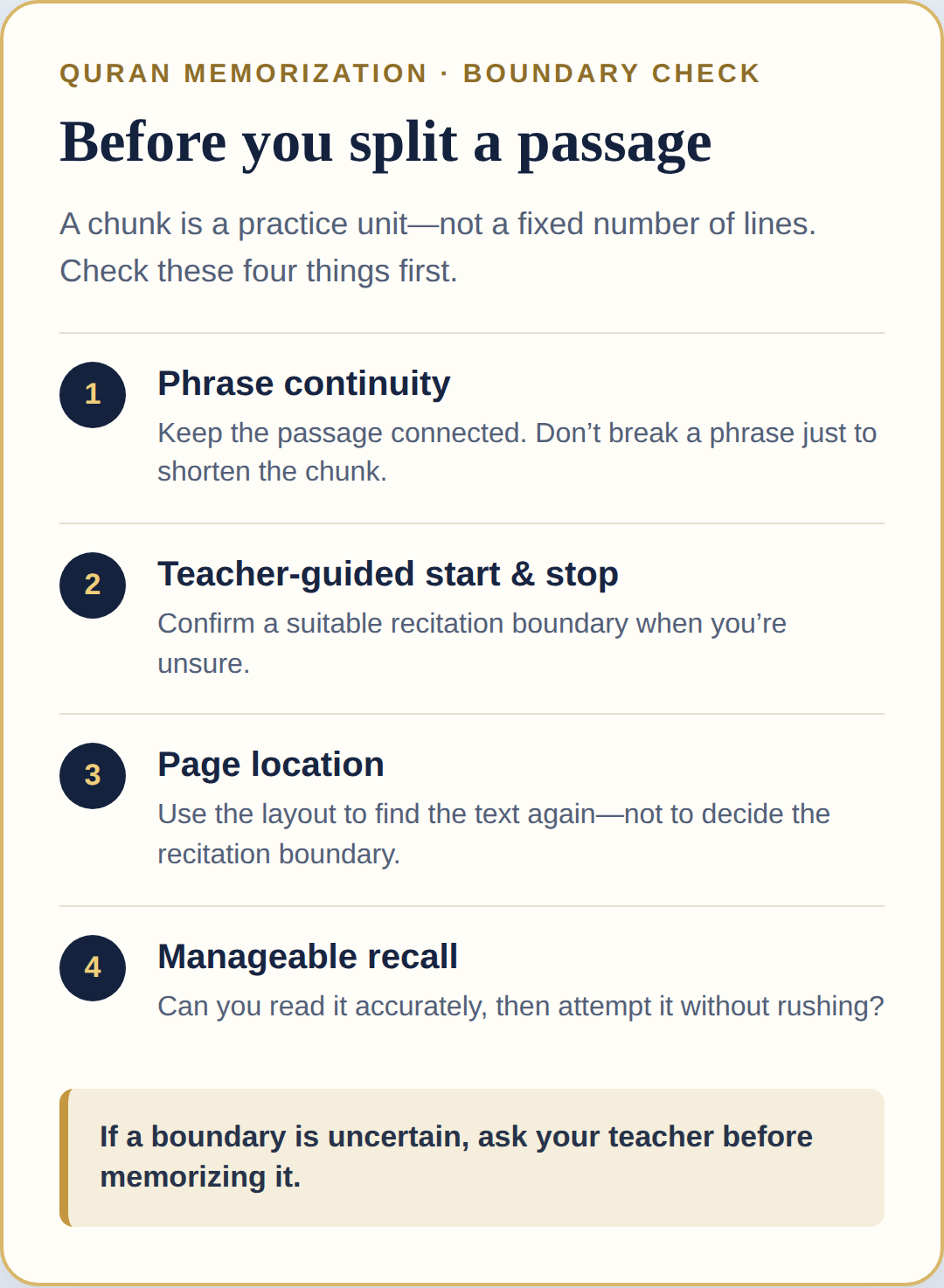
There is no universal best chunk size. Lines differ between mushaf layouts, and passages differ in length and structure. A small section that can be read clearly and recalled with attention is more useful than a larger portion that turns into hurried guessing. Use four checks when deciding where to divide a passage:
- Continuity: Does the proposed section make sense as a connected phrase or thought? Do not invent a break in the middle of a phrase simply to make the chunk shorter.
- Recitation: Is the start and stop suitable according to your teacher’s guidance? If you are unsure, ask rather than choosing by page layout alone.
- Visibility: Can you locate the same portion quickly on the page? A stable visual landmark may help you find it, but it does not determine the correct recitation boundary.
- Manageability: Can you read the portion accurately and then attempt it from memory without rushing? If not, discuss a smaller safe unit with your teacher.
These checks help you select a unit for practice; they do not rank Quranic passages or tell you how much you should memorize each day. For a separate discussion of choosing a sustainable portion, see how to choose a daily memorization amount.
3. Learn one section before adding another
Once the boundary is confirmed, work on the first chunk without setting a magic repetition target. The goal is attentive practice and accurate recall—not reaching a particular number because another learner uses it.
- Orient yourself. Read the passage from the same mushaf and locate its start and end. If helpful, listen to a teacher-approved recitation while following the text. Listening is a model, not proof that you can recite the passage yourself.
- Read accurately. Read the whole selected unit at a measured pace. Ask for correction if you are unsure about a letter, vowel, connection, or pause.
- Try recall. Cover the text and recite the unit as far as you can. If you lose a word, stop and check the exact place rather than filling the gap by guessing.
- Correct one thing at a time. Look back at the mushaf, identify the missed or changed part, then try the relevant phrase again. If the same error persists, mark it as a question for your teacher.
- Return later. After a gap, try to recall the section again before looking. A successful immediate repetition and a successful later recall are different checks.
The U.S. Institute of Education Sciences’ practice guide on organizing instruction and study recommends spacing learning over time and using quizzes to re-expose learners to key content. That is general educational guidance, not research establishing a Quran-specific chunk size or repetition count. It supports the modest idea of returning to a passage and trying to recall it, while recitation accuracy and suitable boundaries still need Quran-specific teacher guidance.
4. Practise the join between chunks
When chunk A and chunk B can each be recalled with reasonable accuracy, begin practising the transition. Recite A and continue directly into B. Then check the end of A and the beginning of B against the mushaf. The join is a useful place to listen carefully: a learner may know both sections in isolation yet hesitate when moving from one to the other.
If the transition breaks, do not automatically restart the entire page. Locate the precise point of hesitation. Revisit the end of A, the beginning of B, or both, and check whether the selected boundary is clear and suitable. Then try the connection again. If you are uncertain about where the recitation should pause or resume, ask your teacher to confirm the boundary instead of moving it on your own.
Keep the joining work connected to the passage. A teacher may ask you to recite the relevant section in order, or use a suitable cue to check whether you can find the next part. Quranytime’s teacher-guided random-start practice describes a separate way to check approved entry points in material that is already stable; it should not replace connected recitation or be applied to arbitrary words.
5. Use a short troubleshooting note
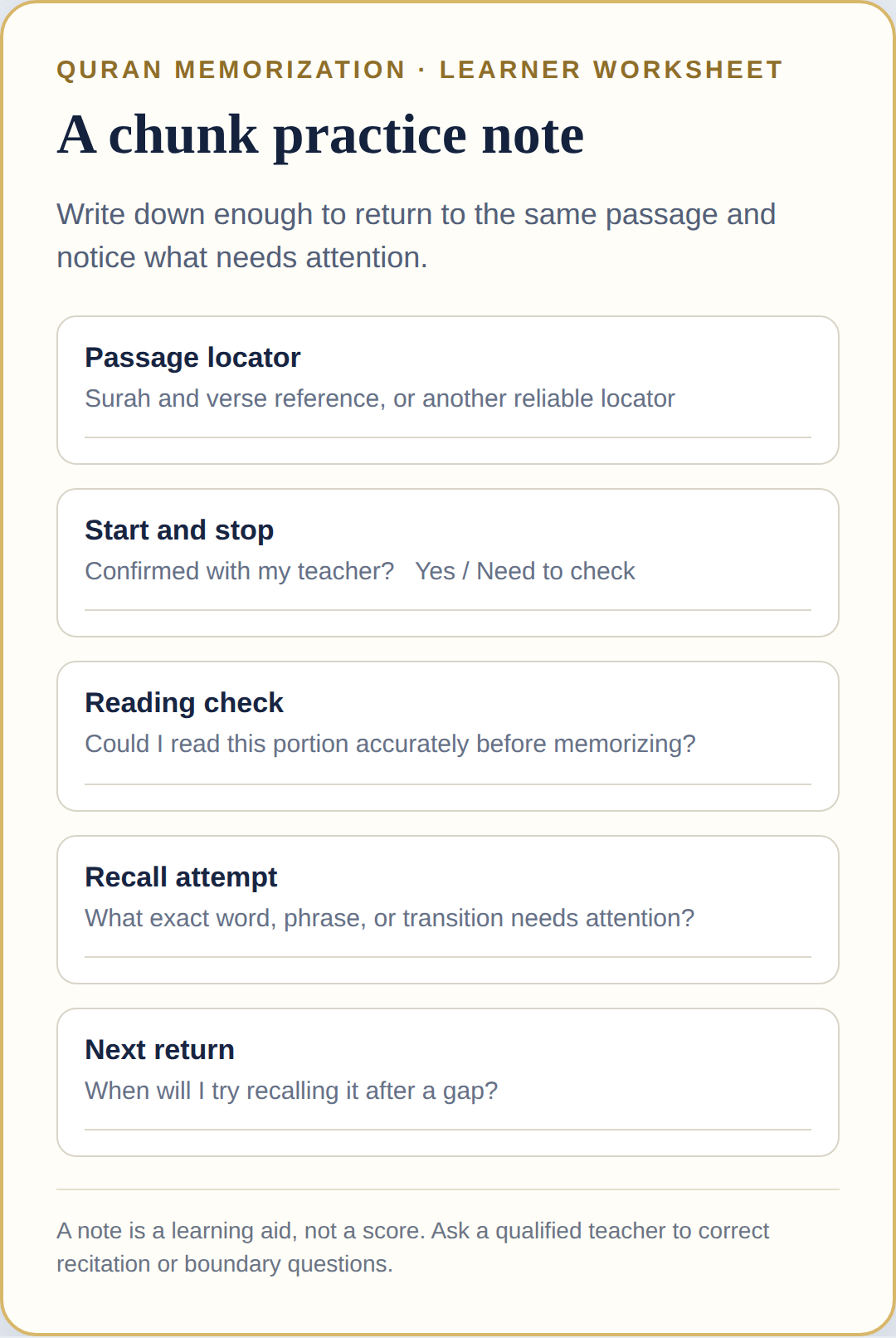
A small note can turn “I keep forgetting it” into a clearer next step. Record the location, the part that went wrong, and what you will check next. Keep the note factual; it is a practice aid, not a score for your commitment.
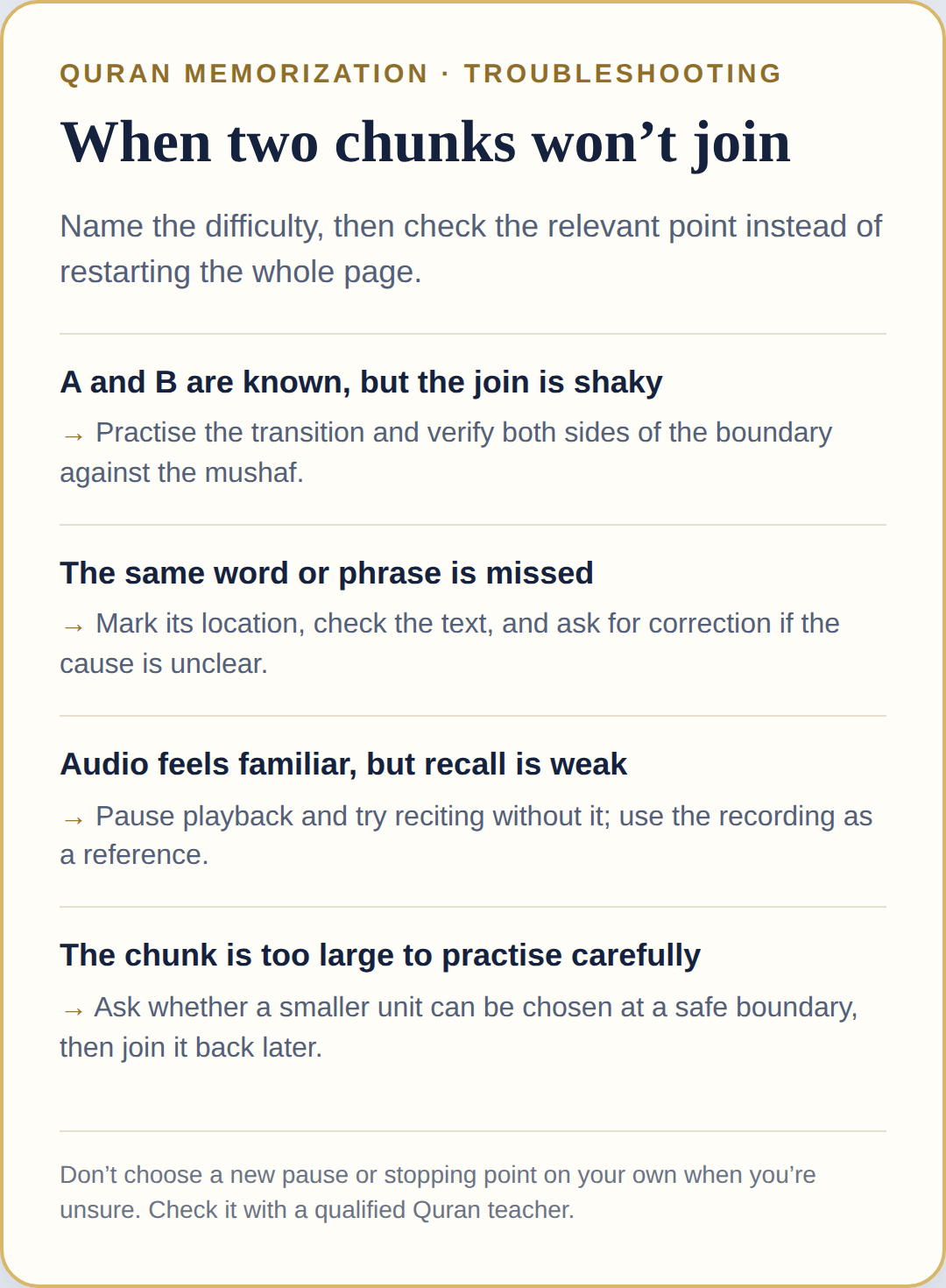
- If A and B are known separately but the join is weak, practise the transition and check both sides of the boundary against the mushaf.
- If the same word or phrase is missed, mark its location, verify the text, and ask for correction if the cause is unclear.
- If audio feels familiar but you cannot recite without it, pause playback and try recall yourself; use audio as a reference, not a substitute for reciting.
- If the chunk is too large to read and recall carefully, ask whether it can be divided at a safe boundary before joining the smaller units again.
For focused audio work, Quranytime’s listen–pause–check practice explains how to alternate a model recitation with your own attempt. For the wider balance between new learning and revision, use the Hifz revision schedule rather than letting new chunks crowd out earlier memorization.
6. Keep the method flexible
Some learners can manage a longer connected section; others need smaller units while they develop reading confidence or get used to a new passage. Even one learner may need a different chunk size on a demanding day. The useful question is not “How many lines should everybody learn?” but “Can I read this portion correctly, recall it carefully, and connect it to what comes next?”
Do not turn the worksheet into a rigid schedule. If the chosen unit repeatedly breaks down, reduce its size only after checking the boundary with a teacher. If a unit is easy, you can discuss combining it with the next portion. Either way, keep revision in the plan. The broader Hifz techniques guide covers other learning supports; this chunking method is one practical tool, not a complete memorization system. If a missed practice session makes it harder to return, the guide to staying consistent with Quran memorization offers a non-shaming reset approach.
For help choosing safe boundaries, listening to your recitation, or building a plan around your current reading level, you can book a free Quran and Arabic trial class. A teacher can help you practise the method with a suitable passage and give feedback that a checklist cannot provide.
A simple way to begin
Choose a short passage you can already read with reasonable accuracy. Confirm the start and stop with a teacher. Learn one connected chunk, test it without looking, check the exact errors, and return to it after a gap. Once two chunks are ready, practise the join between them. If the boundary, reading, or correction is uncertain, pause and ask. A small, accurate unit that connects well is more useful than a large section learned in a rush.