

Mudood tajweed rules tell you how long to stretch a vowel sound when you recite the Quran. Mudood is the plural of madd, which means lengthening. You extend the sound of a long vowel letter (alif, waw, or ya) for a set number of counts. Some stretches last two counts, others four, five, or six, depending on the letter that comes right before or after the madd letter.
These rules matter early because most verses contain at least one madd letter. A learner who holds them wrongly repeats the same mistake dozens of times on a single page. Our teachers at Quranytime Academy correct madd length in live one-to-one Tajweed lessons, so this guide explains it step by step.
You will see why the rules matter, how to count and identify any madd in a few seconds, and every type with its length and Quranic examples. A full walkthrough of Surah Quraysh follows, along with the most common mistakes. The counts below follow Hafs ʿan ʿAsim, the narration most Muslims read, and I flag the places where teachers differ.
Why mudood tajweed rules matter for your recitation
Length is part of the word
In Arabic, vowel length is not decoration. A short fatha, kasra, or damma and its long counterpart (alif, ya, or waw) are different sounds, and every word is written with one or the other. Stretching a short vowel adds a sound the word does not contain. Cutting a madd letter short removes a sound it does contain. Either way, you are no longer reading the word as written.
That is why teachers push mudood early. Tajweed has several families of rules: where letters come from in the mouth, noon sakinah and tanween, meem sakinah, qalqalah, ghunnah, stopping, and madd. Most of these apply only to particular letter combinations. Madd applies constantly, so one habit repeated wrongly becomes hundreds of small errors, and one habit corrected improves your whole recitation.
A madd held too short or too long is a mistake in the word itself, not only in the style of recitation.
What the sources say about prolongation
The Quran instructs you to "recite the Quran with measured recitation" (73:4), and tajweed is the discipline built on that command. On madd specifically, Sahih al-Bukhari records that Qatadah asked Anas ibn Malik about the Prophet’s recitation, peace be upon him. Anas answered that it was with madd, then showed it by prolonging the words of "Bismillah ar-Rahman ar-Rahim". So prolongation is part of the reported recitation, not a later ornament.
Mudood also give recitation its rhythm. When every two-count madd is the same length and every longer madd is a clear multiple of it, the recitation sounds even and unhurried. Listeners can follow each word, and you can hear your own errors more easily.
Which reading these counts follow
The Quran is transmitted in several recognized readings, and the length of some madds differs between them. Everything here follows Hafs ʿan ʿAsim, the reading in most printed copies of the Quran worldwide. Several Quranytime teachers hold an Ijazah in the recitation of ʿAsim. Where a madd allows a range, such as four or five counts, your teacher will tell you which length their chain of transmission uses. Choose one and stay consistent.
How to apply the madd rules to any word
Set your count before you read
A count, also called a harakah, is the time it takes to pronounce one letter carrying a short vowel. One count equals one short vowel, so a two-count madd lasts as long as two vowelled letters said in a row, such as "ma-ma". Many teachers use a finger as a metronome. Closing or opening one finger equals one count.
Speed changes the length of a count, not the number of counts. A slow, measured reciter has a longer beat than a fast one, but a four-count madd must always be twice a two-count madd. Keep your beat steady through the whole recitation. As an illustration, if your beat is half a second, a two-count madd lasts one second, a four-count madd two seconds, and a six-count madd three seconds.
Check what follows each madd letter
First find the madd letter. There are three: an alif after a fatha, a waw with sukoon after a damma, and a ya with sukoon after a kasra. A waw or ya with sukoon after a fatha is a leen letter, a softer relative that only stretches when you stop on it. Then look at what comes next:
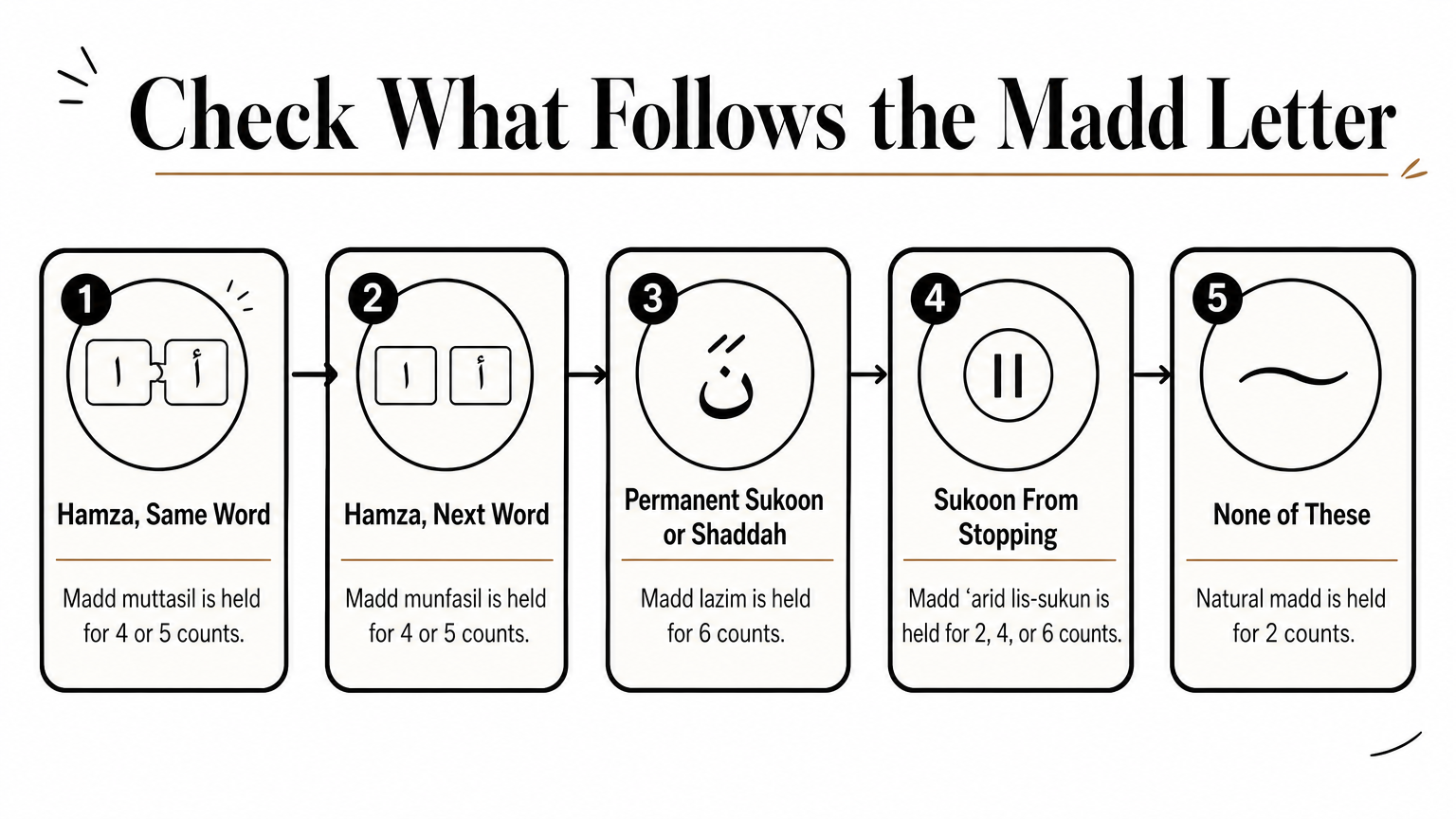
- A hamza after the madd letter in the same word: madd muttasil, 4 or 5 counts.
- A hamza at the start of the next word: madd munfasil, 4 or 5 counts.
- A permanent sukoon or shaddah after the madd letter: madd lazim, 6 counts.
- A sukoon that exists only because you stop: madd ʿarid lis-sukun, 2, 4, or 6 counts.
- None of the above: natural madd, 2 counts. A hamza before the madd letter, as in "āmanū", makes it madd badal, which is also 2 counts.
Read the letter after the madd letter first, because that letter decides the length.
Quick reference for all the types
The table puts every madd in one place. The next three sections give examples and the exceptions that trip learners up.
| Madd | What triggers it | Counts in Hafs |
|---|---|---|
| Natural (asli, tabiʿi) | No hamza or sukoon beside the madd letter | 2 |
| Badal | Hamza before the madd letter | 2 |
| ʿIwad | Tanween fathah when you stop | 2 |
| Silah sughra | Pronoun "hu/hi" between two vowelled letters | 2 |
| Muttasil | Hamza after the madd letter, same word | 4 or 5 |
| Munfasil | Hamza at the start of the next word | 4 or 5 |
| Silah kubra | Pronoun "hu/hi" followed by a hamza | 4 or 5 |
| ʿArid lis-sukun | Sukoon created by stopping | 2, 4, or 6 |
| Leen | Leen letter followed by a stopping sukoon | 2, 4, or 6 |
| Lazim | Permanent sukoon or shaddah after the madd letter | 6 |
The first four are the two-count family. The rest are the longer, secondary madds, caused either by a hamza or by a sukoon.
The two-count madds: natural and its relatives
Natural madd (madd asli)
Natural madd is a two-count stretch of a madd letter with no hamza or sukoon beside it. It is the foundation of all other types. The name asli (original) says every other madd is built on it. The name tabiʿi (natural) says a reciter with a sound ear would not make it longer or shorter. Take قَالَ (qāla), يَقُولُ (yaqūlu), and قِيلَ (qīla). Each uses a different madd letter, and each gets two counts.
The small alif written above a letter, as in الرَّحْمَٰنِ (ar-raḥmān), is pronounced as a full alif for two counts. Keep the vowel pure for the whole stretch. Open the mouth vertically for the alif, round the lips fully for the waw, and lower the jaw for the ya. Letting the vowel drift, tilt, or collapse into a short "i" is a common error.
Natural madd stays natural only while you read on. Stop on يَقُولُ and the last letter takes a stopping sukoon, so the madd becomes ʿarid lis-sukun. Also watch for the madd letter that disappears. When a word ending in a madd letter meets the sakin lam of "al-" while you connect, you do not pronounce the madd letter. فِي الْأَرْضِ is read "fil-arḍ", and هَٰذَا الْبَيْتِ is read "hādhal-bayt".
Natural madd is two counts every time, unless a hamza or a sukoon gives it a reason to be longer.
Madd badal and madd ʿiwad
Madd badal is a two-count madd that follows a hamza, as in آمَنُوا (āmanū), إِيمَانًا (īmānan), and أُوتُوا (ūtū). Badal means "substitute". In the original form of these words, the long vowel replaced a second hamza, so āmana comes from a-amana. Hafs reads badal at two counts. Some other narrations extend it, so do not copy their length into a Hafs recitation.
Madd ʿiwad (replacement) appears when you stop on a word ending in tanween fathah. The tanween becomes an alif held for two counts. Stopping on عَلِيمًا حَكِيمًا gives "ʿalīmā ḥakīmā". One exception matters: if the tanween sits on a ta marbuta, as in رَحْمَةً, you stop on a soft "h" sound ("raḥmah") and there is no madd at all.
Silah sughra and the opening letters
Silah sughra applies to the masculine pronoun "hu" or "hi" meaning "he, him, his". When it sits between two vowelled letters and no hamza follows, the damma or kasra is stretched into a waw or ya for two counts. In Ayat al-Kursi, لَهُ مَا فِي is read "lahū mā fī", not "lahu mā fī". There is no stretch when the letter before the pronoun has a sukoon, as in مِنْهُ (minhu), or when the next letter has a sukoon, as in لَهُ الْمُلْكُ (lahul-mulk).
Five of the letters that open some surahs also take two counts: ḥā, yā, ṭā, hā, and rā, remembered as حي طهر. In طه you read "ṭā hā", each for two counts. The remaining opening letters follow different rules, which the section on madd lazim covers.
The longer madds caused by a hamza
Madd muttasil: hamza in the same word
Madd muttasil, the connected madd, happens when a madd letter is followed by a hamza in the same word. Hold it for 4 or 5 counts, and never cut it back to two. Scholars of recitation call it wajib, meaning the lengthening is obligatory. Examples are جَاءَ (jāʾa), السَّمَاءِ (as-samāʾi), and الْمَلَائِكَةُ (al-malāʾikah). If you stop on a word that ends with the hamza, such as السَّمَاءِ, you can extend it to 4, 5, or 6 counts.
Madd munfasil: hamza in the next word
Madd munfasil, the separated madd, occurs when a word ends in a madd letter and the next word begins with a hamza. In Hafs it is commonly held for 4 or 5 counts. It is called jaʾiz (permissible) because the cause sits in a different word. Examples are يَا أَيُّهَا (yā ayyuhā), بِمَا أُنزِلَ (bimā unzila), and إِنَّا أَعْطَيْنَاكَ (innā aʿṭaynāka).
If you stop on the first word, the hamza is no longer in front of the madd letter, so it drops to the ordinary two counts. Most teachers also ask you to keep munfasil the same length as muttasil throughout a recitation. If you hold the connected madd at four, hold the separated one at four too.
Silah kubra: the pronoun before a hamza
Silah kubra is the longer cousin of silah sughra. The pronoun "hu" or "hi" sits between two vowelled letters, but this time a hamza follows it. The pronoun’s vowel is stretched into a waw or ya and treated like a madd munfasil, at 4 or 5 counts. Take مَالَهُ أَخْلَدَهُ (mālahū akhladah) in Surah Al-Humazah, and إِنَّهُ أَوَّابٌ (innahū awwāb) in Surah Sad.
Telling the two silahs apart takes one glance at the next letter. A hamza after the pronoun means long, 4 or 5 counts. Anything else means short, 2 counts. Both need the same conditions on the left side: a vowelled letter before the pronoun.
Whenever a hamza stands next to a madd letter, expect more than two counts, and match the length to your chosen setting.
The longer madds caused by a sukoon
Madd lazim: the six-count madd
Madd lazim occurs when a madd letter is followed by a permanent sukoon or shaddah, and it is always held for 6 counts with no flexibility. Because the sukoon never goes away, the length does not depend on stopping. There are four kinds.
| Kind | What follows the madd letter | Example |
|---|---|---|
| Kalimi muthaqqal | A shaddah, in a word | الضَّالِّينَ، الْحَاقَّةُ |
| Kalimi mukhaffaf | A plain sukoon, in a word | آلْآنَ (only in Surah Yunus, 10:51 and 10:91) |
| Harfi muthaqqal | An opening letter whose final sound merges into the next | الٓمٓ (the lam merges into the mim) |
| Harfi mukhaffaf | An opening letter with a plain final sukoon | قٓ، نٓ، صٓ |
Among the 14 letters that open surahs, eight have a madd letter in the middle of their name followed by a sukoon, and they take six counts: nun, qaf, sad, sin, lam, kaf, mim, and ʿayn. The mnemonic is نقص عسلكم. ʿAyn is the exception, because its middle letter is a leen ya, and it is commonly held at four or six counts.
Madd ʿarid lis-sukun: the stopping madd
Madd ʿarid lis-sukun appears when the letter after a madd letter becomes sakin only because you stop on it. You may hold it for 2, 4, or 6 counts, and it exists only at the pause. Stop on نَسْتَعِينُ and you read "nastaʿīn". Stop on الْعَالَمِينَ and the last ī is the stopping madd, while the earlier ā stays a natural two counts.
When you continue reading into the next word, the stopping sukoon vanishes and the madd goes back to natural. So the length is a choice of pace: shorter for a quick recitation, longer for a slow one. Pick a length and apply it to every verse ending in the same passage. Mixing two, four, and six at random is one of the most noticeable habits in uncorrected recitation.
Madd leen: the soft letters at a stop
A leen letter is a waw or ya with sukoon after a fatha, as in خَوْفٍ (khawf), قُرَيْشٍ (quraysh), and الْبَيْتِ (al-bayt). Leen letters stretch only when you stop on the word, for 2, 4, or 6 counts, matching the length you chose for ʿarid.
In connected reading you give them no stretch at all. In "khawfin wa…" the waw is a soft "w" glide, and nothing is prolonged. The same holds inside words such as بَيْنَ and يَوْمَ. Stretching a leen letter in the middle of a verse is a classic beginner error, because the letter looks like a madd letter but lacks the matching vowel before it.
Sukoon-based madds depend on the pause. Decide whether you are stopping, and the length follows.
Mudood in practice: Surah Quraysh and common errors
A worked example in Surah Quraysh
Surah Quraysh packs five types of madd into four short verses, which makes it a good drill. The table marks each one, with stopping at the end of every verse.

| Verse | Word | Type | Counts |
|---|---|---|---|
| 1 | لِإِيلَافِ (li-īlāf) | Badal, then natural | 2 + 2 |
| 1 | قُرَيْشٍ (quraysh) | Leen, on stopping | 2, 4, or 6 |
| 2 | إِيلَافِهِمْ (īlāfihim) | Badal, then natural | 2 + 2 |
| 2 | الشِّتَاءِ (ash-shitāʾi) | Muttasil | 4 or 5 |
| 2 | وَالصَّيْفِ (waṣ-ṣayf) | Leen, on stopping | 2, 4, or 6 |
| 3 | فَلْيَعْبُدُوا (falyaʿbudū) | Natural | 2 |
| 3 | هَٰذَا (hā, small alif) | Natural | 2 |
| 3 | الْبَيْتِ (al-bayt) | Leen, on stopping | 2, 4, or 6 |
| 4 | الَّذِي أَطْعَمَهُمْ (alladhī aṭʿamahum) | Munfasil | 4 or 5 |
| 4 | جُوعٍ (jūʿin) | Natural | 2 |
| 4 | وَآمَنَهُمْ (wa āmanahum) | Badal | 2 |
| 4 | خَوْفٍ (khawf) | Leen, on stopping | 2, 4, or 6 |
Now count verse 4. Hold munfasil at 4 and the final leen at 4. That gives 4 + 2 + 2 + 4 = 12 counts of lengthening. At a half-second beat, that is six seconds of stretch in one short verse. Remember that the second alif in "hādhā" disappears when you connect into "al-bayt", so it earns no counts.
Five mistakes to correct
- Shortening muttasil to two counts. The connected madd is obligatory beyond two, so reading "jāʾa" like a natural madd is an error.
- Changing the beat mid-recitation. If four counts is twice as long as two in verse 1 and the same as two in verse 4, your rhythm has drifted.
- Over-stretching natural madd. Giving it three or four counts is a habit that feels expressive but breaks the rule.
- Stretching leen letters while connecting. The waw in "khawfin" and the ya in "bayna" stay short unless you stop on them.
- Letting the vowel change shape. An alif that tilts, a waw with unrounded lips, or a ya with a half-closed jaw spoils the madd even when the count is right.
How to practice with feedback
Record yourself reading a page, tap one count per beat, and mark every madd letter with the type from the table. Then compare your recording with a recitation by a master reciter such as Mahmoud Khalil al-Husary or Mishary Alafasy. It is hard to hear your own length errors, which is why a teacher’s correction speeds things up. In Quranytime’s live one-on-one Quran reading and Tajweed lessons, the teacher listens to your recitation and corrects madd length immediately.

Start holding your madds with confidence
Mudood tajweed rules come down to one habit: find the madd letter, read what follows it, and give it the right count. Natural madd and its relatives take two counts. A hamza next to the madd letter calls for four or five. A permanent sukoon calls for six, and a stopping sukoon gives you a range of two, four, or six. Keep your beat steady, keep your vowels pure, and choose one length for each type and stay consistent.
If you are unsure which of your habits need fixing, a teacher who hears you read will tell you faster than any chart. You can book a free assessment class to read for a Quranytime teacher, talk through your goals, and get matched with a suitable teacher and learning path for Tajweed.