
Some Quran learners wonder whether they should recite slowly, at a steady everyday pace, or as quickly as possible. Tajweed lessons often use three pace labels: Tahqiq (very deliberate), Tadwir (moderate), and Hadr (faster). The important point is that speed never replaces accuracy: each letter, vowel, and applicable Tajweed rule still needs its due.
This guide explains the three speeds of Quran recitation, where Tartil fits, and how to practise without turning a recitation into a race. A peer-reviewed review describes the familiar trio of Tahqiq, Tadwir, and Hadr as slow, moderate, and fast tempos; these labels describe pace, not permission to blur words or shorten a rule.
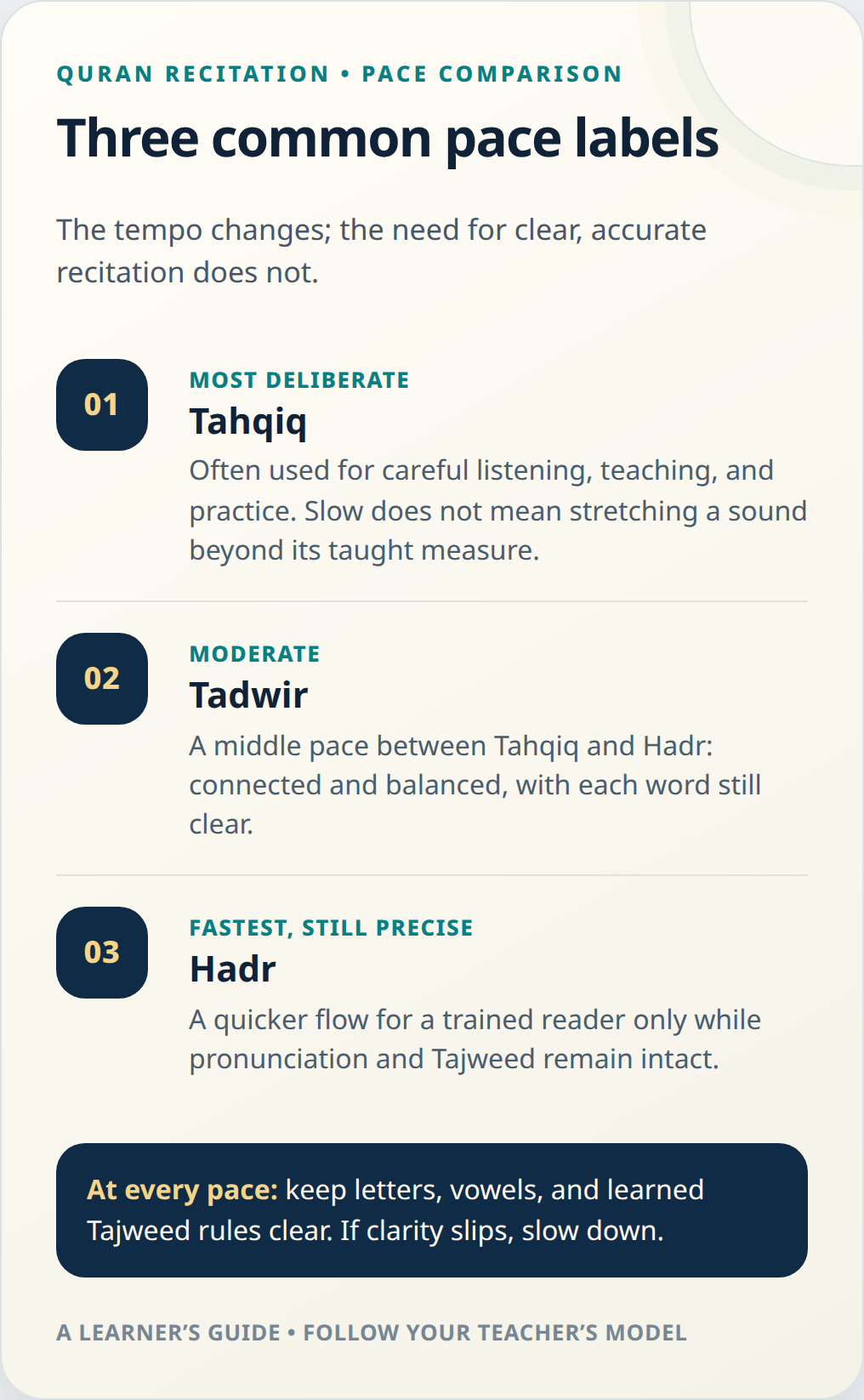
At a glance: Tahqiq, Tadwir, and Hadr
Think of the labels as a simple map rather than a test. A slower pace can make it easier to notice articulation and vowel length; a moderate pace helps a learner read continuously; a faster pace requires the rules to remain secure even when less time is spent on each phrase. The correct pace is the one at which you can recite clearly for your current level and purpose.
What does Tahqiq mean?
Tahqiq is commonly used for the most deliberate pace of recitation. The reader gives the words space and makes each articulation easier to hear. Teachers may use a slow demonstration to help a learner listen for a letter’s point of articulation, distinguish a short vowel from a long one, or notice a sound that disappears when the reader hurries.
Slow does not mean dragging every sound beyond its proper limit. A reader should not stretch a vowel until it sounds like an extra syllable, exaggerate a letter, or insert pauses inside a word. The aim is careful, measured recitation—not theatrical over-lengthening. If you are learning a new passage, ask your teacher which feature to focus on first rather than trying to monitor every rule at once.
What does Tadwir mean?
Tadwir is the middle pace between the very deliberate and faster forms. Many learners find it a useful everyday pace because it allows connected reading while leaving time to pronounce clearly. It can be a sensible starting point for a familiar passage once a teacher has confirmed that the letters and basic rules are stable.
There is no universal number of words per minute that makes a recitation Tadwir. The same reader may sound more measured or more flowing depending on the passage, pauses, breath, and the recitation tradition being followed. Use the label as a rough description of tempo, not a stopwatch target or a ranking of skill.
What does Hadr mean?
Hadr is the fastest of the three commonly named paces. It is quick and flowing, but it is not careless. A faster recitation still needs clear letters and vowels, proper articulation, and the required lengths and nasal qualities. If a learner starts clipping word endings, confusing similar letters, or shortening a rule below what their teacher has taught, the pace is too fast for that reading.
Hadr is not a shortcut for a beginner who simply wants to finish more pages. A trained reader may use a faster pace for well-known material, but the lesson for a learner is simpler: build accuracy first, then increase tempo only while the same accuracy remains audible. When in doubt, return to a comfortable pace and ask a qualified teacher to listen.
Is Tartil a fourth speed?
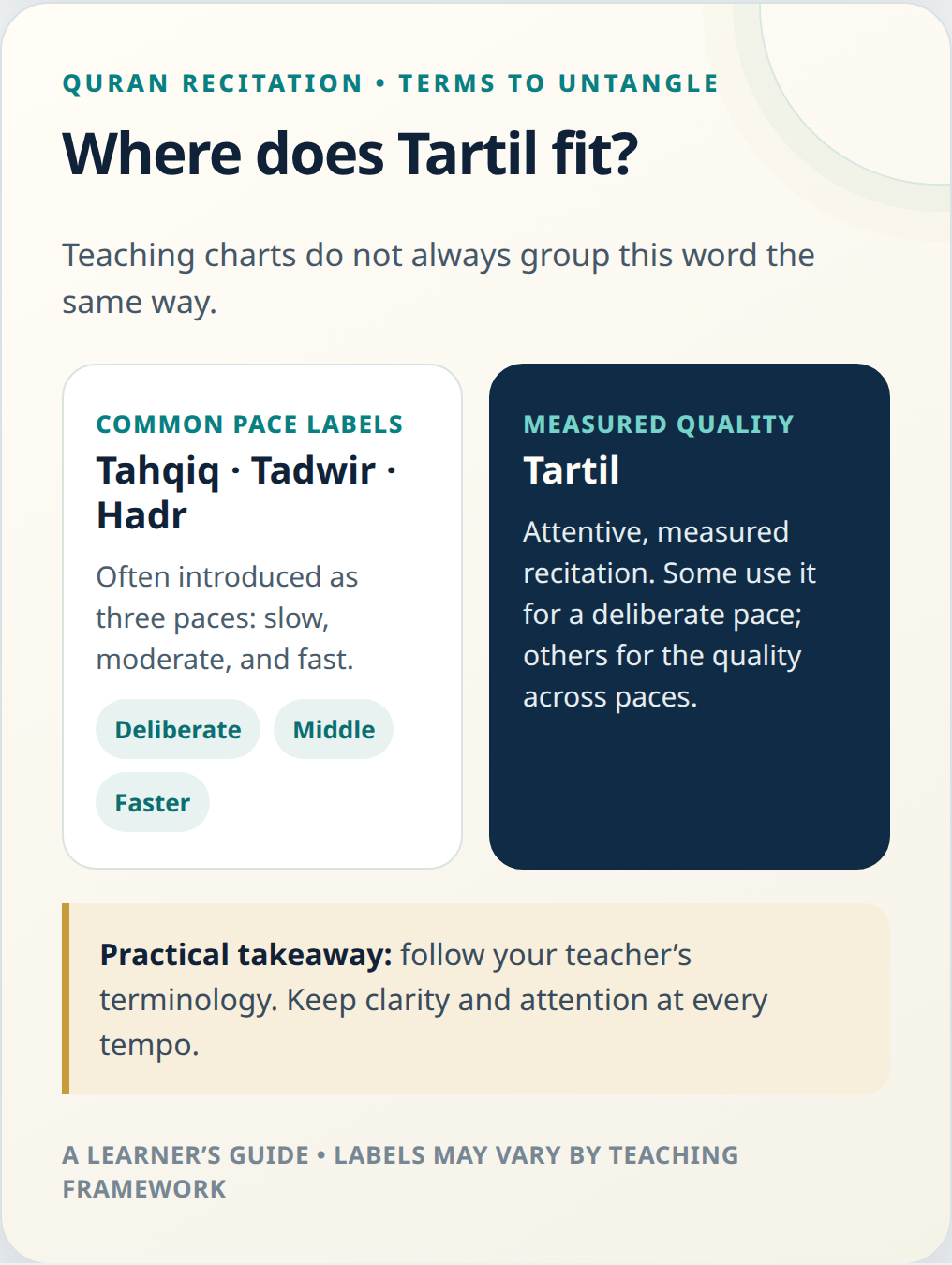
Tartil is connected with the Quranic instruction to recite the Quran in a measured manner (Surah Al-Muzzammil 73:4). In teaching materials, the word is sometimes used for a deliberate pace; in other explanations, it describes the quality of careful, clear recitation that should be present at slow, moderate, and faster tempos. That is why charts do not always group Tartil in the same way. For a separate beginner explanation, see our guide to Tartil and measured Quran recitation.
For a learner, the useful distinction is practical: Tahqiq, Tadwir, and Hadr are often presented as pace labels, while Tartil points to measured and attentive recitation. If your teacher uses a different classification, follow their explanation instead of treating one chart as the only valid vocabulary. The goal is not to win a terminology debate; it is to recite carefully and understand what your teacher means when they ask you to adjust your pace.
Do not confuse pace with Qira’at or with Tajweed itself. A pace describes how quickly the recitation flows. Tajweed concerns how the letters and rules are performed, and a learner follows the reading tradition assigned by a qualified teacher. Slowing down does not create a different reading, and speeding up does not remove the rules.
Which Quran recitation pace should a beginner use?
Choose a pace that matches the task, not the pace that sounds most impressive. When a teacher is introducing a new sound or correcting a specific error, a very deliberate model may help you hear it. For a familiar passage, a comfortable moderate pace may help you maintain continuity. A fast pace is not necessary for progress, and no learner needs to use every label every day.
Start with the basics in your Tajweed guide and work on Quran reading fluency without rushing. If breath is making you hurry or break words unnaturally, review these breath-control tips for Quran recitation. These are connected skills, but they do not require you to chase a particular speed.
A simple practice routine: listen, record, and check
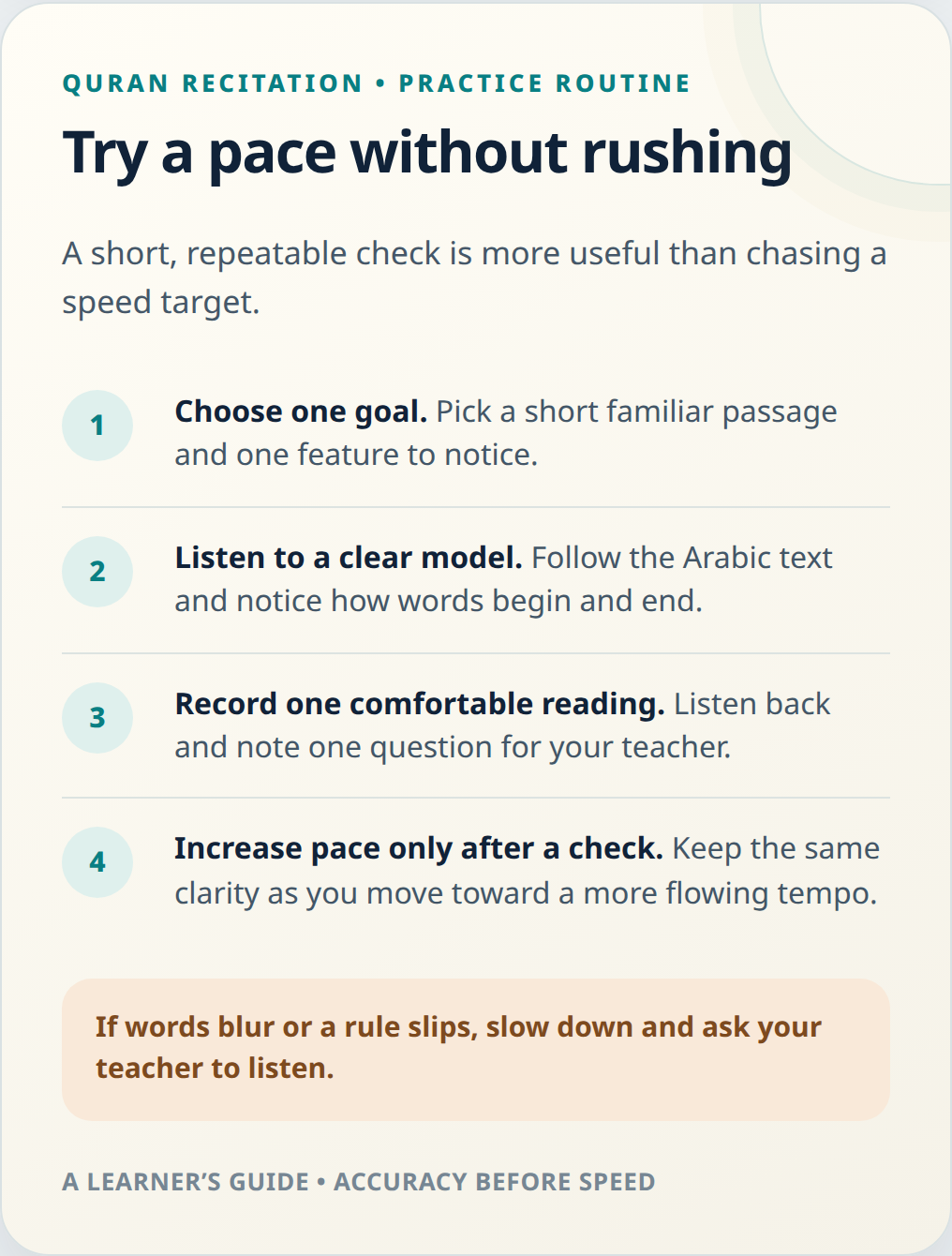
Use a short familiar passage, such as a few verses your teacher has assigned, and practise in small steps:
- Set one goal. Ask whether you are practising a letter, vowel length, connected reading, or a pause. Avoid trying to fix everything in one pass.
- Listen to a clear model. Follow along with the Arabic text. Notice where the reader separates phrases and how clearly each word ends.
- Record one comfortable reading. Do not speed up for the recording. Listen back once and note one question for your teacher.
- Change pace only after a check. If the letters and rules stay clear, your teacher can help you try a slightly more flowing pace. If accuracy slips, slow down and practise the difficult part again.
A short listen–pause–check audio routine can help you repeat one phrase without rushing through a whole page. You can also keep a Quran recitation mistake log and record the cue that helped, rather than writing down only that a passage felt “too fast.” For stopping and restarting between phrases, learn the common Quran waqf signs with your teacher.
Listen to a measured Al-Fatihah example
This short recording of Surah Al-Fatihah by Mahmoud Khalil Al-Hussary lets you follow the Arabic text as each verse is highlighted. Use it as a listening example for measured, clear recitation; it is not a side-by-side comparison of all three paces. Follow your own teacher’s model for your assigned reading and recitation tradition.
Common mistakes to avoid when changing pace
- Rushing to match a recording. A polished reciter may be reading at a pace that does not suit your current level. Listen for clarity, not just speed.
- Stretching everything when reading slowly. A careful pace still observes the taught measure; do not turn every vowel into an extended sound.
- Assuming a fast pace is automatically wrong. Hadr is commonly described as a faster mode, but it still depends on keeping the rules intact. The problem is not speed by itself; it is losing accuracy.
- Using transliteration as the final check. It can help with a first orientation, but it cannot reliably show every Arabic articulation or recitation rule. Ask a teacher to listen to your Arabic recitation.
- Treating labels as a scorecard. Moving from slow to fast is not proof of improvement. A clear, steady reading at a comfortable pace is a meaningful step.
Frequently asked questions
Are there three or four speeds of Quran recitation?
Many introductions name three paces—Tahqiq, Tadwir, and Hadr. Some teaching materials also list Tartil separately, while others describe it as a quality of measured recitation across paces. Ask your teacher which terminology they use; the labels are not a reason to change a recitation rule.
Is Hadr the same as rushing?
No. Hadr is a faster, flowing pace that still preserves the required pronunciation and Tajweed. Rushing is when speed makes the recitation unclear or causes rules to be missed. If that happens, slow down until your teacher confirms the reading is sound.
Should I practise Tahqiq before Tadwir and Hadr?
A slow, clear model can help when you are learning, but your teacher may choose a different exercise for your level. Do not force a sequence or move faster just because a chart presents one. Work on the pace that best supports the skill being taught.
Keep clarity ahead of speed
The three speeds of Quran recitation offer language for very deliberate, moderate, and faster reading. They do not change the need for careful pronunciation. Tartil may be grouped differently across lessons, so use the terms your teacher explains, practise one goal at a time, and increase pace only while clarity remains. If you would benefit from guided feedback, Quranytime offers a free Quran and Arabic trial class where you can discuss a learning plan with a teacher.
For pace labels, a review in Heliyon describes Tahqiq, Tadwir, and Hadr as commonly used slow, moderate, and fast tempos (Kannan et al., 2022). Use that as general background—not as a substitute for a qualified Tajweed teacher’s correction.