
The Quranic Arabic Corpus reports 77,429 words in the Quran. That is a clearly attributable answer, rather than a universal total independent of counting rules. A responsible word count identifies its source text, how words are divided, whether introductory basmalahs are included and whether the count refers to Arabic or a translation. Small differences between published totals can come from different methods.
This guide explains how to interpret the number, compare competing claims and use word-level study productively. It does not turn a counting convention into a theological test or a promise of an easy memorization schedule. The goal is to make the method visible enough that another reader can understand what was counted and why a different dataset might produce another result.
The short answer with its source attached
On its frequently asked questions page, the Quranic Arabic Corpus describes reviewing annotations for 77,429 words. You can cite that figure as the Corpus’s reported total. Keep the source attached to the number when sharing it, especially in a classroom slide, worksheet or social-media graphic. “The Corpus reports 77,429” is more precise than presenting a bare number as the only possible count.
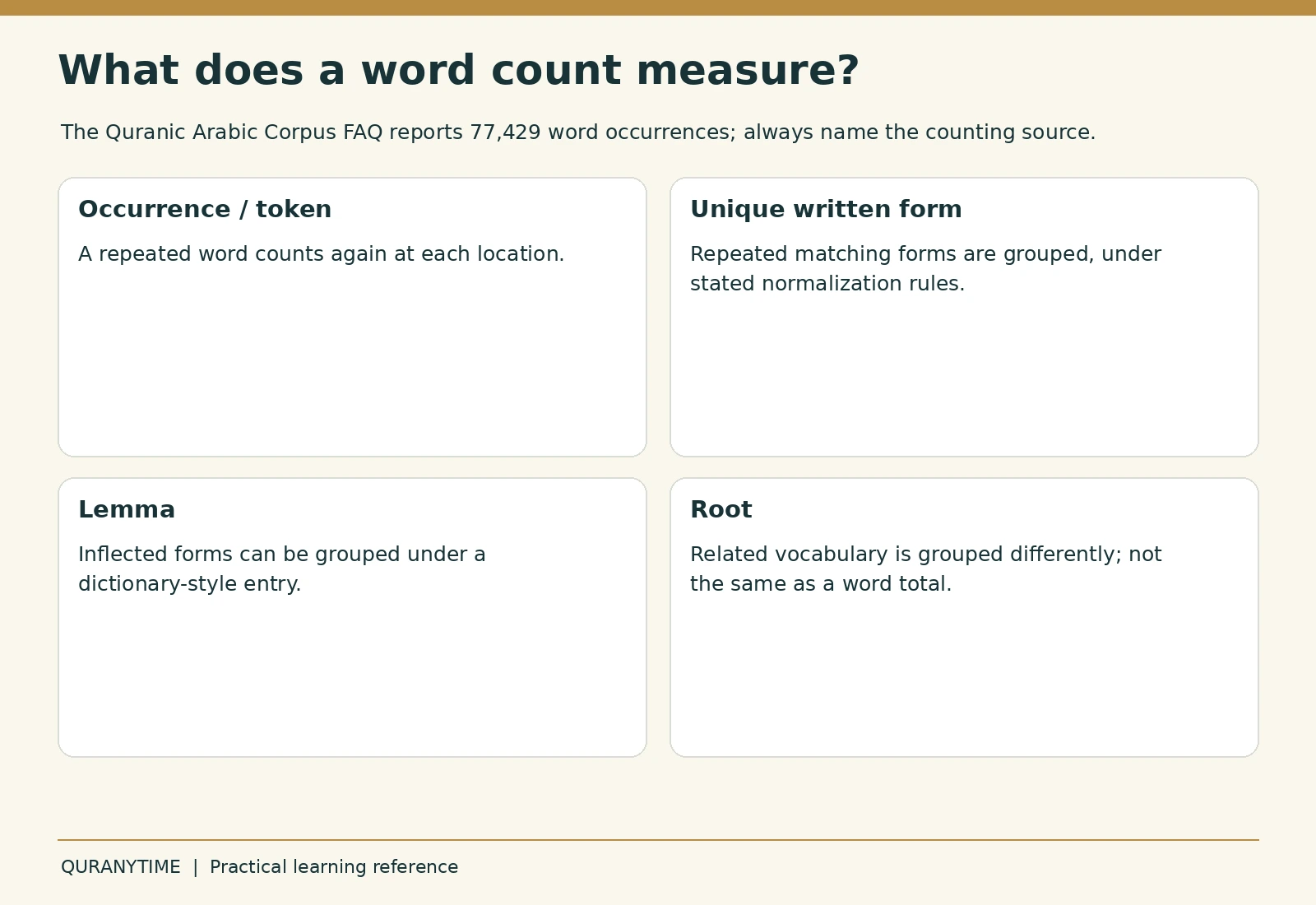
This total is a count of word occurrences, not a claim that the Quran contains that many different vocabulary items. A repeated word appears again in an occurrence count. A list of unique forms, a list of dictionary headwords and a list of roots answer different questions and will produce different totals.
For the broader purpose and meaning of the text, the introduction to the meaning of Quran supplies context. Counting words describes one feature of the text; it does not replace reading the verses in their setting or studying their meaning with reliable explanations.
What counts as a word?
In a simple text file, a program might define a word as a sequence of characters separated by whitespace. That rule is easy to apply, but it does not settle every linguistic question. Arabic can attach conjunctions, prepositions and pronoun suffixes to a written word. A morphological analysis may examine several meaningful segments within that one written unit.
Consider the illustrative form وَكِتَابُهُ. In a whitespace-based example, it appears as one written unit. A teacher can also analyse it into a conjunction, a noun and an attached pronoun. Counting those meaningful pieces would answer a segmentation question rather than reproduce the same written-word count. The example illustrates a method; it is not being used here as a quotation from a particular verse.
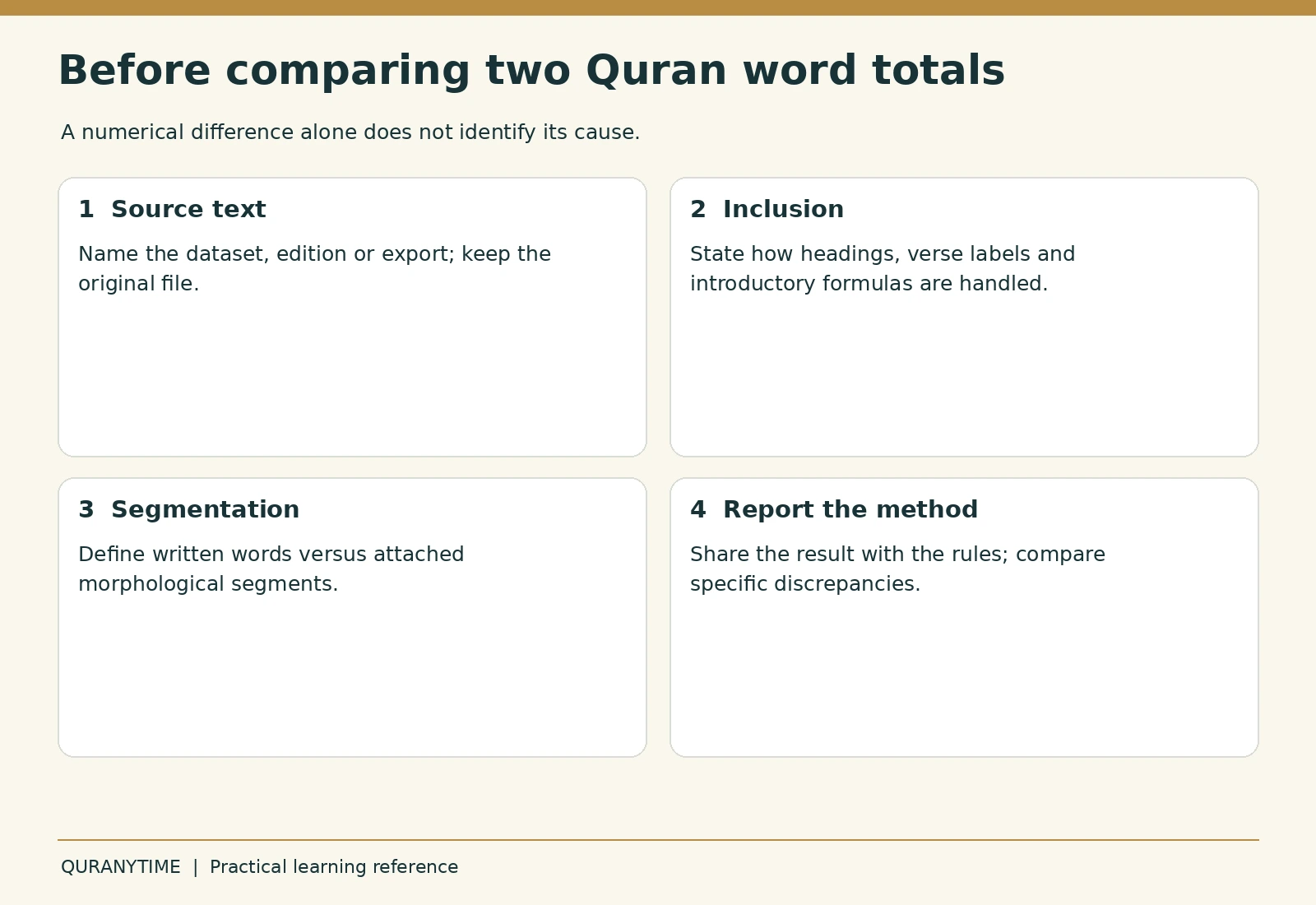
Before comparing two totals, ask whether they count written tokens, morphological segments or unique forms. The phrase number of words is too vague when these definitions are mixed. A clear explanation can prevent an apparent disagreement from being mistaken for a disagreement about the underlying passage.
Tokens, types, lemmas and roots
A token is an occurrence in a particular location. If a word appears ten times, a token count records ten occurrences. A type count groups matching forms according to the chosen normalization rules. Changing those rules can change whether two spellings are treated as the same type.
A lemma groups inflected forms under a dictionary-style entry. A root groups related vocabulary in another way, but not every meaning can be recovered simply by substituting a root’s broad idea into a sentence. These categories are useful for study and research when their definitions remain explicit.
For example, a learner’s notebook might record a written word, its lemma, a root where applicable and the meaning it has in one verse. That is much more informative than treating every item as an isolated English equivalent. Our Quranic Arabic roots and patterns introduction explains that next layer of language study.
Why basmalah handling matters
The opening formula appears at the start of surahs in printed copies, with the familiar exception of At-Tawbah, and it also occurs within An-Naml 27:30. A counting project needs to specify how introductory formulas are represented in its source file. Some datasets store an unnumbered introduction separately from verse text, while others include additional display material in an export.
If one count includes material that another omits, their totals cannot be compared fairly until that difference is identified. Do not assume that every number online followed the same inclusion rule. Equally, do not infer an exact numerical difference without checking the actual dataset and its segmentation.
For classroom work, write a short inclusion note before running a calculation. State whether you are counting only the numbered verse text from a named edition or an exported display that may repeat headings and introductions. That simple choice often matters more than the arithmetic itself.
Script marks are not additional words
Arabic vowel signs and recitation marks help readers interpret the script, but a mark is not automatically another word. A naive program that treats unusual symbols as text units may miscount. Headings, verse numbers and ornamental markers can also enter a copied passage if the export is not checked carefully.
At the same time, removing every unfamiliar character indiscriminately is risky. Some characters belong to the written form rather than to decoration. A reproducible count needs a defined cleaning rule and a retained copy of the original input. Keep display formatting separate from the text you intend to analyse.
The guide to using the Quranic Arabic Corpus can help you inspect words and their annotations. Use word locations to examine a disagreement rather than relying only on a screenshot of a final total.
Arabic and English translation counts are different questions
An English translation does not preserve a one-to-one word correspondence with Arabic. A translator may need several English words to express one Arabic form, or may choose a shorter phrase where another translation is more explicit. Footnotes, headings and explanatory brackets also change the number of displayed English words.
Therefore, a claim about the Arabic Quran should not be checked by counting an English translation. If your question concerns a translation, identify the translator, edition and whether commentary is included. Two English editions may convey the same verse with different wording and different word totals.
Our guide to Quran translation gives further context for this distinction. For a study project, keep separate columns for Arabic text, translation and notes. Combining them into one count creates a number that is difficult to interpret and easy to mislabel.
A reproducible checking workflow
Start by writing the question in a single sentence: for example, how many whitespace-delimited Arabic units appear in a specified export of a chosen passage? Next, record the source, access date and inclusion rules. Keep the original file unchanged and make a separate working copy for any cleaning.
Test the method on a short passage that you can inspect manually. Compare the program’s units with the displayed Arabic, checking attached forms, punctuation and verse numbers. If the short example is wrong, a full-text total will not become reliable merely because it looks plausible.
After running the count, record the result with the method. If another source differs, compare a few specific locations or preprocessing rules. Do not alter the rules repeatedly until you obtain a preferred number. The value of the exercise lies in transparency, not in making every source agree by force.
Read competing figures with care
When you see 77,430 or another nearby total, do not immediately call it an error or assume it proves a textual difference. Ask where the number came from and what it counts. A figure without a named source or method is difficult to verify, even if it appears on many websites.
Conversely, a possible methodological explanation is not proof that a particular count is correct. The underlying data still need checking. State what is known, what is inferred and what remains unresolved. A careful answer can say that the Corpus reports 77,429 while declining to explain another exact total without its source file.
This approach is especially important when numbers are used to support elaborate numerical patterns. Selecting one counting rule for one claim and a different rule for another can produce misleading comparisons. Consistent definitions are necessary before any pattern can be assessed responsibly.
Use word counts to support learning
A total of roughly seventy-seven thousand occurrences can sound intimidating to a beginner. However, repeated forms, recurring structures and familiar vocabulary make language learning different from memorizing that many unrelated items. Build a small study set from the passage you are reading and revisit it in context.
Record one useful meaning, a pronunciation model and the verse location. Later, compare the word in another passage rather than assuming its first English gloss always applies. A Quranic Arabic vocabulary notebook can organize these observations and separate confident understanding from questions for a teacher.
Do not turn a word total into a guaranteed completion time. Dividing the count by a daily target ignores pronunciation, comprehension, memorization difficulty and revision. A realistic plan includes review and teacher correction. Numbers can describe the workload approximately, but they cannot predict one person’s retention.
Download the counting and source-check worksheets
Download the free three-page practice worksheets and answer guidance (PDF). No registration is required.
The worksheet pack includes a method checklist, token-versus-segment examples and a source comparison form. Begin by defining the unit before counting. Then identify which extra material should be excluded from a sample export: headings, translation notes or verse labels. Explain each decision rather than erasing items without a rule.
One exercise repeats an ordinary English word to distinguish occurrences from unique forms. Another uses a constructed Arabic example to show how an attached conjunction and pronoun can sit within one written unit. The answer guidance identifies the intended distinction and reminds learners that a full Quran count requires a documented dataset.
For a class project, ask students to present a short method statement alongside their result. A well-explained small example demonstrates more understanding than repeating an impressive number without knowing its definition. Keep the activity connected to careful reading rather than competition over who can claim the largest total.
A small example before a large claim
Before accepting a full-text total, examine how the method handles a tiny sample. Include a repeated word, a number label and a note outside the passage. Ask which items belong to the intended text and which are display material. Then apply the stated rule consistently. This does not verify an entire corpus, but it reveals obvious mismatches between the question and the calculation. Save the sample and the rule with your result so that another person can understand the procedure. If you later change the inclusion rules, label the new result clearly rather than silently replacing the old number.
Frequently asked questions
What is the most useful short answer?
Say that the Quranic Arabic Corpus reports 77,429 words, and identify the source. Add that exact totals depend on the text and counting convention. This preserves a verifiable answer without pretending that method is irrelevant.
Are those all different words?
No. Occurrence counts include repeated words. Unique written forms, lemmas and roots are different categories. Always specify which category you mean when comparing vocabulary figures or planning a study list.
Can I count words by dividing the page count?
No. Pages vary in density, script and layout. An average number of words per page can describe a particular edition approximately, but it does not establish an exact full-text total or a universal reading time.
Does a different count mean a different Quran?
A numerical difference alone does not establish that conclusion. First compare source text, segmentation, normalization and included material. Only a documented comparison can explain the cause of a particular difference.
Where should a beginner start studying the words?
Choose a short passage, learn its words in context and check pronunciation. To build an appropriate reading and vocabulary plan, book a free trial class. Tell the teacher whether your main aim is recitation, Arabic comprehension or both.
Sources and scope
The reported total comes from the Quranic Arabic Corpus FAQ. Its documentation describes the annotation resource. The comparisons and worksheet examples here explain counting concepts; this article does not claim to have independently recounted every Quranic word or verified every alternative figure published online.