

A Quranic Arabic vocabulary notebook should do more than list Arabic words beside English glosses. It should help you remember where a form appeared, what you have verified about it, and whether you can still recall it later. This paper-first system is deliberately small: one useful word, its verse context, a careful lookup, and a brief review record. For a broader weekly sequence, see Quranytime’s study plan for Quranic Arabic vocabulary; this guide focuses on the notebook page itself.
Use the notebook as a learner’s record, not as a dictionary, translation, or tafsir. Mark what you checked and what remains uncertain. That keeps a short English gloss from becoming an overconfident claim about every occurrence of an Arabic word.
What belongs on one notebook entry?
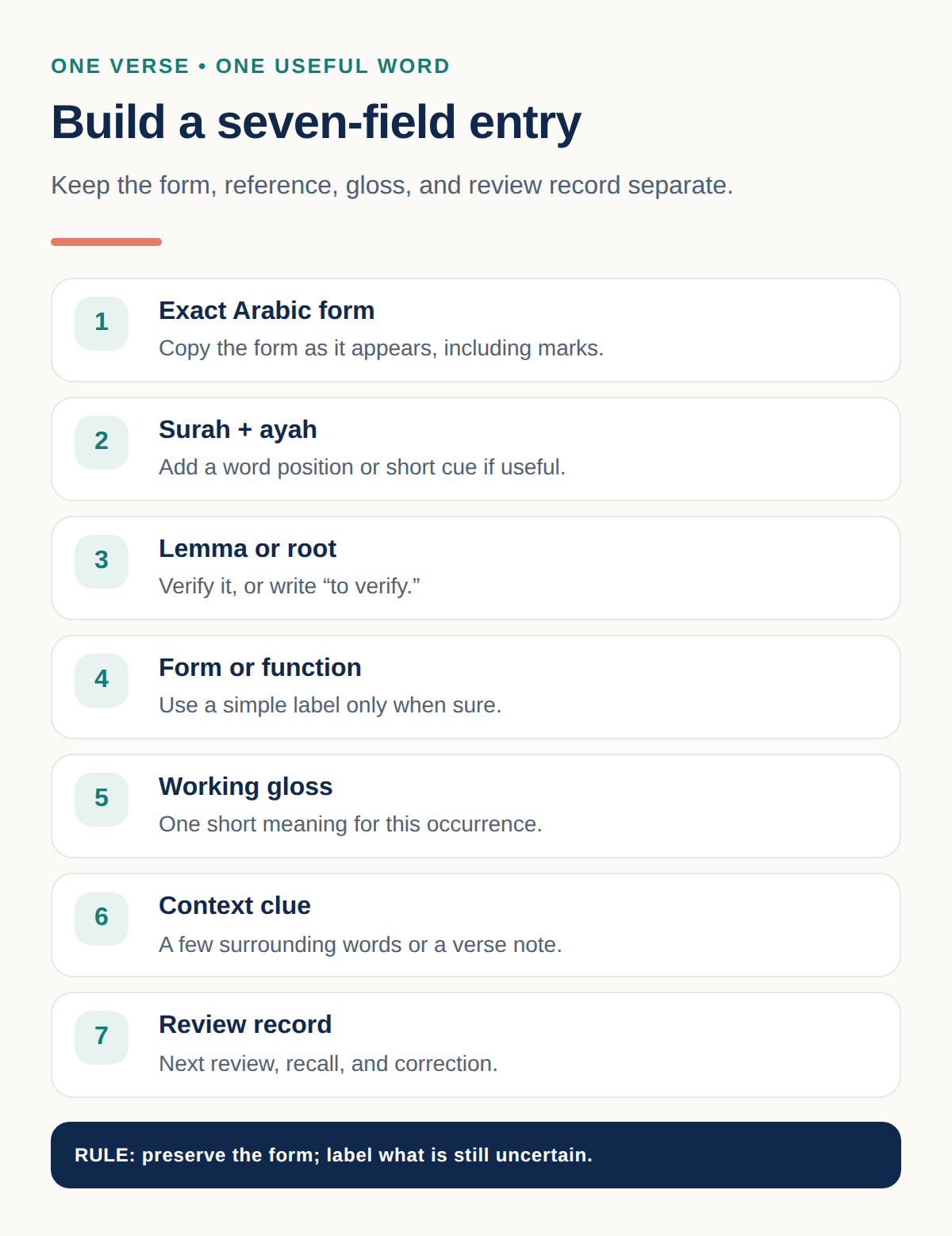
Give each entry enough structure to make it findable and reviewable, but keep it short. A reusable page can contain these seven fields:
- Exact Arabic form: copy the form as it appears, including visible vowel marks; do not replace it with a root or headword.
- Location: write the surah and ayah, plus a word position or short phrase if needed.
- Lemma or root: add it only after checking a reliable reference. If unsure, write “to verify.”
- Form or function: add a simple verified label, such as noun, verb, or particle, when useful.
- Working gloss: record one short meaning that fits this occurrence, not a complete translation.
- Context clue: note a few surrounding words or how the word fits the verse.
- Review record: date added, next review, what you recalled, and any correction.
This separates the form you saw, the reference’s analysis, and your current understanding. A root can help you compare related forms, but it does not by itself prove that they mean the same thing in context.
Copy-ready line: [Arabic form] — [surah:ayah] — [lemma/root: verified or unknown] — [form/function] — [working gloss for this verse] — [context clue] — [source checked] — [next review]. Leave a field blank if you have not verified it; empty space is more accurate than a guess. Reuse the same layout so each later review starts with the same cues.
Start with a verse, then choose a word
Begin with a passage you are already reading, not a long list without context. Read the whole ayah, then choose one word that is repeated, unfamiliar, or relevant to the Arabic pattern you are learning. Keeping the verse in view helps prevent an entry from becoming an isolated translation puzzle. Use this word-by-word approach that keeps the ayah in context.
Copy the exact written form and reference before looking anything up. If Arabic script is still new, review the Arabic harakat used in Quran reading so you preserve the marks you see. Then check a trustworthy dictionary or morphology reference. Start from the form, and record any suggested lemma, root, or grammatical label separately. Quranytime’s guide to a Quran dictionary lookup explains why morphology and the surrounding phrase matter. If a reference is unclear, mark it for a teacher rather than guessing.
Use listening as a prompt, not as a dictionary
The short Al-Fatihah video below shows each ayah in Arabic alongside English translation and transliteration. Listen to a passage, choose one word, and try to recall its location and working meaning before checking your notes. Treat the displayed translation as a prompt, not as a substitute for checking the word’s form and context.
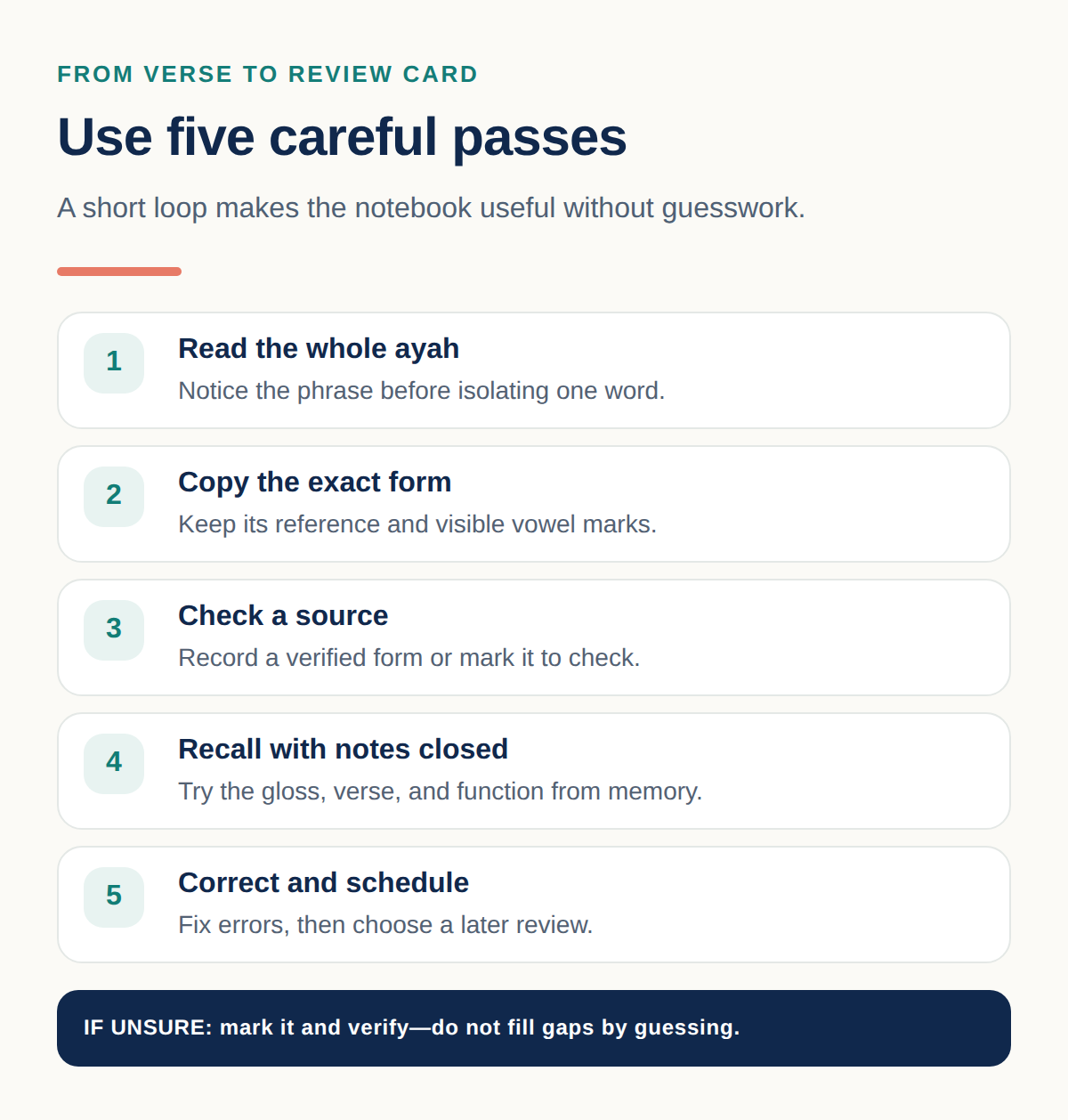
A five-pass routine for a reliable entry
- Read: read the full verse and note its reference first.
- Copy: record the exact Arabic form and a little context.
- Check: consult a reliable dictionary or morphology source; mark uncertainty.
- Recall: close the reference and write what you remember about the meaning, form, and verse.
- Correct: reopen the source, fix mistakes clearly, and set a later review.
For words with several possible senses, keep the verse-specific gloss in the main entry. Add other uses only after checking another passage. To connect vocabulary with meaning, try Quranytime’s Arabic reading-comprehension practice.
Make review small, spaced, and easy to correct
Do not reread every page from the beginning each time. Cover the gloss and prompt yourself with the Arabic form or verse reference. Try to recall the working meaning and context, then check the answer and correct it promptly. If you remember the gloss but not where the word appeared, mark that as partial recall.
The Australian Education Research Organisation recommends distributing learning across two or more lessons, asking learners to retrieve information instead of only restudying it, and correcting misconceptions in a timely way. It does not prescribe an exact schedule for Quran vocabulary, so use the dates below as a flexible routine, not a proven formula. Read the AERO guide to spacing and retrieval practice for those general principles.
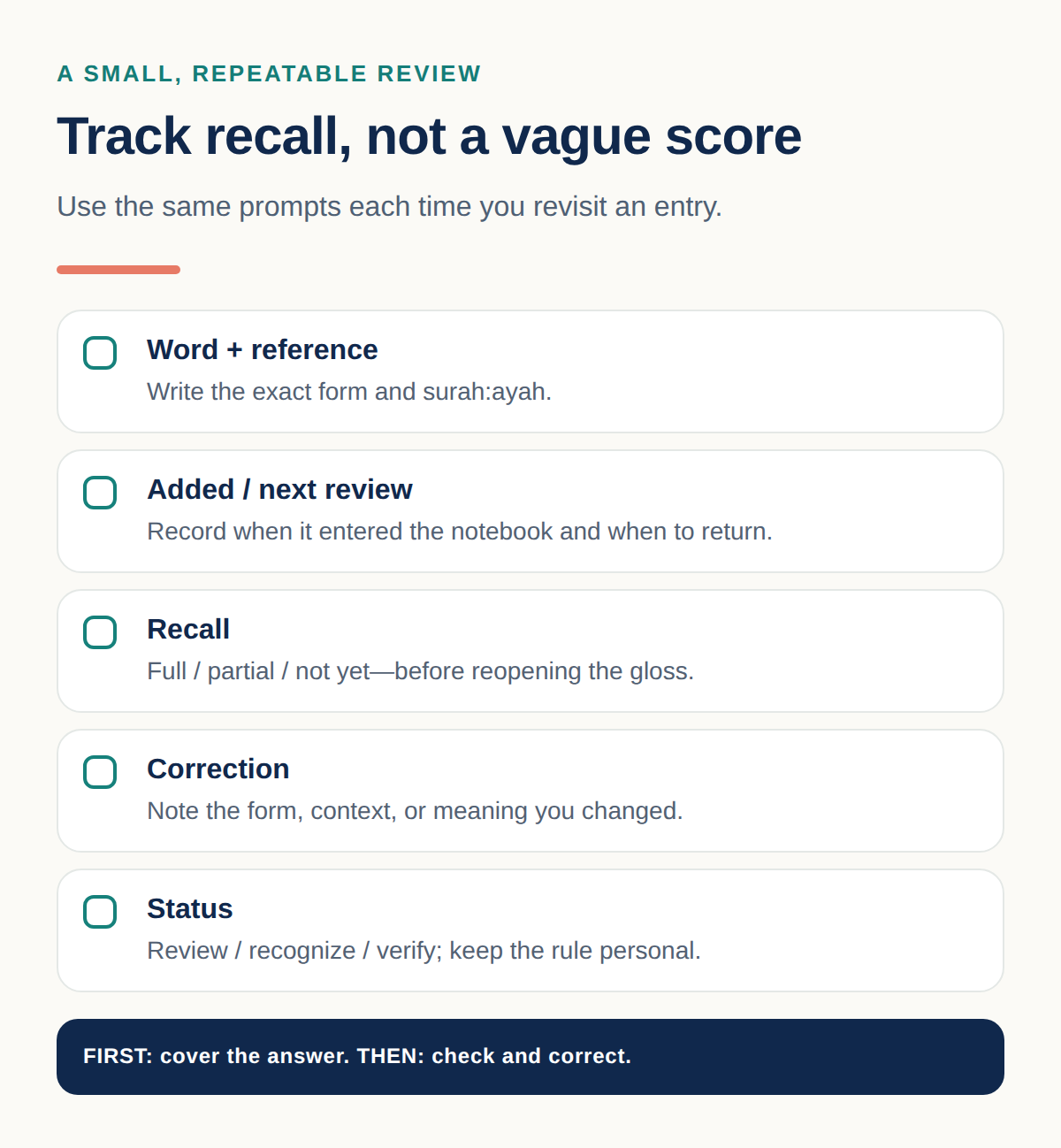
A tracker can use “added,” “next review,” “recalled without looking,” “correction,” and “status.” You might revisit an entry the next day, several days later, and the following week. Adjust the gaps to your routine; the key is to return after time has passed and retrieve before revealing the note. Keep each session short. A different activity, such as Quranytime’s Quranic Vocabulary Match, can vary practice, but return to the verse to check context.
On alternate reviews, test in two directions: given the Arabic form, recall its working gloss and verse; given the reference, find the word and explain its role in that passage. If you needed to see the English first, mark the result as partial. Write one next action—check a form, revisit context, or review again—so the notebook stays usable instead of becoming an open-ended task list.
When is an entry ready to move out of review?
Recognizing a word while its gloss is visible is not the same as recalling it later. Choose a personal rule and write it at the front of your notebook. For example, move an entry to “recognize” after you can recall its working gloss and verse context on two separate reviews. This is an organizing rule, not a guarantee that you have mastered every use.
If you miss the meaning, keep the entry active and record the problem: a related form was confusing, the verse was forgotten, the gloss was too broad, or the marks were hard to read. Choose one next step—check the form, reread the passage, ask a teacher, or schedule another review. A specific correction is more useful than “study harder.”
If you meet the same form in another verse, add that reference as a separate context note instead of overwriting the first entry. A word can be familiar while its use in a new passage still needs checking. The notebook should preserve those differences, not flatten them into one universal translation.
A ten-minute notebook session
- Two minutes: choose a short passage and read it as a whole.
- Three minutes: add one or two useful words with exact forms and references.
- Two minutes: close the source and recall what each entry says.
- Two minutes: check, correct, and mark anything uncertain.
- One minute: set the next review and choose where you will meet the words again.
Use the notebook beside Quran reading, not instead of it. When you return to a passage, notice whether familiar forms help you follow the phrase more smoothly. Quranytime’s guide to Quran reading fluency without rushing discusses accuracy and comfortable pacing together.
Common notebook mistakes to avoid
- Copying a gloss without the verse: add a reference and context clue.
- Guessing a root by removing letters: verify the form instead of relying on guesswork.
- Putting interpretation in the meaning field: separate a brief vocabulary gloss from commentary.
- Adding too many words: one or two reviewed entries beat a long list you never revisit.
- Marking a word learned after recognition: hide the answer and retrieve it later.
- Leaving errors uncorrected: show the correction so the next review tests the right information.
For a structured route beyond self-study, compare your notebook with Quranytime’s guided Quranic Arabic learning path. A teacher can help check a form or explain why a gloss does not fit; the notebook records the correction for practice.
Start with one page, not a perfect system
Draw the seven fields on a page, choose one verse you are already reading, and add one word only if you can record its form and reference accurately. Use a question mark where your knowledge stops. At the next review, close the book, retrieve what you can, and correct it from a trustworthy source. A small record you revisit is more useful than a beautiful list that never returns to the Quran.
If you would like help choosing a level or checking what to work on next, book Quranytime’s free assessment class. The goal is not to fill every notebook page; it is to build a careful habit of noticing, checking, and remembering Quranic Arabic in context.