

Free online Arabic courses can be a strong starting point for alphabet recognition, basic vocabulary and regular independent practice. Paid lessons can add live speaking time, correction, structure and accountability, but a price tag alone does not establish quality. Choose according to your learning goal, the feedback you need, the time you can maintain and the full cost of the arrangement.
For many learners, a combination works well: use a small set of free resources between guided lessons. Others can make substantial progress independently or prefer a structured group course. This guide helps you compare the options fairly and test whether a course fits your actual needs before committing to a long package. Quranytime offers paid teaching, so that commercial interest should be kept visible when considering its recommendation.
Define the Arabic you want to learn
Arabic learning can mean several different things. You may want to read the script, understand Modern Standard Arabic, speak an everyday dialect or study Quranic vocabulary and recitation. A course can be excellent for one goal while offering little practice for another. Write a specific outcome before comparing prices.
For example, a parent may want a child to recognize letters and read short vowelled words. An adult travelling to Egypt may mainly need spoken interaction. A learner studying the Quran may need accurate decoding, pronunciation feedback and vocabulary in context. Those goals require different examples, teachers and ways of assessing progress.
The guide to Quranic Arabic and Modern Standard Arabic explains one important distinction. Ask a prospective provider what variety and skill the course teaches. A vague promise of fluency is less useful than a clear explanation of what you will practise each week.
What free resources can do well
Free lessons can introduce the alphabet, provide listening models and supply repeatable exercises without a financial commitment. They are especially useful when you want to explore the language before choosing a goal or when you already know how to organize independent study. Repetition is easy because you can revisit the same material whenever your schedule allows.
A clear sequence matters more than the number of resources collected. Choose one beginner pathway, finish a small lesson and test what you remember. Opening five apps in one evening can create activity without producing much independent recall. A modest routine with checks is easier to evaluate.
Madinah Arabic offers free learning material that can serve as one example of a self-study option. Features and availability can change, so inspect the current course rather than assuming that every exercise includes live correction. Free material is most useful when you understand what it provides and what you must supply yourself.
Where self-study can leave gaps
A recording can model a sound, but it may not tell you exactly why your own attempt differs. A multiple-choice exercise can check recognition while giving little information about spontaneous speaking. A completed lesson badge may therefore measure participation more than usable performance.
These gaps do not make free learning ineffective. They show where another source of feedback may help. You might use a teacher, an appropriate conversation partner or a well-designed recording review. The key is to avoid assuming that repetition alone has corrected an error that nobody has actually checked.
Children may also need adult support to follow the task and explain what they learned. An attractive interface cannot replace all guidance. Observe whether the child can identify a letter in a new position or read an unfamiliar example after the activity ends. Transfer matters more than screen time.
What paid lessons should add
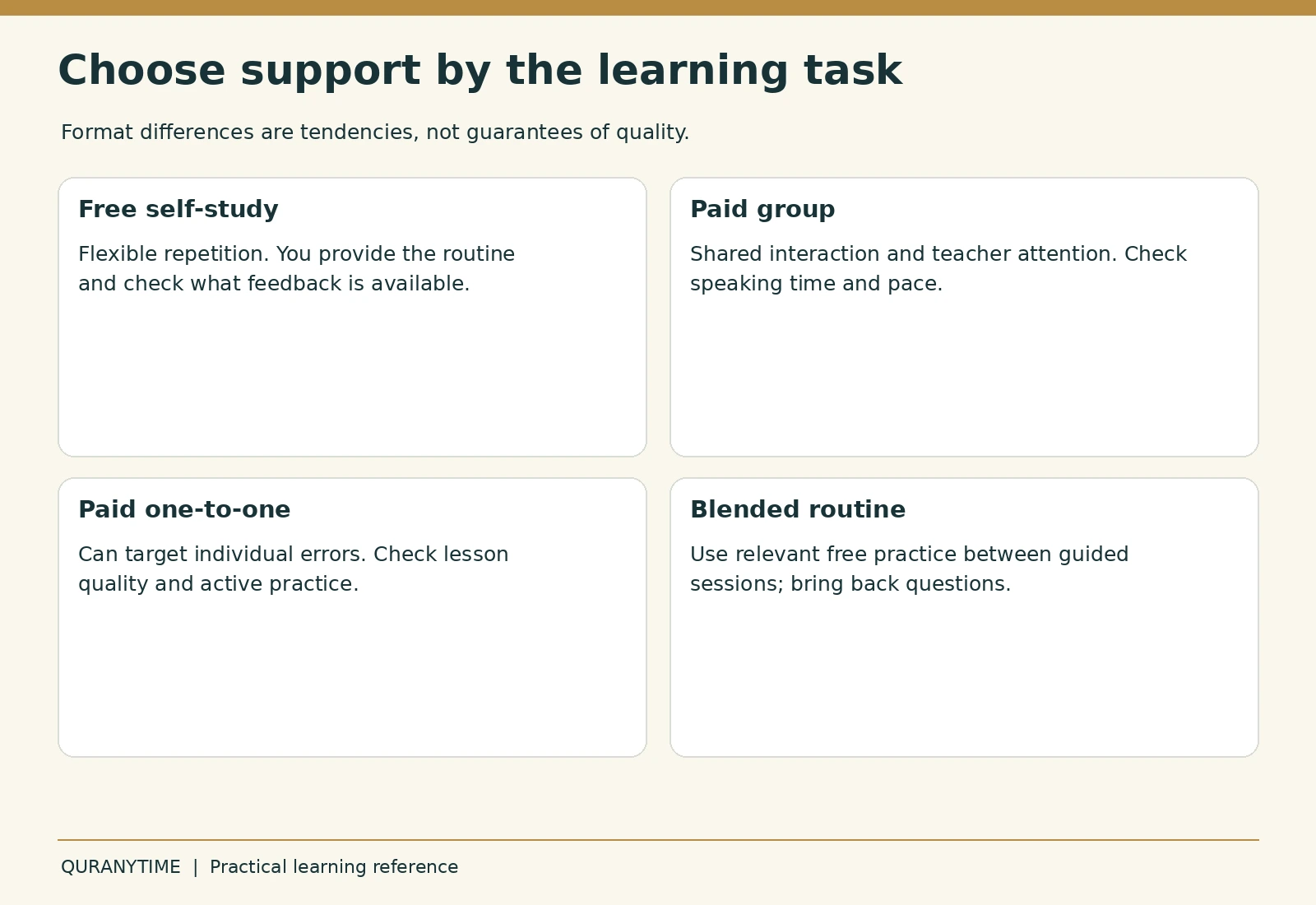
Paid teaching should offer identifiable value beyond access to material already available elsewhere. That value may include individual diagnosis, immediate correction, structured practice, feedback on homework and a clear plan for the next lesson. Group lessons may offer interaction and affordability, while one-to-one sessions can allocate more time to a specific learner’s difficulties.
Ask how much of a typical lesson the student actively reads or speaks. A tutor talking for most of the session may provide explanations without enough practice. Ask how mistakes are recorded and revisited, whether the lesson follows the stated goal and what happens when the student needs a slower pace.
Our online Arabic classes overview describes the institute’s offering. Compare those details with your own requirements rather than treating any provider’s marketing copy as a complete evaluation. A suitable course should be able to explain its teaching approach in concrete terms.
Compare options using the same questions
| Criterion | Free self-study material | Paid group course | Paid one-to-one lessons |
|---|---|---|---|
| Scheduling | Usually flexible | Often fixed | Depends on provider and availability |
| Individual correction | May be limited or absent | Shared teacher attention | Can be tailored to the learner |
| Speaking turns | Depends on resource design | Shared with classmates | Can provide more individual practice |
| Pace | Learner controls review | Usually follows group sequence | Often adjustable |
| Cost | May have optional paid extras | Check all fees | Check lesson length and package terms |
| Accountability | Mainly self-managed | Class schedule and assignments | Teacher follow-up if included |
These are common format differences, not guarantees about every course. A thoughtful group teacher may provide better feedback than an unprepared private tutor. A carefully organized independent learner may progress more steadily than someone who pays for sessions but never practises between them.
Calculate the real monthly cost
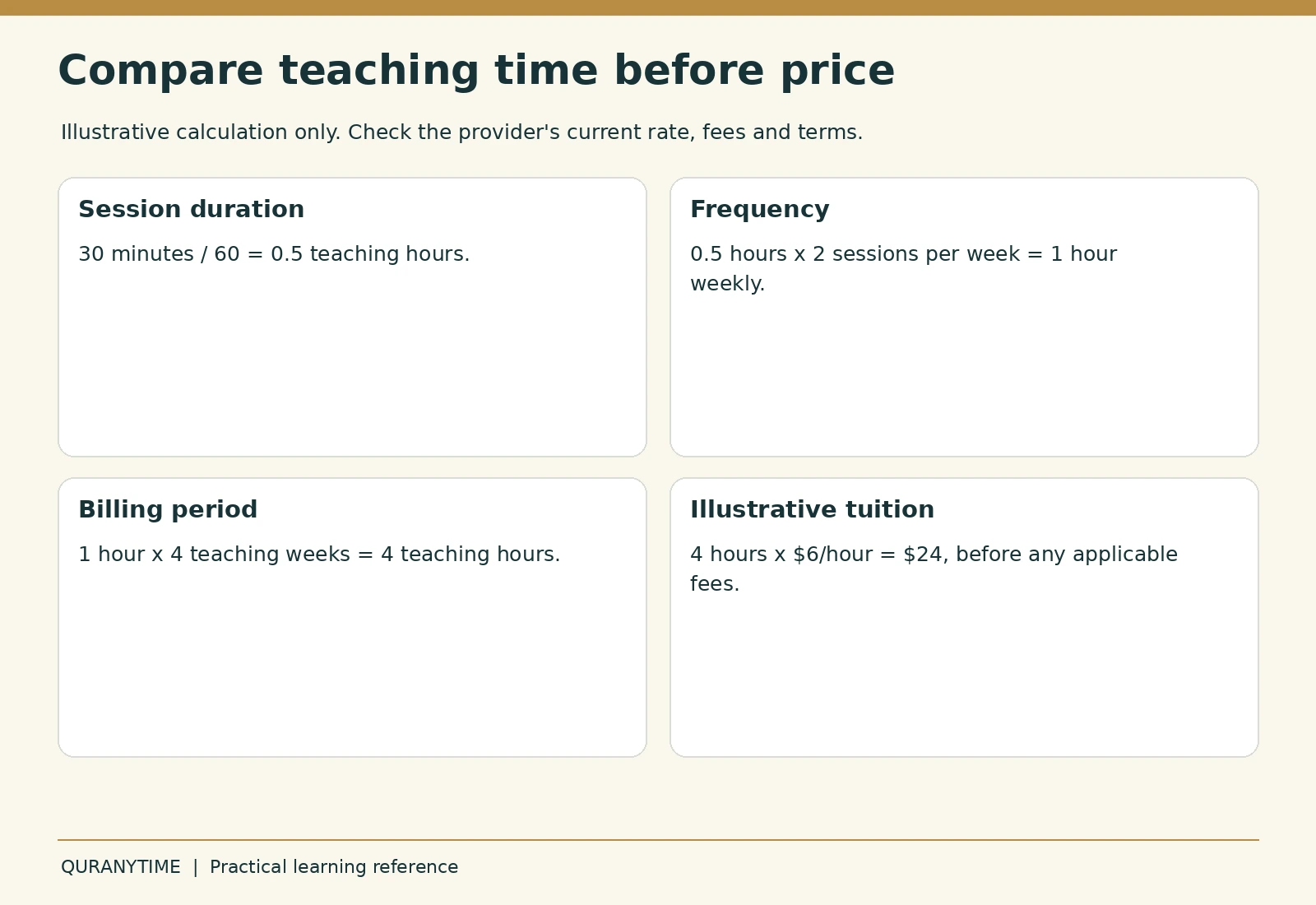
Compare teaching minutes rather than the word lesson alone. Four thirty-minute sessions contain two hours of teaching; four sixty-minute sessions contain four. An attractive per-session price may look different after you normalize the lesson duration. Also check whether a trial is free, discounted or charged at the normal rate.
Use this simple calculation: monthly teaching hours equal session minutes divided by sixty, multiplied by sessions per week and the number of teaching weeks billed. Monthly tuition then equals those hours multiplied by the hourly rate, if the provider bills that way. A four-week package and a calendar month are not automatically identical.
For an illustrative rate of six dollars per hour, two thirty-minute sessions weekly over four teaching weeks total four hours and twenty-four dollars. This is a calculation example, not a claim about a competitor’s current pricing or a binding offer. Check Quranytime’s current pricing and any applicable fees before enrolling.
Check the terms before buying a package
Ask about missed lessons, rescheduling deadlines, teacher absence, refunds and package expiry. Also confirm the payment currency and any transfer fees. These details affect practical value, particularly for families coordinating several students across time zones. A low headline rate is less attractive if the schedule cannot be used reliably.
Write down the teacher’s time zone and your own. Daylight-saving changes can shift the relationship between them during the year. Confirm how the provider handles those changes rather than assuming the same clock-time conversion applies forever. The lesson reminder should identify the student’s local time clearly.
For children, ask who supervises communication, how class links are shared and what safeguarding arrangements apply. Keep the questions specific to the actual service. Responsible providers should explain their process plainly; a reassuring adjective is not a substitute for practical information about how a lesson operates.
Use a trial as a learning test
A useful trial reveals the student’s starting point and gives at least one concrete correction. Bring a short reading sample or a clear speaking goal. Notice whether the teacher listens, adapts the task and explains the next step. A trial is less informative when it consists mainly of a sales conversation.
Afterwards, ask the learner what they practised and what they now know to change. For a child, look for comfortable participation and understandable instructions. For an adult, look for useful feedback rather than a flood of terminology. The teacher should be able to describe a realistic near-term goal.
If you want to understand the institute’s process before booking, read what happens in a free Quran and Arabic assessment. Use that description as something to check against the actual experience, not as proof that every student will have the same needs or outcomes.
A blended routine for a limited budget
Choose one guided session or a manageable number of lessons, then assign the independent work a clear purpose. For example, use free audio to review the sounds corrected in class, a worksheet to practise the target joins and a short reading task to test transfer. Bring questions from that work into the next lesson.
Avoid making the free portion an unrelated collection of activities. If the paid lesson focuses on vowelled reading, spending the week only memorizing travel phrases may not reinforce it. Variety is useful when the tasks support the same goal or when you have deliberately separated two learning aims.
The Arabic Reading Guide can support script and audio practice between sessions. A teacher can help choose a small relevant section. The resource does not replace all correction, but it can make guided time more productive by keeping familiar material active.
When free learning may be enough for now
Self-study can be appropriate when you are exploring the script, reviewing familiar material or maintaining a habit with reliable feedback already available elsewhere. You do not need to purchase a course simply because you have begun learning Arabic. Start with a realistic goal and evaluate what you can do after a few weeks.
Keep a record of tasks completed independently: letters identified out of order, words read without transliteration or short phrases understood from audio. If those measures improve, the routine is doing useful work. If you remain uncertain about pronunciation or cannot transfer the skill, consider targeted help rather than assuming you need a large package immediately.
A small paid intervention can sometimes address one persistent obstacle, but it is not the only possible next step. Better resource selection, a clearer schedule or more careful self-testing may also help. Match the solution to the problem rather than equating commitment with spending.
When guided teaching becomes more valuable
Individual feedback becomes especially useful when mistakes repeat, the learner cannot identify why a sound is wrong, or the course’s difficulty jumps beyond the student’s preparation. It can also help when a family needs structure or an adult has a specific performance goal with limited practice time.
For Quran recitation, listening to one’s own recording may not reveal every articulation or timing error. A suitable teacher can provide correction and distinguish decoding, pronunciation and tajweed issues. Ask about relevant teaching experience and how correction is delivered rather than relying only on titles or broad claims.
Guided teaching still requires participation. Paying does not make practice unnecessary or guarantee a completion date. A strong arrangement gives the learner clear work between lessons and adjusts the plan according to retention. The value appears in better decisions and usable feedback, not simply in having a subscription.
Download the course-comparison worksheets
Download the free three-page practice worksheets and answer guidance (PDF). No registration is required.
The pack contains a learning-goal planner, a side-by-side comparison sheet, a monthly teaching-hours calculator and a trial-lesson reflection form. Fill it with the provider’s actual answers. Leave unknown items marked unknown instead of filling the gaps with assumptions from an advertisement.
Choose your three most important criteria before assigning scores. A family needing a particular time may weigh scheduling more heavily than an adult with flexible hours. Someone studying independently may prioritize occasional pronunciation feedback over a full curriculum. The worksheet helps make that reasoning visible; it does not produce an objective universal winner.
Make the decision after the trial
Do not decide only while the lesson is still fresh and the sales conversation is active. Review your notes later and compare the experience with the goal you wrote beforehand. Did the student practise the target skill? Was the correction understandable? Can the proposed schedule actually be maintained? If one answer is unclear, ask a focused question before purchasing. If the course is a poor fit, retain what you learned about your needs and compare another option. A useful trial can improve your decision even when you choose not to continue with that particular provider.
Frequently asked questions
Are paid Arabic courses always better?
No. Quality depends on teaching, practice, feedback and fit. Paid lessons should provide specific value, while free resources can be excellent for appropriate goals. Compare the actual experience rather than assuming price establishes effectiveness.
Can I combine free and paid learning?
Yes. Keep the independent practice aligned with the guided lesson and bring unresolved questions back to the teacher. A small consistent resource set is often easier to use than many disconnected apps.
How should I compare lesson prices?
Normalize the teaching minutes, then include fees, expiry rules and rescheduling conditions. Confirm whether the package covers four teaching weeks or a calendar month. Ask what feedback and materials are included.
What should I do next?
Complete the goal and comparison sheets first. If guided Arabic or Quran learning fits your needs, book a free trial class and use the trial checklist to assess the match before choosing a continuing schedule.
Sources and disclosure
Madinah Arabic is an example of publicly available Arabic learning material. Provider features and prices can change. Quranytime is the publisher and offers paid lessons; this article is a decision guide, not an independent ranking of all providers or a guarantee of learning outcomes.