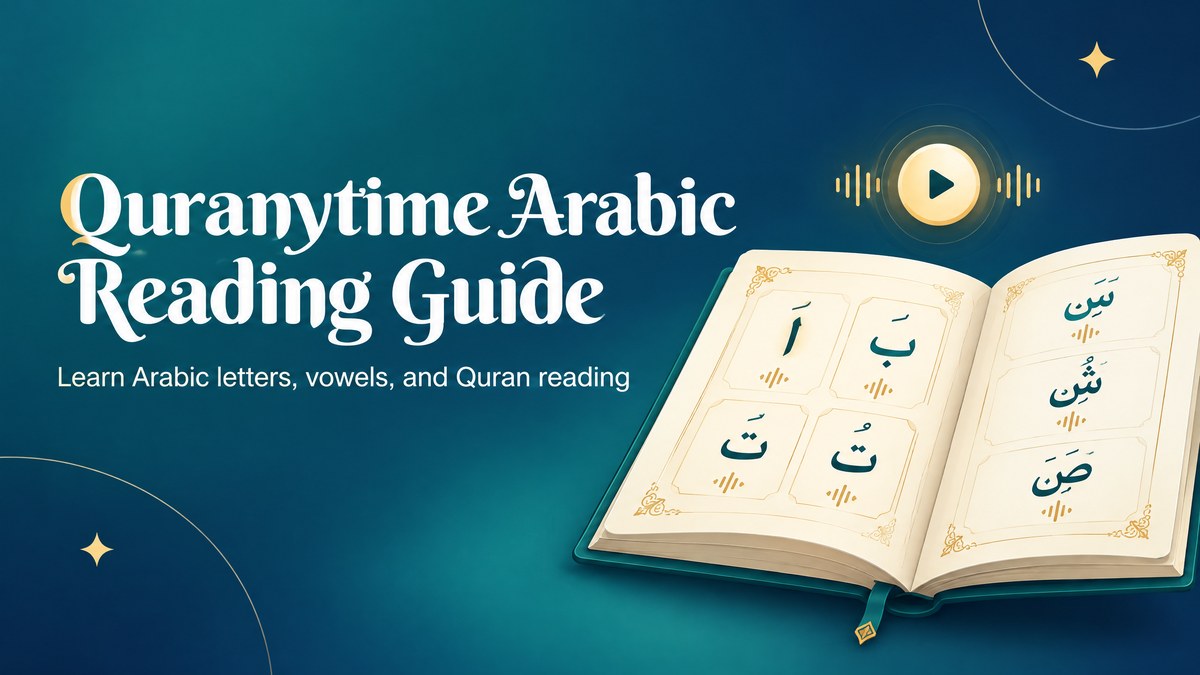
Practice Arabic letters, vowels, and reading skills step by step with teacher audio.
0 ★
Start with the alphabet, then unlock every reading skill in the book.Your progress is saved on this device.
Play with the sounds
Use the teacher’s voice to build, compare, and review Arabic sounds.
Chapter 1 • Page 5
Listen to every letter
Tap a card to hear the native recording of its Arabic name.
Sound Lab
Listening games
؟
★
Chapter complete!
Created by Quranytime website
Arabic Reading Guide for Quran Learners
Quranytime’s interactive Arabic reading guide helps children, adults, and beginners learn Arabic letters and build confident Quran reading skills step by step. Use the teacher audio to hear each letter, practise short vowels and long vowels, and review the sounds that support accurate reading.
What You Can Practise
Recognise and pronounce the Arabic alphabet with guided listening.
Practise fatḥah, kasrah, ḍammah, tanween, sukoon, shaddah, and long-vowel patterns.
Repeat sounds, compare answers, and review difficult reading patterns through short listening games.
Build a foundation before progressing to Quran reading, recitation, and Tajweed.
Start with the alphabet if the learner is new to Arabic print. Play a letter name, invite the child to repeat it, and point to the matching shape. The guide includes all 28 letter names with teacher audio. A child may enjoy moving through the map, but there is no need to rush. Pause whenever a sound needs another listen. The progress shown in the guide stays on the device, so using the same browser makes it easier to continue a later session.
After letter names, practise one short vowel at a time. Fatḥah gives a short a sound, kasrah a short i sound, and ḍammah a short u sound. Listen and repeat each pair carefully. Then use the short-vowel review to tell the three patterns apart. A teacher can model the sound and ask the learner what changed when the vowel mark moved. For home practice, choose a small set of letters and revisit them on several days rather than completing every activity at once.
From letters to reading patterns
The long-vowel activities introduce long ā with alif, long ī with yāʾ, and long ū with wāw. Let the learner compare a short sound with a stretched sound. Tanwīn activities then add the -an, -in, and -un endings. A review activity brings the three endings together. Sukūn helps the learner hear a consonant without a following vowel. Shaddah activities practise a doubled consonant, including examples with fatḥah and tanwīn. These steps help learners notice the marks that change how a written syllable is read.
Listen to the teacher recording before asking a child to read independently. If an answer is difficult, replay the sound and look at the printed sign together. Ask the learner to explain what they see: a vowel mark, a long-vowel letter, a tanwīn ending, a sukūn, or a shaddah. That explanation can show whether the learner is recognising the pattern or guessing. The listening games make it comfortable to try again, while a teacher can correct sounds that are hard to represent in English letters.
A gentle practice routine
Begin with two or three minutes of review from a previous session. Introduce one new pattern, listen to a few examples, and let the learner respond. End by returning to a sound they can read confidently. For younger children, keep each visit brief and praise careful listening. For older beginners, ask them to compare two patterns and tell you why the sounds differ. Recordings support repetition, but spoken feedback from a knowledgeable adult remains valuable.
The Arabic Reading Guide supports early reading, and children can continue with guided Quran recitation when ready. The British Council Arabic education pack gives further background on Arabic script for families and teachers. For another playful starting point, try Arabic Letter Explorer. The Educational Games hub gathers the other activities.
Questions learners ask
Should I finish every level in one sitting? No. Short, regular sessions are easier to repeat. Can I replay a sound? Yes. Use the listening controls to hear the teacher model again. Does this replace a lesson? It is a practice companion. A teacher can guide pronunciation, explain the writing system, and help the learner move from isolated sounds to connected reading.