
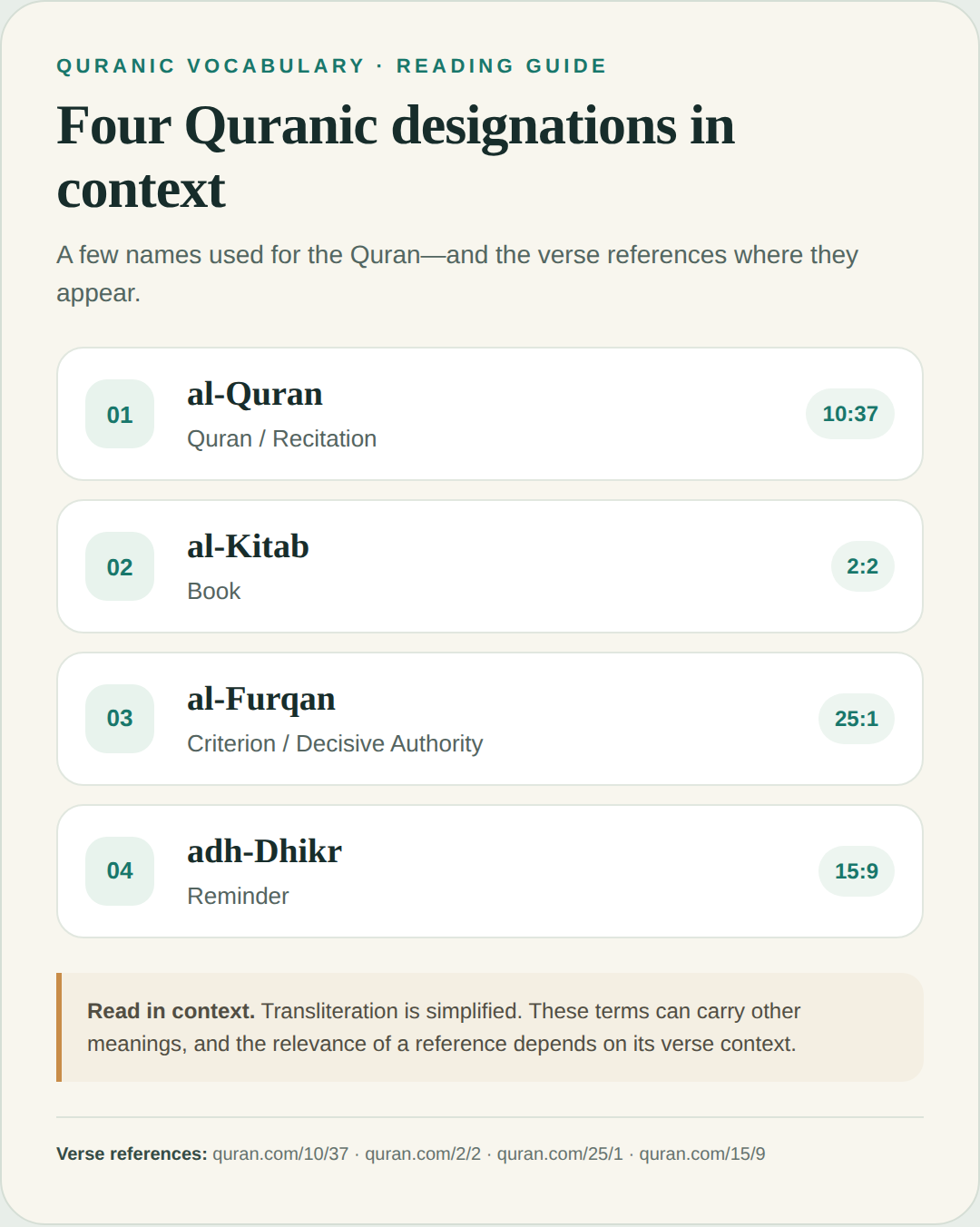
Among the names of the Quran in Arabic and related Quranic designations are القرآن (al-Qur’an, the Quran/Recitation), الكتاب (al-Kitab, the Book), الفرقان (al-Furqan, the Criterion) and الذِّكْر (adh-Dhikr, the Reminder). These words describe the revelation in particular verses; they should not be treated as a closed, universally agreed list of exclusive proper names. Their meaning depends on context, and some of the same Arabic words can refer to other things elsewhere.
Looking at the four expressions in their verses gives a useful starting point for understanding how the Quran speaks about itself. The references below link directly to the relevant ayat. English glosses are approximate: translation helps us approach the Arabic, but no single English word carries every shade of meaning.
What do “names of the Quran in Arabic” mean?
People often search for the names of the Quran hoping for a simple list. A careful answer begins with a distinction. The Quran uses different words and descriptions for itself in different passages. Some are often discussed as designations of the revelation, while other words describe what it does or how it was sent down. Not every meaningful description is necessarily a proper name in the same sense.
That is why it is more accurate to discuss examples with their verse contexts than to announce a definitive number. The verses examined here use the words al-Qur’an, al-Kitab, al-Furqan and adh-Dhikr in reference to the revelation. This article does not claim that these are the only valid designations or that scholars agree on one fixed count.
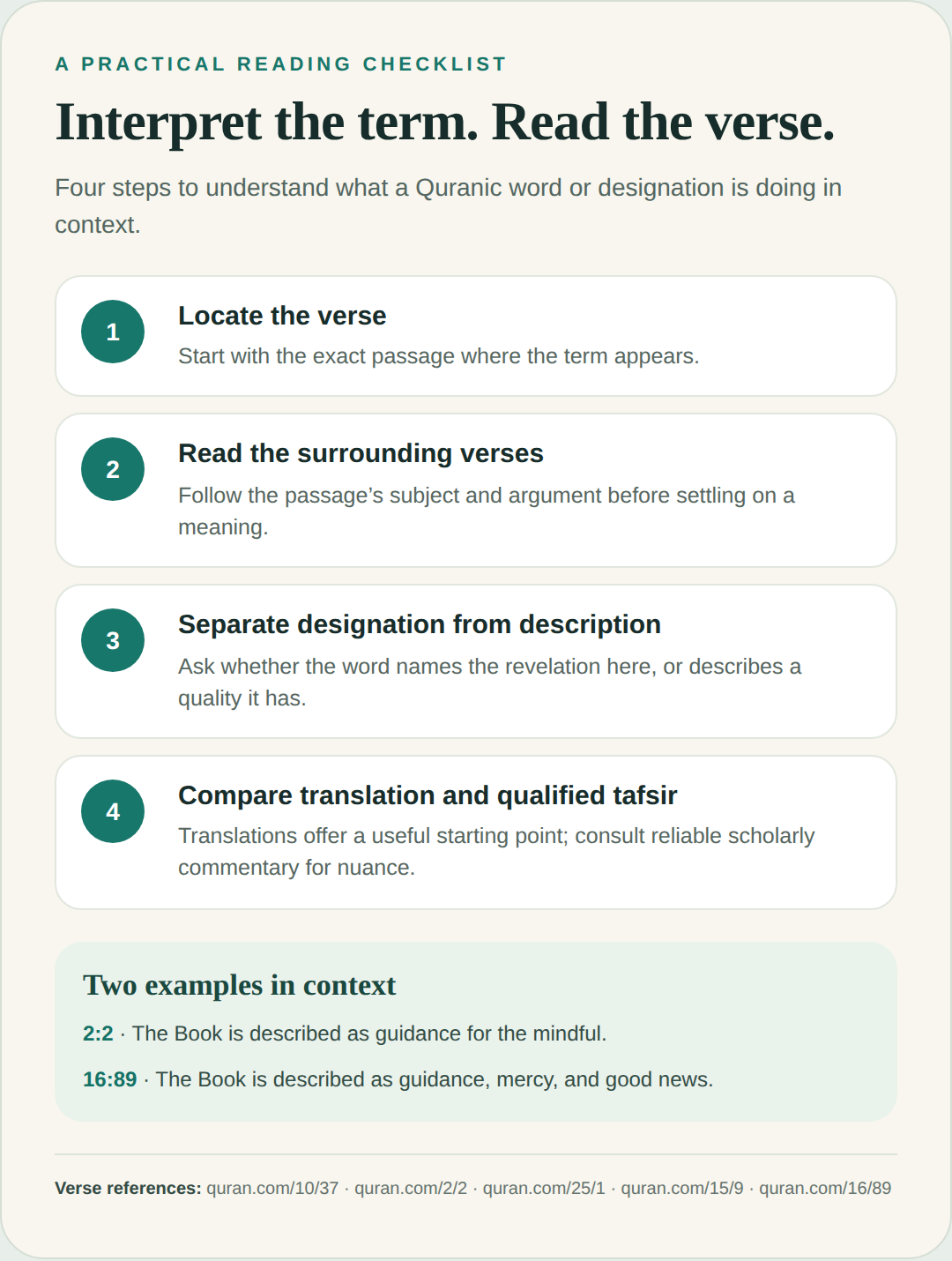
The Quran also describes itself as guidance and mercy, among other things. Those are important descriptions, but they are not simply interchangeable labels or a reason to extend a numbered list. In 2:2, the Book is described as guidance for the mindful; in 16:89, the revealed Book is described as a guide, mercy and good news. These descriptions tell readers about its role in those passages.
1. القرآن (al-Qur’an): the Quran, or Recitation
Al-Qur’an is the familiar Arabic name used for the scripture. The word is associated in common explanation with reciting or reading, so “the Recitation” is a helpful approximate gloss. It points naturally to a text that is recited as well as read and studied. For a fuller introduction to the word and its meaning, see Quranytime’s guide to the meaning of Quran.
Two verse references make the usage clear. In Yunus 10:37, the Arabic phrase هَٰذَا الْقُرْآنُ refers to “this Quran” in a verse speaking about its origin and its relation to earlier scripture. In Al-Isra 17:9, the verse says that this Quran guides to what is most upright and gives good news to believers who do good. The word is not merely an abstract label: in each place the surrounding sentence tells readers what is being said about it.
“Recitation” should be understood as an explanatory gloss, not a complete definition of the scripture. And while al-Qur’an names the Quran in these passages, the wider meaning of any Arabic word still depends on how and where it appears. Reading the verse and its neighboring lines is a better safeguard than relying on a one-word English equivalent.
2. الكتاب (al-Kitab): the Book
Al-Kitab means “the Book.” In Al-Baqarah 2:2, the verse begins ذَٰلِكَ الْكِتَابُ—commonly rendered “This is the Book”—and describes it as guidance for those mindful of God. Here, the Quran is referred to as the Book, with the verse immediately adding a description of its role.
The word kitab is not exclusive to the Quran in every Quranic context. It can refer to scripture or a book in other passages, including earlier revelation. So the word by itself does not always identify the Quran; context does that work. In 2:2, the opening and surrounding passage establish the reference.
This distinction matters when compiling lists. A word can be used of the Quran in one verse and carry a broader or different reference elsewhere. Rather than assuming the word has one fixed referent in every instance, note the phrase and its location. If you are learning how verse references and page markers work, Quranytime’s guide to reading a Quran page explains the difference between a surah-and-ayah address and edition-specific page numbers; its guide to Juz Amma gives a useful example of identifying a reading section by verse boundaries rather than page count.
3. الفرقان (al-Furqan): the Criterion
Al-Furqan is commonly glossed as “the Criterion”: that which distinguishes or separates. In Al-Furqan 25:1, the word appears in a verse about what God sent down to His servant. Quran.com’s English rendering uses “the Decisive Authority” in this verse. “Criterion” is another common explanatory gloss, but it is not the wording of that particular translation. This distinction is a useful reminder that English renderings can differ.
The title of Surah Al-Furqan uses the same Arabic word. In 25:1, the verse presents the furqan as something sent down, and the following passage continues by discussing the revelation and its message. The contextual connection is what supports reading the word here as a designation for the Quran, rather than treating any one English gloss as a full definition.
In ordinary Arabic and in other Quranic contexts, a word related to distinguishing can be used in a wider sense. It should not be forced to mean “the Quran” wherever it appears. The reference Al-Furqan 25:1 is therefore more informative than a bare glossary entry: it shows how the word functions in this particular verse.
4. الذِّكْر (adh-Dhikr): the Reminder
Adh-Dhikr is often translated “the Reminder” or “the Remembrance.” In Al-Hijr 15:9, the Arabic phrase نَزَّلْنَا الذِّكْرَ refers to the Reminder that God says He has sent down and will preserve. Islam Question & Answer, quoting al-Tabari on this verse, explicitly identifies the Dhikr here as the Quran; the verse itself and its immediate context provide the primary reference.
“Reminder” captures an important aspect of the word, but should not be mistaken for an exhaustive account of the Quran. The text also calls people to reflect, receive guidance and respond to revelation. A name or description highlights one aspect in a given passage; it does not reduce the whole scripture to that one aspect.
As with the other Arabic terms here, dhikr can mean remembrance or reminder more broadly and can have other referents in other contexts. When you encounter it, check the grammar, the surrounding words and the subject of the passage before concluding that it names the Quran. For related practical advice about distinguishing the Arabic text, translations and paraphrases, see Quranytime’s guide to verifying a Quran verse quote before sharing.
Names, descriptions and context
It is tempting to gather every positive word associated with the Quran into one long list of names. A more precise reading keeps categories in view. Al-Qur’an, al-Kitab, al-Furqan and adh-Dhikr are contextual designations examined above. “Guidance,” “mercy” and “revelation” are better described here as descriptions of the Book or its sending, rather than simply added as further entries in a definitive name list.
For example, Al-Baqarah 2:2 describes the Book as guidance for the mindful. An-Nahl 16:89 describes the Book sent down to the Prophet as explanation, guidance, mercy and good news for those who submit. Ash-Shu‘ara 26:192 states that it is a revelation from the Lord of all worlds. Each verse makes its own point. The terms illuminate the Quran’s role and origin, but they do not establish a numerological scheme or a complete, exclusive inventory of names.
There is also no need to infer that a word is a formal proper name every time it appears in an English translation with a capital letter. Capitalization is an editorial convention in English. The Arabic wording, sentence structure and context remain the better evidence for what a verse is referring to. For a supplementary classification, IslamWeb lists Quran, Book, Criterion, Reminder and Revelation among names, while separately describing terms such as guidance and mercy as attributes; that answer is one source’s classification, not a claim of universal agreement or a fixed exhaustive list.
How to study these references carefully
Start with the Arabic phrase and its verse address. Read the whole ayah, then look at the neighboring verses where they help clarify the subject. A translation is an aid to understanding, not an exact replacement for the Arabic. Different translators may choose “Reminder” or “Remembrance,” or “Criterion” instead of a longer phrase. Those differences do not necessarily indicate that the Arabic text differs.
Keep three things distinct in your notes: the Arabic word, a translation or gloss, and your explanation of what the passage means. This prevents a paraphrase from appearing to be an exact Quran quotation. If you want help choosing an English rendering for study, Quranytime’s translation guide for learning Arabic offers a useful comparison method.
For interpretive questions that cannot be answered from a simple word gloss, consult reliable tafsir and a qualified teacher or scholar. Tafsir discusses meaning and context; it is different from a dictionary entry or translation. Quranytime’s overview of tafsir books for beginners explains what to look for when selecting an introductory resource. The goal is not to turn a list into a debate, but to read each verse accurately and modestly.
Frequently asked questions
What are the four names of the Quran in Arabic?
Four contextual designations discussed here are القرآن (al-Qur’an), الكتاب (al-Kitab), الفرقان (al-Furqan) and الذِّكْر (adh-Dhikr). Examples appear at 10:37 or 17:9, 2:2, 25:1 and 15:9 respectively. This is a focused set of examples, not a claim that there are exactly four names.
What does Al-Quran mean?
Al-Qur’an is the Arabic name of the scripture and is commonly explained with the sense of recitation or reading. The verses 10:37 and 17:9 show the word in context. “Recitation” is an approximate English gloss, not a complete substitute for the Arabic meaning.
Does Al-Furqan mean “Criterion” or “Decisive Authority”?
Both are English renderings used to convey the Arabic al-Furqan. Quran.com renders 25:1 “the Decisive Authority”; “the Criterion” is a common gloss. Translation choices can differ, so avoid presenting one English phrase as a direct quotation from a source that uses another.
Are guidance, mercy and revelation also names?
They are Quranic descriptions in the verses cited here. For precision, this article distinguishes such descriptions from the four contextual designations it examines, rather than adding them to a fixed or exclusive list of proper names.
How many names of the Quran are there?
This article does not assign a definitive count. Lists can differ according to whether they include descriptions, contextual terms or words used elsewhere with other meanings. The most reliable way to study a proposed designation is to examine its exact Arabic use and verse context.
Can the same Arabic word refer to something other than the Quran?
Yes. Words such as kitab and dhikr have broader uses. Whether a particular occurrence refers to the Quran depends on the phrase and passage, not just the isolated word.
Source notes
- Yunus 10:37 — al-Qur’an in a passage about the Quran and earlier scripture.
- Al-Isra 17:9 — al-Qur’an described as guiding to what is most upright.
- Al-Baqarah 2:2 — al-Kitab and guidance.
- Al-Furqan 25:1 — al-Furqan; Quran.com uses “Decisive Authority” in its English rendering.
- Al-Hijr 15:9 — adh-Dhikr, the Reminder.
- An-Nahl 16:89 — Book described as explanation, guidance, mercy and good news.
- Ash-Shu‘ara 26:192 — description of the Quran as revelation from the Lord of all worlds.
- Islam Question & Answer, answer 10012 — cites Al-Hijr 15:9 and quotes al-Tabari identifying “Dhikr” there as the Quran; cited specifically for that contextual point, not as a comprehensive list of names.
- IslamWeb, “Names of the Qur’an” — supplementary example distinguishing its listed names from attributes/descriptions.
All English meanings in this article are approximate paraphrases unless explicitly identified as a named translation’s wording. Verse references link to Quran.com’s individual verse pages, where Arabic, English rendering, context and tafsir access are available.