
If you already have a line you want to post, quote, or send to a friend, take a moment to verify a Quran verse quote before sharing it. The goal is simple: make sure the Arabic, surah and ayah reference, surrounding context, and English label all match what you intend to share. This is a text-checking routine, not a substitute for tafsir or a religious ruling.
People may search for how to check a Quran quote, confirm a surah and ayah, or decide whether English wording is a translation or a paraphrase. Those are parts of one task: pause, compare, cite, and label. If you first need to find a verse from a remembered phrase, use this guide to finding a Quran verse from a few remembered words, then return to the checks below.
The phrase “verify Quran verse quote” names this same source-checking task; close wording variations do not need separate rules or separate articles.
First, name the kind of text you are sharing
“Quran quote” can refer to several different things. The Arabic wording is one layer. A transliteration represents pronunciation in Latin letters. An English translation expresses a translator’s rendering of meaning. A paraphrase restates an idea in your own words, while a personal comment or explanation is another layer again. Do not place them all inside quotation marks as if they were the same text.
Before you start, decide which layer your post contains. If you are combining Arabic with an English rendering, label both. If you are paraphrasing, say so. If you cannot tell whether a sentence is a translation or someone’s explanation, do not attribute it to the Quran as exact wording.
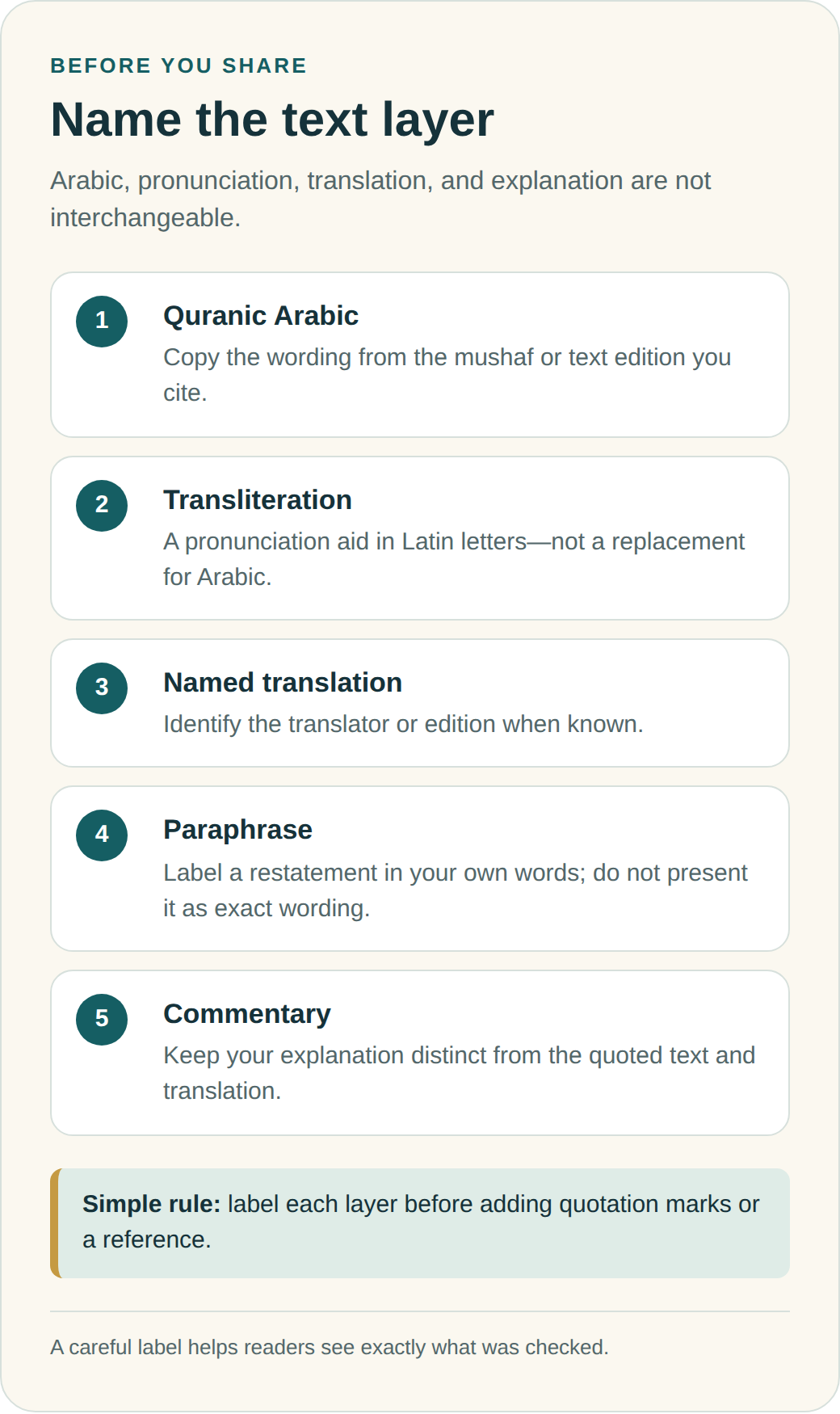
A six-step method to verify a Quran verse quote
- Freeze the version you received. Copy the exact text into a note before correcting spelling, punctuation, or diacritics. Keep the original message or image available. This lets you compare what you received with a source instead of unknowingly repairing it from memory.
- Search by the Arabic wording when possible. If you have Arabic, compare the whole phrase, not just a familiar opening. If you only have a translation or a few remembered words, treat those as clues, not proof. A verse may be found from partial memory, but discovery and verification are separate steps.
- Confirm the address. Check the surah name and number, then the ayah number. A surah index can help confirm chapter naming and navigation. Record the reference in a consistent form, such as “Surah Al-Ikhlas 112:1,” rather than relying on a screenshot caption alone.
- Check the verse boundary. Make sure the quotation begins and ends where you think it does. A sentence fragment may be valid as an excerpt, but the citation should not imply that it is a complete ayah. Watch for a line that accidentally joins the end of one verse to the start of the next. Read the complete ayah—and, when needed, the neighboring ayat—using a word-by-word method that keeps the phrase in context.
- Compare the Arabic and English separately. First verify the Arabic text in the copy or edition you intend to cite. Then verify the English rendering and name its translator or edition where known. Translations may use different English wording; that does not mean the Arabic verse itself changed. Quranytime’s guide to choosing a Quran translation for Arabic study can help you keep the translation layer distinct.
- Record the source and decide what you can honestly claim. Save the verse reference and the text source you checked. If your post includes grammar, identify it as a grammatical note; if it gives interpretation, label it as interpretation and consult a qualified teacher or trusted tafsir. A sentence-parsing guide can support language study, but a grammatical label alone does not settle every interpretive question.
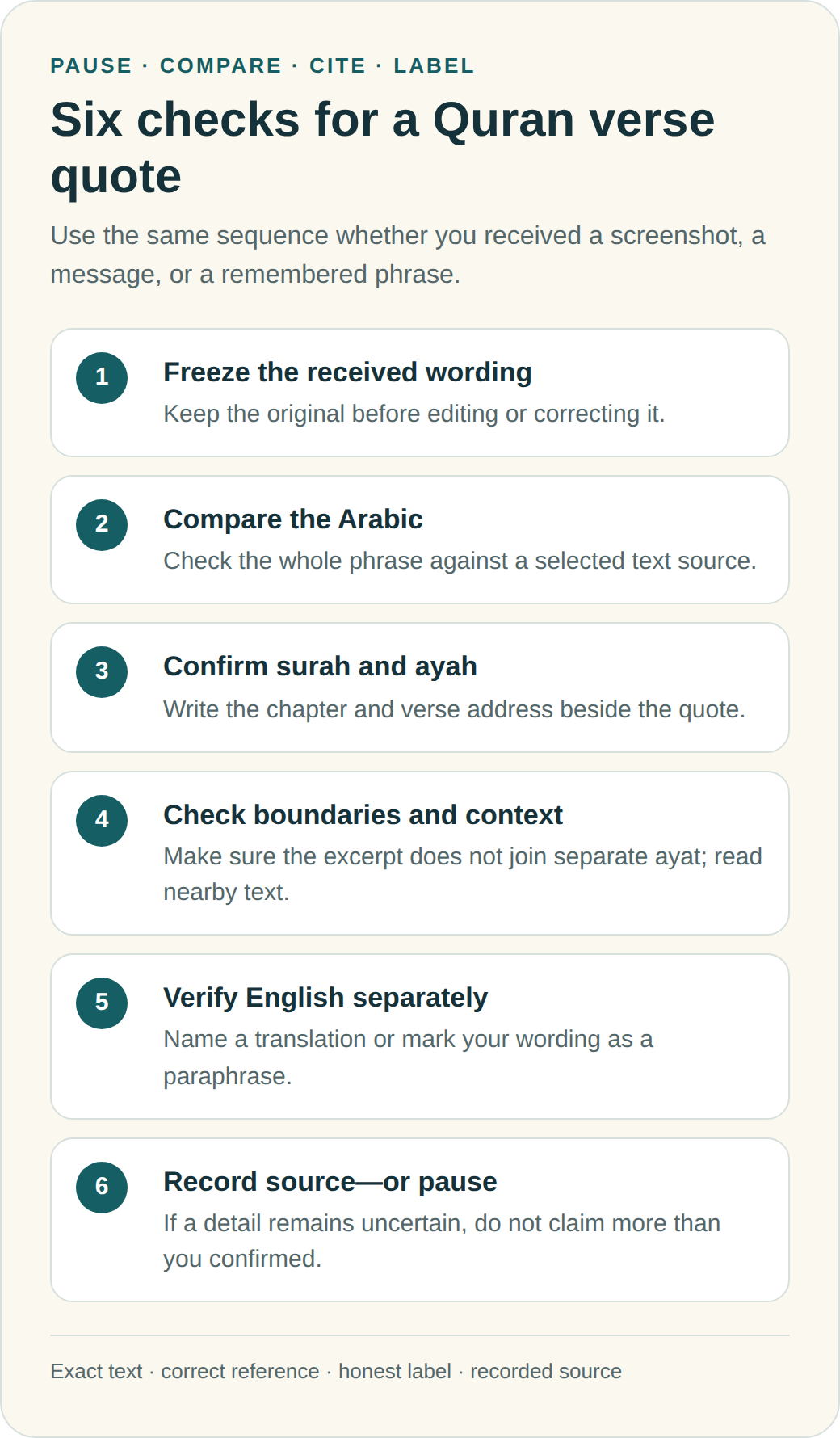
A worked example: checking Surah Al-Ikhlas 112:1
Suppose a message contains قُلْ هُوَ ٱللَّهُ أَحَدٌ and says it is “Surah Al-Ikhlas.” Do not stop at recognizing the phrase. Check the chapter and verse address, then compare the full written sequence with a verse-addressed text. The Quranic Arabic Corpus lists 112:1 word by word and shows the passage as four tokens—qul, huwa, Allāhu, and aḥadun—alongside translation and linguistic analysis. Its project description also explains that its annotations can be reviewed and corrected, so use it as a reference aid rather than an automatic guarantee. See the Quranic Arabic Corpus for the word-by-word view.
Now compare the message with the Arabic in the mushaf or text source you selected. Is the Arabic quotation exactly verse 1, or did the sender include an opening formula or words from another verse? Is the English line the translator’s wording, a shortened excerpt, or someone’s paraphrase? Write the reference beside the text before forwarding it. This example shows the checking process; it is not an invitation to infer a verse’s full interpretation from a word list.
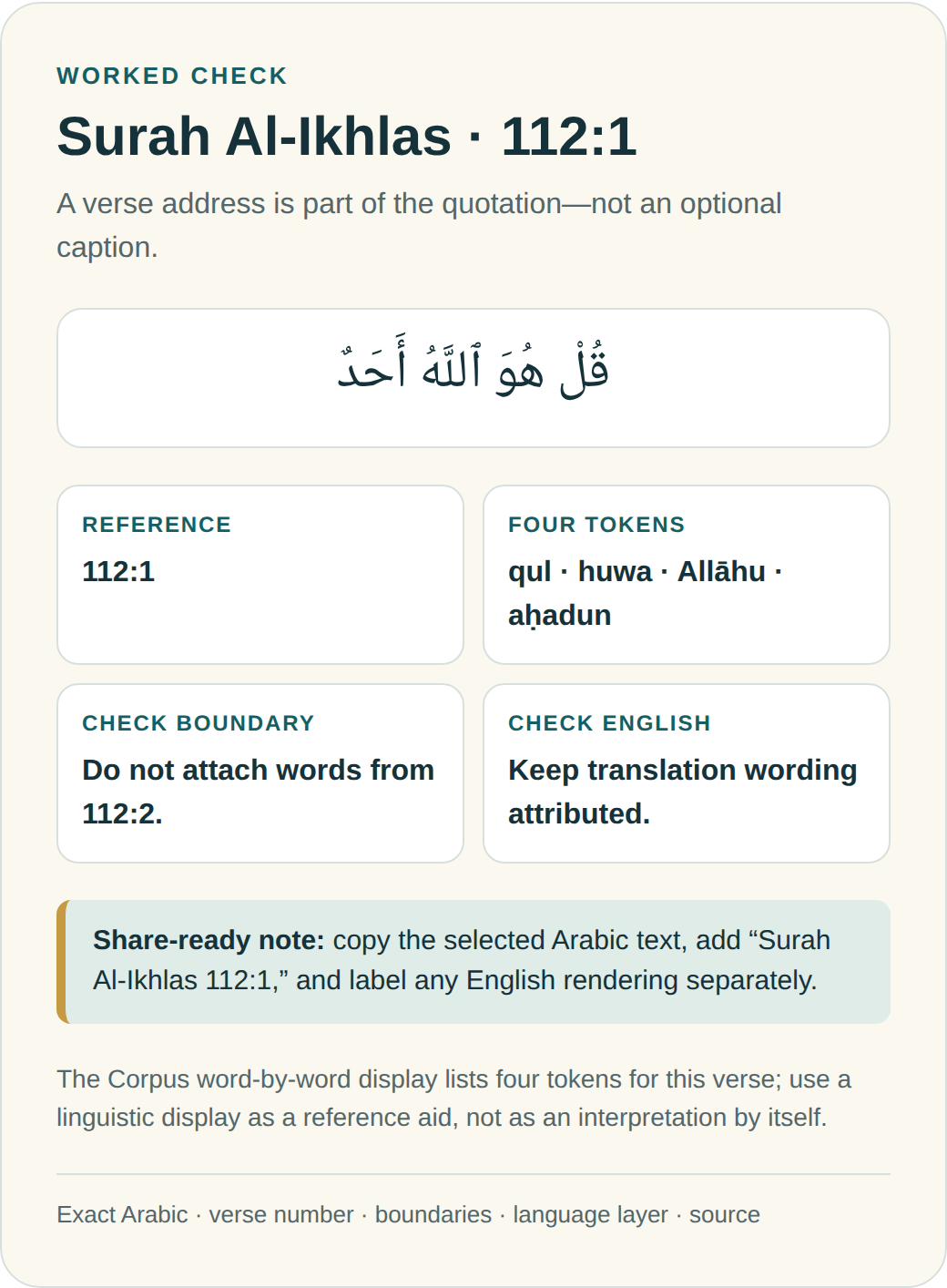
Keep transliteration, translation, and explanation distinct
Transliteration is useful when a reader cannot yet read the Arabic script, but it is not a substitute for checking the Arabic characters. Systems differ in how they represent long vowels, emphatic consonants, and other sounds. A line typed from memory can therefore look plausible while still pointing to a different phrase. For recitation practice, compare what you hear with a reliable written text and keep pronunciation questions separate from citation checks. A listening-and-repeat practice routine can help with the audio layer.
Likewise, an English translation should be attributed to the translator or source when you know it. If you shorten a translation, mark the omission clearly and do not let the edit change the sentence’s sense. If you rewrite it in your own words, call it a paraphrase. If your note adds a language observation, distinguish that from the translated text. A corpus can help you inspect word-by-word and grammatical information; Quranytime’s guide to using a Quranic Arabic Corpus explains how to read those fields cautiously.
When similar verses create uncertainty
Some Quranic phrases resemble wording elsewhere. A reader working from memory may blend two passages, shift a word, or attach a familiar continuation to the wrong opening. Compare the complete passages, not just the shared phrase, and check the reference for each candidate. If the same wording appears in more than one place, list each location rather than selecting the first result. This is especially useful during memorization; see the guide to reviewing similar Quran verses without mixing them.
If a source’s spelling or diacritics differ from your printed mushaf, do not silently “correct” one into the other. Check which text convention or edition you are using and preserve it consistently. A difference in transliteration is not automatically a difference in Arabic wording; a difference in an Arabic letter should be checked, not guessed away.
When your source is a screenshot or forwarded card
A picture may show a reference in one corner while cropping away the words before or after it. Treat the image as a lead, not the final verification. Search the complete Arabic phrase in a text that lets you view the verse address; confirm that the words in the image match the source, including the first and last words. If the image has an English line but no translator, find a matching translation edition before naming it. When a design inserts ellipses, quotation marks, brackets, or line breaks, check whether those marks belong to the original text or were added by its editor. Keep a private note of any edits you made, and use brackets or an ellipsis only when the convention is clear to your readers.
If the source is a photo of a printed page, make sure page notes or verse markers are not mistaken for part of the Arabic text. Check the printed wording in context, then copy from a trusted verse-addressed source if you plan to reproduce it digitally.
Use a video as a listening aid—not as your only citation
The short video below presents Surah Al-Ikhlas with Arabic, English, and transliteration while a male reciter reads the passage. Use it to follow the visible verse sequence and listen, then verify the written quotation against your chosen text source. The video also displays the opening Basmala before verse 1, so be precise about whether your own quote includes it. A video’s caption or translation is helpful for comparison but should not replace a stable surah-and-ayah reference.
A final checklist before you share
Read the post once as a careful reader would: can they tell what is Quranic Arabic, what is transliteration, which English translation you used, and what is your own explanation? Does the reference point to the exact words shown? Does the excerpt preserve its ayah boundary? Have you checked the nearby context, not just the line that suits the message? If any answer is no, pause and fix the label or reference before publishing.
- Exact Arabic copied from the selected text source or mushaf.
- Surah name/number and ayah number written beside the quote.
- Excerpt boundaries and nearby context checked.
- Translation credited or paraphrase labeled; transliteration kept separate.
- Source recorded; unresolved wording left unquoted or marked uncertain.
If the wording still cannot be confirmed, do not circulate it in quotation marks as an exact verse. You can ask a qualified Quran or Arabic teacher to review the reference and the text; if you would like guided feedback on Arabic reading, you can request Quranytime’s free assessment class.