

A daily Quran reading schedule is not a test of how quickly you can finish a page. It is a practical plan for returning to the Quran in a way that fits your life, your current reading ability and the purpose of your study. For one person, that may mean a few attentive minutes with a translation. Another may read Arabic fluently for longer. Both need a schedule shaped around their real circumstances, not someone else’s pace.
If you are new to reading regularly, begin with a small plan you can actually follow. Decide when you might read, what you hope to do in that session and how you will restart after a missed day. Then treat the first version as an experiment. Your schedule is a support, not a universal prescription or a measure of your worth.
Start with your purpose and your present ability
Before choosing a number of pages or verses, name the main purpose of your reading. Are you practising Arabic reading, following a translation, listening and reading along, revising familiar passages, or combining a little of each? These activities take different amounts of time. A short passage read aloud with careful attention may take longer than silently scanning several pages.
Separate your goal from your capacity. A goal is a direction, such as reading on most days; capacity is what you can comfortably do now, considering fluency, time, energy, eyesight, language familiarity and interruptions. Begin where you are and adjust later—beginners and experienced readers do not share one pace.
Before making a weekly commitment, try a brief “baseline” session with an accessible passage. Read without timing yourself and notice pauses for pronunciation or translation and how the session feels. This is information for choosing a manageable starting point, not an exam.
The Quran describes recitation “in a measured way” in the context of Al-Muzzammil 73:4, while 73:20 mentions reciting what is manageable in its passage about night prayer and varied circumstances. Both appear in a discussion of night prayer; neither verse sets out a universal daily timetable for every reader. Read the verses in their context at Quran.com 73:4 and Quran.com 73:20.
Choose a time and a realistic minimum
Look at a typical day rather than an ideal one. An existing cue—after breakfast, during a quiet break, or before bed—may be easier to remember than rearranging your day. Your best slot is personal; if prayer times structure your day, one might serve as a reminder, but readers have different work, family and health conditions.
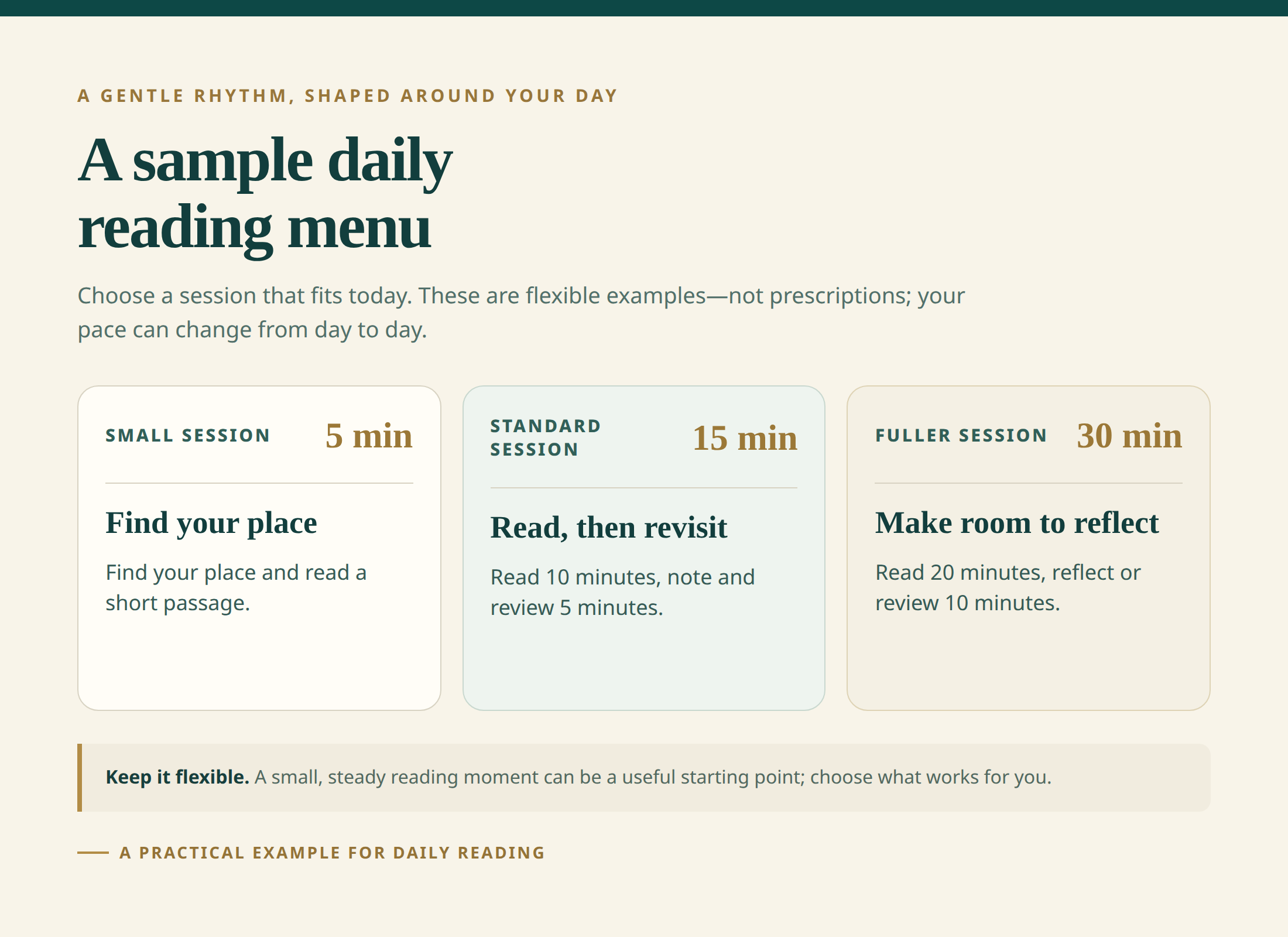
Choose a “minimum session” for demanding days. This is a smaller version of your usual plan, not a claim that every day must look identical. For example, you might set aside five minutes for a brief reading, fifteen minutes for a more settled session, or thirty minutes when you have more time. These are illustrations, not religious rules or recommended minimums. A session might instead include listening while following the Arabic text, or returning to the verse where you left off; listening and translation can support learning and understanding but are not identical to Quran recitation. Decide in advance what counts as a reasonable minimum for you. The point is to make restarting simple, not to create a second quota that causes guilt.
Also decide what will happen when the day goes differently. If you miss your chosen time, will you use a later window, do a shorter session, or continue the next day? Any of these can be sensible. Avoid automatically doubling the next session to “repay” missed reading; that can make the plan harder to resume. One missed day is a scheduling problem to learn from, not evidence that you cannot build a habit.
Pick a measure that makes sense for your reading
There is no single best unit for everyone. You can plan by minutes, pages, verses, or a reading division such as a hizb or juz. A time-based target can suit someone whose fluency varies or who pauses to understand a translation. A passage-based target can help when you want to complete a connected section. A division marker can make it easier to navigate a printed muṣḥaf or app.
Remember that page counts and page breaks depend on the edition, script and layout. The common system of juz, hizb and rubʿ gives readers useful navigation points, but a unit does not take the same amount of time for everyone. Quranytime’s guide to Quran reading divisions: juz, hizb and rubʿ explains how the markers relate, and its guide to the surahs in each juz can help you find what each division contains. Use these divisions as options, not as a compulsory personal pace.
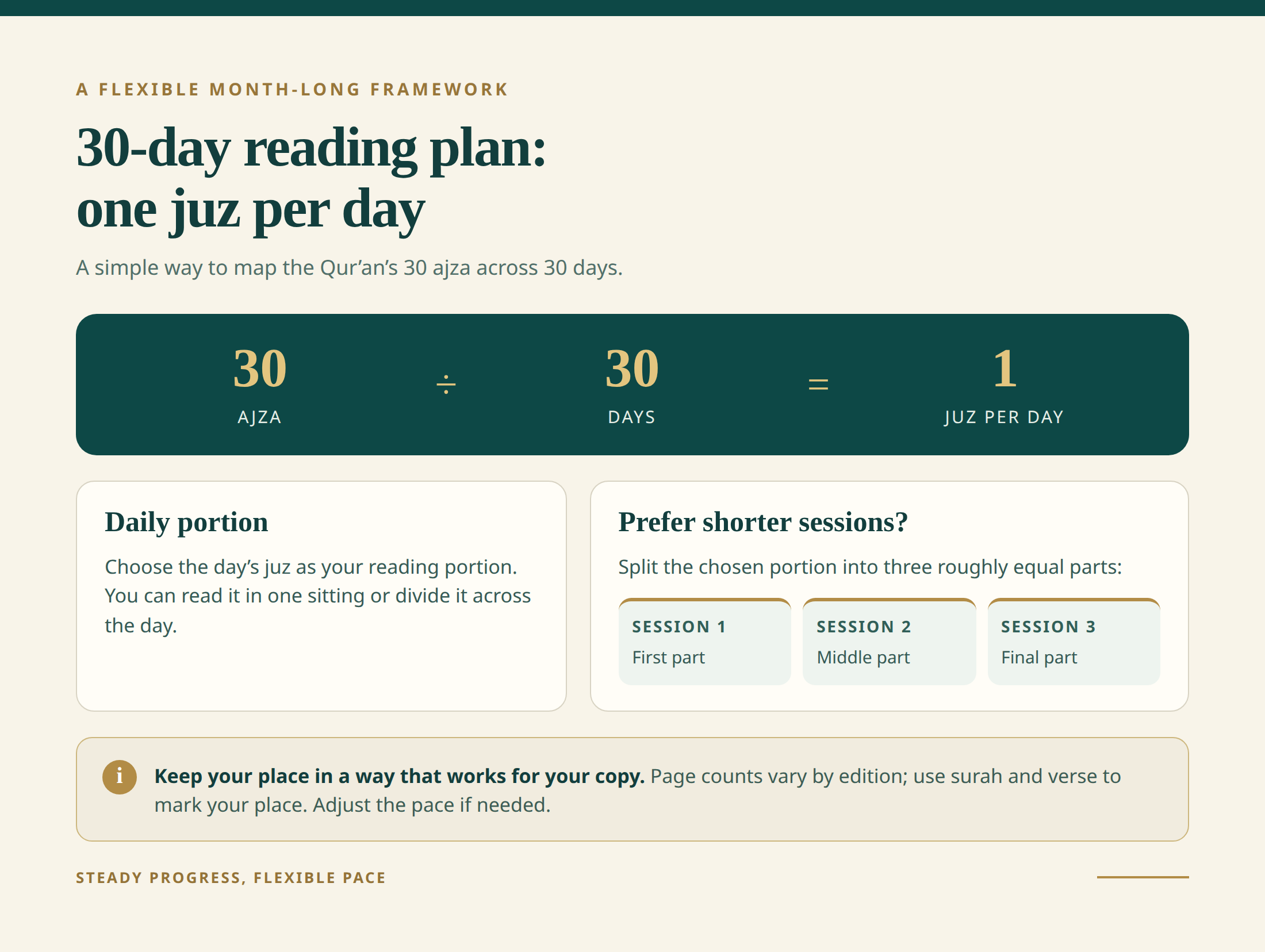
For a simple planning example, the Quran is divided into 30 ajza (plural of juz). Someone choosing a 30-day completion goal could divide 30 ajza by 30 days and plan for 1 juz per day. They might split that portion into three roughly equal reading sessions—for instance, one around each of three convenient parts of the day. This is planning arithmetic, not a religious rule or an expectation for every reader. If a 60-day horizon fits better, half a juz per day is another optional arithmetic example. The time required varies with fluency, pauses and whether you are reading Arabic, consulting translation or following audio; a translation or listening session is not identical to reciting the Arabic Quran.
For a beginner still learning Arabic letters or pronunciation, a small number of lines may require focused practice. If you read comfortably but consult translation often, a few verses may fill a session. If you read fluently, you may choose a longer passage while still leaving room to pause. The number on your plan should describe your intention, not make a claim about what all beginners can achieve.
When reciting aloud, do not equate a larger daily portion with better reading. A measured pace can include appropriate pauses and attention to pronunciation. If you are working on fluency, see Quranytime’s guidance on improving Quran reading fluency without rushing. A teacher can help with pronunciation or stopping questions that are difficult to assess alone. For a discussion specifically about recitation completion pace, Islam Question & Answer’s response on completing the Quran reports advice against making a habit of completing it in fewer than three days, while recognizing occasional exceptions in particular circumstances. This is that source’s religious guidance, not a universal timetable for daily readers; choose a personal plan in light of your circumstances and seek qualified advice for religious questions.
Three flexible Quran reading schedule templates
Use these as starting patterns, not rules. Adjust the duration, days and reading amount to your own ability. You can also begin with only one or two scheduled sessions each week and build from there.
Template 1: The beginner’s short session
Set aside a realistic window on several days. Read a short passage that fits your Arabic ability, or follow along with audio to support learning; consult a translation if meaning is part of your aim. Note where you stopped and use your chosen minimum on a busy day.
Template 2: Reading plus understanding
Divide a session into two parts: reading or listening, then a brief look at translation or context. Keep each part modest enough that the full session feels possible. You might focus on a few verses rather than aiming for a page count. Write down one question or observation if useful, but do not treat personal notes as authoritative interpretation. Quranytime’s beginner guide to a Quran reflection journal offers a simple way to keep observations and questions distinct.
Template 3: A weekly rhythm with a rest or catch-up option
Choose reading days that match your responsibilities and energy. Leave a flexible day for rest, a missed session or optional extra reading; you need not fill every calendar space. The right rhythm is one you can revisit without strain.
Make the plan easy to resume
A schedule works better when you do not have to spend the first minutes figuring out where you stopped. At the end of a session, write down the surah and verse you completed and the next verse you plan to read. If you use an app, check that its bookmark returns to the right place. If you switch between a phone and a printed copy, record a verse reference as well as any page number, because page layouts can differ.
For phone readers, keep the text view consistent and save a precise location before closing the app. Quranytime’s article on reading Quran on your phone without losing your place explains practical ways to recover your position. A simple note in a notebook can work just as well as a digital bookmark.
Keep a physical copy or your app and any translation or headphones accessible. Reduce decisions at the start and silence controllable notifications; the aim is simply to make beginning easier.
Review and revise without starting over
After a week or two, ask whether the time and amount worked on ordinary days and served your purpose. Change one part at a time—the time of day, unit or number of sessions—so you can tell what helped.
If you regularly stop halfway, reduce the target. If you finish easily and remain attentive, gradually add a little. There is no fixed timetable for increasing it; keep the target proportionate to your circumstances.
If you miss several sessions, return with the next planned reading rather than trying to reconstruct an impossible streak. For a completion plan, you can continue from where you stopped, revise the target date, or distribute the remaining portion across the days you have left if that remains comfortable. There is no need to force the original arithmetic by doubling portions or rushing. You may want to revisit Quranytime’s guide to returning to Quran study after a break for a gentle restart. A schedule should be something you can revise after illness, travel, a new job, exams or family changes.
Common schedule mistakes to avoid
Borrowing someone else’s quota: Another reader’s daily pages reflect their own experience and available time. Use their routine for ideas, not as a benchmark for your ability.
Measuring only by quantity: Pages completed do not show whether your chosen aim was reading practice, understanding, revision or listening. Pick a measure suited to your purpose.
Making every day identical: A flexible plan can include a short version and a regular version. That is more realistic than assuming every day has equal time and energy.
Turning a missed session into a failure: Review why the plan did not fit, then adjust it. Restarting at a manageable point is more useful than abandoning the schedule altogether.
Rushing to meet the number: If the target consistently pushes you to hurry through words or ignore questions, lower the target. A schedule is meant to support reading, not displace attention.
Frequently asked questions
How much Quran should a beginner read each day?
There is no universal amount. Start with what you can read attentively in the time you have, based on your Arabic reading ability and purpose. A beginner may choose a short passage or a few minutes. Review the plan after trying it in real life rather than assuming another person’s amount will fit.
Is it better to read by pages or by time?
Choose whichever measure is clearer and less stressful for you. Time can be useful when fluency varies or you want to include translation. Pages or verses can help you mark a stopping point, but page layouts differ between editions. You can combine both—for example, read for a short window and stop at a suitable passage boundary.
What if I cannot read Arabic fluently yet?
Build the schedule around your learning stage. Your session may include reading practice, listening while following the text, or asking a teacher about a difficult sound. Do not compare your pace with someone who has more experience. If understanding is also a goal, use a translation and keep questions for a reliable teacher or source.
Should I make up reading I missed?
You can continue from the point that makes sense for your personal plan. There is no need to double a later session unless you choose to and it remains comfortable. A backup slot or shorter minimum may help, but the schedule should be adaptable rather than punitive.
When should I increase my daily target?
Consider increasing only after the current plan feels manageable and attentive for a while. Add a small amount, then see whether it still fits your time and energy. If the increase leads to rushing or frequent missed sessions, return to the previous level.
Build a schedule you can return to
Choose one purpose, a realistic reading window and a small target suited to your ability. Decide on a shorter demanding-day version, note your place, then revise after trying the plan.
A daily Quran reading schedule does not need to be elaborate. It needs to leave room for real life and make the next reading session easy to begin. Let your goal guide you, but let your present capacity shape the first step.