

Arabic adjective agreement is the pattern that connects a describing word to the noun it modifies. In a phrase such as الطَّرِيقُ الطَّوِيلُ (the long road), the adjective follows the noun and normally matches it in gender, number, definiteness, and grammatical case. For Quran readers, noticing those clues helps keep words grouped correctly instead of translating each word in isolation.
Arabic grammar calls the describing adjective a naʿt or ṣifah, and the noun it describes a manʿūt or mawṣūf. This beginner guide focuses on how to recognize the agreement pattern in short noun phrases. It is not a substitute for a teacher’s correction of pronunciation or a full course in Arabic syntax.
Start with a four-part agreement check
When you see two adjacent Arabic words and suspect that the second describes the first, identify the noun, then compare the adjective across four features. Check the relationship in context: a word that follows a noun is not automatically an adjective, and case endings may be unwritten in ordinary Arabic text.
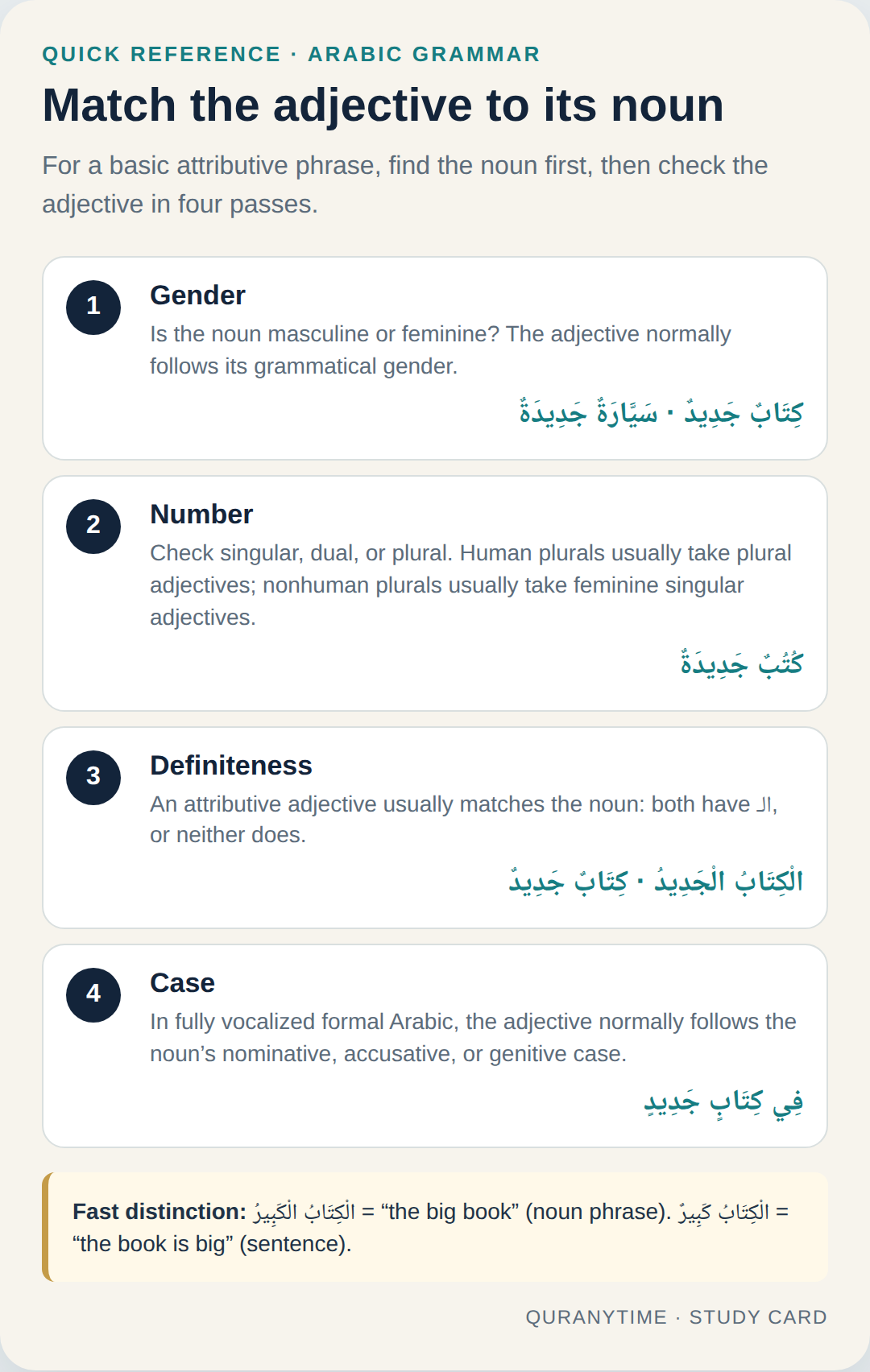
In a fully vocalized phrase, matching can be visible in the endings as well as in the basic form. In unvocalized text, the learner may still recognize the order, the article الـ, and familiar noun-adjective pairs, but should not guess a case ending from the bare letters alone.
1. Gender: follow the noun’s grammatical gender
Arabic nouns are grammatically masculine or feminine. Many feminine nouns end in ة, but that ending is a useful clue rather than a complete gender test. Learn a new noun together with a common adjective or demonstrative when possible, and follow the noun’s established grammatical gender rather than the English meaning.
For example, كِتَابٌ جَدِيدٌ means “a new book.” Both words are masculine and indefinite. With a feminine noun, the adjective changes: سَيَّارَةٌ جَدِيدَةٌ means “a new car.” The ending ـة in جَدِيدَة signals the feminine form here. These are simple learner examples; individual adjectives can have less predictable shapes, so check unfamiliar vocabulary rather than creating a feminine form by guesswork.
2. Number: singular, dual, and plural
Arabic has forms for one, exactly two, and more than two. In the dual, noun and adjective generally show corresponding dual forms. In the nominative, for example, كِتَابَانِ جَدِيدَانِ means “two new books,” while سَيَّارَتَانِ جَدِيدَتَانِ means “two new cars.” In other cases, the dual endings change together; the case section below explains why the noun and adjective travel as a unit.
Plural agreement has an important human/nonhuman distinction in formal Arabic. Human plural nouns normally take plural adjectives: الْمُعَلِّمُونَ الْمُخْلِصُونَ (“the sincere male teachers”) and الْمُعَلِّمَاتُ الْمُخْلِصَاتُ (“the sincere female teachers”). The adjective matches the plural noun in the relevant form.
A plural referring to nonhuman things normally takes a feminine singular adjective. Thus كُتُبٌ جَدِيدَةٌ means “new books,” and الْكُتُبُ الْجَدِيدَةُ means “the new books.” Although كُتُب is plural, جَدِيدَة is feminine singular. Treat this as a strong default for ordinary nonhuman plurals, not a permission to force every classical or personified expression into one simple pattern; advanced texts and rhetorical contexts may require a teacher’s explanation.
3. Definiteness: the article usually appears on both words
In an ordinary attributive phrase, a definite noun takes a definite adjective, and an indefinite noun takes an indefinite adjective. Compare كِتَابٌ جَدِيدٌ (“a new book”) with الْكِتَابُ الْجَدِيدُ (“the new book”). In the definite phrase, both noun and adjective carry الـ. With an indefinite noun, neither word has the definite article.
This is more than a spelling detail. It helps separate an adjective phrase from a short nominal sentence. الْكِتَابُ الْكَبِيرُ means “the big book”: the adjective is definite and remains inside the noun phrase. By contrast, الْكِتَابُ كَبِيرٌ means “the book is big”: the second word is an indefinite predicate, not an attributive adjective. English places “big” before the noun in a phrase but after it in a sentence; Arabic relies on its own word order and definiteness pattern.
4. Case: the adjective follows the noun’s grammatical role
In fully vocalized formal Arabic, an attributive adjective normally shares its noun’s case: nominative, accusative, or genitive. The short final vowel may be absent from everyday writing, but case still belongs to the grammar. A simple comparison with the same noun phrase makes the pattern easier to see:
- كِتَابٌ جَدِيدٌ — a new book, in a nominative context.
- قَرَأْتُ كِتَابًا جَدِيدًا — I read a new book; both words are accusative objects.
- فِي كِتَابٍ جَدِيدٍ — in a new book; both words are genitive after the preposition.
Notice that the adjective does not independently choose a case just because it describes something. Its case follows the noun it modifies. For a refresher on how Arabic prepositions affect the following noun, see the beginner guide to common Arabic prepositions.
Read the pattern in a Quranic phrase
In Al-Fātiḥah 1:6, the phrase الصِّرَاطَ الْمُسْتَقِيمَ appears in “Guide us to the straight path.” The noun الصِّرَاطَ (“the path”) is masculine, singular, definite, and accusative in this phrase. The following word الْمُسْتَقِيمَ (“straight”) is also masculine, singular, definite, and accusative. It is an adjective describing the path, not a separate noun that should be translated on its own.
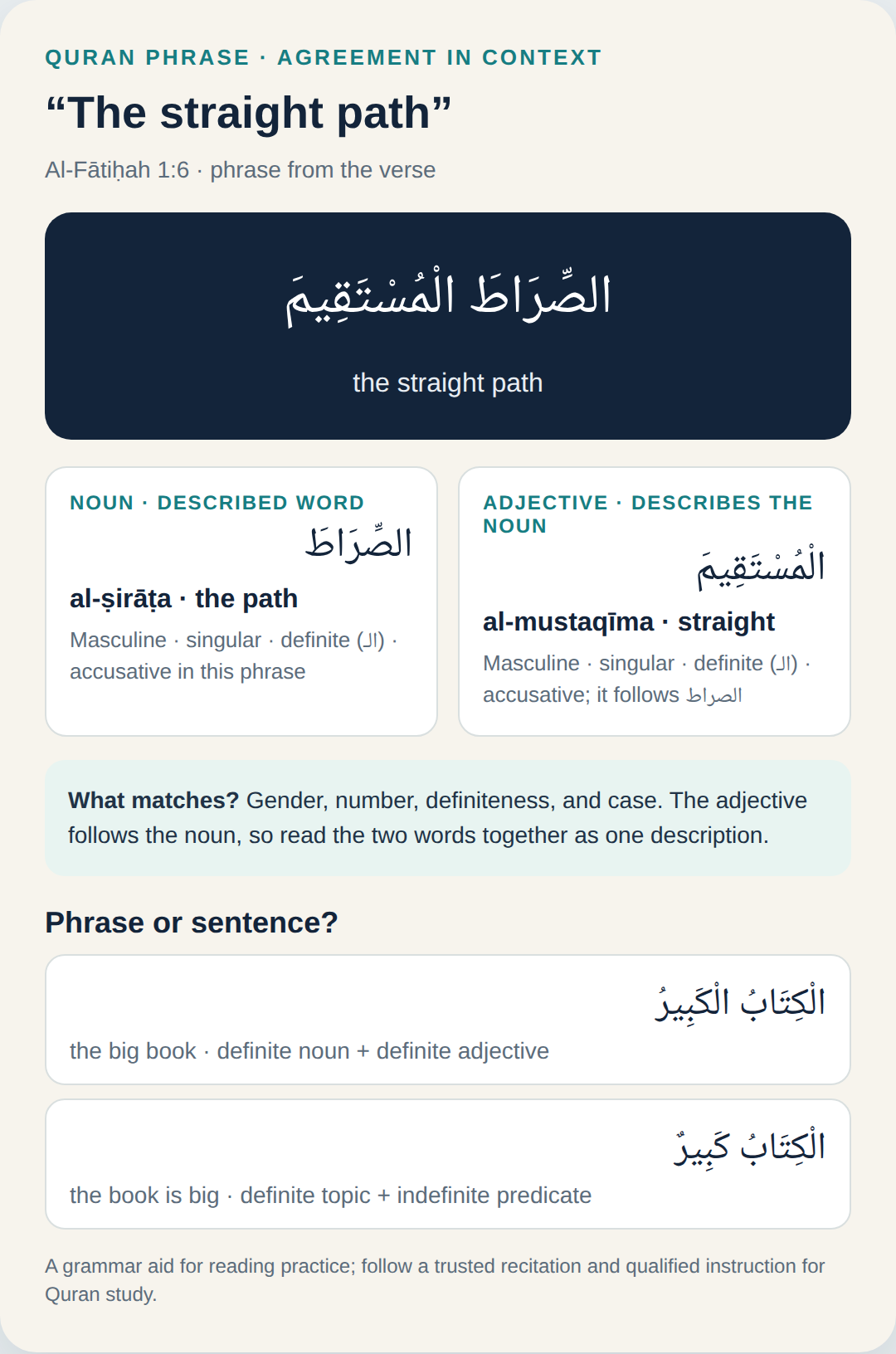
Try a small reading routine: first read the whole phrase aloud with a trusted recitation; next identify the likely noun; then look to the word that follows for agreement clues; finally return to the whole ayah and confirm that your grouping makes sense. Do not let grammar study interrupt careful recitation or replace learning from a qualified teacher. Quranytime’s guide to building Quran-reading fluency without rushing offers a complementary practice approach.
Common beginner mistakes
- Putting the adjective first. In a basic Arabic noun-adjective phrase, the adjective normally follows its noun: كِتَابٌ جَدِيدٌ, not the English order “new book.”
- Adding الـ to only one word. For the ordinary attributive reading “the useful lesson,” use الدَّرْسُ الْمُفِيدُ. If the second word is indefinite, the relationship may instead be a predicate: “the lesson is useful.”
- Using a plural adjective for every plural noun. Start with plural agreement for human groups and feminine singular agreement for nonhuman plurals, then check the specific construction.
- Ignoring case in fully vowelled text. When a preposition, object marker, or sentence role changes the noun’s case, its attributive adjective normally follows that case.
- Confusing an adjective with a predicate. Compare definiteness as well as word order. The pair الطَّرِيقُ الطَّوِيلُ (“the long road”) differs from الطَّرِيقُ طَوِيلٌ (“the road is long”).
A short self-check
In فِي الْبَيْتِ الْكَبِيرِ (“in the big house”), which word is the noun? Which word is the adjective? Both are definite because each has الـ, and both are genitive because the phrase follows فِي (“in”). The adjective is الْكَبِيرِ; its position and matching features connect it to الْبَيْتِ.
Now compare السَّيَّارَاتُ السَّرِيعَةُ (“the fast cars”) with الطُّلَّابُ السَّرِيعُونَ (“the fast male students”). The first noun is a nonhuman plural, so its adjective is feminine singular. The second noun refers to people and normally takes a plural adjective. The rule is not “copy the visible plural ending every time”; identify what the noun refers to.
How to keep learning
Adjective agreement becomes easier when studied alongside the other patterns that help a reader recognize who or what each word refers to. Review Arabic personal pronouns in a practical chart when a phrase contains an attached or implied pronoun, and use the Arabic verb-conjugation guide when the subject appears on the verb rather than beside the noun. For a wider learning sequence, see the Quranic Arabic roadmap for beginners and the introduction to Quranic Arabic roots and patterns.
Build a short practice routine
Choose a small set of familiar nouns rather than trying to memorize every adjective ending at once. Write one masculine noun and one feminine noun, then make each phrase indefinite and definite. Add a dual example, a human plural, and a nonhuman plural so you can compare the forms side by side. Read the noun first, then say the adjective; this reinforces the Arabic order instead of the English habit of placing the description first.
For each pair, use four quick marks in your notebook: G for gender, N for number, D for definiteness, and C for case. At first, write the Arabic with full vowel marks and add a short translation. On a second pass, cover the translation and name the noun’s four features before checking the adjective. Finally, try reading a short Quranic phrase in context and ask a teacher to correct your grouping or pronunciation. Keep a separate note for uncertain vocabulary instead of turning one example into a rule. A few accurate comparisons repeated across several days are more useful than a long list copied once.
For a deeper reference beyond this beginner lesson, see this overview of Arabic adjective agreement, which also discusses case and the nonhuman-plural pattern. Use it as a grammar reference, then apply what you learn to short examples with a teacher’s guidance.
Watch a short lesson
This slide-based lesson reviews Arabic noun-adjective agreement. Use it as a visual companion to the examples above; pause when a rule is introduced and identify the noun and adjective before moving on.