
When a Quranic verse begins with a noun or pronoun, beginners often search for a verb that is not there. In many Arabic nominal sentences, the present-tense idea of “is” or “are” is understood rather than written as a separate verb. Once you learn to find the mubtada (what the sentence starts by telling you about) and the khabar (the information given about it), short phrases become easier to read.
This guide explains Arabic nominal sentences for Quranic Arabic learners. You will practise identifying both parts, recognizing several kinds of predicate, and checking your first guess against the surrounding words. The aim is not to label every verse from its first word alone; it is to build a careful reading habit you can use alongside a wider Quranic Arabic study plan.
What is an Arabic nominal sentence?
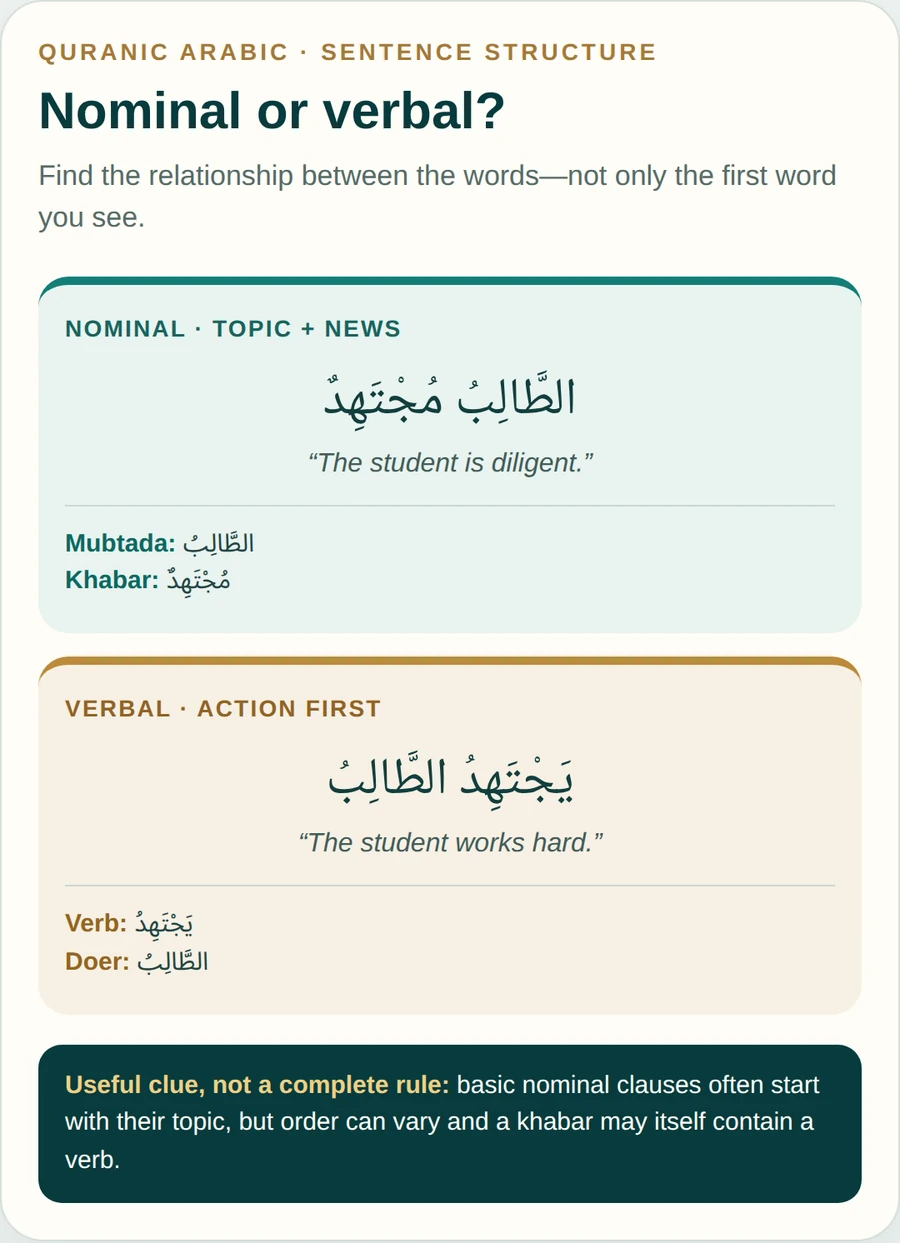
An Arabic nominal sentence is called الجملة الاسمية (al-jumlah al-ismiyyah). In a simple example, one part names the topic and another gives the news about it. The topic is the mubtada; the news is the khabar. For instance, الطَّالِبُ مُجْتَهِدٌ (al-ṭālibu mujtahidun) means “The student is diligent”: “the student” is the mubtada, and “diligent” is the khabar.
English needs the word “is” in that sentence. In a basic Arabic present-tense nominal sentence, it is usually understood rather than spoken or written. A University of Oregon open lesson on Arabic nominal sentences also explains that the khabar may be a word, a phrase, or a sentence, not just a single adjective.
Many simple sentences begin with the mubtada, which is often a noun or pronoun. Treat that as a useful first clue, not a complete rule. Arabic can place information in a different order, and conjunctions or other particles may appear before the main parts. A stronger question is: “What is this clause about, and what does it tell me?”
Start with a clear Quranic example
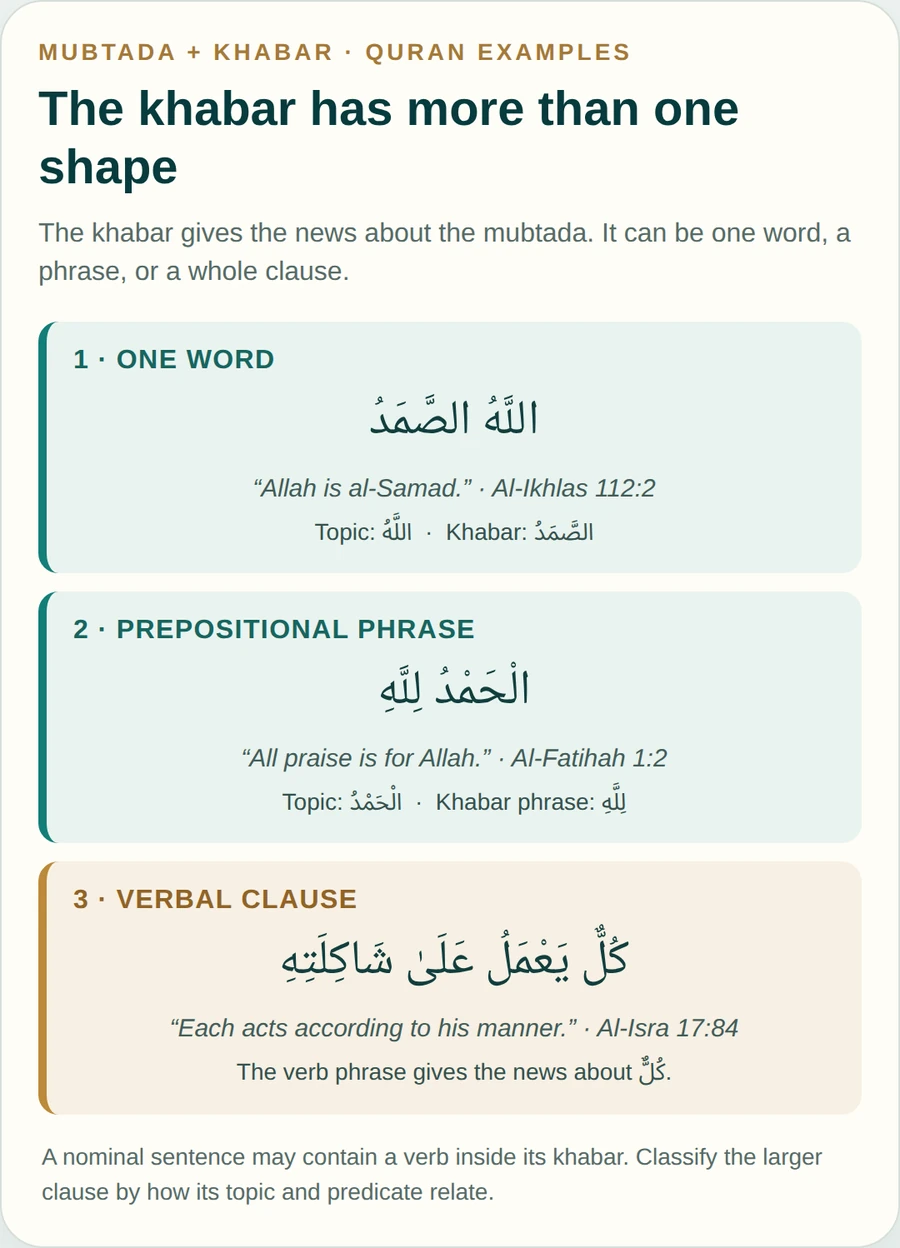
In Al-Ikhlas 112:2, the phrase اللَّهُ الصَّمَدُ (Allāhu al-ṣamadu) contains two nominative words. For a beginner’s first parse, read اللَّهُ (“Allah”) as the mubtada and الصَّمَدُ (“al-Samad”) as the khabar. English translations express the relationship with “is,” even though no separate present-tense verb appears between the two Arabic words.
Notice what the example does and does not teach. It shows a noun followed by a noun that completes the statement. It does not mean that every Arabic sentence without a visible “is” must be parsed the same way. First identify the whole clause, then check whether each word’s form and meaning fit the proposed roles. If you need to refresh person and number clues on pronouns, review the Quranic Arabic pronoun chart.
A practical scan for mubtada and khabar
Use this short scan when you meet a sentence in a verse. It keeps the grammar connected to meaning instead of turning reading into a hunt for labels.
- Find the clause you are reading. A verse may contain more than one clause. Start with a short, complete unit rather than assigning roles to an entire verse at once.
- Ask what the clause is about. In a simple nominal sentence, this is often a noun or pronoun. That topic is a candidate for the mubtada.
- Ask what information completes it. The khabar may be an adjective or noun, a prepositional phrase, or a whole clause.
- Check the evidence. Look at case endings when they are shown, agreement, definiteness, and the meaning of the surrounding words. Do not use one clue as a shortcut for the whole analysis.
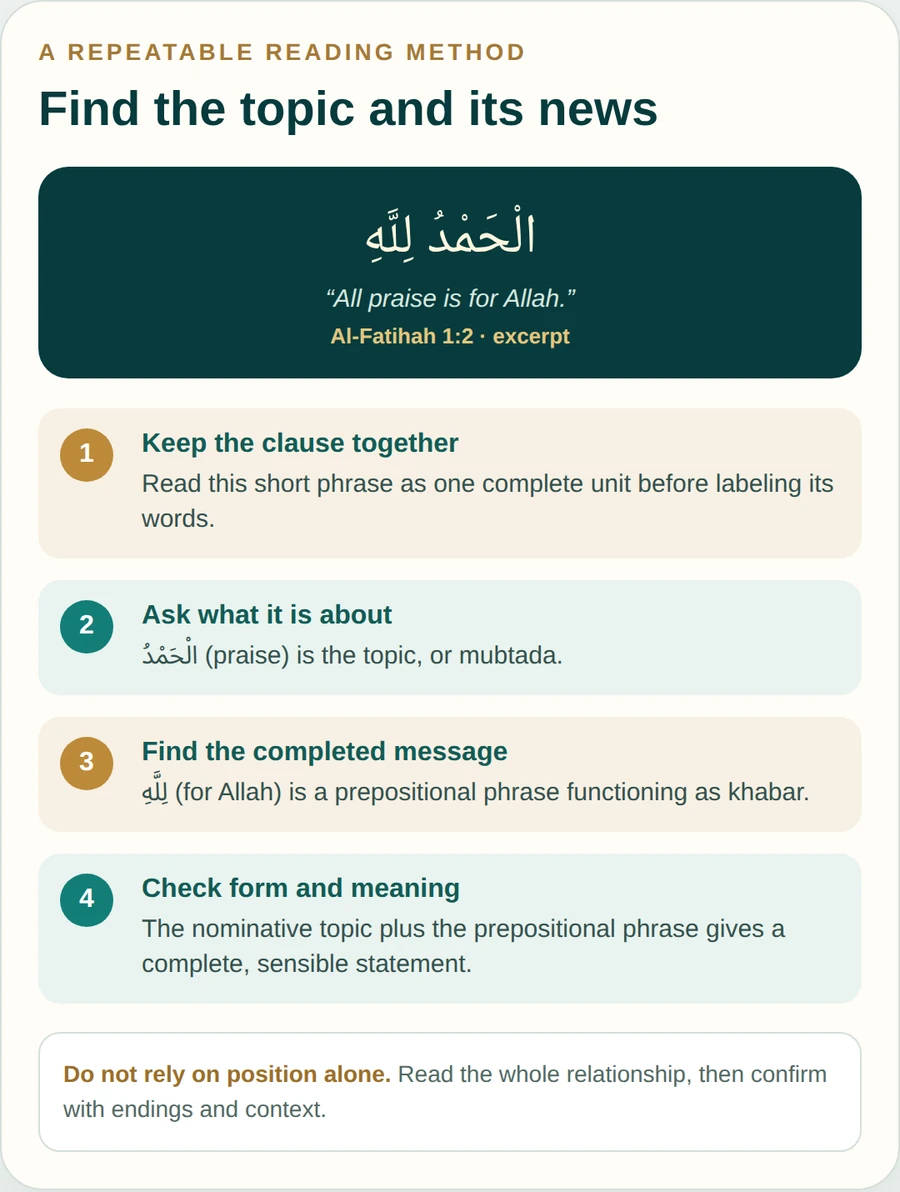
As a small example, الْحَمْدُ لِلَّهِ in Al-Fatihah 1:2 can be read “All praise is for Allah.” الْحَمْدُ is the topic; لِلَّهِ is a preposition joined to “Allah,” and the prepositional phrase completes the statement. The English phrase “is for” helps express the relationship, but it is not a separate word-for-word Arabic verb.
This is why recognizing khabar matters in real reading. If you assume the predicate must always be one adjective, you may stop too soon. If you want more practice separating noun roles from their modifiers, connect this lesson with Arabic adjective agreement and common Arabic prepositions in Quranic reading.
The khabar can take different forms
A single word. In اللَّهُ الصَّمَدُ (Al-Ikhlas 112:2), الصَّمَدُ is a single-word predicate. In a beginner-friendly explanation, it supplies the central information about اللَّهُ.
A prepositional phrase. In الْحَمْدُ لِلَّهِ (Al-Fatihah 1:2), لِلَّهِ begins with the preposition li-, “for/to.” The prepositional phrase acts as the predicate, so the sentence remains nominal even though its second part is not a single adjective.
A verbal clause. Consider كُلٌّ يَعْمَلُ عَلَىٰ شَاكِلَتِهِ in Al-Isra 17:84, commonly rendered “Each acts according to his manner.” For an introductory parse, كُلٌّ is the topic and the verbal clause يَعْمَلُ عَلَىٰ شَاكِلَتِهِ gives the news about it. The khabar here contains a verb. So “nominal” does not mean “a sentence with no verb anywhere”; it describes the larger clause’s structure.
These examples are a starting point, not permission to flatten every verse into one formula. A clause may be linked to another, embedded inside it, or affected by particles. For more practice with verb forms that occur inside a statement, see the guide to past and present Arabic verb forms. The goal is to identify the relation first and then check the forms in context.
Nominal sentence or verbal sentence?
A verbal sentence is called الجملة الفعلية (al-jumlah al-fiʿliyyah). In many basic examples, it begins with a verb and then names the doer. Compare الطَّالِبُ مُجْتَهِدٌ, “The student is diligent,” with يَجْتَهِدُ الطَّالِبُ, “The student works hard.” The first reports information about a topic; the second leads with the action.
Word order is a helpful clue, but avoid turning it into the only test. A conjunction may come before the clause. A predicate may be placed before the topic. A nominal sentence’s predicate may itself contain a verb. Ask how the parts relate, and use the visible endings and full context to confirm your first reading. The site’s relative-pronoun lesson is a useful next step when a clause also contains a phrase such as “who…” or “that…”.
Try the four-step scan on a verse phrase
Read الْحَمْدُ لِلَّهِ (Al-Fatihah 1:2) once more. First, keep the phrase as one small unit. Second, ask what is being discussed: praise. Third, ask what is said about it: it is for Allah. Fourth, notice that the first noun is nominative and the second part begins with a preposition. You have a simple nominal structure with a phrase functioning as khabar.
Common beginner mistakes
Looking for a written “is.” In a basic present-tense nominal sentence, English “is/are” is often understood. Do not add an Arabic verb that is not present in the text.
Calling every second word the khabar. The predicate may extend beyond the next word. A phrase or clause can function as one larger unit, so keep reading until the sentence’s news is complete.
Assuming every mubtada is definite. A definite noun or pronoun is common in simple examples, but this is a tendency rather than a test that works by itself. Some constructions allow an indefinite topic for a reason. Learn the basic pattern, then attend to the phrase and context.
Ignoring word endings. When full vowel marks appear, they may help you notice nominative or genitive relationships. But do not identify a role from a final vowel alone. Related grammar, including broken plural forms in the Quran and Quranic roots and patterns, becomes clearer when morphology is read together with syntax.
Treating one English translation as the grammar. Translators choose natural English wording. “For,” “belongs to,” or “is” can express a relationship whose Arabic parts look different. Keep the Arabic structure in view before choosing an English paraphrase.
Make it a repeatable Quran-reading habit
When you meet a short clause, mark the likely topic and bracket the words that tell you something about it. Name the khabar’s form, then reread the full verse so particles and neighboring statements keep their context.
Arabic nominal sentences are not difficult because they hide a missing verb; they become confusing when we expect every language to arrange a statement the same way as English. Learn the two roles, recognize the different forms a khabar can take, and verify your reading with grammar and context. With that habit, Quranic Arabic begins to read as connected meaning rather than isolated vocabulary.
A short visual lesson on the nominal sentence follows for learners who benefit from seeing examples explained on screen.
For a broader progression, continue from sentence recognition to the site’s resources on adjective agreement, prepositions, pronouns, and verb forms. Study each topic as one connected toolkit for understanding the verse, not as a reason to split closely related keyword variations into separate articles.