
If you know the Arabic alphabet but pause when a letter looks different inside a word, you are meeting a useful feature of the script: Arabic letter forms change with their joining context. A letter may appear isolated, at the beginning, in the middle, or at the end of a connected word. The shape changes, but it is usually the same letter fitting around its neighbours—not a new alphabet entry.
This guide explains the four common positions, why some letters do not use all four, and how to practise with real words. For a refresher on letter names and sounds, start with Quranytime’s beginner’s Arabic alphabet guide.
What are Arabic connected letter forms?
Arabic is written from right to left, and many letters join to a neighbour within the same word. In handwriting and most Arabic type, the outline adjusts at the connection so the word reads as a continuous line. That connected outline is a contextual form, not a different letter. The letter ب (bāʾ), for example, keeps its bowl-and-dot identity while its entry and exit strokes change according to the letters beside it.
Keep two ideas separate: a letter is the character you identify and pronounce; a glyph is the shape a font draws for it in a particular context. The written sequence remains the normal letters in order. A font uses the joining context to display a suitable glyph.
The four common positions
Teaching charts often show four forms. The labels describe a letter’s role in the word, read in Arabic’s right-to-left direction. Look at whether it connects to the letter before it and the letter after it, rather than relying only on its place on the page.
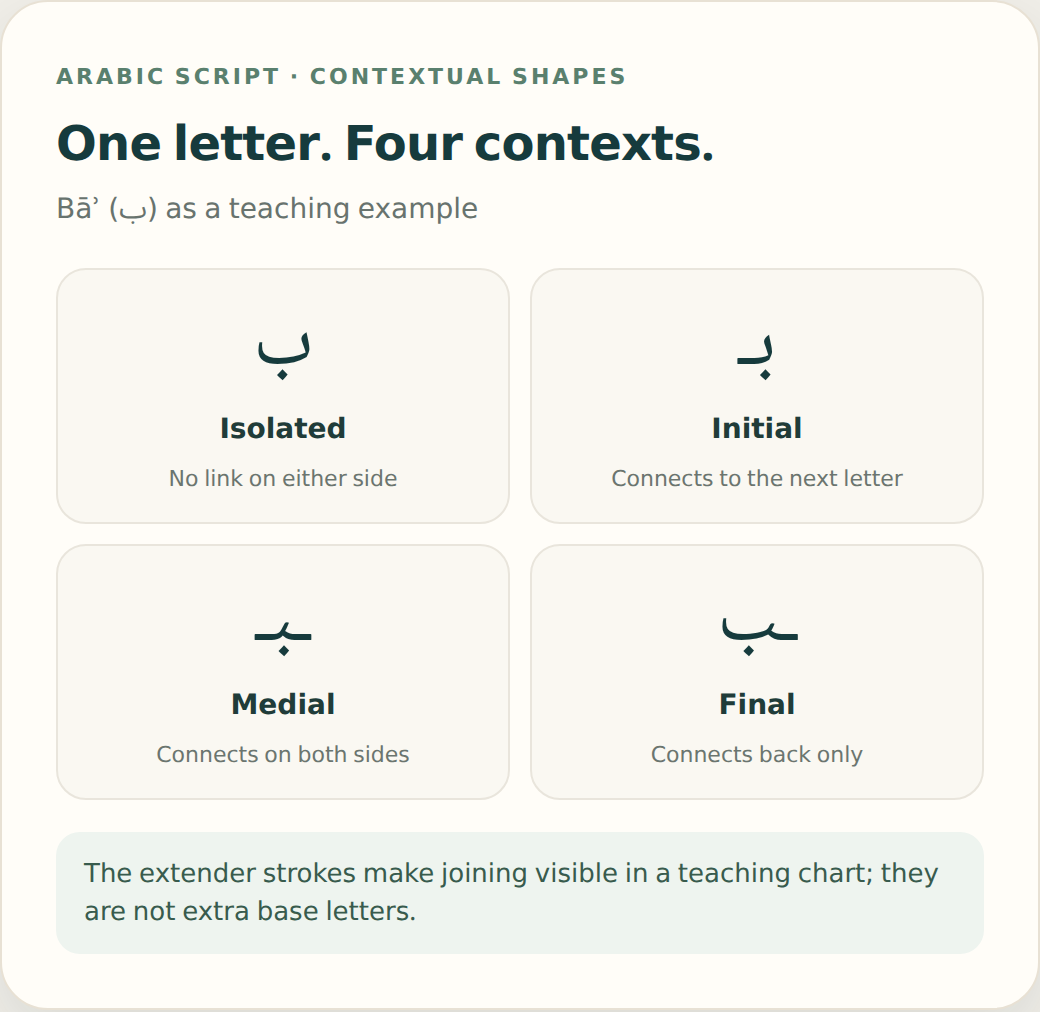
- Isolated: no connection on either side.
- Initial: the first letter of a connected word; it can connect to the next letter in the word.
- Medial: connected to a neighbour before and after it in the word.
- Final: the last letter in a connected sequence; it connects to the preceding letter but has no following letter to join.
For ب, a common teaching display is ب (isolated), بـ (initial), ـبـ (medial), and ـب (final). The extender-like strokes in the last three examples make the connection visible; they are not extra base letters. The exact contour can vary by font and handwriting style. For a handwriting refresher, see how to write the Arabic alphabet.
Do all Arabic letters have four forms?
No. Many letters are dual-joining: they can connect to letters on both sides in a word and can therefore have isolated, initial, medial, and final forms. ب, ت, ج, س, and ع are familiar examples.
Other letters connect only to the letter before them in the word, not onward to the following letter. Alif ا, dāl د, dhāl ذ, rāʾ ر, zāy ز, and wāw و are common examples. They can appear isolated or after a connection, but do not normally have initial or medial connecting forms. Some characters, including hamza ء, do not join. So a visible gap can be exactly where a letter stops the connection—not a spacing error.
Quranytime’s Arabic Reading Guide lets you practise recognizing letters while reading, rather than memorizing a chart alone. For more writing practice, see ways to improve Arabic writing skills.
A quick way to see where a connection stops
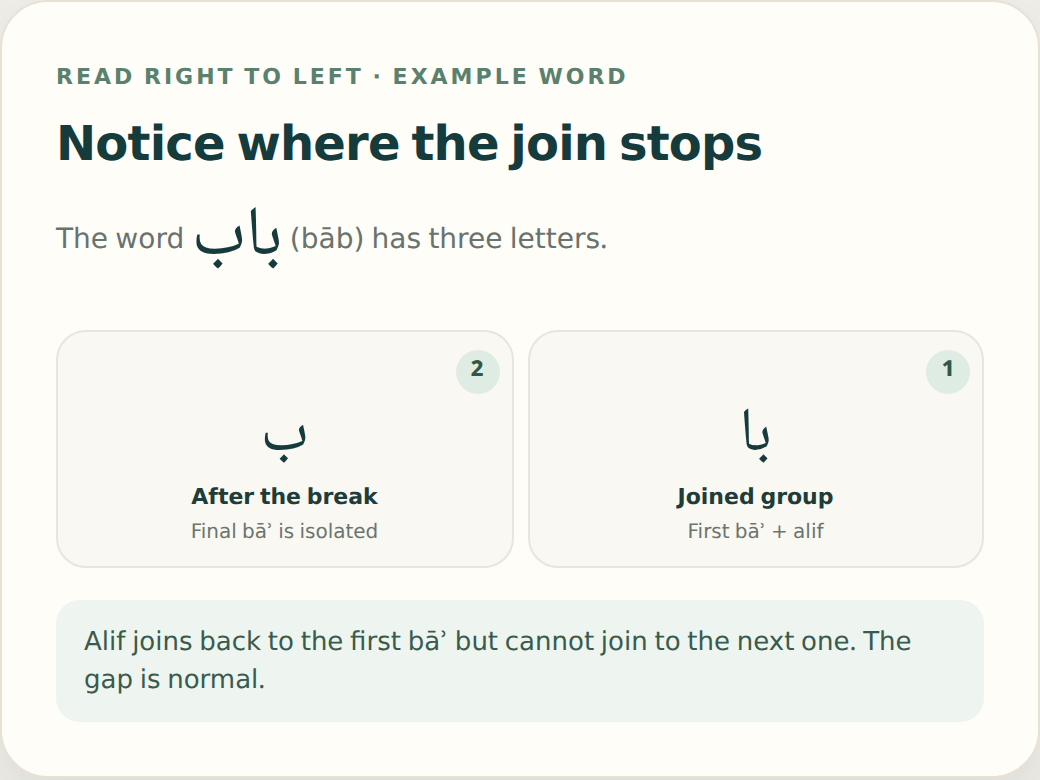
Take باب (bāb). Read it from right to left: bāʾ, alif, bāʾ. The first ب can connect to the alif after it. Alif does not connect onward to the final ب, so the word has a visible break after alif. That final ب is not attached to alif even though the letters belong to one word.
For longer words, begin at the right edge, name each letter, and ask whether it can connect to the next letter in the word. Mark any break, then look at the shape of each letter in its connected group. This is more reliable than guessing from a memorized chart.
Dots and vowel marks still matter
When a shape changes, check its dots as well as its main stroke. Letters with similar skeletons may be distinguished by the number or placement of dots; a connected form can reposition a mark. Look at the whole letter, not only its outline. Short vowels and other reading marks are separate signs around the base letters. They guide pronunciation but do not create a new joining position for the consonant.
In بَيْت (bayt, “house”), the connected sequence is bāʾ-yāʾ-tāʾ. The vowel marks help show pronunciation, while the connections help identify each letter’s position. A printable resource such as the Arabic alphabet learning PDF can help you move from isolated shapes to short sequences.
How computers display the forms
In ordinary digital writing, people type the underlying Arabic letters rather than choosing separate “initial” or “medial” codepoints for every word. The Unicode Standard explains that a display system selects an appropriate glyph from the immediate joining context. It describes dual-joining and right-joining types, and notes that Arabic presentation-form characters are not generally intended for ordinary text interchange. In short: type the letters in sequence and let a capable text-shaping system display their contextual forms. See Unicode Standard, Chapter 9: Arabic Cursive Joining.
If a word displays as disconnected blocks, check whether the font and application support Arabic shaping and right-to-left text. Copying decorative presentation glyphs into ordinary text can also cause searching, editing, or accessibility problems. For learning notes, keep the normal letters and use an example or image to explain the forms.
Use the shapes while reading
Position charts are a starting point; their purpose is to make real words easier to read. When a letter looks unfamiliar, identify its dots and skeleton, check the connections on both sides, then read the whole word from right to left. This is useful in Quran reading, where a learner may recognize an isolated letter but hesitate when it appears in a connected word.
Shape recognition and pronunciation are related but different skills. If you are also learning where a sound is made, Quranytime’s guide to the makharij of Arabic letters covers articulation points. For the wider goal of understanding Quranic text, see learning Arabic to understand the Quran, or explore Quranytime’s online Arabic learning path.
A simple five-step practice routine
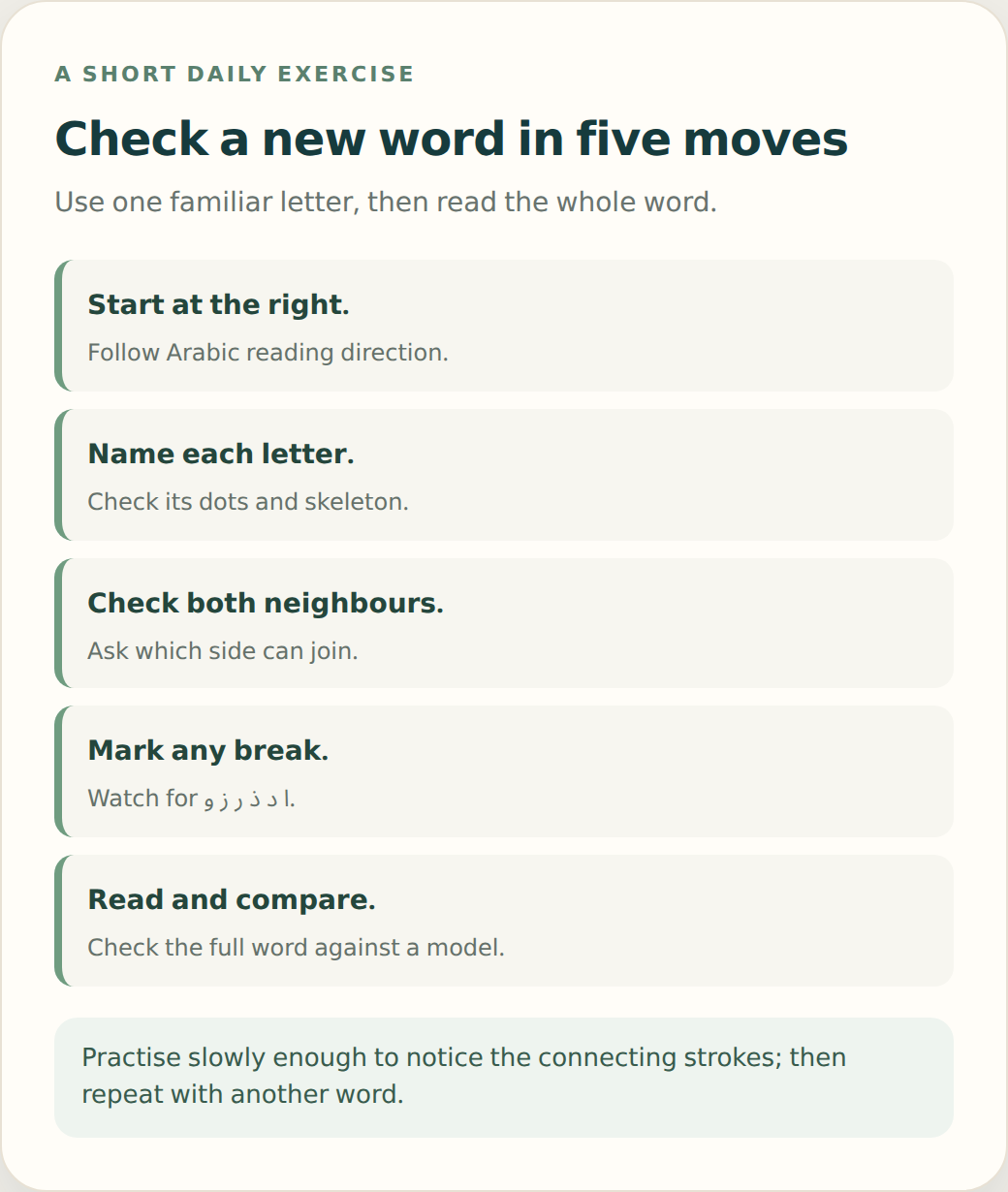
- Choose one letter. Start with a dual-joining letter such as ب or س.
- Notice its identity. Say its name and note the dots or features that distinguish it.
- Place it in a short sequence. Write it alone, then at the start, middle, and end of a word.
- Check the neighbours. Ask which letters can join; do not force a link across alif, dāl, dhāl, rāʾ, zāy, or wāw.
- Read and compare. Read the word from right to left and check it against a model before repeating.
Cover the labels on the card and name each ب form from its open or connected sides. Then try a familiar word such as بيت. You are not memorizing four unrelated symbols; you are recognizing the same letter in predictable contexts. Keep practice short and slow enough to notice the connecting strokes.
Watch Arabic letters flow together
This brief Guardian feature follows calligrapher Taha Al-Hiti as he shapes Arabic letters and adjusts how they sit beside one another. It is a visual companion, not a tutorial naming all four schoolbook positions; watch it to notice connected flow and spacing.
Common questions
Are initial and final shapes different letters?
No. They are contextual glyph forms of the same underlying letter. Its name and place in the word stay the same; the font changes its displayed shape to join correctly.
Why does a word have a gap in the middle?
Some letters connect only to the preceding letter in the word, not to the following one. A break after such a letter is expected.
Must I memorize four shapes for every letter?
No. Learn which letters join on both sides, which stop a connection, and which do not join. The four-position chart applies most clearly to dual-joining letters.
Build confidence one word at a time
Arabic connected letter forms become easier when you look for the base letter, its dots, and its connections in order. Start with dual-joining letters, notice where one-way letters interrupt the line, and read complete words instead of treating each shape as a separate symbol. If you would like a teacher to check your Arabic reading or writing starting point, book a free trial class with Quranytime and discuss a suitable next step.