
When you read Arabic, you may recognize an action word without seeing a tense or a named doer. That word may be a maṣdar (مصدر), often called a verbal noun: it names the action or idea associated with a verb. Learning to recognize an Arabic maṣdar in Quranic reading helps you notice whether a word presents an action as something happening, or as an action being discussed, described, or emphasized.
This guide explains how a maṣdar differs from a finite verb and how to inspect Quranic examples without guessing from a pattern alone. “Arabic verbal noun,” “masdar in Quranic Arabic,” and “Arabic gerund” describe closely related learning needs, not separate lessons. For the wider grammar picture, visit Quranytime’s Arabic grammar learning guide.
What does maṣdar mean?
A finite verb normally carries information such as tense or aspect, person, and number. In رَتِّلْ (rattil, “recite”), the form is a command addressed to one person. A maṣdar instead names the action itself: تَرْتِيل (tartīl, “measured recitation”). It is a noun, even though its meaning is closely related to a verb.
Compare “recite” with “recitation,” or “study” with “studying” when it names the activity. The match is not exact: English “-ing” words are not always nouns, and Arabic maṣdars have no single English suffix. Ask what the Arabic word does in its sentence instead of relying on its gloss.
A maṣdar shares a root with a related verb, but may use a different pattern. Augmented forms often offer clues; Form I maṣdars are more varied, so learn them with the verb or check a dictionary. Quranytime’s Arabic verb-conjugation guide is a useful companion.
Recognize the verb–maṣdar relationship in Quranic examples
Some of the clearest examples place a verb and its related maṣdar close together. In Quran 73:4, the phrase وَرَتِّلِ الْقُرْآنَ تَرْتِيلًا includes the command rattil (“recite”) followed by tartīlan, a Form II verbal noun from the same root, ر ت ل. The Corpus labels tartīlan an indefinite accusative verbal noun. In a learner’s first reading, you can see the command and then the named manner or action of recitation. The verse is a language example here; its religious meaning should be studied with trusted translation and tafsir.
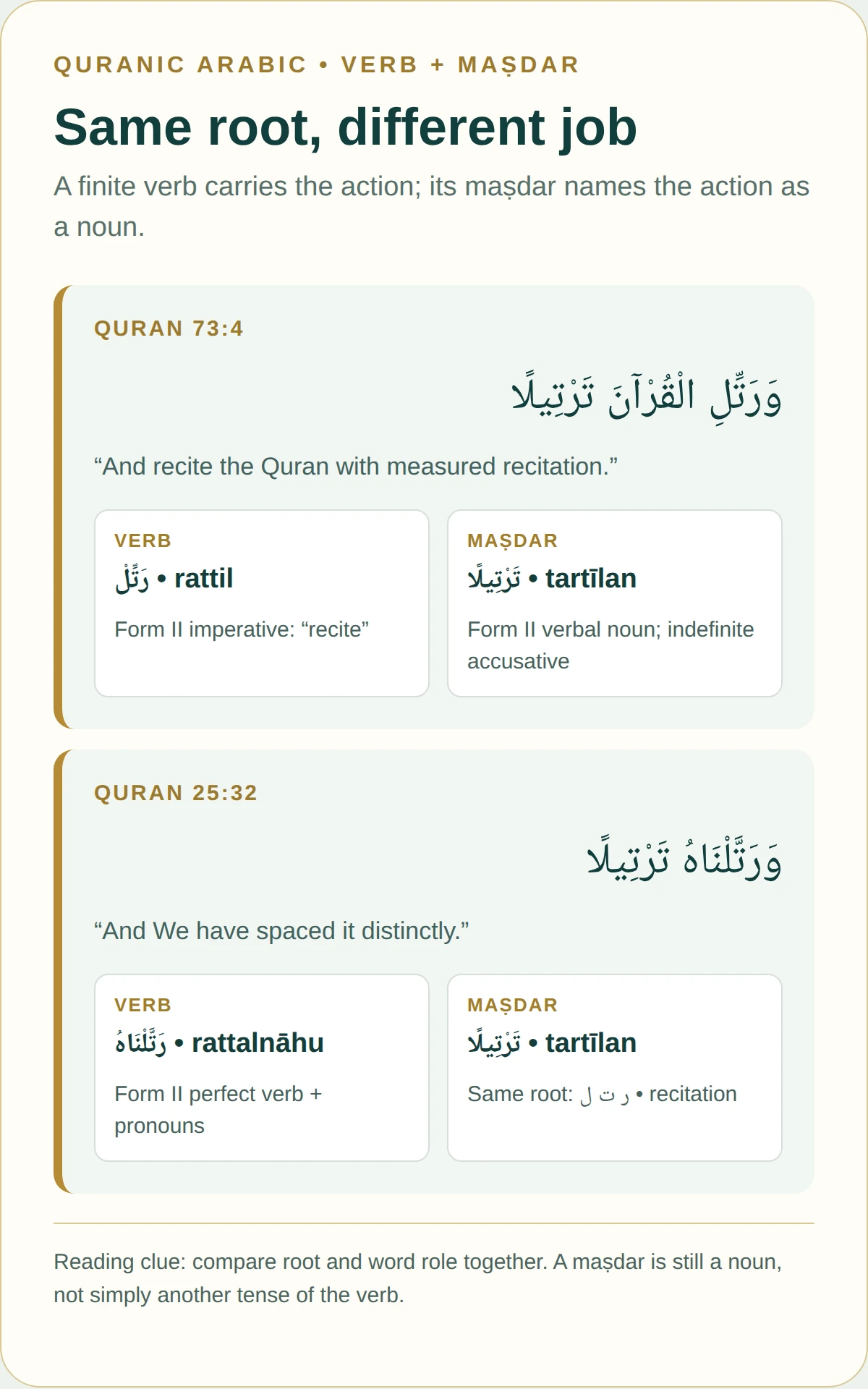
Quran 25:32 uses tartīlan again after وَرَتَّلْنَاهُ (wa-rattalnāhu, “and We recited it”). This Form II perfect verb has subject and object pronouns; its following maṣdar shares the root. The noun is not simply another tense of the verb.
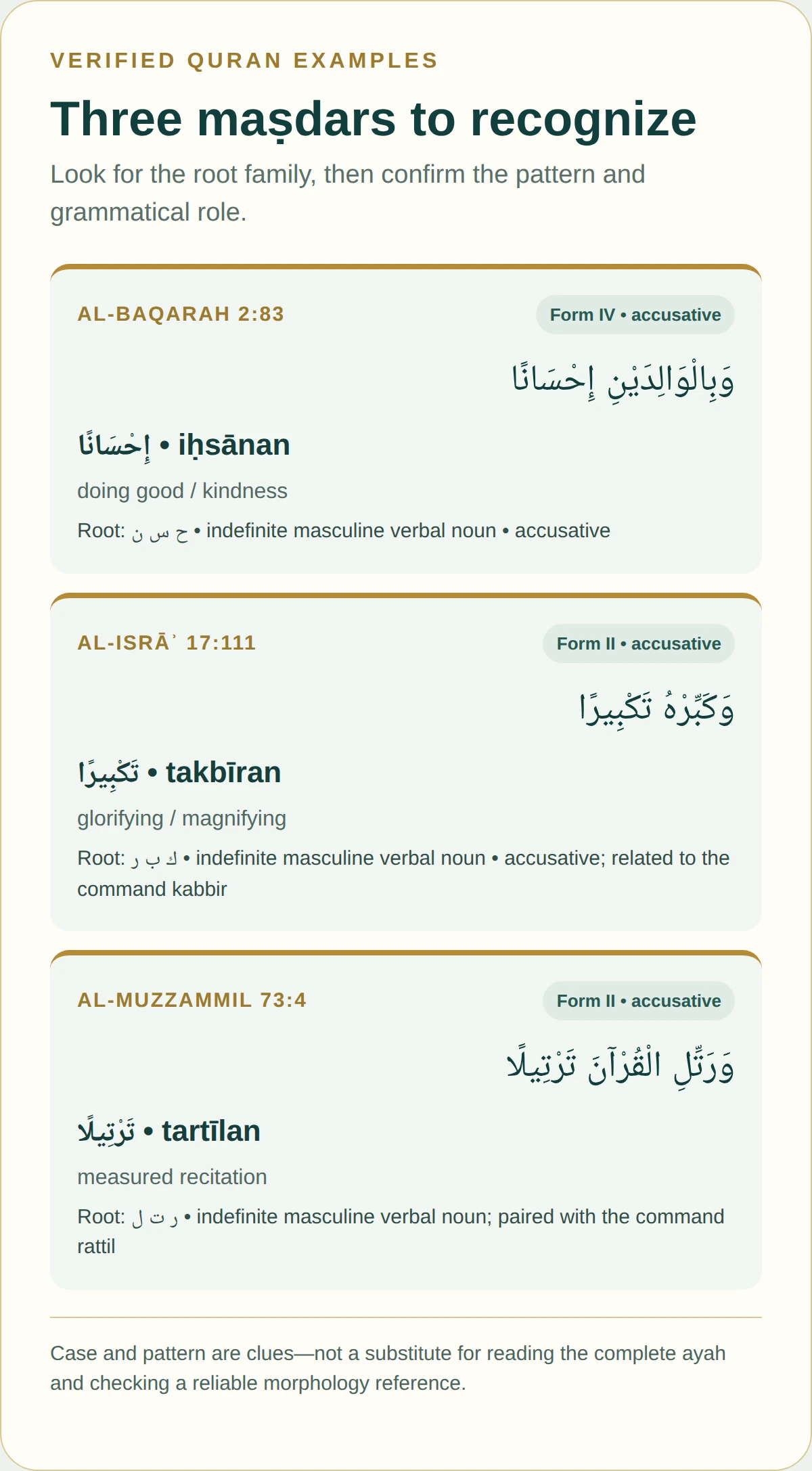
In Quran 2:83, iḥsānan (إِحْسَانًا) appears in the instruction about treating parents well. The Corpus identifies it as an indefinite Form IV masculine verbal noun in the accusative, from ح س ن. Quran 17:111 has takbīran (تَكْبِيرًا), an indefinite accusative Form II maṣdar related to the command kabbir. Check each root and pattern, then read the clause before settling on a translation.
A practical method for spotting an Arabic maṣdar
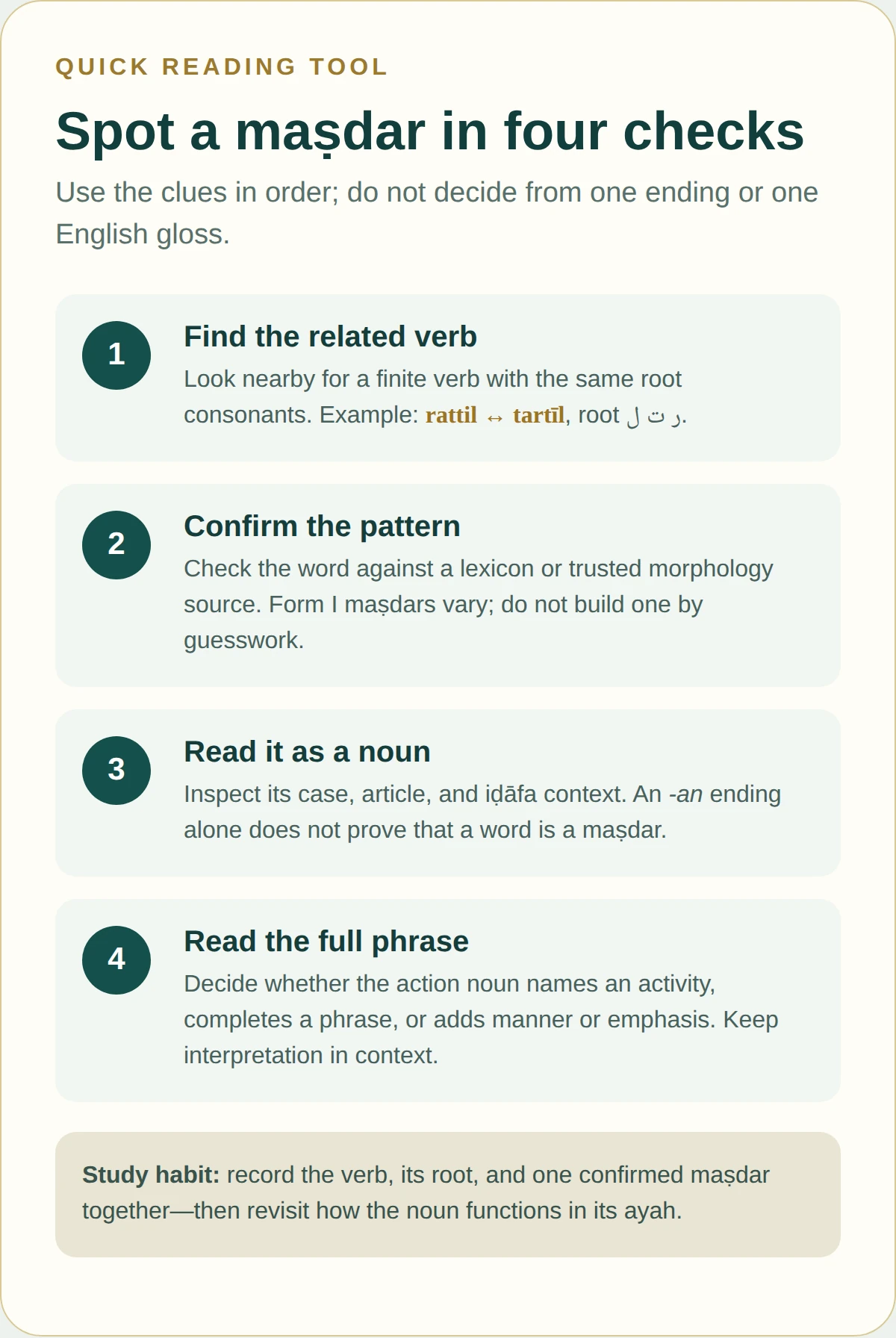
Use this sequence when you meet an unfamiliar action-related word in an ayah:
- Locate the whole word. Notice attached prefixes, the definite article الـ, and any pronoun ending. These can affect how the word is written and how it fits into the phrase.
- Look for a verb-shaped clue. Ask whether a nearby finite verb shares the same root consonants. In 73:4, rattil and tartīl share ر ت ل; in 17:111, kabbir and takbīr share ك ب ر.
- Check the pattern, but do not overpredict. A recognizable augmented form can suggest a likely maṣdar pattern. For Form I in particular, several patterns are possible, so confirm the word in a reliable lexicon or morphology reference instead of manufacturing a form from the root.
- Test its noun role. Can the word take the definite article, appear in an iḍāfa construction, or show a case ending according to its sentence role? These are clues that it functions as a noun, though not every individual test will be visible in an unvowelled text.
- Read the full clause. Decide whether the maṣdar names an action, completes a phrase, or adds emphasis or manner. Do not treat the English translation as a one-to-one grammatical label.
The Quranic Arabic Corpus’s word-by-word analysis of Quran 73:4 explicitly labels tartīlan an indefinite Form II verbal noun in the accusative. It is a useful example of how a morphology reference can confirm a learner’s observation; it does not replace broader Quran study, a reliable translation, or scholarly interpretation. See the Corpus analysis of tartīlan in Quran 73:4.
Morphology tools may also connect a word to its root and other Quran occurrences, helping you compare forms. Treat their labels as analysis aids, not complete interpretations: related roots are not interchangeable, and their sentence roles can differ. Return to the ayah after checking a tool so grammar, translation, and recitation remain connected.
Why the maṣdar still behaves like a noun
A maṣdar takes a noun’s role, and its ending may reflect case and syntax. The Corpus marks tartīlan in 73:4 as accusative, but neither -an nor accusative case alone proves a word is a maṣdar. Identify form and role together with Quranytime’s guide to Arabic case endings.
A maṣdar can be definite or indefinite according to context. In an iḍāfa, the first noun is the construct term and has no article; the following noun is genitive. Kitābat al-dars means “writing the lesson.” An independent maṣdar may take the article when context calls for it; action nouns are not always definite. See Quranytime’s guides to iḍāfa and definite and indefinite nouns.
Maṣdar or finite verb? Common points of confusion
Do not equate every Arabic noun with a maṣdar. A noun may name a person, object, quality, or concept without naming the action of a verb. Trace a proposed maṣdar to its root and compare its meaning with the verb family.
Do not use a suffix as your only test. A final -an can mark the accusative case of many kinds of nouns. It does not, by itself, establish that a word is a verbal noun. In the examples above, the analysis depends on the root, pattern, and grammatical annotation—not only on the final sound.
Do not expect every English “-ing” word to become a maṣdar. “I am reading” describes an ongoing verbal action; “reading is helpful” uses “reading” as a noun in English. Arabic expresses these ideas through different structures. Look at the Arabic grammar, not the English spelling.
Do not confuse the maṣdar with an active participle. A maṣdar names an action or idea; an active participle often names the person or thing doing it. Quranytime’s guide to nominal sentences can help when these nouns appear as subjects or predicates, but the distinction starts with asking whether the word refers to an action or an actor.
A short study routine for Quranic Arabic
Choose a verb family from a verse you are studying. Write its root and finite form, then add a confirmed maṣdar and label the pattern only when verified. Finally, mark the noun’s case or connection to a neighboring word. This builds recognition without turning each verse into a full morphology exercise.
For a small practice set, compare the verb–noun pairs rattil and tartīl in 73:4, rattalnāhu and tartīl in 25:32, and kabbir with takbīr in 17:111. Then identify iḥsānan in 2:83 as a verbal noun and ask how its phrase relates to the command about parents. Use a translation to understand the full statement, and grammar references to check the word form. If a verse raises a question of interpretation, consult reliable tafsir rather than drawing a religious conclusion from morphology alone.
Quick questions
What is an Arabic maṣdar?
It is a verbal noun that names an action or concept associated with a verb, without carrying the same person-and-tense information as a finite verb.
Is a maṣdar the same as an infinitive?
It is often translated with an English infinitive or an “-ing” noun, but the grammar systems are not identical. Use the Arabic word’s form and sentence role to identify it.
Can I predict every maṣdar from a verb?
No. Some verb forms offer useful patterns, but Form I verbal nouns are varied. Check a lexicon or reliable morphology resource when you are unsure.
How do I find a maṣdar in a Quranic verse?
Look for a noun related by root and meaning to a verb, confirm its pattern and grammatical role, and then read the entire phrase. A nearby verb–maṣdar pair is especially helpful for beginners.
In short, recognize the root, distinguish the finite verb from the action noun, confirm the pattern, and read the maṣdar as a noun in its ayah. That method keeps “Arabic masdar,” “verbal noun,” and “Arabic gerund” within one clear lesson while helping you approach Quranic examples with care.