
Want to count from one to one hundred in Arabic? Start with two things that English speakers often call “Arabic numbers”: the written digits, such as 1, 2, 3 or ١, ٢, ٣, and the Arabic words you say aloud, such as wāḥid (واحد) and ithnān (اثنان). Learn the digits first, then the core number words and one useful pattern: after twenty, Arabic usually says the units, then wa (“and”), then the tens—“five and thirty” for 35.
This beginner guide uses clear Modern Standard Arabic (MSA) forms as a learning reference. Pronunciation and everyday forms can vary by region, and the gender of a counted noun can change some number forms. You do not need to master every grammar detail before you can recognize or practise numbers.
Digits, number words, and “Arabic numerals”
A digit is a written symbol; a number word is a word you pronounce. You may see the familiar Western digits 0–9 as well as Eastern Arabic-Indic digits ٠–٩. Both represent the same values. The symbols found on clocks, signs, worksheets, and devices vary by country and setting, so it is useful for Arabic learners to recognize both forms instead of assuming that one is used everywhere.
Arabic sentences usually run from right to left, while multi-digit numeral strings are commonly written with the largest place on the left, as in ١٢ (12). Do not confuse the direction of the surrounding script with the order of the digits themselves. For a quick refresher on letter shapes and joining, see the step-by-step Arabic alphabet guide; for handwriting practice, use this guide to writing Arabic letters.
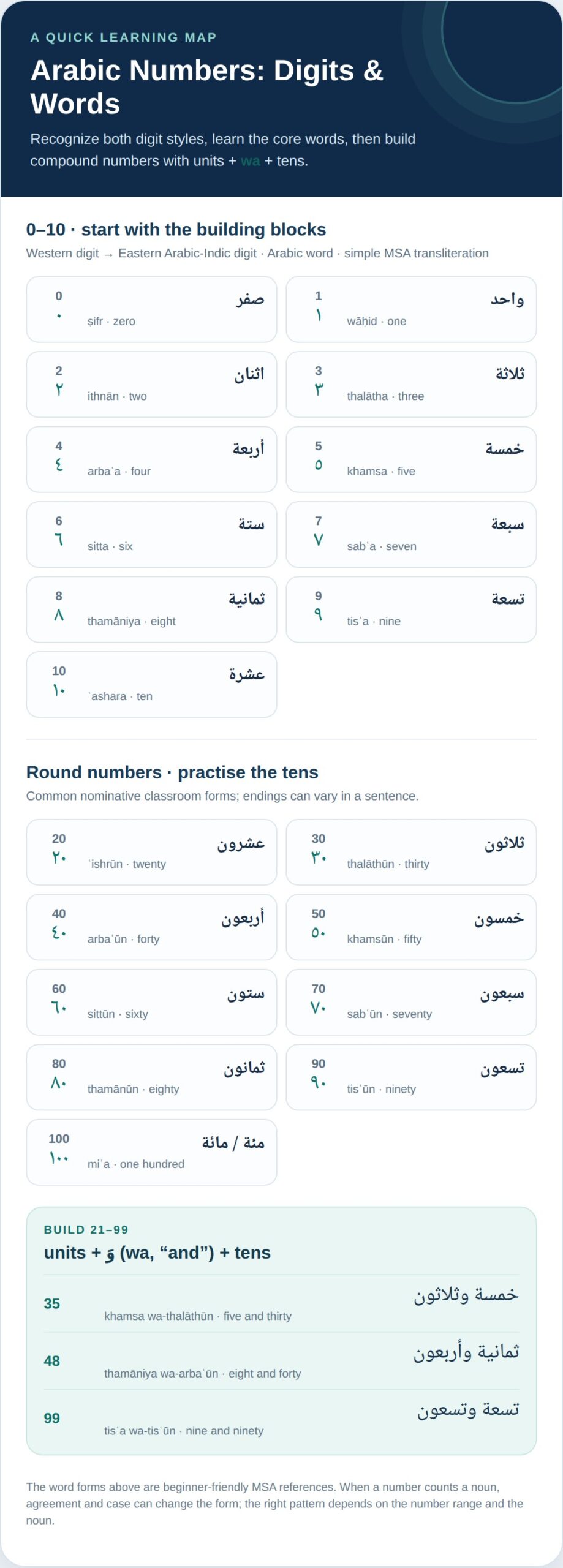
The table card below puts the two digit styles beside the core number words. Its spellings are a practical starting point, not a promise that one transliteration captures every accent. Read each word aloud slowly, then compare it with a trusted pronunciation recording or teacher.
Arabic numbers 0–10: learn the building blocks
Zero is ṣifr (صفر), written ٠. The numbers one to ten are the foundation for larger numbers. Learn to recognize the Arabic word as well as the digit: in a Quran or Arabic-reading study session, this helps you move between the written symbol, a page or lesson reference, and the number spoken by a teacher.
Some Arabic numerals change form according to the gender of the noun being counted. The standalone words in a beginner chart are useful for recognition, but a complete counted phrase can require a different form. For example, the word for “one” agrees with the noun; “two” commonly uses a dual form. Treat the list as a map of the basic words, and learn the noun patterns separately when you are ready.
From 11 to 20: a short group to practise as words
The teens do not come from simply placing a familiar English-style ending after each digit. They are best learned as a small set of number words. In a common MSA counting pattern, 11 and 12 are built differently from 13–19; for 13–19, the unit and “ten” combine, and their forms depend on the gender of the counted noun. That is why a word list without context can be misleading.
For a first pass, notice the repeated idea in expressions such as thalāthata ʿashar (ثلاثة عشر, thirteen in a masculine-noun context) and khamsata ʿashar (خمسة عشر, fifteen in a masculine-noun context). If the noun is feminine, the relevant parts may change. Learn the digits ١١–١٩ visually, listen to the number words, and avoid applying one gender rule to every number range.
If you want to understand why a numeral can change when it counts a noun, first review the basics of Arabic grammar. This guide keeps the grammar note intentionally short so that the main skill—recognizing and building numbers—stays manageable.
The tens: 20, 30, 40, and up to 100
After the teens, the tens give you a dependable set of anchors. Learn the round numbers—20, 30, 40, 50, 60, 70, 80, 90, and 100—by sound and sight. Their endings may appear as -ūn or -īn depending on grammatical case and use; the common chart forms are enough for a beginner who is counting aloud or recognizing a number in a lesson.
In standard classroom examples, 20 is ʿishrūn (عشرون), 30 is thalāthūn (ثلاثون), 40 is arbaʿūn (أربعون), 50 is khamsūn (خمسون), 60 is sittūn (ستون), 70 is sabʿūn (سبعون), 80 is thamānūn (ثمانون), 90 is tisʿūn (تسعون), and 100 is miʾa (مئة / مائة). The card gives a compact visual reference for the tens alongside the single digits.
How to build 21–99: units + wa + tens
For many compound numbers from 21 to 99, use the unit first, then wa (و, “and”), then the tens. The order may feel reversed if you expect English, but the pattern is consistent: 21 is “one and twenty,” 35 is “five and thirty,” and 48 is “eight and forty.” This gives you a simple way to construct and understand a large part of the 1–100 range without memorizing ninety-nine unrelated words.
- ٢١ — واحد وعشرون — wāḥid wa-ʿishrūn — twenty-one (“one and twenty”)
- ٣٥ — خمسة وثلاثون — khamsa wa-thalāthūn — thirty-five (“five and thirty”)
- ٤٨ — ثمانية وأربعون — thamāniya wa-arbaʿūn — forty-eight (“eight and forty”)
- ٩٩ — تسعة وتسعون — tisʿa wa-tisʿūn — ninety-nine (“nine and ninety”)
The word wa attaches the unit to the tens in speech and writing. When you see a compound number, look for the unit, the small connecting و, and the tens. Practise reading the pieces separately before blending them into one smooth phrase.
A small grammar note: counting a noun is different
Saying a number by itself and counting a named object are related but not identical tasks. In MSA, numeral agreement depends on the number range and the gender and form of the counted noun. One and two behave differently from three to ten; teens, whole tens, and compound numbers bring their own patterns. A quick rule such as “Arabic numbers always use the opposite gender” is therefore inaccurate.
For example, “one book” can be kitāb wāḥid (كتاب واحد), while “one car” is sayyāra wāḥida (سيارة واحدة). For “three books,” a common MSA pattern is thalāthatu kutub (ثلاثة كتب); for “three cars,” it is thalāthu sayyārāt (ثلاث سيارات). These examples show why the noun matters. For a detailed reference on numeral phrases and counted-noun agreement, see Chapter 15, “Numerals and numeral phrases,” in Karin C. Ryding’s Reference Grammar of Modern Standard Arabic.
Do not let the grammar slow down your first reading practice. If your goal is Quranic vocabulary, begin by recognizing the number and the noun, then study their grammatical relationship in context. A gradual Quranic Arabic vocabulary plan can help you build that skill without treating each new word as an isolated list.
Pronunciation tips for clearer counting
Transliteration is a helper, not a replacement for listening. In number words such as thalātha (ثلاثة) and thamāniya (ثمانية), the letter ث is the unvoiced “th” sound heard at the start of English thumb. It is not the “th” in this. In Egyptian Arabic and some other dialects, this sound may be pronounced differently in everyday speech, so choose a target variety if you are learning conversation. For reading, practise the standard sound and recognize the written letter. Our guide to Quranic Arabic and Modern Standard Arabic explains why the register you learn matters.
Some learners also find ʿayn (ع) challenging in words such as ʿashara (عشرة) and ʿishrūn (عشرون). Do not insert a plain English vowel before it; listen to a clear example, repeat the word slowly, and ask a teacher to correct the sound. The complete Arabic letters reference is useful if you want to review individual sounds before practising longer numbers.
Practise Arabic numbers in five minutes
- Match digit to word: point to ٣, say “three,” then say thalātha (ثلاثة).
- Build a tens ladder: say 20, 30, 40, and continue to 100. Repeat the Arabic words while looking at the digit shapes.
- Make a compound: choose a unit and tens, then connect them with wa. For 62, say “two and sixty,” then read اثنان وستون.
- Switch scripts: write 7 and ١٠, then say sabʿa and ʿashara. Recognize both symbol styles rather than memorizing only one keyboard layout.
- Use real study references: read a page number or lesson number aloud before you begin. If you are also learning common classroom expressions, practise them with these useful Arabic phrases.
For a broader learning path, this guide to learning Arabic for Quran understanding explains how sound, vocabulary, and reading practice support one another. If you are choosing what to study next, our overview of learning Arabic offers a wider starting point.
Common questions about Arabic numbers
Are 1, 2, 3 “Arabic numbers”?
They are commonly called Western digits or Western Arabic numerals. Eastern Arabic-Indic digits are ١, ٢, ٣. In everyday conversation, people may use the phrase “Arabic numbers” for either digits or number words, so check the context.
How do you say 35 in Arabic?
A common MSA counting form is khamsa wa-thalāthūn (خمسة وثلاثون), literally “five and thirty.” If you are counting a noun, the exact form may change to agree with that noun.
Do Arabic numbers read from right to left?
The Arabic script is written right to left, but multi-digit numerals such as ١٢ are conventionally read and written with the larger place first, like 12. Learn the digit shapes separately from the direction of the surrounding sentence.
Should I learn number words or digits first?
Learn both together: digits help you identify a value quickly, and number words help you pronounce it. Start with 0–10, add the tens, and then use the compound pattern to work through the rest.
Keep counting one useful pattern at a time
To learn Arabic numbers from 1 to 100, recognize both digit styles, memorize the basic number words and tens, then build most compound numbers with units + wa + tens. Treat noun agreement as a separate next step rather than forcing one rule onto every number. A few minutes of reading, listening, and saying numbers aloud each day will make Arabic script more familiar and help you follow lessons with confidence.