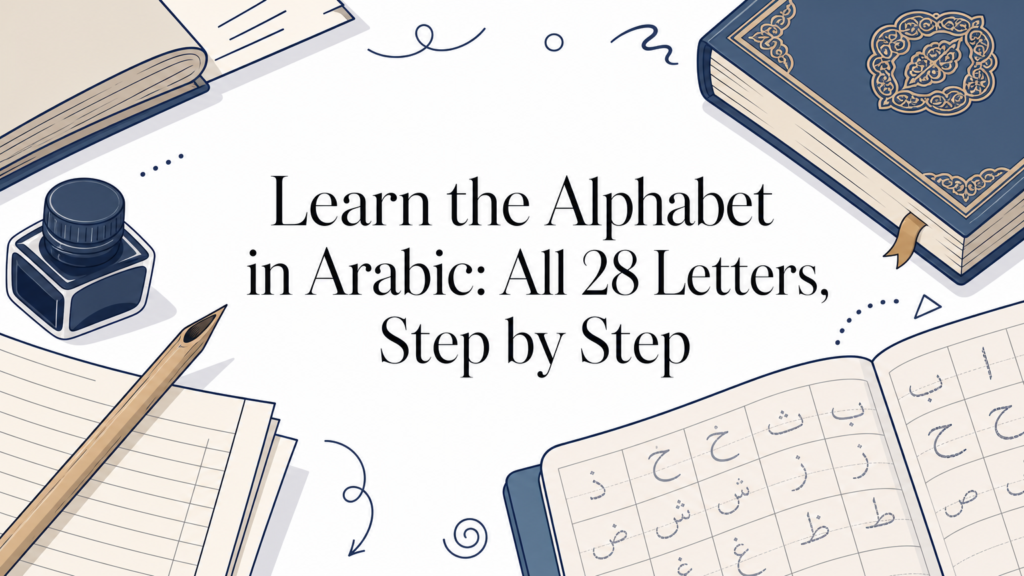
To learn the alphabet in Arabic, you need to master 28 letters. All of them are consonants, the script runs from right to left, and each letter changes shape depending on where it sits in a word. Most beginners can recognize the isolated letters after about a week of 20 to 30 minutes a day. Reading short, vowelled words usually follows within a few weeks. The fastest route is to study letters in shape families instead of alphabetical order, and to say every letter name aloud.
The Arabic alphabet, called al-abjadiyah, is the set of letters used to write Arabic. Short vowels are not letters. They are small marks placed above or below a consonant. The same script also writes Persian, Urdu, and Pashto, so the effort pays off beyond Arabic itself.
This guide gives you the full 28-letter chart with sounds, explains how letters connect and change form, and lays out a seven-day plan you can start today. It also covers the mistakes that slow beginners down. At Quranytime Academy we teach Arabic and Quran reading one-to-one online.
Why learning the Arabic alphabet comes first
Learning the Arabic alphabet first matters because reading, writing, spelling, and Quran recitation all depend on recognizing letters instantly. Skip this step and you stay stuck with romanized spellings, which hide sounds that Arabic distinguishes and English does not.
One alphabet for everyday Arabic and the Quran
If you want to learn the Arabic alphabet for Quran reading, there is no separate Quranic alphabet. The Quran is written with the same 28 letters as a newspaper or a novel. What differs is that the Quran is printed with full vowel marks, while most Arabic books and newspapers leave them out.
That makes the Quran friendlier to a beginner than it looks. Once you know the letters and the three short vowel marks, you can start sounding out Quranic words. Tajweed rules then refine how you pronounce them, but they build on the letters, so the alphabet has to come first.
Why romanization is not enough
Romanization writes both ه and ح as "h", and both س and ص as "s". They are different letters with different sounds. Latin spellings also vary from site to site, which is why you see Quran, Qur’an, and Koran for the same word.
Learning to read the script itself removes that guesswork. It also lets you use any textbook, dictionary, or Quran copy without depending on someone else’s spelling system.
Learn the letters themselves, because Latin spelling blurs sounds that Arabic keeps apart.
The 28 Arabic letters with names and sounds
The Arabic alphabet has 28 letters, shown below in standard order with the closest English sound for each. Read the chart from the top, and say each name aloud, or follow along with the Arabic Reading Guide with teacher audio. The sound hints are approximations, so a teacher or native audio will always sharpen them.
The full letter chart
| Letter | Name | Closest sound |
|---|---|---|
| ا | Alif | long "aa", also carries hamza |
| ب | Baa | b as in "bat" |
| ت | Taa | t as in "tin" |
| ث | Thaa | th as in "think" |
| ج | Jeem | j as in "jam" (g in Egyptian speech) |
| ح | Haa | breathy h from the throat |
| خ | Khaa | like ch in Scottish "loch" |
| د | Daal | d as in "door" |
| ذ | Dhaal | th as in "this" |
| ر | Raa | rolled r |
| ز | Zayn | z as in "zoo" |
| س | Seen | s as in "sun" |
| ش | Sheen | sh as in "ship" |
| ص | Saad | heavy s |
| ض | Daad | heavy d |
| ط | Taa (heavy) | heavy t |
| ظ | Dhaa (heavy) | heavy th as in "this" |
| ع | Ayn | deep throat sound, no English match |
| غ | Ghayn | gargled r, like French "r" |
| ف | Faa | f as in "fan" |
| ق | Qaaf | k from the back of the throat |
| ك | Kaaf | k as in "kite" |
| ل | Laam | l as in "lamp" |
| م | Meem | m as in "moon" |
| ن | Noon | n as in "nose" |
| ه | Haa (soft) | soft h as in "hat" |
| و | Waaw | w as in "water", or long "oo" |
| ي | Yaa | y as in "yes", or long "ee" |
Letters with no English equivalent
Two groups need extra attention. The first is the throat letters: ح, خ, ع, غ, and ق. They are produced deep in the mouth or throat, and English has nothing close, which makes them some of the pronunciation problems for English speakers that learners meet first. The second is the four heavy letters ص, ض, ط, and ظ. You pronounce them by raising the back of the tongue toward the roof of the mouth, which gives a fuller, darker sound than their light partners س, د, ت, and ذ.
Do not expect to get these right from a chart. Listen to a native speaker, repeat, and have someone correct you.
Is it 28 or 29 letters?
Most teachers count 28 letters. Hamza (ء) is a glottal stop, like the pause in "uh-oh". It is often taught beside the alphabet, and some lists count it as a 29th letter. Taa marbuta (ة) appears only at the end of a word, usually marks feminine nouns, and is treated as a variant of taa, not a separate letter.
Start with 28 letters, and treat hamza as a bonus you meet naturally in your first words.
How Arabic letters connect and change shape
Arabic letters join to their neighbors, so most letters have four forms: isolated, initial, medial, and final. Which form you see depends on the letter’s position in the word and on whether the neighboring letters connect.
The four forms in practice
Most letters keep the same core shape in every form, and only the connecting stroke changes. Here are four examples, including a letter that does not connect forward.
| Letter | Isolated | Initial | Medial | Final |
|---|---|---|---|---|
| ب | ب | بـ | ـبـ | ـب |
| ع | ع | عـ | ـعـ | ـع |
| ه | ه | هـ | ـهـ | ـه |
| د | د | د | ـد | ـد |
The letter ه changes the most, and ع shifts noticeably, while ب simply gains a connecting line. Learn the isolated form first, then add the other three in the second week.
The six letters that never connect forward
Six letters join to the letter before them but never to the one after: ا, د, ذ, ر, ز, and و. After one of them, the next letter starts fresh in its initial form, even in the middle of a word.
The word كتاب (kitaab, "book") shows this. ك connects to ت, and ت connects to ا. Because ا does not connect forward, the final ب stands alone in its isolated form. Once you know these six, word shapes stop looking random.
Vowels and marks
Arabic has three long vowels written as letters: ا (aa), و (oo), and ي (ee). The short vowels are marks: fatha (a), kasra (i), and damma (u). A sukun means no vowel follows, and a shadda doubles a consonant. With the marks, the word reads كِتَاب, which is why beginner books and the Quran print them.
Letters carry the skeleton of a word, and the small marks tell you how to say it.
How to learn the Arabic alphabet fast, step by step
The fastest reliable method is a seven-day letter plan, then a second week on letter forms and vowel marks, with 20 to 30 minutes of practice daily. This is also the easiest way to learn the Arabic alphabet for beginners, because each day adds only three to five letters that look or sound related.
A seven-day letter plan
| Day | Letters | Why they are grouped |
|---|---|---|
| 1 | ا ب ت ث | Alif, plus three letters with one shape and different dots |
| 2 | ج ح خ | One shape, with a dot below, no dot, or a dot above |
| 3 | د ذ ر ز | Two pairs, none connect forward |
| 4 | س ش ص ض | Tooth shapes and their heavy partners |
| 5 | ط ظ ع غ | Two heavy letters, then the throat pair |
| 6 | ف ق ك ل | Two loop letters and two upright letters |
| 7 | م ن ه و ي | The remaining five |
That is 4, 3, 4, 4, 4, 4, and 5 letters, 28 in total, or an average of four a day. In week two, spend three days on the four forms, two days on vowel marks, and two days reading short words such as كتاب and باب (baab, "door").
Memory techniques that work
- Group by shape. Learn ب, ت, and ث as one family with different dots, not as three unrelated symbols.
- Say the name, then the sound. Aloud, every time. Your mouth learns the throat letters alongside your eyes.
- Write by hand, right to left. Trace each letter first, then practice how to write the Arabic alphabet from memory.
- Review before you add. Spend five minutes on yesterday’s letters before starting today’s.
- Read real words early. Even three-letter words tell your brain the letters are useful.
What to expect on timing
After the seven days, you should recognize most isolated letters, which is the first milestone in how long it takes to learn the Arabic alphabet. Reading slowly with full vowel marks usually takes a few more weeks. Reading unvowelled text smoothly takes longer, because you rely on vocabulary and context to fill in the missing vowels. That is normal, so measure progress by the words you can read, not by the days passed.
Seven short days of focused letter practice beat one long weekend of cramming.
Common mistakes and when a teacher helps
The most common mistakes are ignoring dots, writing left to right, and mispronouncing throat and heavy letters. The first two you can fix yourself. The last one needs a human ear.
Five mistakes to avoid
- Ignoring the dots. ب, ت, ث, ن, and ي share a base shape, and only the dots tell them apart.
- Writing left to right. It breaks the connecting strokes and makes your letters look wrong.
- Merging heavy and light letters. Saying ص like س, or ط like ت, changes the word.
- Swapping similar throat sounds. Replacing ع with ا, ق with ك, or ح with ه are the classic errors.
- Learning only isolated forms. You will recognize the chart but fail on real words.
When a one-to-one teacher helps
Pronunciation is where self-study stalls, because you cannot hear your own mistakes. Quranytime Academy offers live, one-to-one Arabic and Quran reading lessons online. Our teachers are Al-Azhar graduates, and no previous knowledge is required. Our Quran reading and Tajweed lessons start from the letters and vowel signs, then move into accurate recitation.

A teacher corrects in seconds what you could repeat wrongly for months.
Start with the letters, then get them checked
The Arabic alphabet is 28 consonant letters, four forms each, plus a small set of vowel marks. You learn it fastest by grouping letters by shape, saying and writing each one, and reading real words from the first week. The same letters carry you from everyday Arabic to the Quran.
If you want someone to listen to your pronunciation and set a path that fits your level, book a free assessment class. A teacher will hear where you are today and recommend your next step.