

Yes—an adult can memorize Quran without knowing Arabic beforehand. Understanding Arabic is not a prerequisite for learning a passage by heart, but memorization, accurate recitation, reading the Arabic script, and understanding meaning are different skills. You can work on them together in manageable steps: learn to decode the written words, get pronunciation checked, memorize a small confirmed passage, and study its meaning with a reliable translation or teacher.
This distinction matters because progress in one area does not automatically settle the others. Repeating sounds you cannot yet read may help you remember a sequence, but it does not by itself teach you how to recognize that sequence on the page, pronounce every sound accurately, or understand its message. A balanced approach gives each goal its own place rather than expecting one tool—especially transliteration—to do everything. You do not need to master all four areas before beginning, but it helps to be clear about what you are practising in each session.
Separate four skills that often get bundled together
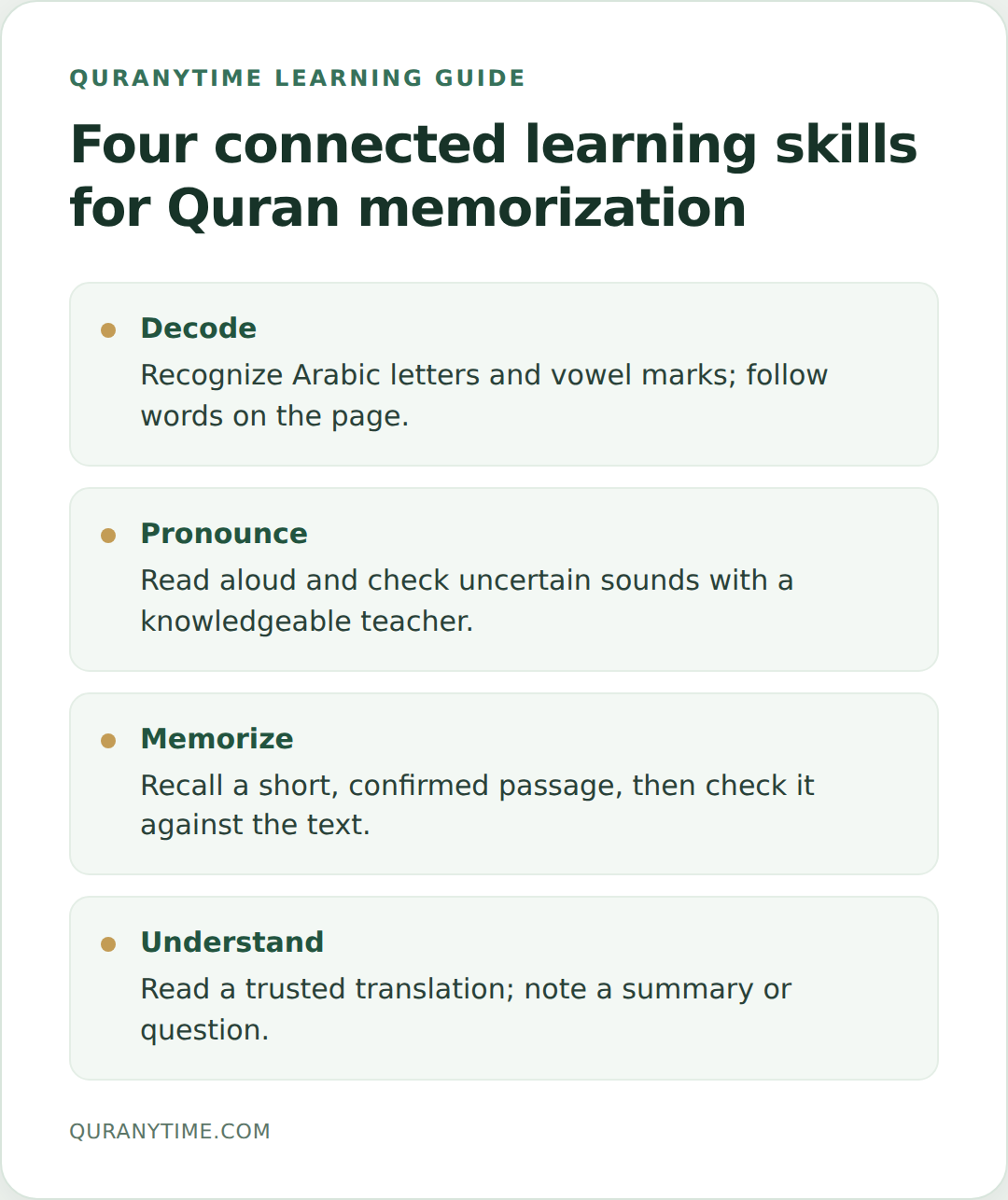
When someone says, “I want to memorize Quran but I don’t know Arabic,” they may mean one or more of these things:
- Decoding: recognizing Arabic letters and marks, joining them into words, and following the written text.
- Pronunciation: producing the sounds and reciting the passage in a way that can be checked and improved.
- Memorization: recalling the passage without looking, then revisiting it so it remains familiar.
- Meaning: learning what the words and verses convey through a trustworthy translation, vocabulary study, or instruction.
These skills can support one another, but they do not arrive automatically as a single package. A learner may memorize a short surah from repeated listening while still needing help to read its letters. Another may read aloud but not know the vocabulary. Neither situation means the learner has failed; it identifies what to practise next. Likewise, being able to explain a translation does not necessarily show that you can read or recite the Arabic text accurately.
Think of one short passage as four parallel questions: Can I find it on the page? Can I recite it with the sounds checked? Can I bring it to mind without looking? Can I explain its general meaning using a reliable source? Your answer may differ for each question.
Start by checking your Arabic reading foundation
Before choosing a memorization amount, notice how you handle the written text. Can you identify the letters? Do short vowel marks such as fatḥah, kasrah, and ḍammah make sense to you? Can you join letters into a word, and do you recognize when a sound is held longer? If not, begin with a short reading lesson or a structured beginner resource alongside any memorization you undertake.
For example, a learner might recognize the shape of a word but mistake a short vowel for a long one, or pause because two similar-looking letters are uncertain. Reading slowly with the text visible gives you a chance to notice these questions. A concise guide to short and long vowels in Arabic can help you identify one part of the script, while feedback from a knowledgeable Quran teacher can help you check what you actually recite.
If you are beginning from the alphabet, you do not have to finish every language course before you start memorizing any passage. Instead, set a sensible boundary: choose material with a teacher or trusted guide, work on it at a pace that leaves room to read and check it, and keep developing the decoding skills you need for the next step. Quranytime’s gentle adult beginner path discusses how to identify a starting level without treating adult learning as a race.
Use listening as support, not as your only map
Listening to a reliable recitation can help you become familiar with how a passage sounds. For practice, follow the Arabic text with your eyes while listening, pause after a short phrase, and try to repeat it. Then return to the written words and check where the phrase begins and ends. This connects sound to script instead of leaving the learner with an audio sequence alone.
Transliteration—Arabic sounds written using the Roman alphabet—may feel approachable at first, but spellings vary and cannot represent every feature of Arabic pronunciation consistently. Treat it as a temporary cue if it helps you orient yourself, not as a substitute for learning the Arabic script or receiving pronunciation guidance. When possible, let a teacher hear a short sample and point out one specific sound or reading issue. A small correction is easier to use than a long list of unfamiliar technical terms.
Use one recitation model at a time while learning a passage, and ask your teacher which text and reading convention you should follow. If an audio recording, transliteration, and printed page seem to disagree, pause and ask rather than guessing. A recording supports practice; it does not tell you whether your own pronunciation is accurate.
Learn the meaning without making a word list do too much
You can begin to understand a passage even while Arabic vocabulary is new to you. Read a reputable translation alongside the Arabic, note the surah and verse, and make a simple summary in your own words. For a short passage, ask: What is the broad subject? Who is being addressed? Is there a repeated word or idea? If a phrase is unclear, mark it as a question instead of turning a guess into a definition.
A translation is a way to access meaning in another language; it is not the Arabic text itself, and English wording can differ from one translation to another. Avoid assuming that one English word always matches one Arabic word exactly. If you want to investigate vocabulary more closely, keep each word in its verse and surrounding passage. Quranytime’s guide to studying a Quran verse word by word without losing context explains how a first-pass gloss differs from fuller interpretation.
Keep memorization practice and meaning study connected but distinct. You might spend one part of a session listening, reading, and recalling a short passage, then use a separate few minutes to review a translation and write one question. Meaning can make the passage more intelligible to you, but a summary is not a pronunciation check; correct recitation still needs its own attention.
A practical cycle for a short passage
Choose a short portion that suits your current reading level. If you are not sure where to begin, ask a qualified Quran teacher to suggest and check a passage. Then try this flexible cycle; it is a study routine, not a universal religious ruling or guaranteed pace.
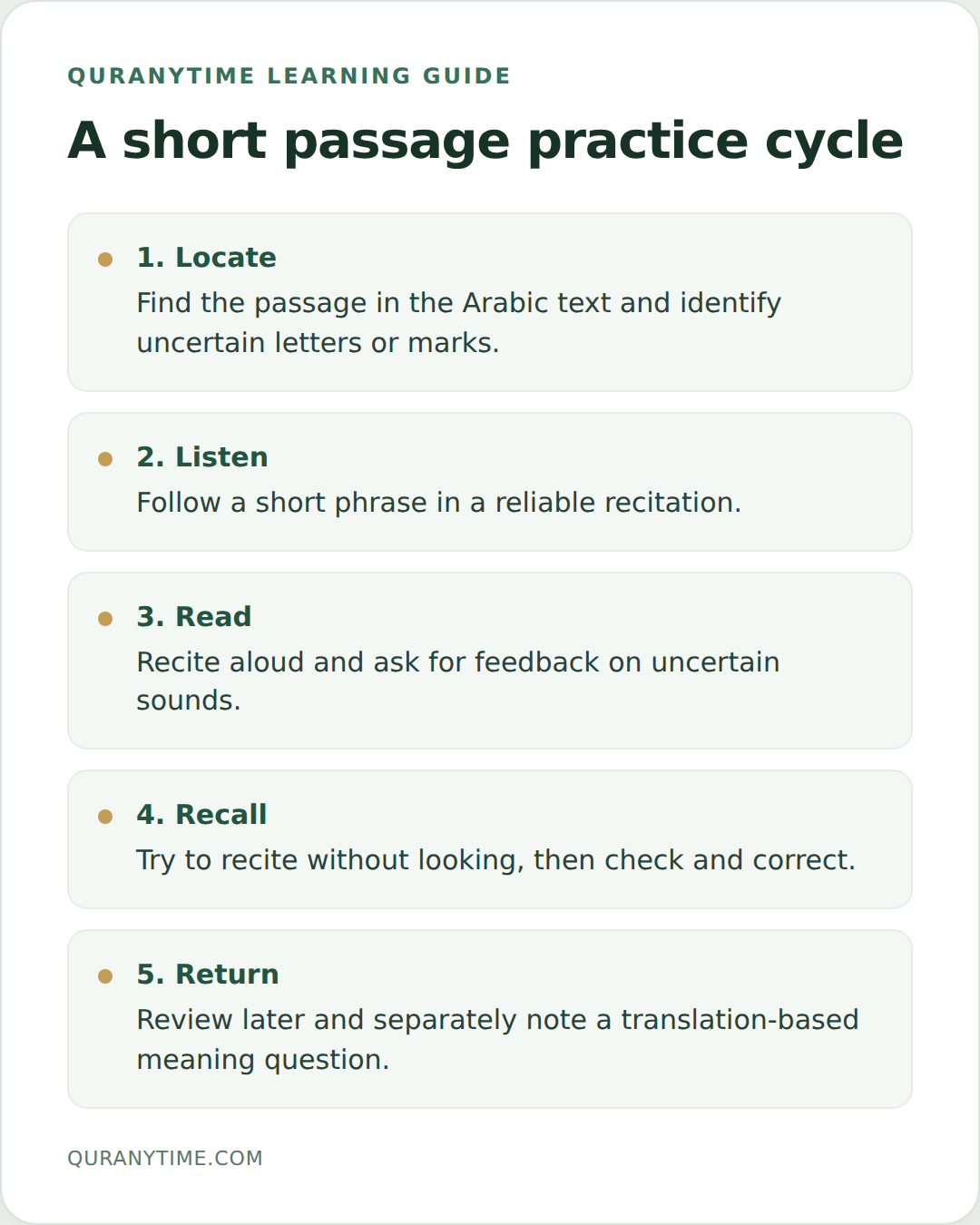
- Look and locate. Find the surah and verse on the Arabic page. Follow the words from right to left, and notice any letters or marks you cannot identify. If a particular word is unclear, note it rather than quietly substituting a guess.
- Listen and follow. Play a short phrase from a reliable recitation while tracking the same words. Pause before the next phrase rather than letting a long recording run in the background.
- Read aloud and check. Recite the phrase slowly. If you have access to a teacher, ask for feedback on the particular sounds or word boundaries you are unsure about.
- Memorize a manageable unit. Work on a short phrase or verse as appropriate. Look away and try to recall it, then check the text and correct what you missed.
- Return later. Revisit the passage in another session. Notice which part comes readily and where you need the page or a prompt. Keep older memorization in your plan instead of adding new material every time.
- Study a meaning note. Read a trusted translation and write a plain-language summary or a question to bring to a teacher or reliable commentary. Keep the note modest when the translation does not answer a question fully.
For instance, after working on a brief phrase, you might discover that you can recite the sound sequence but lose your place when reading it. That points toward more text-following practice, not necessarily more repetitions with your eyes closed. If the words are easy to find but a sound is uncertain, ask for pronunciation feedback. If you can recite and read the phrase but cannot explain it, add a meaning check. Match the next activity to the gap you actually noticed.
Make review a return visit, not a test of worth
Memorization is not finished simply because a passage came out correctly once. Make time to recall it again after a gap, check it against the text or a teacher’s guidance, and review older passages as your learning grows. A general educational principle supports spreading practice over more than one sitting and asking yourself to retrieve what you learned instead of only rereading it. The Australian Education Research Organisation describes spacing and retrieval practice for classroom learning in its spacing and retrieval practice guide; it is general learning guidance, not research that sets a Quran memorization schedule.
Keep your record simple: passage, date, what you could recall, and one next action. If pronunciation needs correction, note the correction. If the memory feels secure but its meaning is still unfamiliar, note that as a separate task. The point is to make the next session clear, not to grade yourself or compare your pace with another person’s.
A flexible weekly Hifz plan for beginners can help you make space for new learning, recent review, and older review. Adjust it to your reading level, available time, and teacher’s advice. If reviewing the passage repeatedly still leaves you unsure about how it should be pronounced, do not try to fix that uncertainty by increasing the memorization target alone.
Questions adults often ask
Do I need to understand Arabic before I start memorizing?
No. You can work on memorization while Arabic vocabulary is new. Keep learning to read and pronounce the Arabic text, and study meanings with reliable translations and guidance as separate, connected goals. Your next step depends on what you can already do, not on reaching a single all-purpose standard of readiness.
Can I memorize Quran by listening only?
Listening can help you become familiar with a passage, but it does not by itself teach you to decode the printed Arabic or verify your own recitation. Pair listening with following the text, active recall, and feedback when available.
Should I use English transliteration?
It may serve as a temporary orientation aid, but it cannot show every Arabic sound consistently. Learn the Arabic letters and marks, and ask a qualified teacher to check pronunciation rather than relying on Roman spelling alone.
Should I learn the translation before memorizing a passage?
There is no need to make those tasks compete. You can learn a passage and read a trusted translation alongside it. Keep the meaning note modest, and ask for help with interpretation questions that a basic translation does not answer.
What if I am still learning the alphabet?
Work on decoding with short, appropriate material and seek a clear learning sequence. A teacher can help you decide whether to memorize a small passage at the same time or focus first on reading foundations. There is no single order that fits every adult learner.
Choose a next step that fits your starting point
You do not have to wait until you understand every Arabic word to begin learning, and you do not have to treat memorization as a replacement for reading, pronunciation, or meaning. Identify which of those skills needs attention now, choose a small passage and practice routine that fits, and get help checking what you cannot verify by yourself. Adults returning to Hifz may also find Quranytime’s practical starting guide for adult Hifz useful for separating reading, recitation, and recall goals.
If you would like a teacher to help identify your Quran reading or Arabic starting point, Quranytime offers a free Quran and Arabic trial class. You can describe your experience plainly—such as “I can repeat some short surahs but I’m still learning the letters”—and ask what to practise next.