
Many learners search for “Quran word by word” because they want a verse to feel understandable, not like a list of unfamiliar sounds. Yet a row of English glosses can still hide the verse’s structure: a prefix may be attached to a noun, a verb ending may identify its subject, and a smooth translation may rearrange the Arabic. This guide shows how to study a Quran verse word by word without losing context. We will use a short example from Surah Al-Falaq and follow the same sequence you can use with other verses: read, segment, gloss, check grammar, reassemble, and return to the passage.
This is a language-learning method, not a stand-alone tafsir or a replacement for careful Quran recitation. Treat each gloss as a first draft. For a steady beginner routine, start with a Quranic Arabic vocabulary study plan, then apply the steps below to a complete verse rather than to isolated words.
Why a word list can lose the verse
Word-by-word study is useful when it helps you see how meaning is built. It becomes less useful when every Arabic form is forced into one English equivalent. Arabic words carry relationships through word order, particles, endings, and patterns; English translations often smooth those relationships into natural prose. A learner might write a gloss for each item and still miss who is speaking, what a preposition governs, or how two nouns connect.
Written spaces are not always the same as meaningful parts. In the example below, bi-rabbi is written as one connected token, but the attached bi- is a preposition and rabb is a noun. A root can help you compare related forms, but it is not a complete dictionary definition. Review Quranic Arabic roots and patterns as clues to form, then check the actual word and its sentence before deciding what a particular verse means.
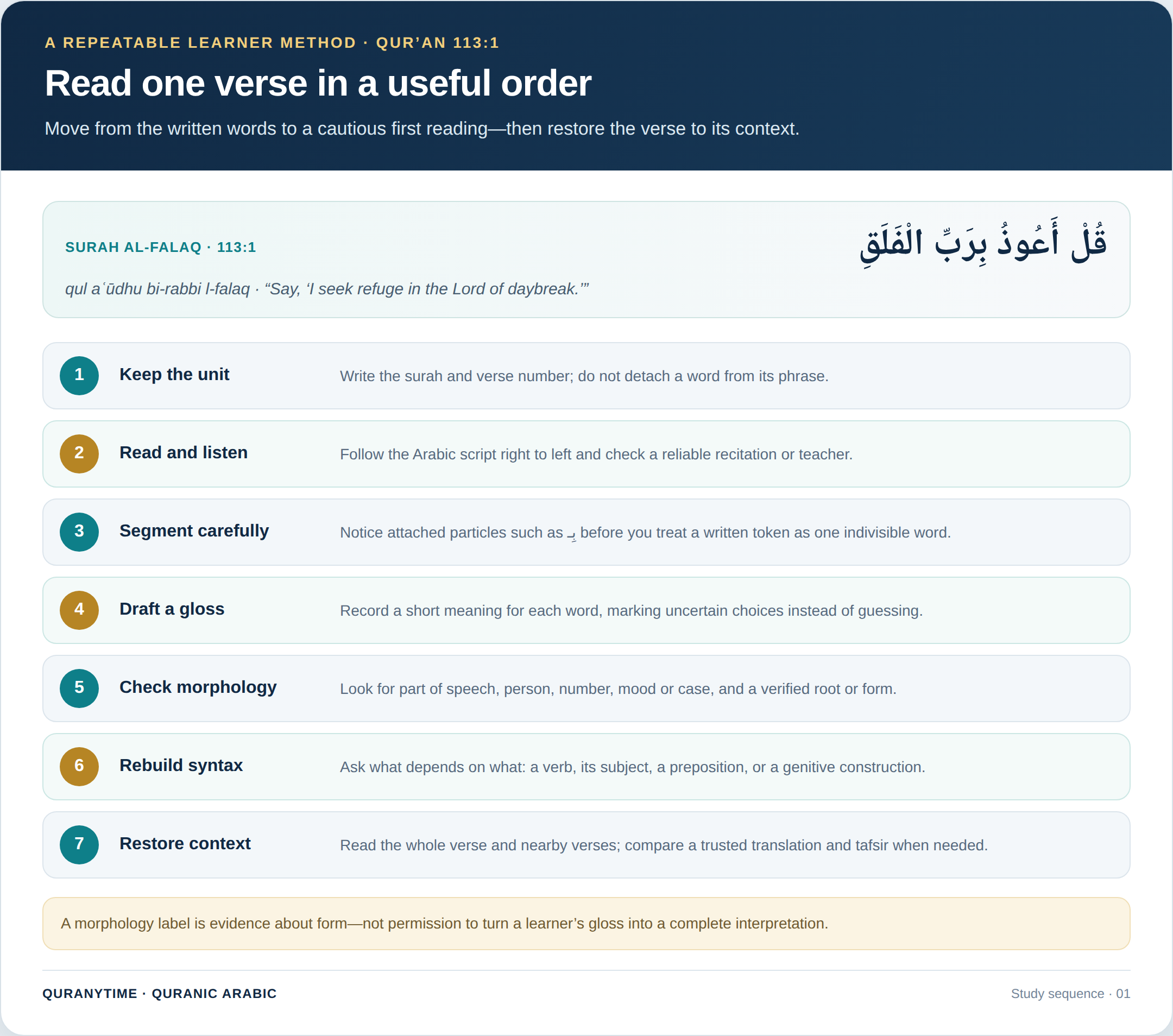
A seven-step method for studying one Quran verse
- Keep the complete unit. Write the surah and verse number beside the Arabic. Begin with a full verse or a clearly bounded phrase, not a single word pulled from a search result. If you need a broader sequence of grammar and reading foundations, use the Quranic Arabic learning roadmap to choose a level-appropriate next step.
- Read the Arabic before the English. Follow the script from right to left and listen to a reliable recitation or teacher if you can. Transliteration is a temporary memory aid; it cannot show every Arabic sound or replace learning the written form. If your goal includes recitation, keep pronunciation questions separate from translation questions.
- Mark attached pieces. Notice prefixes and suffixes before treating each written token as a single indivisible word. A preposition, conjunction, article, or pronoun may be attached to a noun or verb. When you are unsure about a word’s possible root or dictionary entry, use a Quran dictionary carefully: search for the form, inspect likely roots, and return to the verse to check which sense fits.
- Write a modest first-pass gloss. Note a short, provisional meaning for each word. Use a question mark when the form or sense is uncertain. Do not make a polished sentence yet; a fluent translation can hide which Arabic word contributed which idea.
- Check morphology. Ask whether a form is a noun, verb, particle, or pronoun. For verbs, note person and number; for nouns, check relevant case or number labels. Roots and patterns can help you recognize families of words, but a root is not a fixed English meaning. A focused guide to Arabic verb forms in Quranic usage can help when a verb’s pattern is unfamiliar.
- Rebuild the syntax. Look at relationships: what does a preposition govern? Which phrase completes the verb? Are two nouns joined in a genitive or possessive construction? A case ending can be a useful clue, so revisit Arabic case endings in Quranic reading when the sentence structure is unclear.
- Restore context. Read the whole verse aloud or silently, then read its neighboring verses. Compare a trusted translation and, when you want interpretation beyond grammar, consult a reliable tafsir or qualified teacher. A side-by-side translation method for Arabic learners can help you notice where English versions differ without pretending that one gloss is the whole meaning.
Watch a Quranic Arabic analysis of Surah Al-Falaq
This short screen-based lesson walks through the grammar and morphology of Surah Al-Falaq, showing how a word-level analysis can be represented alongside the surah. Use it as a visual example of looking at forms and relationships; keep your own notes in the seven-step order above, and check the Arabic against a trusted text.
Worked example: Quran 113:1
Consider the opening verse of Surah Al-Falaq: قُلْ أَعُوذُ بِرَبِّ الْفَلَقِ (qul aʿūdhu bi-rabbi l-falaq), often translated, “Say, ‘I seek refuge in the Lord of daybreak.’” The Quranic Arabic Corpus entry for 113:1 provides token-level morphology and grammatical labels. It is useful for checking a language note; it is not a complete tafsir or a substitute for reading the surah.
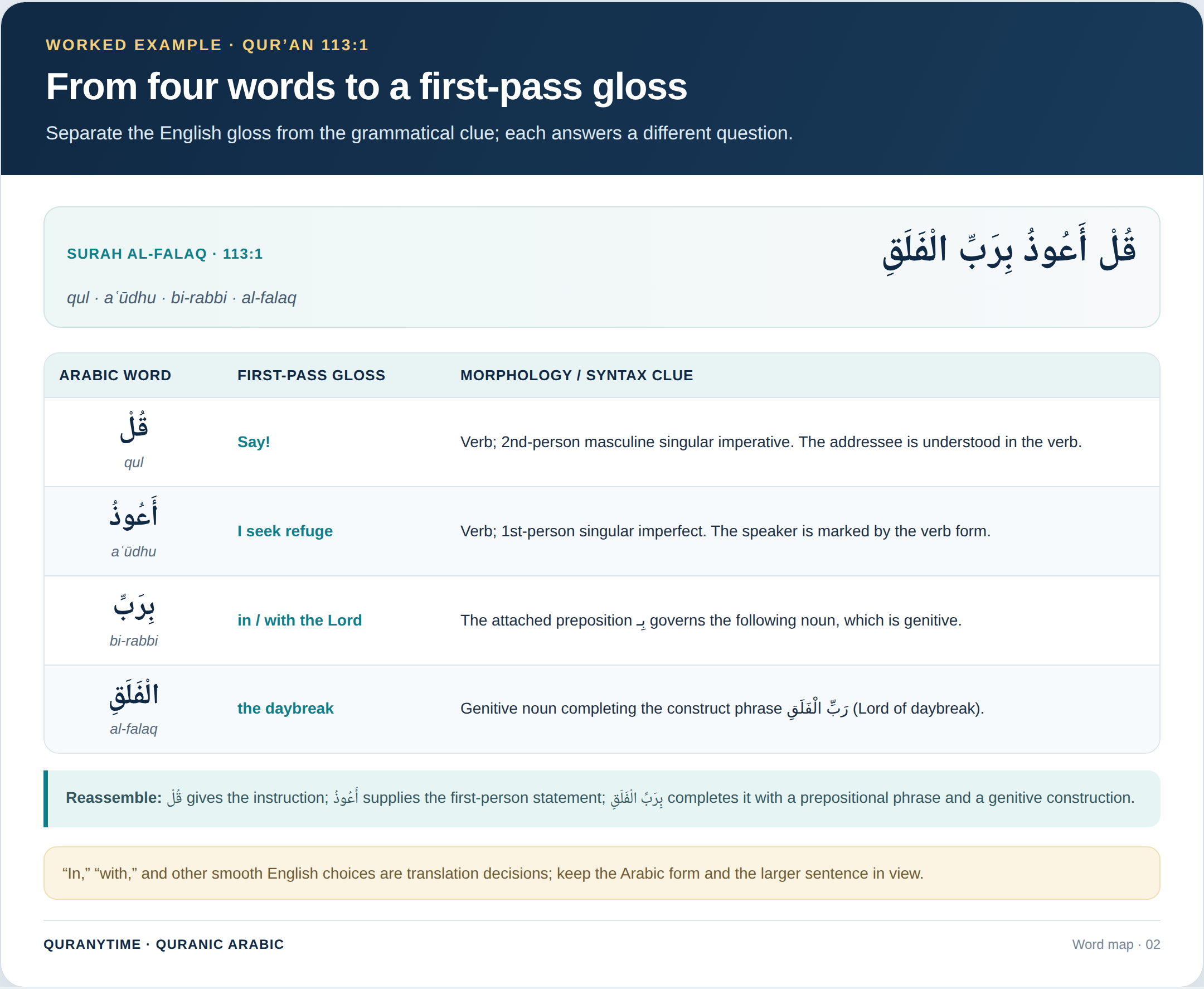
| Arabic token | First-pass gloss | What to notice |
|---|---|---|
| قُلْ qul | Say! | Imperative verb, second-person masculine singular; the addressee is understood. |
| أَعُوذُ aʿūdhu | I seek refuge | First-person singular imperfect verb; its form identifies the speaker. |
| بِرَبِّ bi-rabbi | in / with the Lord | The attached preposition bi- is followed by the genitive noun rabb. |
| الْفَلَقِ al-falaq | the daybreak | A genitive noun completing the construct phrase rabb al-falaq, “Lord of daybreak.” |
The point is not to memorize four English equivalents. Notice how the first verb gives a command, the next verb states “I seek refuge,” and the phrase beginning with bi- completes that statement. The connected phrase rabb al-falaq reads naturally as “Lord of daybreak.” The Quranic Arabic Corpus marks qul as an imperative and aʿūdhu as a first-person imperfect verb; its word-by-word page also labels bi as a preposition and the following nouns as genitive. Those labels help you describe form and structure. They do not, on their own, answer every interpretive question.
Put the gloss back into the surah
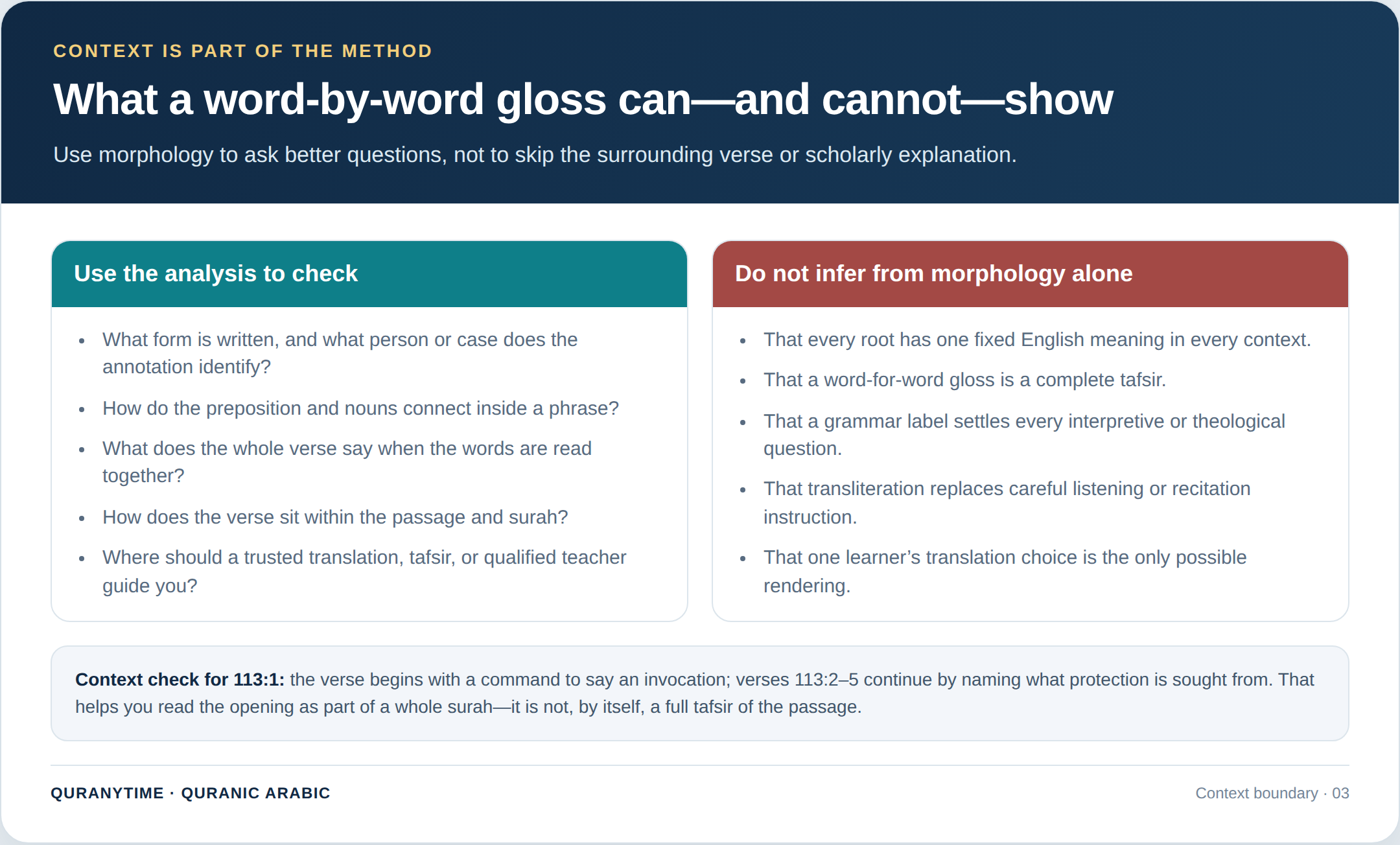
After noting the words, return to the whole verse: “Say, ‘I seek refuge in the Lord of daybreak.’” The opening is an instruction followed by an invocation. The following verses, 113:2–5, continue the refuge theme by naming what protection is sought from. That surrounding sequence helps you read 113:1 as the beginning of a complete surah rather than as a detached grammar exercise. It does not mean a word-by-word worksheet has supplied a full explanation of the passage.
Keep three columns in your notebook: what the form shows, what your provisional gloss says, and what remains for context or tafsir. If two translations choose different English phrasing, do not immediately assume one must be wrong. Compare their wording with the Arabic structure, note what each makes explicit, and consult a trusted explanation for interpretive questions. The aim is to become more observant, not to replace qualified scholarship with a quick root search.
A simple verse-study notebook routine
For a short practice session, use one verse and leave room for uncertainty. First write the reference and copy the Arabic accurately. Next, divide the phrase into tokens and mark any attached prefix or ending. Add one provisional gloss per token, then write one sentence about the morphology or syntax you checked. Finally, read the neighboring verses and record one context note. If you cannot verify a claim, label it “check with a source” rather than turning a guess into a rule.
A useful note might look like this: “113:1 — bi- is attached to rabb; the noun is genitive; rabb al-falaq forms ‘Lord of daybreak’; read verses 2–5 before making a broader claim.” This makes your learning repeatable and keeps language facts separate from interpretation. If journaling helps you remember what to revisit, try a Quran reflection journal for beginners and reserve a line for open questions.
Common mistakes to avoid
- Assigning one permanent English word to a root. Roots connect forms; context still shapes a word’s sense.
- Ignoring attached particles. A written token can contain more than one grammatical part.
- Stopping after the table. A list of glosses is not yet a sentence or a reading of the whole passage.
- Calling morphology tafsir. Grammar can clarify form and relations, while interpretation may require context and trusted scholarship.
- Using transliteration as the only source. It cannot fully represent Arabic spelling, vowels, or recitation.
- Overstating a first draft. Mark uncertainty and ask a teacher when a language or recitation point is beyond your level.
Keep the words, grammar, and context together
To study Quran word by word well, move in both directions: zoom in to notice a form, then zoom back out to hear how the whole verse reads. In Quran 113:1, a few morphological labels help explain the command, first-person verb, preposition, and genitive phrase. Reading the surrounding verses keeps those labels in their proper role. Repeat the process with a short passage, check a reliable linguistic source, and let a qualified teacher or tafsir guide questions that a word list cannot settle.
If you would like feedback on your reading level and a suitable next step, you can book a free Quran and Arabic assessment and trial class with Quranytime.