
If Hifz burnout has begun to feel like persistent depletion—not simply a busy day—do not answer that feeling by doubling your effort. Look for a pattern: growing exhaustion around study, dread or emotional distance from the work, and a sense that your effort is no longer helping. These signs do not diagnose a condition, but they are a reason to pause, review the workload, protect recovery, and discuss a temporary adjustment with your teacher.
“Hifz burnout” is used here as an everyday description of feeling overloaded by memorization; it is not a medical label or a formal Quran-learning category. The aim is not to abandon a meaningful goal or excuse every difficult session. It is to distinguish a plan that needs repair from a momentary dip in motivation—and respond with care rather than shame.
Signs of Hifz burnout and overload
One tiring lesson, a missed day, or a difficult passage does not by itself mean burnout. Pay attention instead to a change that keeps returning, especially when the work that used to feel manageable now seems to take more from you than you can restore. You might notice several of these experiences together:
- Persistent depletion around study: You feel worn down before or after Hifz sessions, and ordinary rest does not seem to make the next session feel manageable.
- Growing avoidance or emotional distance: You repeatedly dread opening your lesson, feel numb about a goal you care about, or find yourself wanting to escape the task rather than work through a particular difficulty.
- Effort without a sense of progress: Sessions are getting longer or more pressured, yet you feel less able to focus, recall, or use feedback constructively.
- A workload that crowds out essentials: New memorization keeps expanding while revision, sleep, responsibilities, or other needed parts of life are squeezed out.
- Self-blame replacing useful feedback: A missed assignment turns into “I am hopeless” rather than a practical question about what made the plan too heavy.
These are prompts for reflection, not a checklist that proves a person is burned out. Fatigue and discouragement can have many causes, including a temporary schedule crunch, health concerns, stress elsewhere, or a specific learning barrier. Avoid diagnosing yourself or another learner from a short list.
The World Health Organization uses “burn-out” for a phenomenon associated specifically with chronic workplace stress and says it should not be applied to experiences in other areas of life. That distinction matters: applying the term to Hifz is informal, not the WHO definition. Read the WHO explanation of burn-out’s occupational scope.
Burnout, a hard week, or a return after a break?
Before changing your plan, name what is happening as specifically as you can. Different situations call for different responses, and not every interruption requires a full reset.
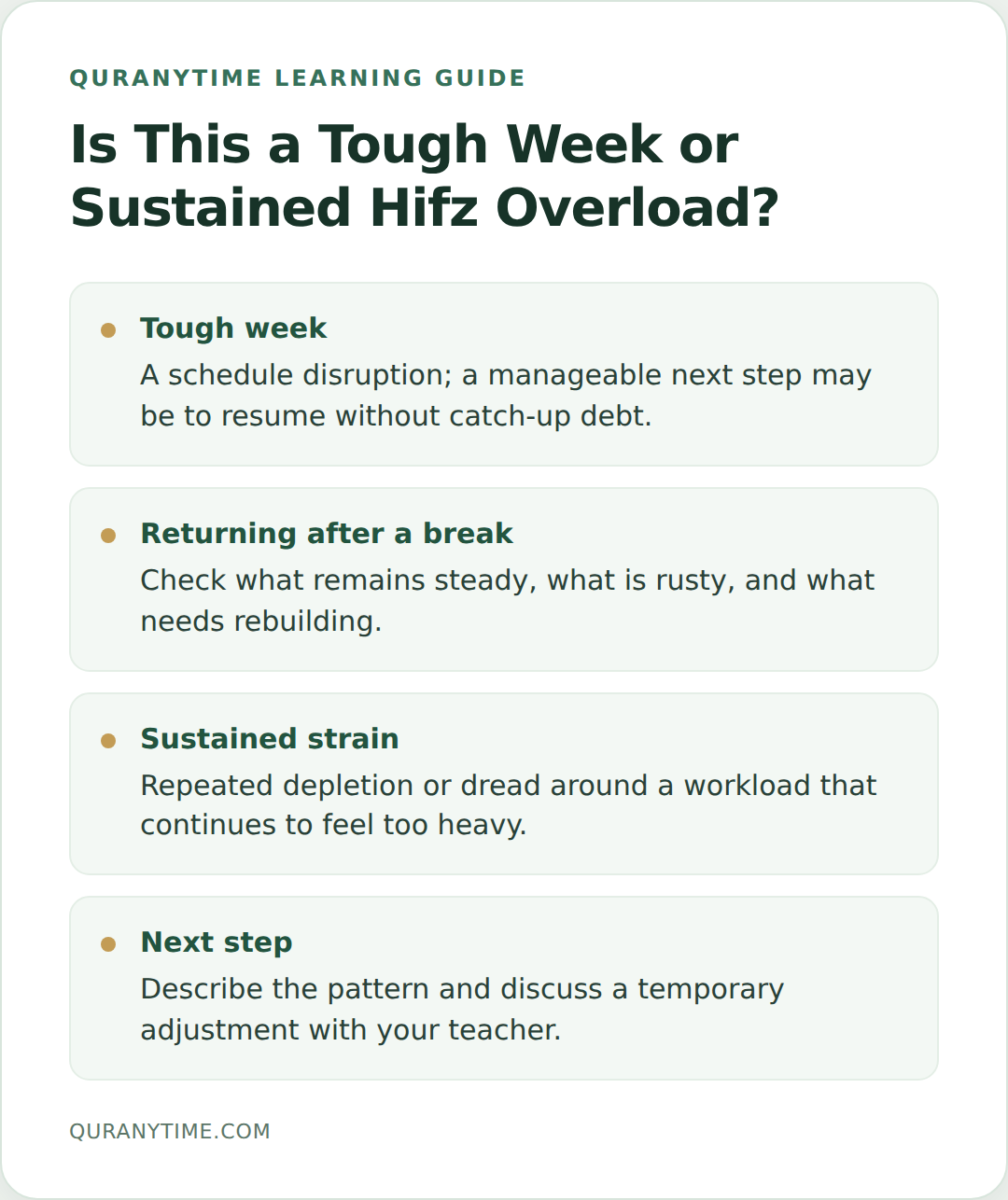
A hard week or ordinary inconsistency
If work, school, family, travel, or a schedule change interrupted your sessions, and you still feel broadly able to return, the main issue may be logistics. Make the next task clear and resume without trying to repay every missed session. Quranytime’s guide to staying consistent with Quran memorization focuses on obstacles, missed sessions, and restarting without catch-up debt; it is useful when the difficulty is a disrupted routine rather than sustained strain.
Returning after a longer break
If you stopped studying for weeks or longer and are now unsure what you remember, the first need may be a baseline: what remains steady, what is rusty, and what needs rebuilding. That is different from being actively overwhelmed by a current workload. The separate return-after-a-break guide addresses checking your present reading and memorization after an absence.
A workload that has stayed too heavy
If the plan itself has felt unmanageable over time—even when you make room for it—the response is not merely to create a stronger streak or restart at the same pace. Look at how much new work is assigned, how revision is going, how demanding the sessions feel, and whether the plan leaves room for ordinary life. A teacher can help identify whether the burden comes from the amount, pace, method, expectations, or a separate challenge.
Use a compassionate workload check
Try a brief review before making a permanent decision. Write down what the current plan asks of you, what is actually happening, and where the strain appears. Keep it factual and kind; this is information for a better plan, not evidence against yourself.
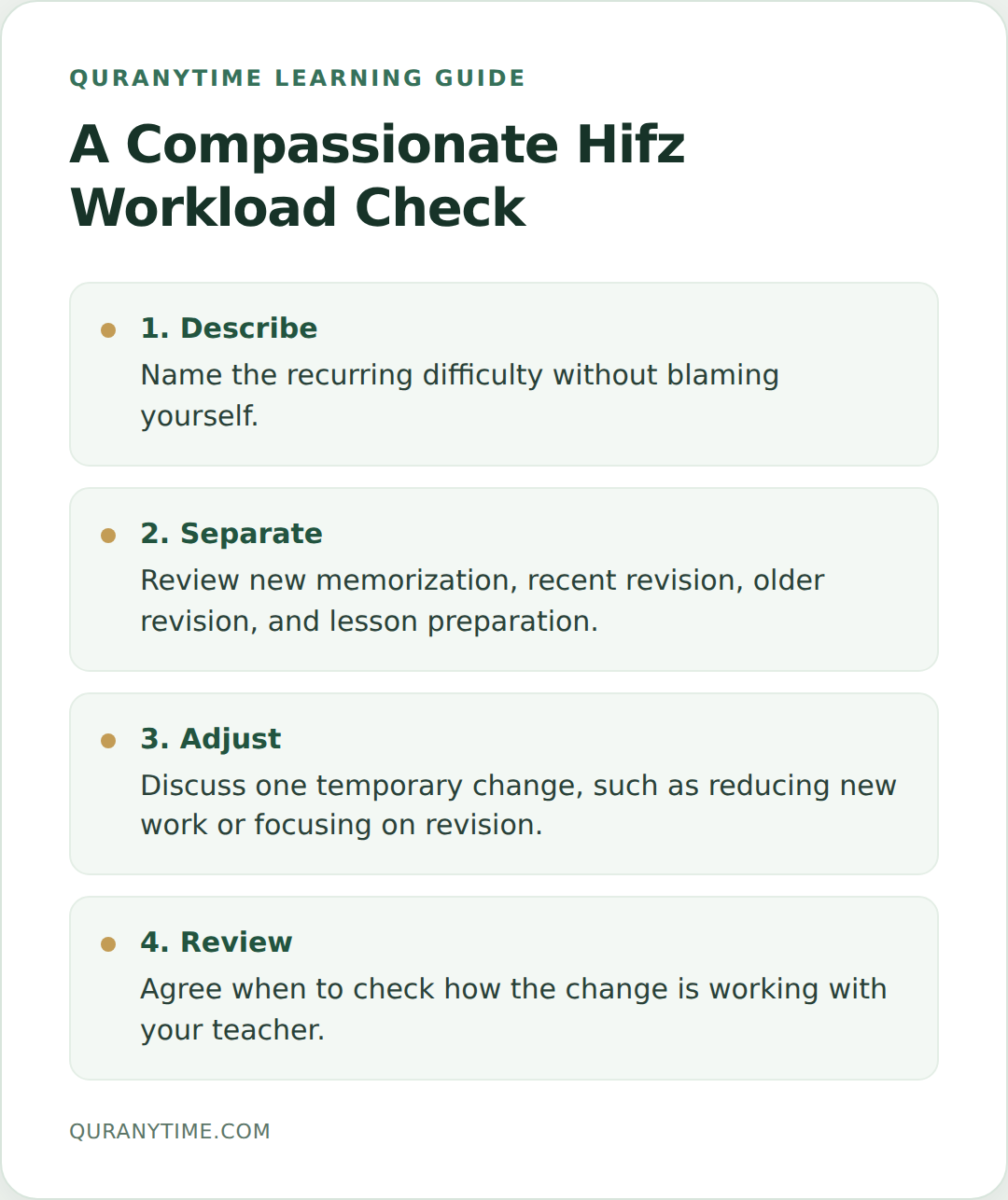
- Describe the pattern. For example: “For the past few weeks, I have put off the new lesson and feel tense when I start; revision is also being rushed.” Avoid labels such as lazy or weak.
- Separate the parts of Hifz. Note new memorization, recent revision, older revision, lesson preparation, and any corrections. Which part feels heaviest? Which part is being dropped first?
- Check the conditions. Consider available time, sleep, competing responsibilities, lesson frequency, and whether the assignment is clear. Do not assume the problem is a lack of willpower.
- Choose one temporary adjustment to discuss. Options might include reducing new material, pausing an increase, shortening sessions, focusing on revision for a defined period, or asking for a lighter assignment. A qualified teacher who knows your learning can help decide what is suitable.
- Agree when to review the change. A temporary adjustment should have a check-in point, not a pressure-filled deadline. At that point, discuss what feels more manageable and what the recitation checks show.
This process is not a prescribed treatment or religious ruling. It is a practical way to make the conversation concrete. For help seeing how new, recent, and older memorization fit together, use the Hifz revision schedule guide as a planning reference, not a quota you must meet.
What a lighter Hifz plan might mean
“Reduce the workload” does not have to mean “stop learning altogether,” and it does not mean every learner should follow the same minimum routine. Your teacher may suggest a short period centered on a small secure passage, selected revision, or careful listening and correction. Another learner may need a complete pause from new memorization while other needs are addressed. The choice depends on the person and should not be imposed as a universal rule.
For example, imagine a learner who has been adding new lines while older passages become uncertain and each lesson feels more pressured. Instead of adding extra evening sessions to catch up, the learner could tell the teacher that revision is slipping and ask whether to hold new work briefly while they review a smaller agreed portion. A week later, they can report which practice felt manageable and where they still need help. This is an illustration, not a claim that one week or one particular amount is right for everyone.
A lighter plan should be genuinely lighter, not a hidden test of whether you can still meet the original demand. Avoid setting an ambitious “minimum” that leaves you feeling guilty if you cannot do it. If an agreed adjustment still feels too difficult, say so and revisit it. The purpose is to find a workable learning arrangement—not to win approval by concealing strain.
If you need to discuss the size of a new portion, the daily memorization amount guide explains why a suitable amount varies and why revision matters. Treat it as a set of questions to take to your teacher, not as a target to compare yourself against.
How to talk to your Hifz teacher
You do not need a perfect explanation or a clinical term. Give your teacher a few concrete details: what the current assignment is, what you manage to complete, what has become difficult, and what you would like help deciding. You could say:
“I want to continue learning, but lately the new portion and revision together feel too heavy. I am rushing review and dreading the next session. Could we look at the workload and agree on a temporary adjustment, then check how it is going?”
If you are unsure what to ask, describe the exact task and the point where it becomes difficult. Quranytime’s guide to asking your Quran teacher focused questions offers a simple way to explain what you tried and ask for one clear next step. A teacher can advise on learning structure and recitation; they are not automatically a mental-health professional.
Keep a brief note after the conversation: the change you agreed on, when to review it, and any question you still have. Do not turn the note into a daily scorecard. If it helps, record whether you completed the agreed work and what needs attention—not whether you were “good” or “bad.”
Care for your wellbeing as well as your study
Hifz is only one part of a person’s life. If distress is persistent, affects sleep or everyday functioning, spreads beyond study, or feels too difficult to manage alone, consider speaking with a qualified health professional or trusted support person. If you feel unsafe or at risk of harming yourself, seek urgent help through local emergency or crisis services. This is not a diagnosis; it is a reminder that learning-plan adjustments cannot replace care for a broader wellbeing concern.
It may also help to tell someone you trust what has been difficult, especially if you are a young learner or rely on family to arrange lessons. Ask for support without making your worth depend on how much you memorize. If you would like a teacher to assess your current Quran or Arabic learning needs, Quranytime offers a free Quran and Arabic trial class; you can use it to discuss a suitable learning next step, not as a promise of a particular pace.
Frequently asked questions
Is Hifz burnout a medical diagnosis?
No. In this article the phrase is informal shorthand for feeling persistently overloaded by memorization. WHO defines burn-out in relation to chronic workplace stress and specifically cautions against applying that definition to other areas of life. Persistent or serious distress is best discussed with an appropriately qualified health professional.
Should I stop memorizing completely?
There is no one answer for everyone. Some learners may benefit from reducing new work while keeping a manageable teacher-guided review; others may need a pause or a different form of support. Discuss your circumstances with your teacher, and seek health support if distress is broader or affecting daily life.
How can I tell whether I need rest or simply better consistency?
Ask whether the main difficulty is a disrupted schedule or a sustained sense of depletion and dread tied to a workload that remains too heavy. A missed session after a busy day may call for a simple restart. Repeated strain despite trying to make time may call for a workload conversation. Neither answer is a judgment of your commitment.
Will taking a lighter workload mean I have failed?
No. An adjustment is information about what fits your current circumstances; it is not a verdict on your ability or sincerity. The learning goal is careful, supported study, and a teacher can help decide how to balance new work and revision at this stage.
What if my teacher says to keep going, but I still feel overwhelmed?
Explain what remains difficult and give concrete examples of what you can and cannot manage. Ask for a follow-up conversation or, if appropriate, another qualified teacher’s perspective on the learning plan. If the distress affects life beyond lessons, contact a qualified health professional or trusted support person as well.
A kinder next step
If Hifz feels persistently heavy, do not make a larger workload your first response. Notice the pattern, identify which part of the plan is straining you, and ask your teacher to agree on one realistic adjustment and a time to review it. If your difficulty is only a missed session or a return after a general break, use the more specific restart guidance instead. You can take your learning seriously while treating yourself with patience—and you do not have to solve a wider wellbeing concern through memorization alone.