
Between lessons, a useful question can turn a vague worry into a clear next step. The goal is not to send your teacher every passing thought or to prove that you have studied perfectly. It is to give enough context for a focused answer, then leave knowing what to do next. When you ask your Quran teacher a precise question, you make limited lesson time more productive and make independent practice less frustrating.
What makes a question useful between lessons?
A teacher can answer more reliably when the question identifies the exact learning point. Start with location: name the surah and ayah, quote or identify the word if appropriate, or give the workbook page, exercise number, and edition. “Page 18” may mean different things in different books, so include the title or edition when that matters. If you are referring to a shared lesson document, use its heading as well.
Next, describe the uncertainty in ordinary language. You might say, “I am not sure whether the sound is coming from the back of my throat,” or “I lose my place when I stop here.” That is enough. You do not have to diagnose your own mistake as a particular tajweed category. A plain description often tells the teacher more than a guessed label.
Then say what you tried, briefly. Mention whether you practised slowly, listened to the assigned example, marked the line, or attempted the homework once. You are not required to produce an elaborate practice history.
Finally, make one concrete ask. Request a demonstration, a contrast with a nearby example, confirmation of a stopping choice, or a recommended next step. One focused request is easier to answer than a paragraph containing several unrelated decisions. For practice context, see these suggestions for practising tajweed at home between lessons, but bring the part that remains unclear back to your qualified teacher.
A four-part question template
Use this simple structure in a message or at the start of a lesson:
- Locate it: “In Surah [name], ayah [number], at [word or phrase]…” For a workbook, include the page, exercise, and edition.
- Describe it: “I am unsure whether…” or “When I reach this point, I notice…” Use your own words, even if they are non-technical.
- Explain your attempt: “I tried reading it slowly and comparing it with the assigned example, but…” Keep this to the relevant attempt.
- Ask one thing: “Could you demonstrate it once and tell me what to practise next?” Choose the response you need.
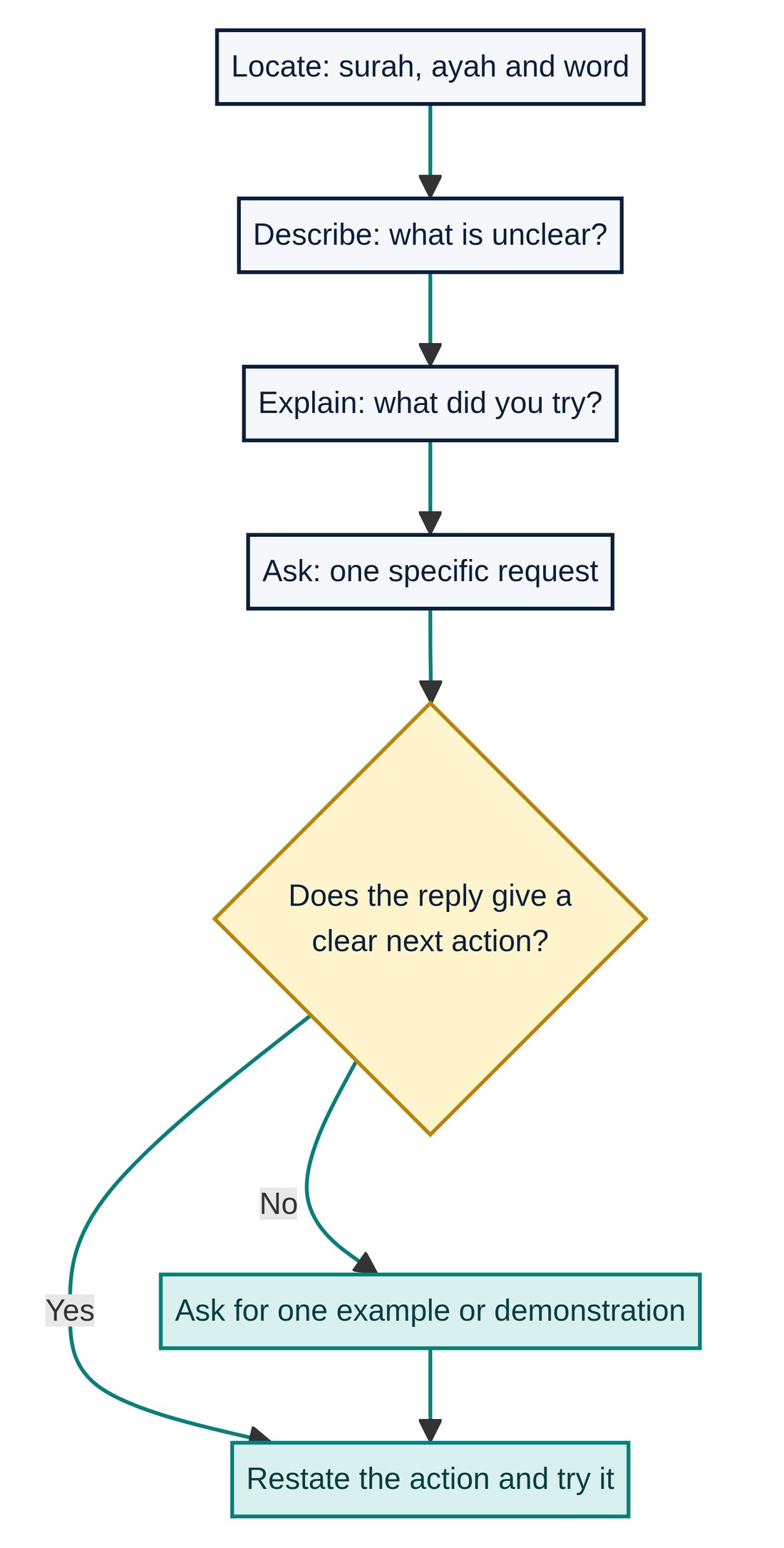
Match the question to the help you need
Meaning and tafsir questions deserve particular care. Ask your teacher for explanation within their qualification and teaching scope; do not treat an automated response, a search result, or a confident-sounding app as a religious ruling. A teacher may need to distinguish language meaning, an established explanation, and a matter requiring a specialist scholar. This is about getting the right kind of guidance, not shutting down curiosity.
| Broad question | Specific version | Response needed |
|---|---|---|
| How do I read this? | In Surah [name], ayah [number], I slow down at the marked word and am unsure about the sound. Could you model it once, then tell me what to repeat? | A demonstration and one practice instruction |
| Where can I stop? | At the end of this line in the assigned exercise, should I pause there for this reading task, or continue to the next marked point? | Location-specific guidance and the reason for the exercise |
| What should I do for homework? | I completed two slow readings but still lose accuracy on the final line. Should tomorrow’s practice focus on that line or the whole passage? | A priority and a manageable next step |
| What does this mean? | For this ayah, could you explain the basic meaning in our lesson context and tell me whether my follow-up needs a qualified tafsir source? | Context, scope, and an appropriate source or referral |
Before-and-after examples
Pronunciation: “This letter is hard.” becomes “In the word on workbook page 12, I can hear my sound becoming too close to another sound. I tried slowing down, but the difference is still unclear. Could you demonstrate the contrast and give me one short drill?”
Stopping: “Can I stop here?” becomes “In the assigned passage, I am unsure where to pause comfortably and how to restart in context. Could you show me a suitable stopping and restarting point for our exercise?” This asks about the specific learning situation without inventing a general rule. For background, review Quran waqf signs and stopping marks.
Homework: “I do not understand the homework.” becomes “I read the assigned section twice, but I am unsure whether the goal is memorisation or accurate recitation. Which should I prioritise before our next lesson, and how much should I prepare?”
Meaning: “Explain this verse.” becomes “I would like help understanding the main meaning of this ayah in our lesson. Which explanation or qualified source should I use for further study?” That keeps the request within the teacher’s scope and avoids asking an automated tool to make a religious ruling.
How to ask your Quran teacher with confidence
Respect does not require an apologetic preface. Replace “Sorry to bother you, this is probably silly” with “I have one focused question about yesterday’s assignment.” A calm, specific question signals that you value the teacher’s time and your own learning. Asking for clarification is not challenging authority. If two explanations appear to conflict, you can respectfully ask, “Could you help me understand the basis or context for the difference?” That invites explanation without assuming that all teachers, readings, or situations are identical.
Also ask which channel is appropriate and what response to expect. Your teacher may prefer questions in the class platform, a scheduled message window, or a parent-managed channel. Do not assume a personal message requires an immediate reply or twenty-four-hour availability. For children, use the private channel agreed with the parent or guardian and teacher. For online lesson logistics, this overview of what to expect in online Quran classes can help you separate a teaching question from a platform question.
A worked example from a fictional learner
Imagine Lina is preparing a workbook exercise. She knows the page and exercise number, but not the technical name of her difficulty. Instead of writing, “I keep getting this wrong—what am I doing?”, she sends: “In the exercise on page 27, the word in the second line sounds rushed when I read it. I tried slowing the whole line and listening to the assigned model, but I still cannot tell whether my sound or timing is the issue. Could you send a short model or show me at the next lesson, and tell me whether to practise that word alone or in the line?”
For a persistent pronunciation difficulty, this overview of pronunciation challenges for English speakers may help you describe what you hear. Keep a brief record of the exact location and the teacher’s next instruction. That is different from turning every practice session into error paperwork; it simply prevents the same uncertainty from being recreated. You can use a recitation mistake log for recurring locations when it helps, while keeping the question itself focused.
When a live lesson is the better question channel
Messages work well for locating an assignment, confirming a goal, or asking for a short reminder. A live lesson is often better when the answer depends on hearing your exact recitation, comparing several attempts, or coordinating breath, sound, and stopping. If a written reply leaves you unsure what to do, ask for a demonstration at the next lesson rather than multiplying messages. You can also review guidance on sharing recitation for teacher feedback if that is a channel your teacher already uses and has approved.
Frequently asked questions
Should I use technical terms? No. Use a technical term only if you are confident it fits. A plain description, exact location, and honest attempt are enough for the teacher to guide you.
How many questions should I send? Group closely related details into one focused question. If you have several unrelated issues, label them or choose the most urgent one first. Do not turn one unanswered message into a chain of repeated follow-ups.
What if the answer seems different from something I heard? Ask for the basis, context, or source respectfully. Clarification is a normal part of learning; it is not a demand that every teacher give the same explanation in every context.
What should I do after the reply? Repeat the action in your own words, try it, and return with a specific result if it did not work. For general study communication, these office-hours question practices offer useful guidance on preparing a purpose, asking for a walkthrough, repeating the advice, and following through; they are general study-communication guidance, not religious authority.
What is the main takeaway? Locate the passage, describe the uncertainty plainly, say what you tried, and ask for one concrete next step. Then restate the answer and practise it. That small discipline helps your teacher respond to the real difficulty and helps you return to the next lesson with progress rather than a longer list of worries.