
When you meet an unfamiliar Arabic verb in the Qur’an, its letters can seem to hide more than they reveal. A reader may recognise a root but still wonder why extra letters appear, whether the word is a command or a statement, and how much its shape tells us about meaning. The standard triliteral Forms I–X give you a practical first map. They do not replace a lexicon or grammar, but they help you notice how a root has been built into a larger pattern.
This guide focuses on recognition rather than memorising ten guaranteed translations. You will see the templates, learn what each pattern may suggest, and practise a repeatable way to test your reading in context. For a foundation in the relationship between roots and patterns, see this introduction to Quranic Arabic roots and patterns.
Root, template, and wazn
Most Arabic verbs are discussed through a root, often three consonants, and a template, called a wazn. Teachers traditionally use ف ع ل (f–ʿ–l) as empty slots: the root consonants enter those slots while vowels, prefixes, suffixes, and sometimes doubled consonants create a recognisable shape. A root carries a broad field of related ideas; the template can add a grammatical or semantic clue.
The ten forms below are the standard triliteral teaching set. They are not the entire Arabic verbal system, and a form is not a dictionary definition. Form I is especially varied: its past and present patterns are not represented by one single vowel recipe, and its meanings must be learned with the individual verb. Weak, doubled, and assimilated roots can also change what you see on the page. A surface that looks surprising may still belong to a familiar form.
The Forms I–X at a glance
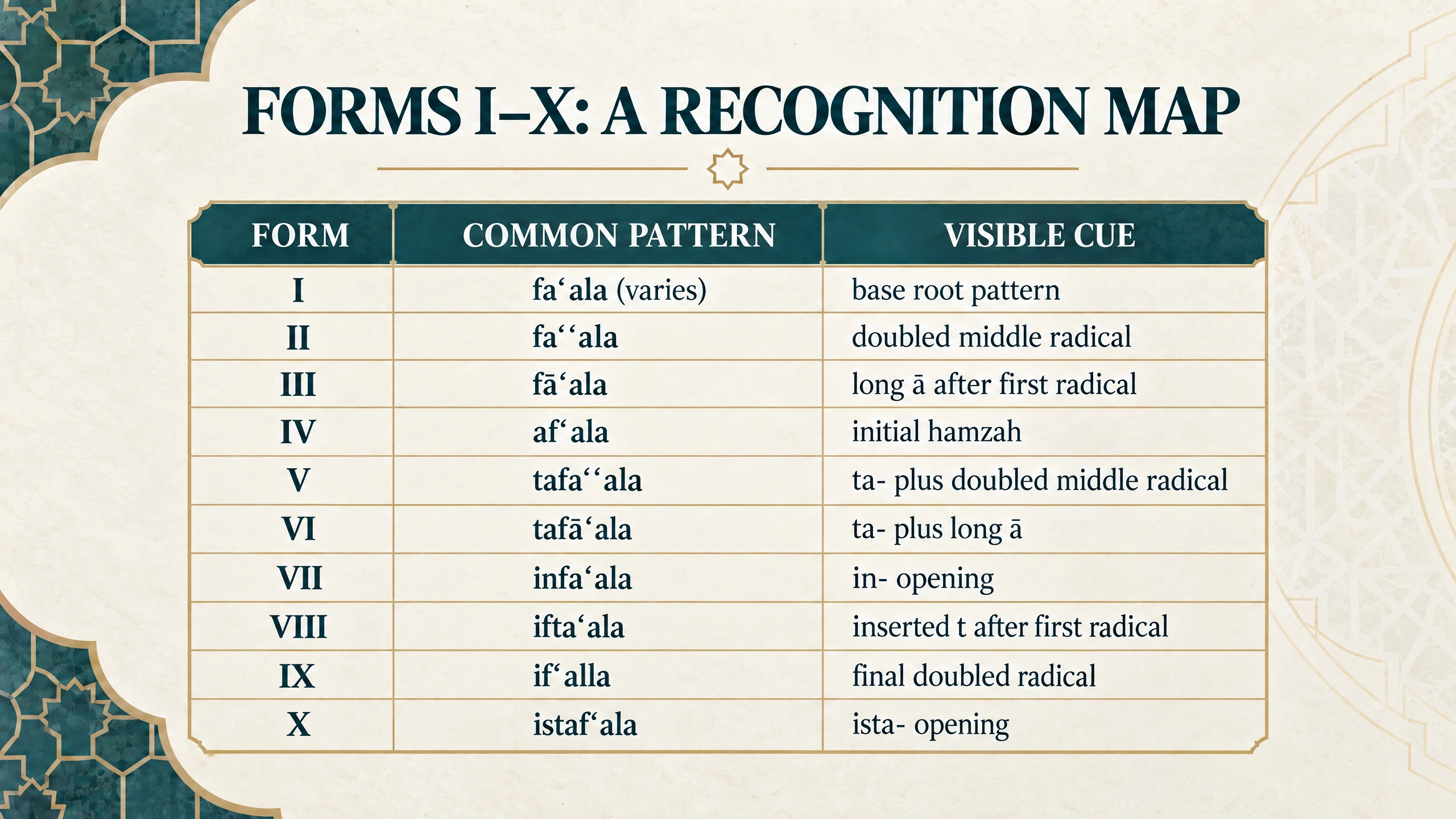
Use this table as a recognition map, not as a translation machine. The “tendency” column describes a common association, while the cue points to features that may help you identify the pattern.
| Form | Common template | Recognition cue | Cautious semantic tendency |
|---|---|---|---|
| I | فَعَلَ / فَعِلَ / فَعُلَ | Basic root shape; patterns vary | Basic action or state; highly variable |
| II | فَعَّلَ | Middle root consonant is doubled | Intensifying, causing, or teaching |
| III | فَاعَلَ | Long ā after the first consonant | Reciprocal or interaction-related action |
| IV | أَفْعَلَ | Initial hamzah-bearing prefix | Causing or bringing into a state |
| V | تَفَعَّلَ | ta- prefix plus doubled middle consonant | Reflexive or becoming/doing for oneself |
| VI | تَفَاعَلَ | ta- prefix plus long ā | Reciprocal or shared action |
| VII | اِنْفَعَلَ | in- opening sequence | Being affected or turning into a result |
| VIII | اِفْتَعَلَ | infix -t- after the first radical | Taking on an action or acting deliberately |
| IX | اِفْعَلَّ | Final doubled consonant | Colours or physical states; rare |
| X | اِسْتَفْعَلَ | ista- opening sequence | Seeking, requesting, or considering |
These templates are classroom shapes. In an actual Qur’anic word, prefixes, suffixes, vowel changes, hamzah spelling, and weak radicals can make the pattern less obvious. The Quranic Arabic Corpus’s overview of verb forms is a useful reference for the standard labels and their examples, but even a label should be checked against the whole verse.
A useful habit is to ask what a visible change contributes, then stop before assigning a translation. Form II’s doubled middle consonant is a strong recognition clue; a dictionary or corpus still confirms the established meaning. Form IV’s initial hamzah can mark a causative relationship in some verbs, while other verbs develop a conventional meaning that is not predictable from the template alone. In Form VIII, the inserted t may blend with a neighboring consonant. If a word does not fit the classroom outline neatly, mark the pattern as uncertain and check a word-level analysis instead of forcing it into a form.
Verified Qur’anic examples
Here are carefully checked examples, with plain-text verse references. Notice that the form label does not by itself tell you the tense, person, or final English wording.
- Form I: كَتَبَ / kataba (Q 2:187:28; Corpus rendering “has ordained”). This is a reminder that Form I varies and can express meanings that must be learned lexically.
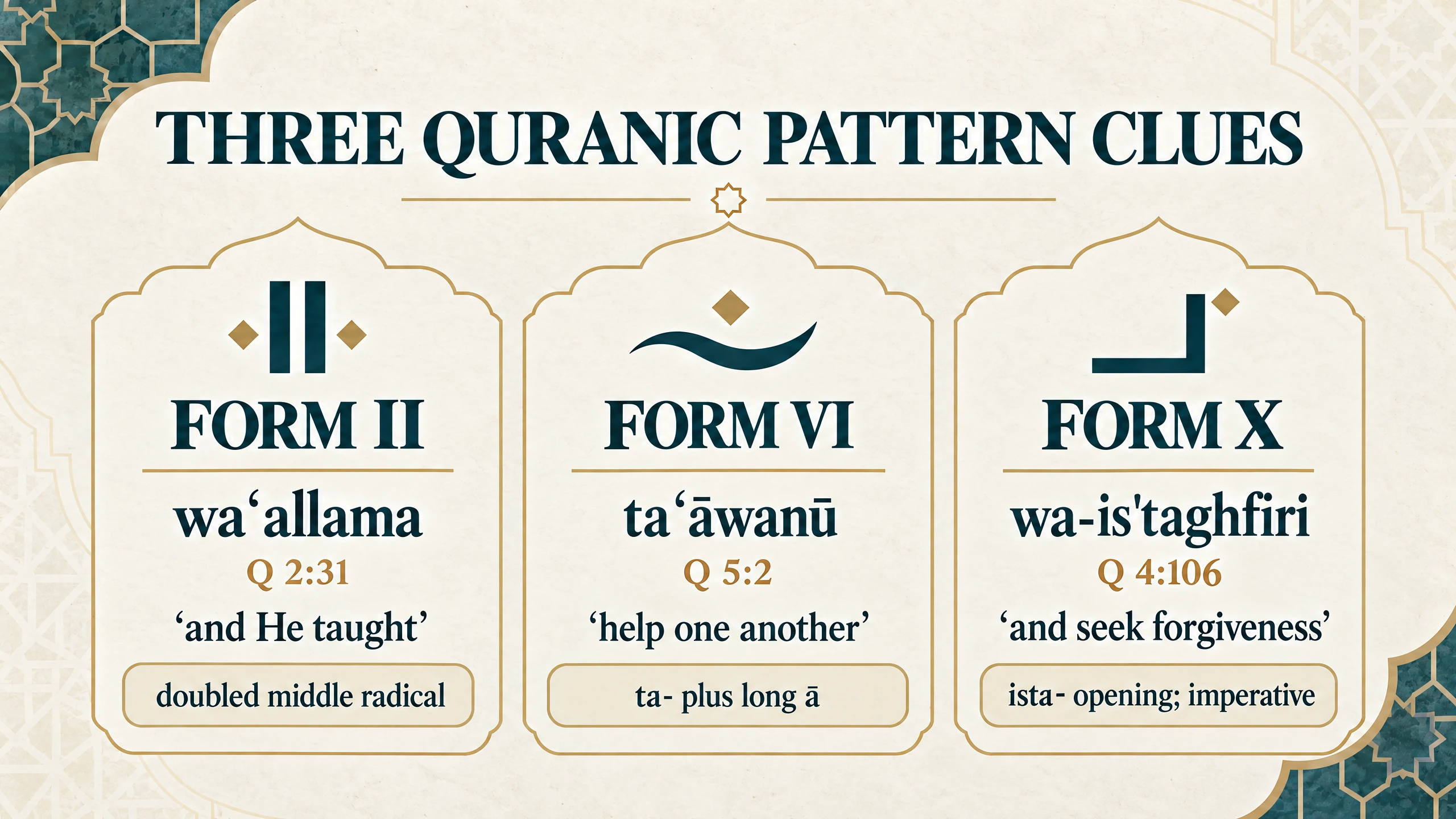
- Form II: وَعَلَّمَ / waʿallama (Q 2:31:1; “and He taught”). The doubled middle radical is a strong visual cue.
- Form III: قَاتِلُوا / qātilū (Q 3:167:7; “fight”). Here the word is an imperative addressed to a plural group.
- Form IV: فَأَخْرَجَ / fa-akhraja (Q 2:22:12; “then brought forth”). The fa- is a conjunction; the verb’s derived pattern is Form IV.
- Form V: يَذَّكَّرُ / yadhakkaru (Q 2:269:13; “remembers”). The surface has assimilation, so the neat classroom template is not fully transparent.
- Form VI: تَعَاوَنُوا / taʿāwanū (Q 5:2:38; “help one another”). Its plural ending and imperative use are separate from its Form VI identity.
- Form VII: فَانْقَلَبُوا / fa-inqalabū (Q 3:174:1; “so they returned”). The fa- again connects the word to what came before.
- Form VIII: اقْتَرَبَتِ / iqtarabati (Q 54:1:1, with الساعة; “has come near”). The feminine ending belongs to agreement and conjugation, not to a new derived form.
- Form IX: تَسْوَدُّ / taswaddu (Q 3:106:4; “would become black”). Form IX is rare and is associated with colours or states; the final doubling is its useful clue.
- Form X: وَاسْتَغْفِرِ / wa-is’taghfiri (Q 4:106:1; “and seek forgiveness”). The opening ista- often suggests seeking or requesting, but context completes the meaning.
Two close readings: Form II and Form X
Start with وَعَلَّمَ / waʿallama. Remove the small connector wa-, then inspect the remaining verb. The middle consonant is doubled: that is the visible Form II signal. Its translation in Q 2:31:1 is “and He taught.” Form II can often suggest making something happen, intensifying an action, or causing another person to acquire a result. Here, however, you should not turn “Form II” into the automatic gloss “cause to learn.” Confirm the root, the lexical entry, the subject, and the surrounding grammar.
Now consider وَاسْتَغْفِرِ / wa-is’taghfiri. Set aside wa- as the conjunction and notice ista- at the beginning. That points to Form X and commonly carries a seeking or requesting association. The ending shows an imperative addressed to a particular listener; it is not part of the Form X template itself. In Q 4:106:1, the natural rendering is “and seek forgiveness.” A pattern clue becomes trustworthy only after conjugation, syntax, lexicon, and context agree.
Form is not tense, voice, or person
Derived form answers one question: how has the root been built? It does not answer all the other questions a reader needs. Aspect distinguishes perfect, imperfect, and imperative uses; mood can affect an imperfect verb; voice distinguishes active and passive; and conjugation marks person, number, and gender. A Form III verb may therefore be a past, imperfect, or imperative form, depending on its endings and setting.
For that reason, do not call every word with a prefix “present tense,” and do not assume every initial vowel belongs to a derived template. A conjunction such as wa- travels with a verb but does not change its form. A subject agreement ending may identify a feminine singular or plural verb without changing the root template. For more practice separating these layers, use this guide to Arabic verb conjugation for Quranic reading and this explanation of passive voice in Quranic Arabic.
A repeatable Quran-reading checklist
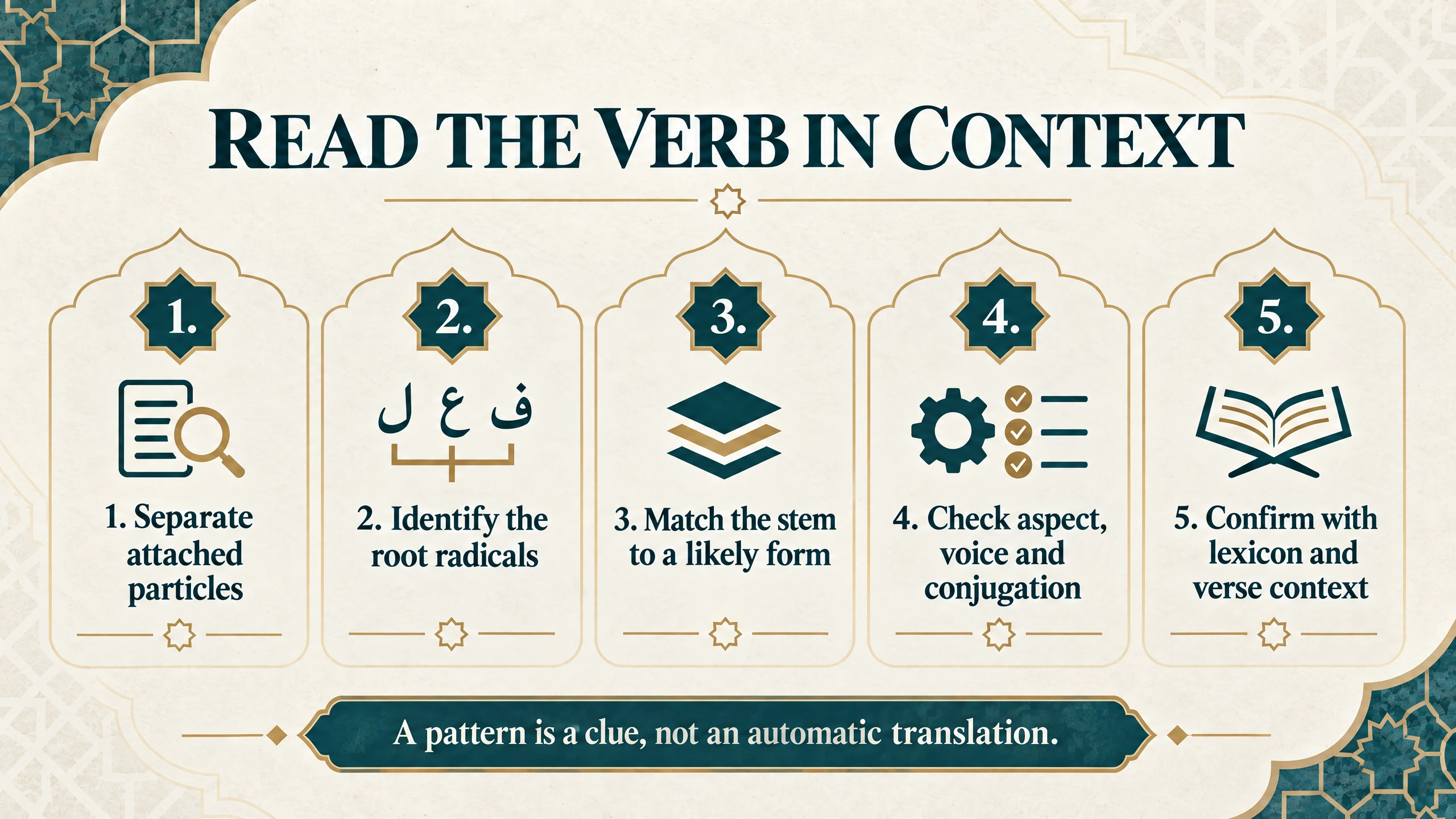
- Mark the word. Copy the Arabic carefully, including shaddah, hamzah, and endings. Do not analyse a blurred or incomplete form.
- Separate attachments. Check for conjunctions, prepositions, pronouns, and other small pieces before identifying the verb stem.
- Find the root. Test the likely radicals, remembering that weak, doubled, or assimilated roots may hide or reshape a consonant.
- Suggest the derived form. Compare the stem with Forms I–X. Treat the result as a hypothesis, especially when vowels have changed.
- Identify aspect and conjugation. Ask whether the verb is perfect, imperfect, or imperative, then check mood, voice, person, number, and gender. A guide to Arabic imperative verbs in Quranic reading is helpful when a command is possible.
- Check grammar. Look at the subject, objects, particles, agreement, and case relationships. Case endings can influence how a sentence is understood, so review this guide to Arabic case endings in Quranic reading.
- Confirm with a lexicon and context. Choose the established lexical meaning, then read the complete phrase and verse. Never force a translation from the form label alone.
Practise the pattern without over-reading it
On your next reading session, choose one verb and write three short notes: root, possible form, and grammatical shape. Then write a fourth note explaining what the verse actually says. This keeps “Form X may suggest seeking” separate from “this verb means seek forgiveness here.” Repeat the exercise with a familiar Form I verb, because Form I’s variability is an important safeguard against overconfidence.
Forms I–X are most useful as a bridge between seeing and understanding. They let you recognise recurring structures, make better lexicon searches, and ask sharper grammar questions. They do not eliminate ambiguity, and they do not make context optional. If you want guided practice applying this process to Qur’anic words, you can book a free Quran and Arabic trial class. With steady reading, the patterns become less like formulas to decode and more like signposts that lead you back to the root, the grammar, and the meaning of the verse.