
A good learn Arabic alphabet song does three things: it names all 28 letters in order, it lets you hear each sound clearly, and it is short enough to repeat ten times in a row. Four videos meet that bar. Zaky’s song is the best all-rounder for children. The Super Muslim Kids phonics version suits adults and parents who want clean pronunciation. The animals-and-objects video suits toddlers. The vowel song from Turmusaya suits older kids and adults heading toward Quran reading.
Searching for these songs gives you dozens of near-identical videos, few lyrics, and no way to tell which ones teach sounds and which only recite letter names. This article sorts them out. You get a chart of the 28 letters with their names and sounds, then four songs, each with what it teaches, who it suits, and how to practice with it.
At Quranytime Academy, the Arabic course covers the alphabet and pronunciation. A song builds familiarity, and a teacher fixes the sounds a video cannot hear. Use the songs below as your warm-up, not your whole plan.
The 28 letters every Arabic alphabet song follows
Every Arabic alphabet song follows the same fixed order, from alif to yaa, so the chart below works as your lyric sheet. Song lyrics are copyrighted, so instead of reprinting them, this chart gives you the order and sounds you will hear in any version.
Letter names and sounds to sing along with
Read the chart while the video plays. Point at each letter as its name is sung. Transliterations vary between songs, so "zayn" may be sung as "zaay" and "jeem" as "geem". The sounds are approximate English matches.
| Letter | Name | Sound | Letter | Name | Sound |
|---|---|---|---|---|---|
| ا | alif | long "aa" | ض | daad | heavy "d" |
| ب | baa | "b" | ط | Taa | heavy "t" |
| ت | taa | "t" | ظ | dhaa | heavy "dh" |
| ث | thaa | "th" in think | ع | ayn | deep throat sound |
| ج | jeem | "j" | غ | ghayn | gargled "r" |
| ح | haa | breathy "h" | ف | faa | "f" |
| خ | khaa | like "loch" | ق | qaaf | deep "k" |
| د | daal | "d" | ك | kaaf | "k" |
| ذ | dhaal | "th" in this | ل | laam | "l" |
| ر | raa | rolled "r" | م | meem | "m" |
| ز | zayn | "z" | ن | noon | "n" |
| س | seen | "s" | ه | haa | light "h" |
| ش | sheen | "sh" | و | waaw | "w" or long "oo" |
| ص | saad | heavy "s" | ي | yaa | "y" or long "ee" |
Learn the order first, because every song you will ever hear sings these 28 letters in this sequence.
What a song can and cannot teach
The easiest way to learn the Arabic alphabet is to listen, say, then trace. A song handles the first two steps well. It fixes the order and the letter names in your memory through rhythm, which is why children can sing it after three plays.
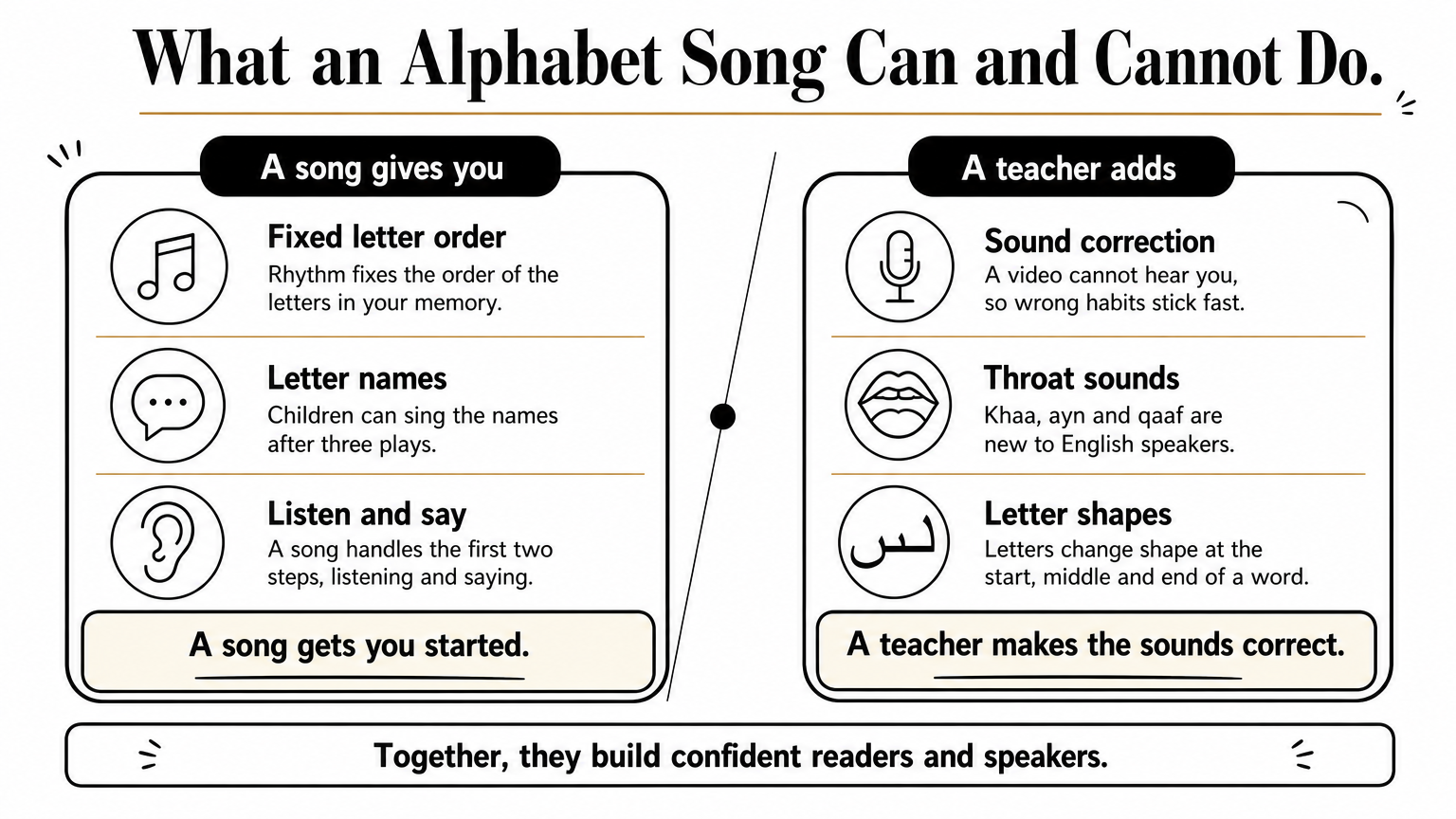
Videos cannot hear you, though. Sounds like khaa, ayn and qaaf are new to English speakers, and a wrong habit sticks fast. Letters also change shape at the start, middle and end of a word. A song gets you started, but a teacher who hears your sounds is what makes them correct.
1. Zaky’s Arabic Alphabet Song
Zaky’s song is the best first pick for children. It is a nasheed-style cartoon video from One4Kids, and it pairs the alphabet with a few Islamic words so children hear letters inside real vocabulary.
What it teaches and who it suits
The video runs about four and a half minutes and walks through the letters in order. A longer version, "Zaky’s Arabic Alphabet Song & Words," adds more Arabic words, which helps once your child knows the basic order.
It suits children from preschool to early primary whose parents want Islamic content from the start. Adults can use it too, but the cartoon style is clearly aimed at kids.
How to practice with it
Search the title on YouTube and try this routine:
- Play it once with no interruptions so the tune sticks.
- Replay and pause on each letter. Have your child say the name back.
- Finish by singing it together without the video.
Choose Zaky if you want one song that gives kids both the letters and their first Arabic words.
2. Arabic Alphabet Song (Phonics) by Super Muslim Kids
This is the best pick for clear pronunciation. It is a phonics-style nasheed sung with vocals only, so no instruments cover the sounds, and it has millions of views.
What it teaches and who it suits
Phonics means the song stresses the sound of each letter, not only its name. With no background music, you can hear the difference between letters that sound alike, such as seen and saad.
It suits parents who want a clean model of pronunciation, and adult beginners who find cartoon videos distracting. It also works for children who get overstimulated by busy animation.
How to practice with it
A few small settings make it far more useful:
- Open YouTube settings and drop playback speed to 0.75 for your first week.
- Listen with the chart above open and follow each letter with your finger.
- Say each sound out loud before the singer finishes it, then compare.
Pick the vocals-only version when you care about hearing each sound without anything covering it.
3. Arabic Alphabet Song for Kids (Animals and Objects)
The video titled "Arabic Alphabet Song for Kids" is the best pick for toddlers. It teaches the letters through animals and objects, so each letter arrives with a picture and a word. It runs about four minutes.
What it teaches and who it suits
A young child cannot hold an abstract symbol in mind, but can remember a picture of an animal. Linking each letter to something familiar gives the sound a hook.
It suits toddlers and preschoolers, and any visual learner. If your child has never seen Arabic script, this is the gentlest introduction on the list.
How to practice with it
Treat the video as a picture book that happens to sing:
- Pause on each picture and ask your child to name the animal or object.
- Say the letter, then the word, then the letter again.
- Draw the animal on paper and write the letter beside it.
Start toddlers here, because a picture makes a new letter feel like something they already know.
4. Arabic Alphabet Song with Three Vowels
The video titled "arabic alphabet song" from Turmusaya goes one step further than most. It sings each letter with all three short vowels, and it counts 29 letters. The extra entry is usually hamza, which the standard 28-letter alphabet does not list on its own.
What it teaches and who it suits
Singing each letter with fatha, kasra and damma gives you ba, bi, bu, then ta, ti, tu, and so on. That is the pattern you need to begin sounding out real words, and the foundation for reading the Quran.
It suits older children and adults, and anyone who already knows the basic letter names and wants the next step. Complete beginners may find it fast, so start with one of the first three songs.
How to practice with it
Break it into small passes instead of treating it as one long song:
- Learn only the fatha line ("ba, ta, tha") for three days.
- Add the kasra line, then the damma line.
- Test yourself by covering the screen and saying the vowel before it plays.
Move to this song once you know the letter names, because the vowels are what turn letters into readable syllables.
Start with one song, then add a teacher
Pick the song that matches your learner. Zaky’s works for most children, the phonics version for adults and careful listeners, the animals video for toddlers, and the vowel song once the letter names are secure. Keep the chart close and repeat one song daily for a week before switching.
A song teaches the order and the names. It cannot correct your throat sounds or show you how a letter joins to the next one. If you want that feedback, book a free assessment class with Quranytime Academy. New students get 3 free trial classes, and a teacher will check your level and suggest a starting path, whether you are a parent or an adult beginner.