

A Quran memorization plan for 2027 should do more than assign a number of pages. It needs to balance new memorization with accurate reading, recent review, and revision of older passages. The best starting pace is the one a learner can repeat while receiving useful correction—not the fastest pace on a chart.
This guide is for adults, parents planning with a child, and learners returning to Hifz. It focuses on how to build a realistic yearlong routine and adapt it as you go. It is not a promise that a particular amount can be memorized in twelve months. Your reading level, teacher’s advice, available time, prior memorization, and mushaf edition all matter.
What a Quran memorization plan for 2027 should solve
A useful plan answers four practical questions: What will I work on next? When will I revise it? Who can check my recitation? How will I know when to adjust? If your schedule answers only the first question, new passages may accumulate faster than you can retain or recite them accurately.
Think of your study as three connected streams: new lesson (the passage you are learning now), recent revision (newer passages that need to become steady), and older revision (memorized portions that still need regular attention). These labels describe planning tasks, not separate measures of a learner’s worth. The balance changes as your Hifz grows.
If you want a guided starting conversation, Quranytime’s Quran memorization (Hifz) learning path explains the academy’s memorization focus. A learner who is unsure whether to begin with reading or Hifz can discuss that question during the free Quran and Arabic assessment.
Set a starting point before choosing a target
Begin with a clear picture of the learner’s present level. Can they read the chosen script comfortably? Do they pause often to work out letters or vowels? Have they memorized any passages already? How much time can they protect on an ordinary week—not during a holiday or a particularly quiet week?
Write down the answers without judging them. If reading accuracy needs attention, build that foundation alongside a teacher before increasing the amount of new material. A learner can explore a Quran reading and Tajweed pathway to understand how reading support and memorization fit together. Reciting from memory cannot replace someone listening for pronunciation and correcting mistakes.
Next, decide what “success in 2027” means for this learner. It might mean establishing a five-day routine, strengthening a short surah, returning to a previously memorized portion, or progressing at a small weekly pace. A clear process goal is often more useful than a dramatic completion deadline. Keep the goal specific enough to review, but flexible enough to change if work, school, health, or family responsibilities shift.
Choose a pace without turning it into a promise
Page estimates can help you compare possible workloads, but they show only how quickly new pages add up. A commonly used Madinah mushaf has 604 pages; other print editions and page layouts differ. In that 604-page example, one new page each week equals about 11.6 years of new pages, two pages about 5.8 years, and four pages about 2.9 years. Those calculations do not include revision, correction, breaks, missed sessions, or time spent strengthening weak passages.
| Illustrative new-page pace | Approximate time for 604 pages | What the estimate excludes |
|---|---|---|
| 1 page each week | 11.6 years | Review, correction, breaks, and edition differences |
| 2 pages each week | 5.8 years | Review, correction, breaks, and edition differences |
| 4 pages each week | 2.9 years | Review, correction, breaks, and edition differences |
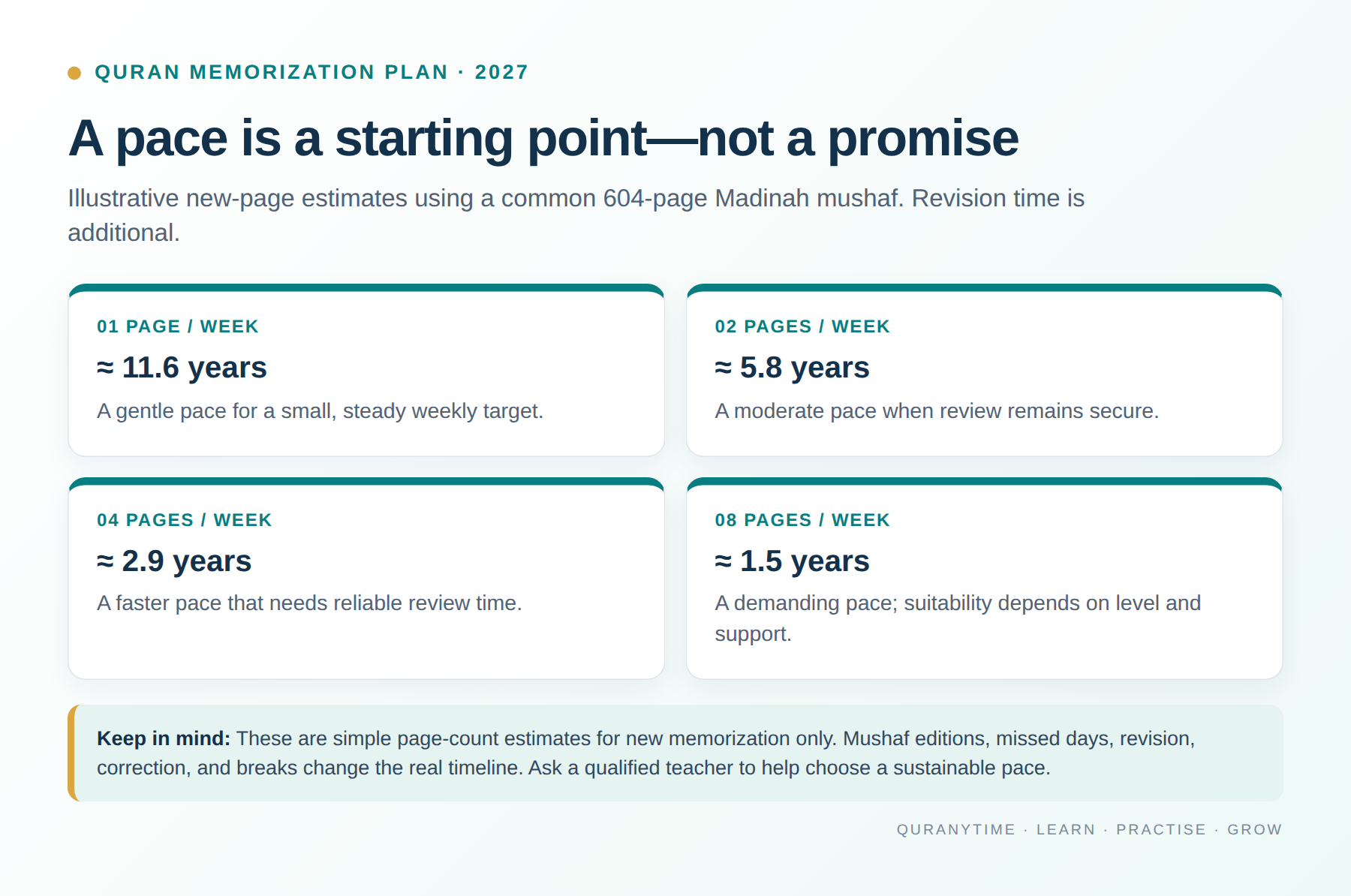
A page target also hides how difficult a passage feels to a particular learner. Some pages contain familiar patterns; others need more attention to pronunciation, similar phrases, or connections between verses. If recall becomes unreliable, reduce the new portion and protect time for review. That is a sensible adjustment, not a failed plan.
If a short daily template would help you test your routine, compare it with Quranytime’s 30-day Quran memorization planner. Use it as a trial structure, then keep only the parts that fit your real schedule.
Build a routine that protects accuracy
A sustainable memorization session does not have to be long. It needs a clear order and a manageable task. Use this sequence as a starting point, and ask a qualified teacher how to adapt it to your reading and memorization level.
- Prepare the passage. Read it carefully and identify any words, sounds, or joins that need correction before trying to memorize them.
- Listen to a reliable recitation. Follow along in the same mushaf and notice where each phrase begins and ends. Audio supports practice, but it does not replace feedback from a teacher who can hear you.
- Learn a small section. Work with a short, coherent unit. Repeat it accurately, then try recalling it without looking. If the section is still uncertain, do not add more simply to meet a page quota.
- Connect sections. When one part is secure enough for your current level, join it to the next part and practise the transition. Many learners need to work on the connection, not only on individual lines.
- Review recent material. Return to passages learned in recent sessions before they become distant. Note the specific places that need another attempt.
- Close with a record. Write down what you practised, one correction, and what you will review next time. A short note makes it easier to resume after a busy day.
The point is not to fit every step into a stopwatch. A learner with a short practice window may spend most of a session on accurate reading and one small passage. Another learner may be ready to spend more time on older revision. Ask a teacher to set priorities rather than copying someone else’s minutes.
Plan the year in stages, then reassess
A calendar can make a long goal feel approachable, but treat the quarters below as review points—not fixed promises about how much Hifz should be completed.
Quarter 1: establish the baseline. Discuss reading accuracy, current memorization, practice time, and the learner’s goal with a teacher. Choose a small routine and record it.
Quarter 2: check what is becoming stable. Review early passages: what is holding and what needs correction? Use that evidence to keep or reduce the new lesson size.
Quarter 3: protect the wider portion. As new material grows, make room for older review. Divide it into checkable portions and note recurring errors for the teacher.
Quarter 4: review the process. Look at consistency, accuracy, recall, and older Hifz. Celebrate progress, identify what needs work, and choose the next step—even if the original target changed.
Make revision a planned part of the week
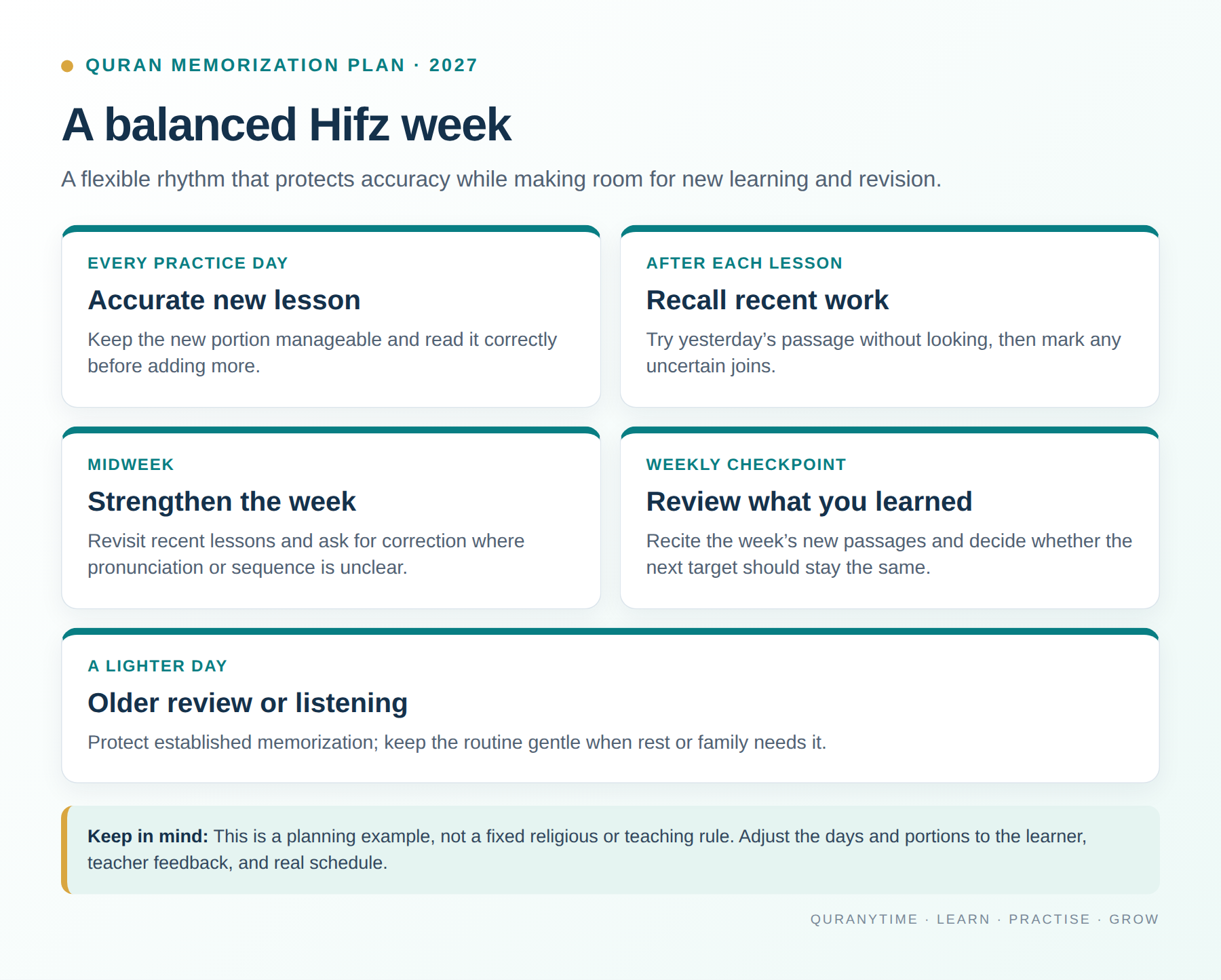
Review works best when it is scheduled rather than left for “spare time.” Choose a recurring slot for new learning, a way to revisit recent passages, and a realistic plan for older portions. The exact pattern should fit the learner’s amount memorized and teacher guidance.
A meta-analysis of 29 studies on retrieval practice found that spacing retrieval sessions improved later retention compared with massed practice. It did not establish that progressively longer intervals are always better than a regular spacing pattern. The studies were not a Quran-specific trial, so use this as general learning evidence—not as a religious rule or a universal Hifz formula. You can read the ERIC summary of the spacing-and-retrieval review.
In practical terms, return to a passage after some time has passed and try recalling it before looking. If the learner cannot recall it accurately, check the text, correct the point, and decide when to revisit it again. A review list or teacher note can help make that cycle visible. Quranytime’s Hifz revision schedule guide offers another way to think about new, recent, and older portions.
Audio can also support repetition when the learner follows the text and listens actively. For a simple listening practice pattern, see the Quran audio listen–pause–check method. Use a consistent reciter and edition so the learner is not switching between different page layouts or recordings without a reason.
How to adjust when the plan stops working
A routine should change when its results or circumstances change. If a learner frequently forgets the newest passage, reduce the next new portion and review the recent lessons more closely. If older portions are fading, make older revision more visible before adding new pages. If pronunciation errors keep recurring, ask the teacher to identify the exact sound or reading habit to practise.
If the learner misses a day, resume with the next planned review rather than trying to “repay” every missed session in one exhausting block. If school, work, or family changes the week, move the sessions or reduce the target. A clear fallback—such as one short review session during a busy week—can protect continuity without pretending that every day will go exactly to plan.
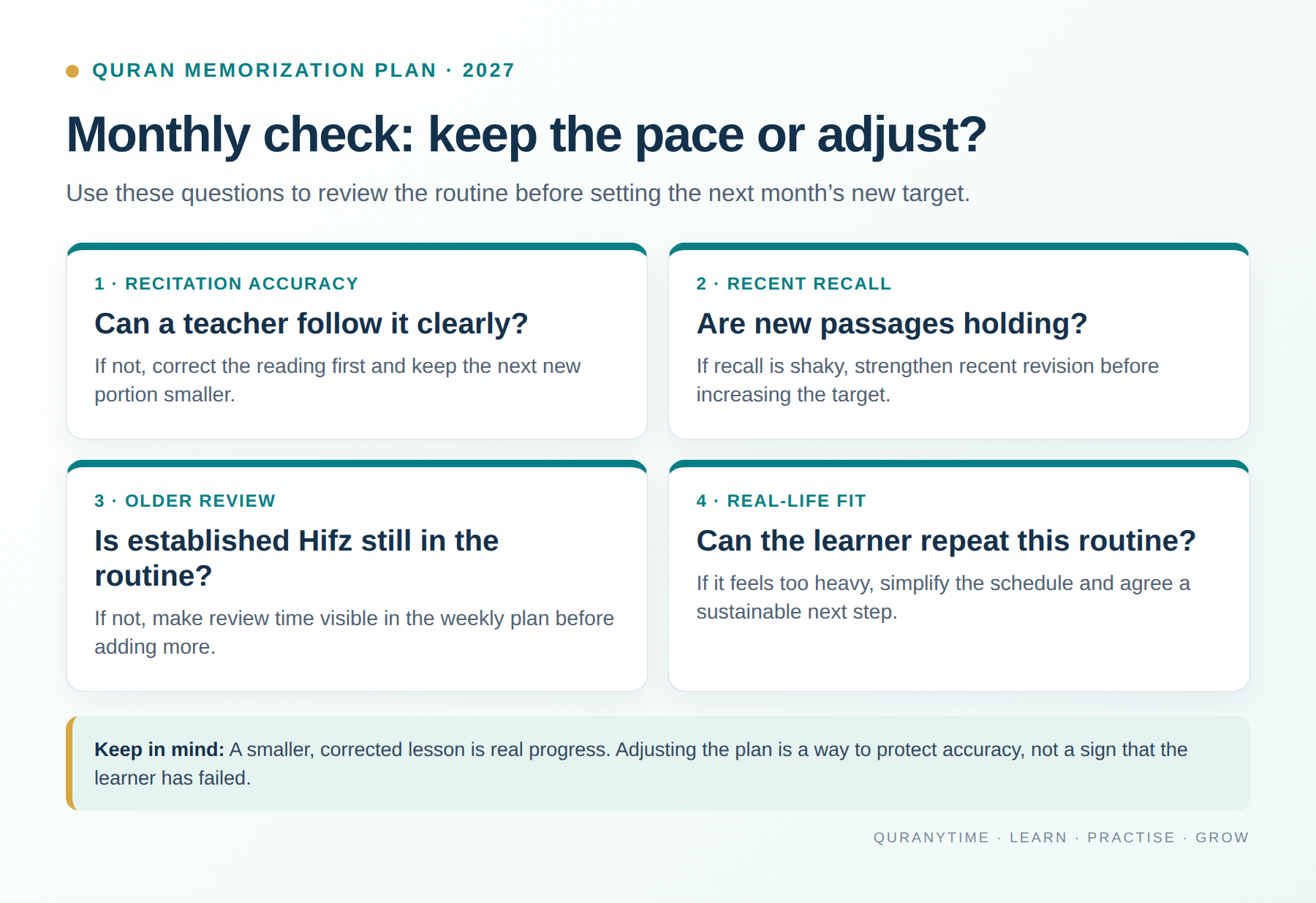
Once a month, ask four questions: Was the recitation accurate when checked? Could the learner recall recent passages? Did older revision happen? Was the routine manageable? Use the graphic below as a reminder, then let teacher feedback and the learner’s experience guide the next decision.
Common planning mistakes to avoid
Setting the target from someone else’s pace. Another learner’s schedule cannot account for your level, responsibilities, teacher, or prior Hifz. Treat examples as options, not standards.
Counting new pages but not revision. Schedule review before choosing new-page volume; a plan that counts only new pages is incomplete.
Treating one good recitation as permanent retention. A passage that feels familiar immediately may still need later recall. Revisit it after time has passed and ask for correction.
Changing too many things at once. Change one factor—portion, practice time, or session length—to see what improves the routine.
Using missed days to justify an oversized catch-up. Resume with a small, accurate task instead of overloading the next session.
What support can make the plan clearer?
A qualified teacher can listen to recitation, check accuracy, help choose suitable portions, and give specific feedback. Families can support a child by protecting a calm practice time, encouraging honest questions, and noticing effort without turning every session into a test. Adults may need a routine that fits work and caregiving responsibilities; Quranytime has a page about online Quran classes for adults that can help you explore a structured learning option.
If you are unsure where to begin, bring your current experience and your hoped-for routine to an assessment. Ask what should be practised first, how revision will be handled, and what feedback will help you know whether the pace is suitable. The aim is a clear next step—not a promise about a completion date.
Frequently asked questions
How much Quran should I memorize each day in 2027?
There is no universal daily amount. Begin with what you can recite accurately and review without rushing. A teacher can help match the portion to your reading level, current memorization, and available practice time.
Can I memorize the whole Quran in one year?
A one-year completion target is not suitable for every learner and should not be treated as a default. Page-count estimates describe new material only; accuracy, revision, prior knowledge, and daily availability change the workload. Ask a qualified teacher to assess your specific situation before setting a deadline.
Should I review before or after new memorization?
Many learners find it useful to include both: a brief recall of recent work before new material and a separate planned review of older portions. The order and amount should reflect teacher guidance and what the learner is finding difficult.
What should I do if I keep forgetting a passage?
Pause to identify the cause with a teacher. The learner may need a smaller section, clearer reading, more recent review, or help distinguishing similar passages. Adjust the routine instead of simply increasing the amount of new material.
Is this the same as a 30-day Quran memorization plan?
No. This article focuses on building a sustainable yearlong routine and evaluating it over time. A short planner can help you test a daily pattern, but it is not a prediction of how long full memorization will take.
A strong Quran memorization plan for 2027 is clear enough to follow and flexible enough to improve. Choose a realistic starting pace, reserve time for revision, seek recitation feedback, and reassess the plan as the learner changes. Consistency and accuracy matter more than a target copied from someone else.