
When you read the Quran, a small Arabic letter can connect a word, phrase, or complete clause. The most familiar is wāw (و), but fa (ف), thumma (ثُمَّ), aw (أَوْ), and bal (بَلْ) do not all work the same way. Learning their common clues helps you follow how an ayah is organized without assuming that one English word explains every occurrence.
This guide treats Quranic Arabic conjunctions as one connected learning topic—not five separate keyword pages. You will compare the forms, see how the Quranic Arabic Corpus classifies selected examples, and use a short reading method to check a particle in context. These notes support language study; they are not a substitute for a trusted translation or tafsir when interpreting an ayah.
What does a conjunction do in Arabic?
In traditional Arabic grammar, ḥarf al-ʿaṭf is a particle that links two elements. Those elements might be words, phrases, or clauses. The word or phrase before the connector is the first member; the one after it is attached to that member. If two nouns are coordinated, they generally share the same grammatical case. If two verbs are coordinated, they generally share the same mood. These are useful grammar clues, but they do not tell you the whole meaning by themselves.
Arabic conjunctions do not always map neatly to English “and,” “then,” or “but.” A connector may show addition, sequence, an alternative, or a change in discourse. Its exact role depends on the words around it and the sentence structure. If you are new to these terms, first review Quranytime’s broad Arabic grammar guide; then use the comparison below as a reading aid.
Five forms to recognize in Quranic Arabic
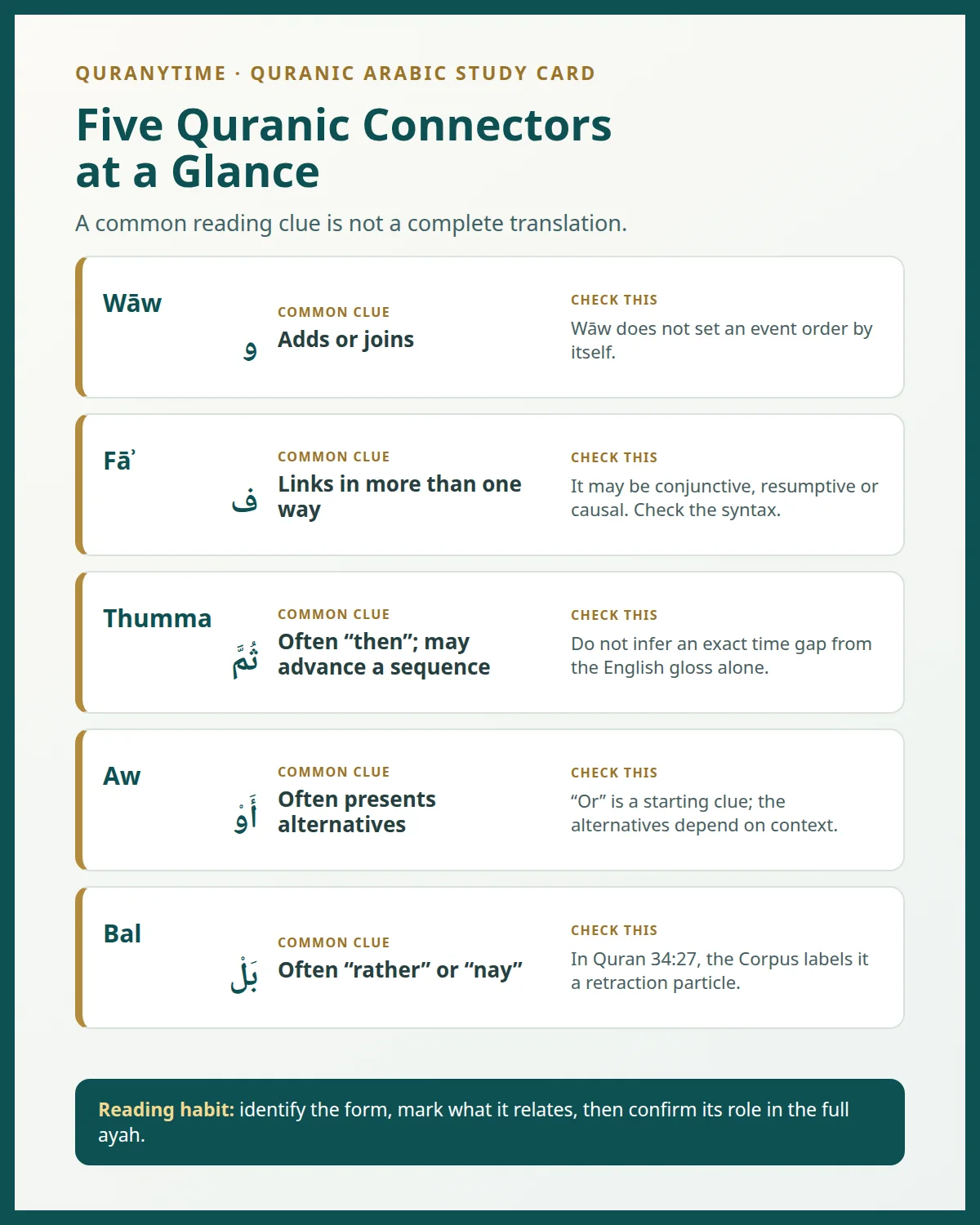
1. Wāw (و): a link, not a built-in timeline
The letter wāw is usually prefixed to the following word, as in وَالْأَرْضَ (wa-l-arḍa, “and the earth”) in Quran 21:30. In that occurrence, the Corpus tags the prefixed wāw as a coordinating conjunction. A common learner clue is simple addition: wāw joins one item to another. By itself, however, it does not prove which event happened first, or that two actions were simultaneous.
Look at the linked elements and their syntax before choosing a translation. When a noun follows another coordinated noun, its case can reflect the first noun’s role in the sentence. Quranytime’s guide to Arabic case endings can help you recognize that pattern. A wāw also appears in many other constructions, so do not label every written و as a conjunction without checking what it is attached to.
2. Fāʾ (ف): a connector with more than one job
Fāʾ is also usually prefixed. Depending on its construction, it may coordinate, signal a result or close follow-up, or begin a resumption. That is why translating every ف as “then” or “so” can mislead. The Quranic Arabic Corpus distinguishes among conjunction, resumption, and cause uses in its grammar descriptions.
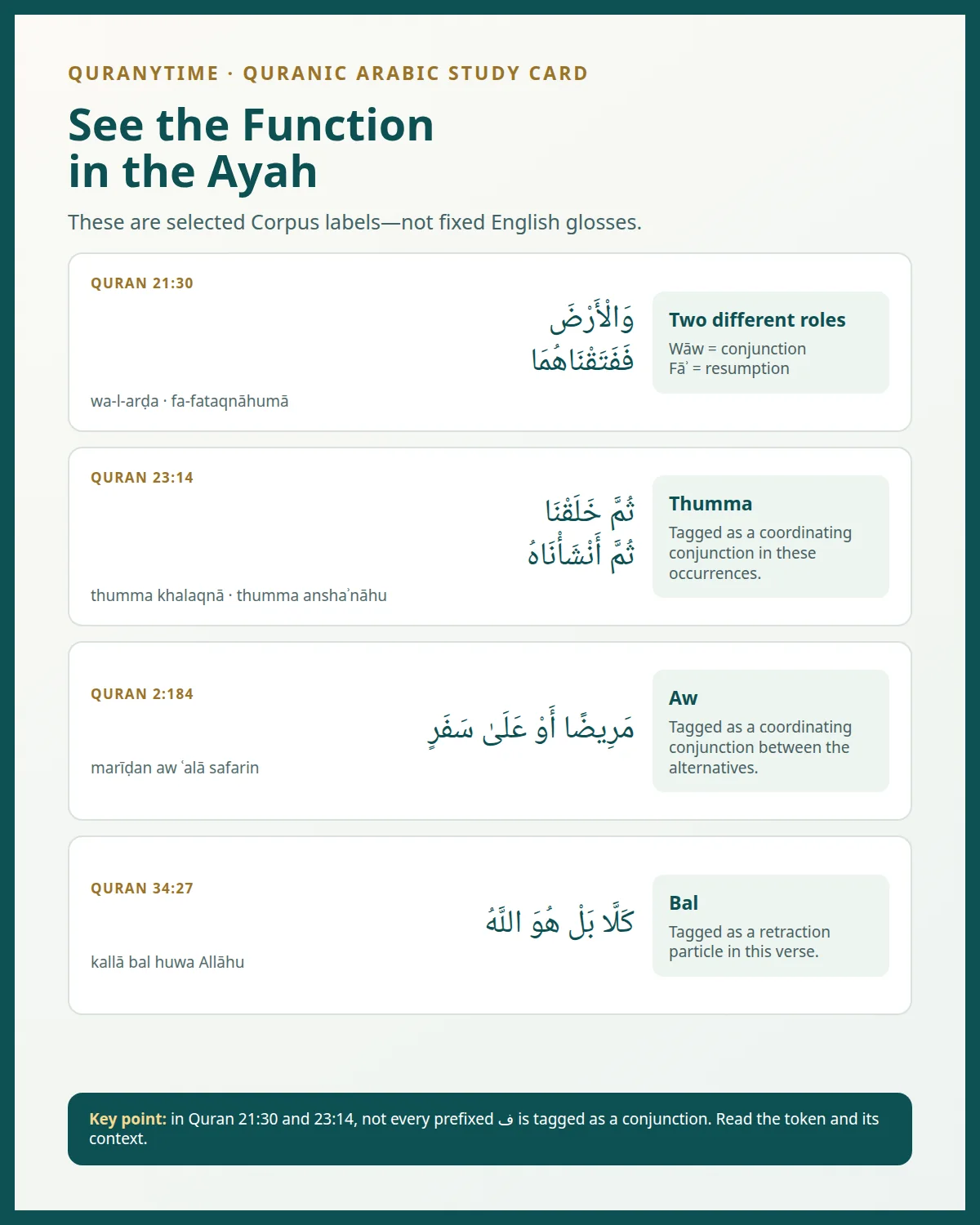
A useful contrast appears inside Quran 21:30. In وَالْأَرْضَ, the Corpus tags wāw as a conjunction; in فَفَتَقْنَاهُمَا (fa-fataqnāhumā), it tags the prefixed fāʾ as a resumption particle. The sounds look similarly attached, but their roles differ in these examples. Read the clause after fāʾ, and ask how it relates to what came before rather than choosing an English gloss by habit.
When fāʾ joins verbs, check their form and mood as well as the meaning. Quranytime’s beginner lesson on Arabic verb forms is a helpful companion. The common idea of a close connection is a starting clue, not a rule that removes the need to read the surrounding phrase.
3. Thumma (ثُمَّ): commonly “then,” with context to check
Thumma is normally written as a separate word, unlike prefixed wāw and fāʾ. It is commonly translated “then” and can mark a later stage in a sequence. Quran 23:14 uses thumma before خَلَقْنَا (khalaqnā, “We created”) and later before أَنْشَأْنَاهُ (anshaʾnāhu). The Corpus classifies these thumma tokens as coordinating conjunctions.
For a learner, thumma is a strong cue to follow the next step in the passage. Still, do not calculate a precise time interval from the English word “then” alone. Let the full ayah and a reliable translation guide the reading. When thumma links two clauses, the second may extend a sequence, but its broader rhetorical force belongs to context.
4. Aw (أَوْ): “or,” whose alternatives depend on context
Aw often presents alternatives and is also written as a separate word. In Quran 2:184, it connects مَرِيضًا (marīḍan, “sick”) with عَلَىٰ سَفَرٍ (ʿalā safarin, “on a journey”). The Corpus tags aw there as a coordinating conjunction.
Use “or” as a first reading clue, not as a complete interpretation. Context determines whether alternatives are presented as a choice, a category, or another rhetorical relationship. In particular, do not assume that every aw in a Quranic passage means the same kind of choice. The words and the surrounding construction matter.
5. Bal (بَلْ): a turn or correction
Bal is often glossed “rather,” “nay,” or “instead.” It can redirect or correct the discourse. In Quran 34:27, it follows كَلَّا and precedes هُوَ اللَّهُ. In that verse the Corpus labels bal a retraction particle. This is a useful caution: learner lists may group several forms under “conjunctions,” while a specific Quranic occurrence can receive a more precise syntactic label.
So, when you see bal, look backward to identify the claim or suggestion being turned away from, then read what follows. Do not substitute the English word “but” automatically; a correction or redirection may be closer in that context. Bal is related to conjunction study, but it should not be treated as interchangeable with wāw, fāʾ, or thumma.
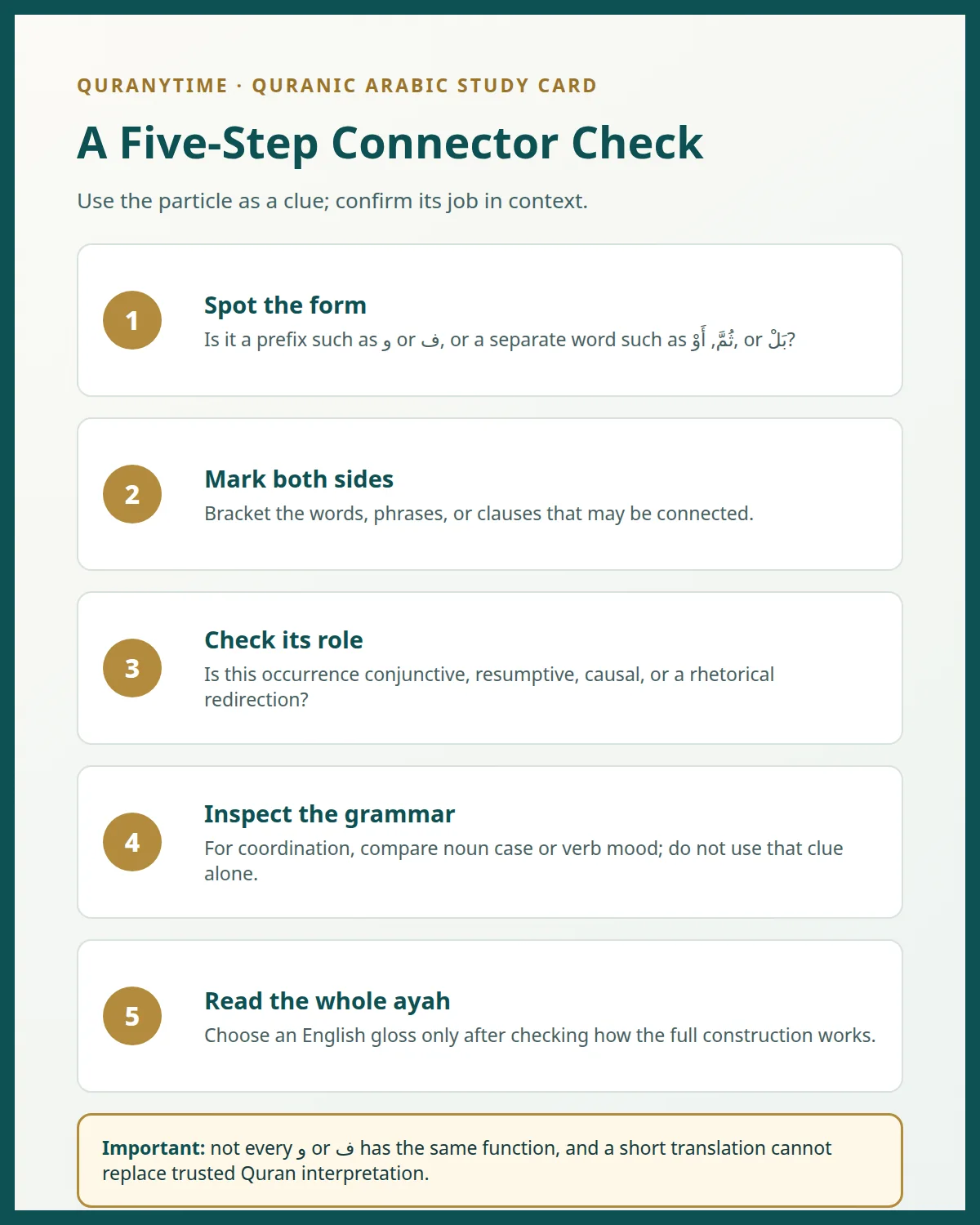
A four-step method for reading a connector
Use this short check whenever a particle seems to change the direction of a phrase:
- Locate the form. Is it a prefix such as و or ف, or a separate word such as ثُمَّ, أَوْ, or بَلْ?
- Mark what it links. Does the next element complete a pair of words, phrases, or clauses? Write a small bracket around each side.
- Check the grammar. If nouns or verbs are coordinated, inspect their case or mood. Review nominal sentence structure when a whole clause is involved, and compare preposition phrases when a connector links phrases rather than single words.
- Read the whole ayah. Decide whether the particle adds, sequences, offers alternatives, or redirects. Keep the English gloss provisional until the full construction makes sense.
Read the Quran examples as clues, not one-word rules
Try the method on the examples above. In 21:30, the Corpus marks the wāw in وَالْأَرْضَ as a conjunction, but marks the fāʾ in فَفَتَقْنَاهُمَا as resumption. In 23:14, thumma is a conjunction, while multiple fāʾ-prefixed verbs in the same verse are marked resumptive. In 2:184, aw joins two stated circumstances. In 34:27, bal redirects the statement and is tagged as retraction. Together, these examples show why identifying the written particle is only step one.
The Quranic Arabic Corpus’s conjunction guide explains how coordinated elements relate and notes that a particle’s precise meaning depends on context. It is a useful reference for checking morphology and grammatical labels; it should complement, not replace, careful reading and trusted interpretation.
If a connector attaches to a pronoun or appears next to a relative clause, the sentence may contain other structures too. Quranytime’s guides to Arabic pronouns and relative pronouns in Quranic Arabic can help you separate those functions from coordination.
Common mistakes to avoid
- Assuming wāw sets the order. It joins, but does not by itself give an event timeline.
- Giving every fāʾ the same label. It may be conjunctive, resumptive, or causal; check the construction.
- Translating thumma as a stopwatch. “Then” is a useful clue, but the English word alone does not define every nuance.
- Treating aw as one fixed kind of choice. Its alternatives must be read in context.
- Calling bal an ordinary “and/but.” It can mark a rhetorical turn or correction, and its grammatical label can differ from simple coordination.
- Guessing from a letter alone. Prefixes and particles can appear in more than one construction; inspect the word and clause around them.
Quick questions
Does wāw mean that two events happened at the same time?
No. Wāw commonly joins two elements, but it does not independently establish whether one happened first or whether both were simultaneous. The passage supplies the context.
What is the learner-level difference between fāʾ and thumma?
Fāʾ can mark a close connection, result, or resumption, while thumma commonly signals a later step. These are practical starting clues, not exceptionless translations; the particle’s syntactic role and the full ayah matter.
Is bal one of the Arabic conjunctions?
Bal is included in many traditional learner lists of connecting particles. For an individual Quranic use, check its function: in Quran 34:27, the Corpus labels it a retraction particle rather than a basic coordinating conjunction.
For a quick recap, remember the forms as prompts to investigate: wāw joins, fāʾ links in several ways, thumma often advances a sequence, aw presents alternatives, and bal can redirect. The safest Quran-reading habit is to identify the connector, inspect what it relates, check the syntax, and then read the surrounding ayah before settling on a translation.