

Can you read Quran without wudu? For the ordinary case of not having wudu, Egypt’s Dar al-Ifta permits recitation and reading from a copy without touching it. Touching the printed Mushaf is a separate question. Here is how to distinguish book, memory and phone reading without treating a general answer as a personal fatwa.
Read Quran without wudu: reciting versus touching
Many people ask this question after wudu has ended, when they are travelling, or when they want to keep a daily Quran habit going. It helps to separate two actions that are often placed in one sentence: reciting or reading Quran, and touching a physical copy. They are related, but a ruling about one should not automatically be presented as a ruling about the other.
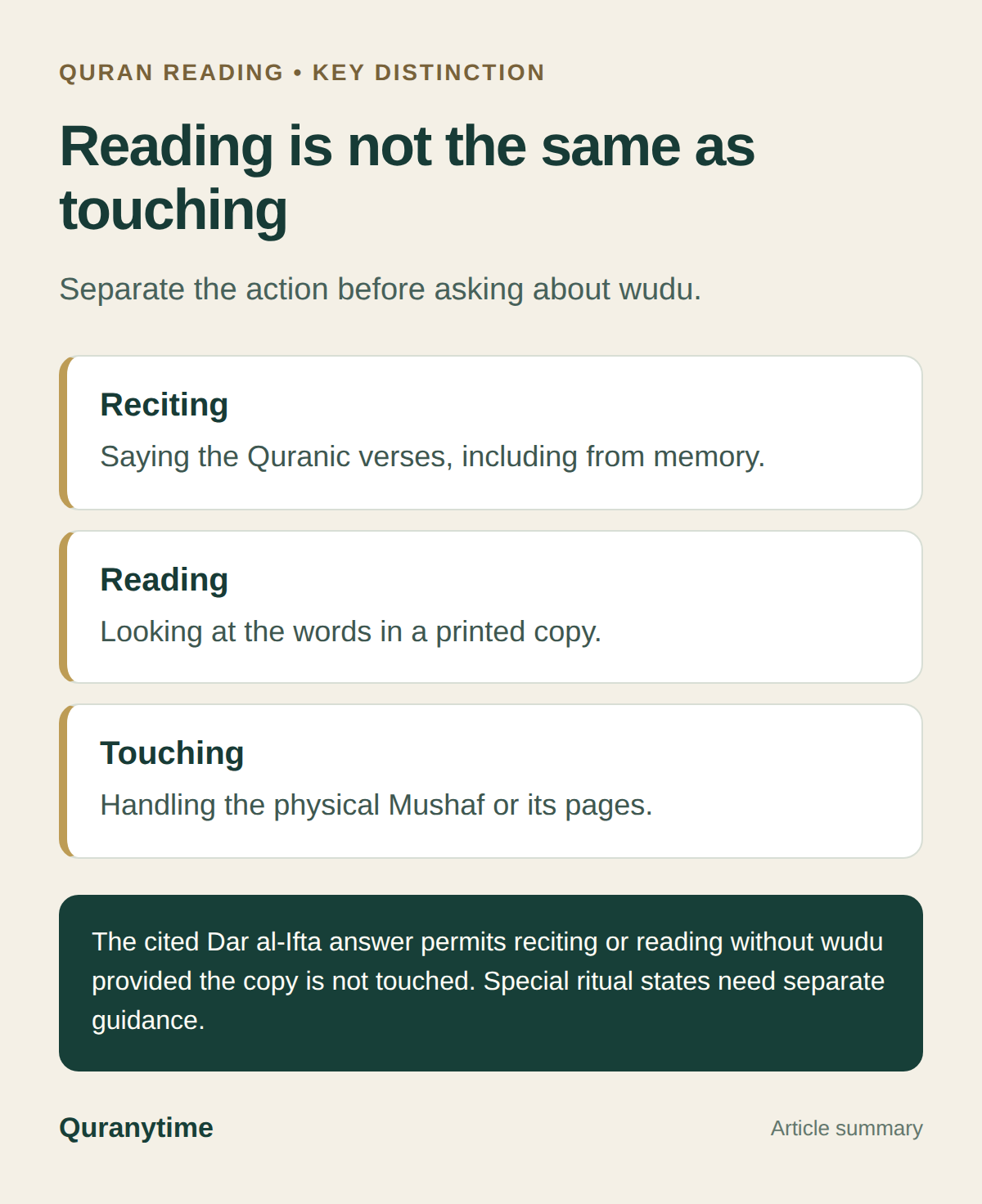
Egypt’s Dar al-Ifta, a governmental non-profit religious institution, answers a general question about reciting without ablution in a fatwa dated May 13, 2009. Its answer says there is no objection to reciting the Quran or reading from a copy without ablution provided that the person does not touch it. It also cites the report that the Prophet recited in every state except janabah, described on the page as a state of major ritual impurity.
That is the exact scope of the source used here: it addresses ordinary recitation and reading without wudu, with a condition about not touching the copy. It is one official answer, not a claim that every school, teacher, or circumstance uses identical details. If your family follows a particular madhhab, or your situation involves a separate state of ritual impurity, ask a qualified scholar who knows that context.
First, what does “without wudu” mean?
Wudu is a specific act of ritual purification. It is not simply the same as being clean, having washed your hands, or feeling spiritually prepared. Someone may be generally clean but not have wudu; someone may also choose to make wudu as an act of respect and readiness even when the question is whether recitation is permitted without it.
That distinction keeps the answer honest. The Dar al-Ifta fatwa is not saying that personal hygiene is unimportant, nor is it a complete guide to every purity question. It gives a focused answer to a focused question. Avoid turning that answer into a universal checklist for menstruation, touching translations, ghusl, or every form of major ritual impurity. Those subjects have their own discussions and should be taken to a trusted local scholar.
For everyday practice, pause and name the action: “I want to recite from memory,” “I want to look at a printed Mushaf,” or “I want to read an app.” That small distinction is more useful than a rushed yes-or-no slogan.
Reading a printed Mushaf without wudu
In the source fatwa’s wording, a person may recite or read from a copy without ablution provided they do not touch it. So a person who has lost wudu should not treat “I can recite” and “I can handle every page” as interchangeable permissions. The physical copy is the part that requires particular care in this answer.
A practical way to apply the distinction is to prepare the setting before you begin. Place the book on a stand or another clean surface, turn pages only in a manner your trusted scholar considers appropriate for your school, and avoid casually moving it from hand to hand. If you need to reposition the stand, move the stand rather than the pages. These are practical illustrations, not a new fatwa, and they do not replace advice for a special circumstance.
Before your next lesson, ask whether your teacher will share the page on screen, whether you need your own printed copy, and what to do when you need to turn a page. Ask before class rather than improvising midway through a reading. A book stand keeps the text stable, but is not a blanket legal workaround.
When you are studying stopping points, a guide to Quran waqf signs and their six marks can help with the reading itself; it does not change the purity distinction.
Reciting Quran from memory
Recitation from memory is the clearest example of why “read” can be too broad a word. If you are not holding a printed copy, you are reciting rather than handling its pages. The Dar al-Ifta answer specifically permits reciting without ablution in the general case it addresses. That supports continuing a memorized surah, reviewing yesterday’s lesson, or quietly reciting while waiting—without pretending that every other purity question has been settled by the same sentence.
Memory practice can be gentle and useful. Choose a short passage, recite slowly, and stop when pronunciation becomes uncertain rather than racing to complete a target. If you are rebuilding consistency after time away, the guide on how to return to Quran study after a long break offers a helpful learning structure. For a teacher-led plan, you can also explore online Quran classes for children and adults.
Keep a reliable verse reference for the passage you know. If you forget a word, pause rather than inventing it. You can mark the verse in a separate notebook and check it when you return to your usual reading setup. Maintaining accuracy matters more than forcing yourself to finish a portion from memory.
What about reading Quran on a smartphone?
A phone is not a bound paper Mushaf. In a published answer about mobile Quran programs, Islam Question & Answer permits touching the device and reading from it without wudu, distinguishing its changeable display from the fixed pages of a Mushaf. This is a named contemporary scholarly answer, not a reason to ignore school-specific guidance for your personal case. The Dar al-Ifta answer linked here does not itself discuss phones.
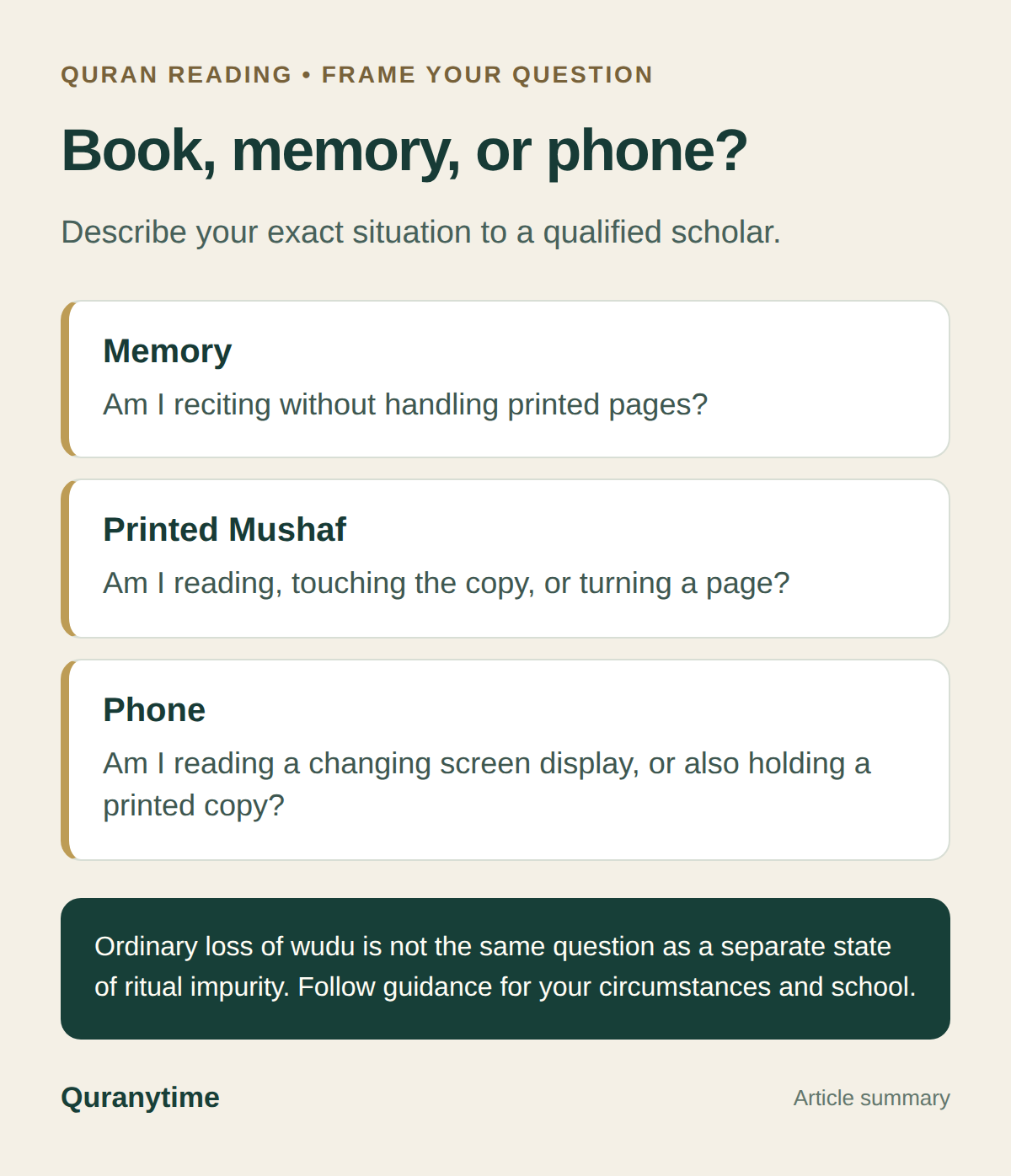
For ordinary study, you can still make the practical questions explicit. Are you reciting aloud from memory while the phone is nearby? Are you reading words displayed on the screen? Are you holding a printed Mushaf as well? Is the app showing Quran text, translation, or notes? Those details are why a local teacher or scholar is better placed than a sweeping internet answer.
If your question is mainly technical—how to keep your place, bookmark a passage, or avoid losing a lesson—see how to read Quran on your phone without losing your place. That practical guide should be kept separate from the fiqh question of ritual purity.
Four everyday scenarios
- You lost wudu and want to recite a memorized surah. The cited fatwa’s general answer supports recitation without ablution. Continue carefully, while remembering that a different personal state may require a separate question.
- You want to read a printed Mushaf. The same answer permits reading from a copy without ablution on the condition that you do not touch it. Follow your school’s practical guidance for positioning and turning pages.
- You want to review on a phone. The contemporary answer described above permits phone reading without wudu. Keep that answer within its context: a separate ritual state, a printed copy alongside the phone, or school-specific practice may require qualified guidance.
- You are unsure which ruling applies. Describe the exact circumstance to a trusted scholar rather than selecting whichever internet answer sounds easiest. Keep the explanation you receive for future reference.
A respectful takeaway
If you searched “read Quran without wudu,” the most accurate takeaway is not a blanket permission or blanket prohibition. In the official Egyptian Dar al-Ifta answer linked here, reciting and reading from a copy without ablution are allowed when the copy is not touched. That is useful guidance, but it remains a bounded answer from one institution and one question.
Make wudu when you can and when it helps you approach the Quran with calm attention. If you cannot, keep the actions distinct: memory recitation, printed-page handling, and smartphone reading are not identical scenarios. For reflection after your reading, a beginner’s Quran reflection journal can help you record a verse, question, or practical lesson without confusing study tools with legal rulings.
For a fuller picture of lesson format and teacher feedback, see what to expect in online Quran classes. And for the source’s precise wording, read the Dar al-Ifta fatwa on reciting the Quran without ablution, then take personal or school-specific questions to a trusted scholar.
FAQ
Can I recite Quran without wudu?
The cited Dar al-Ifta answer says there is no objection to reciting without ablution in the general case it addresses. It is not a universal ruling for every circumstance.
Can I touch a printed Mushaf without wudu?
The same answer says reading from a copy without ablution is allowed provided one does not touch it. Ask your trusted scholar for practical details and school-specific cases.
Does ordinary phone reading require wudu?
The contemporary answer from Islam Question & Answer discussed above permits it, distinguishing a phone from a Mushaf. This should not be stretched into a ruling on every separate ritual state or school-specific circumstance.